
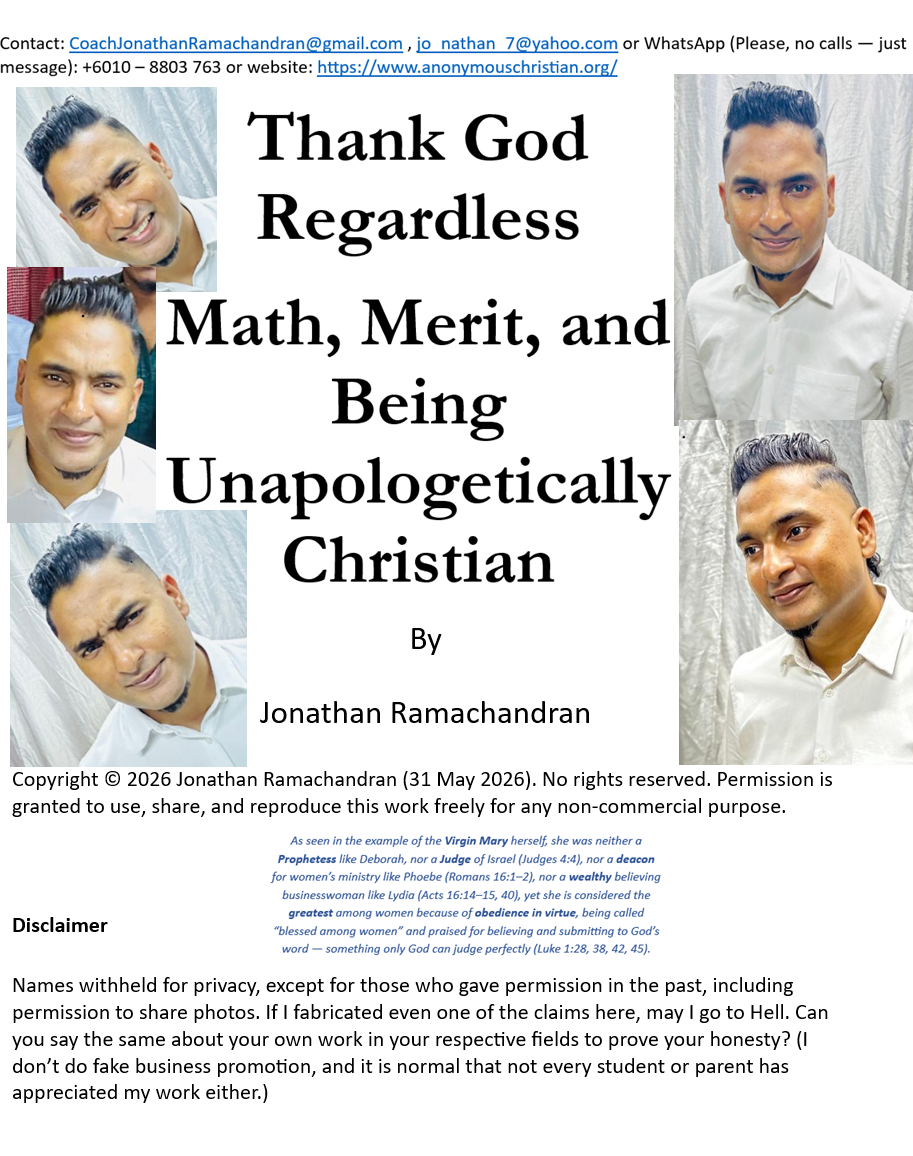
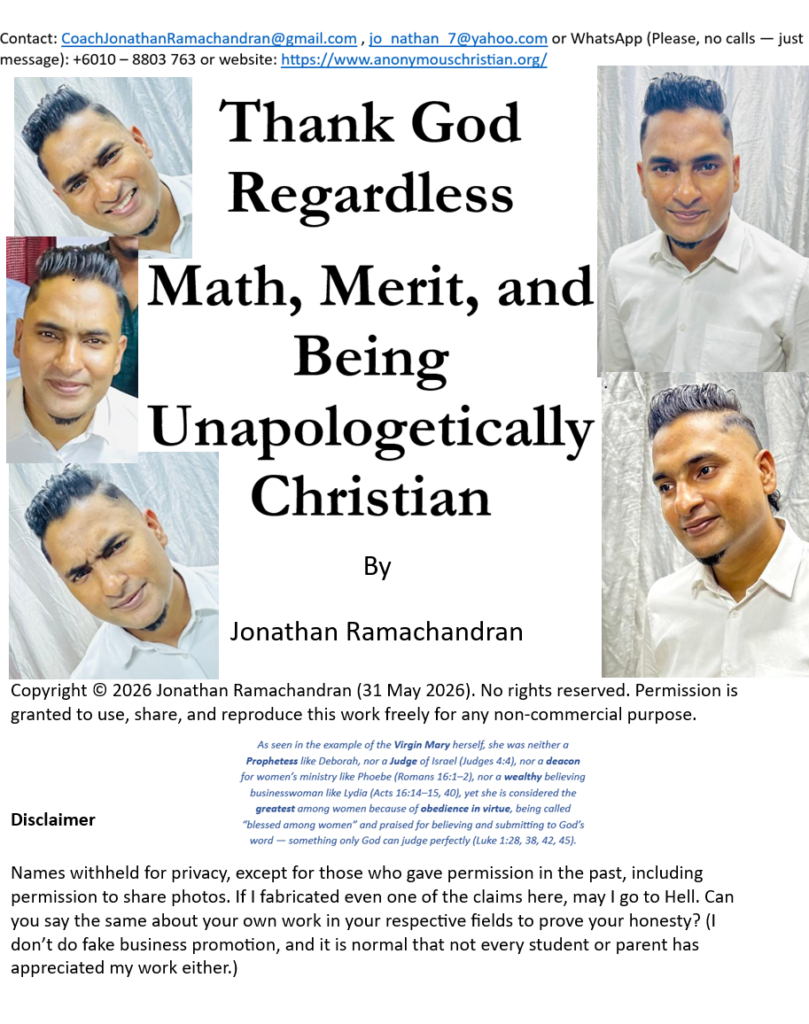
New Book: Thank God Regardless Math, Merit, and Being Unapologetically Christian
Hi there!
Please feel free to share this with anyone and download a copy for your own good self as well.
Please note that any new revisions, updates, or replacements of this book will be placed in this freely shared folder. Please share this link as well which contains the free pdfs:
i) Google Drive Folder:
https://drive.google.com/drive/folders/1d0go0yKivMwt7mseVcJucot_E56h1po7?usp=sharing
New Free Book (Chicago format + Google Drive):
Jonathan Ramachandran, Thank God regardless: Math, merit, and being unapologetically Christian (5 Loaf 2 Fish Publications, 31 May 2026), https://drive.google.com/drive/folders/1d0go0yKivMwt7mseVcJucot_E56h1po7?usp=sharing.
ii) Google Books Link:
https://books.google.com.my/books/about?id=3KPfEQAAQBAJ
New Free e-book (APA format + Google Books):
Ramachandran, J. (2026). Thank God regardless: Math, merit, and being unapologetically Christian. 5 Loaf 2 Fish Publications. https://books.google.com.my/books/about?id=3KPfEQAAQBAJ.
Title: Thank God Regardless Math, Merit, and Being Unapologetically Christian
Author: Jonathan Ramachandran
Language: English
Book Identifier: GGKEY:FUQZWA76N7G
Publisher: 5 Loaf 2 Fish Publications
Pages: 95
Release Date: 31 May 2026
Book Description: The following reflections are shared with gratitude to God for all outcomes—whether success or failure—as part of a broader testimony on learning, teaching, and Christian perspective in everyday life.
They are written not to exalt personal achievement, but to highlight that value, worth, and reward are ultimately defined differently in Scripture than in worldly systems. In particular, academic results, recognition, workplace outcomes, or social approval do not determine a person’s standing before God. Rather, what matters is faithfulness, obedience, and the use of whatever God has entrusted to each individual.
This text also brings together experiences from teaching mathematics and mentoring students, alongside reflections on fairness, recognition, and the challenges of working in imperfect human systems. It further connects these observations with biblical teachings on stewardship, charity, suffering, and eternal reward. Thank you
Jonathan
31 May 2026
Source:
https://www.linkedin.com/pulse/new-book-thank-god-regardless-math-merit-being-jonathan-ramachandran-9vinc
As seen in the example of the Virgin Mary herself, she was neither a Prophetess like Deborah, nor a Judge of Israel (Judges 4:4), nor a deacon for women’s ministry like Phoebe (Romans 16:1–2), nor a wealthy believing businesswoman like Lydia (Acts 16:14–15, 40), yet she is considered the greatest among women because of obedience in virtue, being called “blessed among women” and praised for believing and submitting to God’s word — something only God can judge perfectly (Luke 1:28, 38, 42, 45).
Source:
Jonathan Ramachandran, Thank God Regardless: Math, Merit, and Being Unapologetically Christian (5 Loaf 2 Fish Publications, May 31, 2026), 83, https://books.google.com.my/books/about?id=3KPfEQAAQBAJ.
Similarly, you may be better than me or even any pastor with the biggest church in terms of virtue-context and receive a greater reward in heaven through obedience (Matthew 20:26–28; Matthew 25:21).
Thanks again.
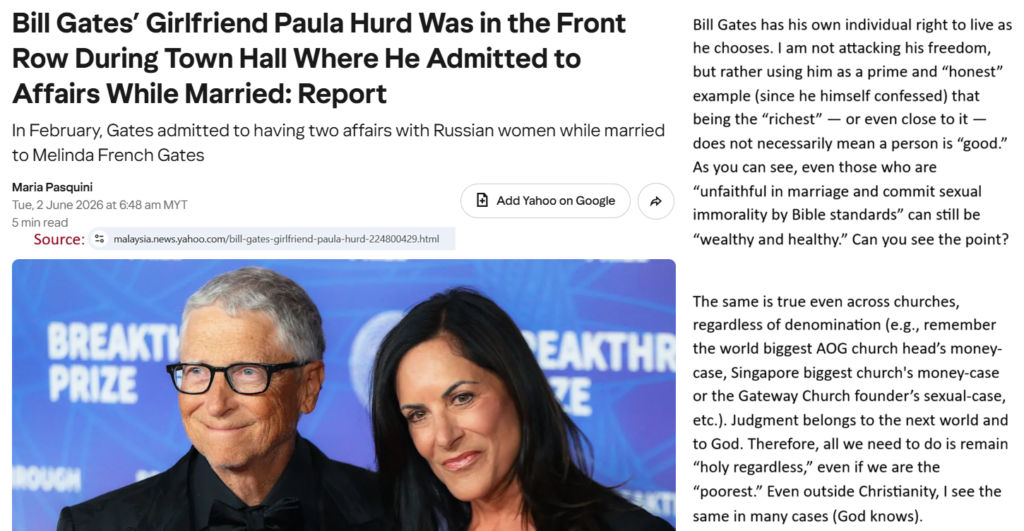
[Text] Bill Gates has his own individual right to live as he chooses. I am not attacking his freedom, but rather using him as a prime and “honest” example (since he himself confessed) that being the “richest” — or even close to it — does not necessarily mean a person is “good.” As you can see, even those who are “unfaithful in marriage and commit sexual immorality by Bible standards” can still be “wealthy and healthy.” Can you see the point?
The same is true even across churches, regardless of denomination (e.g., remember the world biggest AOG church head’s money-case, Singapore biggest church’s money-case or the Gateway Church founder’s sexual-case, etc.). Judgment belongs to the next world and to God. Therefore, all we need to do is remain “holy regardless,” even if we are the “poorest.” Even outside Christianity, I see the same in many cases (God knows).
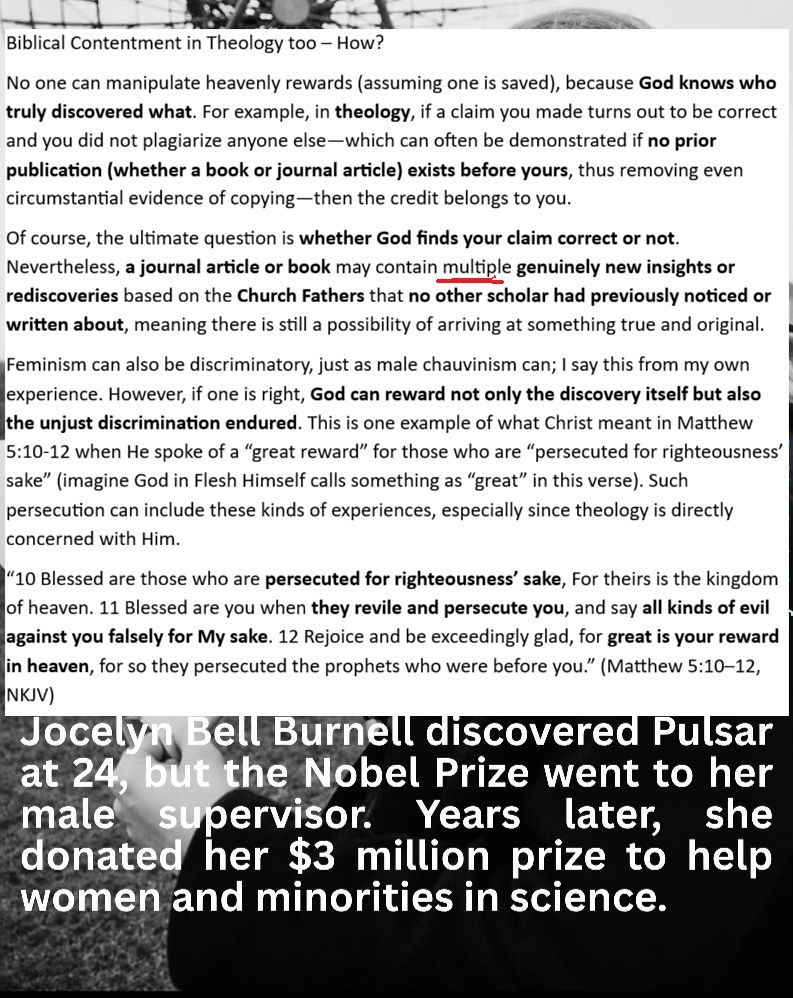
[Text] Biblical Contentment in Theology too – How?
No one can manipulate heavenly rewards (assuming one is saved), because God knows who truly discovered what. For example, in theology, if a claim you made turns out to be correct and you did not plagiarize anyone else—which can often be demonstrated if no prior publication (whether a book or journal article) exists before yours, thus removing even circumstantial evidence of copying—then the credit belongs to you.
Of course, the ultimate question is whether God finds your claim correct or not. Nevertheless, a journal article or book may contain multiple genuinely new insights or rediscoveries based on the Church Fathers that no other scholar had previously noticed or written about, meaning there is still a possibility of arriving at something true and original.
Feminism can also be discriminatory, just as male chauvinism can; I say this from my own experience. However, if one is right, God can reward not only the discovery itself but also the unjust discrimination endured. This is one example of what Christ meant in Matthew 5:10-12 when He spoke of a “great reward” for those who are “persecuted for righteousness’ sake” (imagine God in Flesh Himself calls something as “great” in this verse). Such persecution can include these kinds of experiences, especially since theology is directly concerned with Him.
“10 Blessed are those who are persecuted for righteousness’ sake, For theirs is the kingdom of heaven. 11 Blessed are you when they revile and persecute you, and say all kinds of evil against you falsely for My sake. 12 Rejoice and be exceedingly glad, for great is your reward in heaven, for so they persecuted the prophets who were before you.” (Matthew 5:10–12, NKJV)
Did you notice that Christ never promised any reward on earth, but only in heaven—and not both?

[Text] I find it strange that if you do not have to worry about salary or medical expenses because you are already financially secure, or because you are a pastor under a large church organization that will take care of you (and your family, if any), how can one still be depressed while being in the Lord Jesus Christ?
I can understand depression arising from circumstances such as financial hardship, inability to meet basic needs, or poor health. But otherwise, it seems strange indeed. Is it simply due to feelings? What is there to complain about when you have been given such a significant platform in the church? Spiritually speaking, you have already been entrusted with a substantial opportunity for ministry, unlike others who may have faced discrimination or never received such opportunities.
In Spurgeon’s case below, could it have been due to a combination of health issues and work-related exhaustion?
To quote:
“Charles Haddon Spurgeon is considered by many to be the greatest preacher who ever lived. In the 1800s he pastored the largest church in the world, the Metropolitan Tabernacle in London. He preached to an estimated 10 million people over the course of his ministry. His sermons are still read, studied, and preached from today more than 130 years after his death.
And almost nobody knew he was suffering. …
“I am the subject of depressions of spirit so fearful that I hope none of you ever get to such extremes of wretchedness as I go to,” he once confessed.
The prince of preachers. Drowning in darkness. Still preaching.
He also battled gout, kidney disease, and the physical toll of ministering at a scale no single human being was ever designed to sustain. He died at just 57 years old. Worn out. Poured out. Given out completely.”
Source:
https://www.facebook.com/photo/?fbid=1534641988030430&set=a.635667507927887
Comment: Again, I appreciate his honesty. It also serves as a reminder that even with great faithfulness and abundant opportunities for ministry, good health and longevity are not necessarily guaranteed, contrary to the claims of the prosperity gospel.
Thank you!
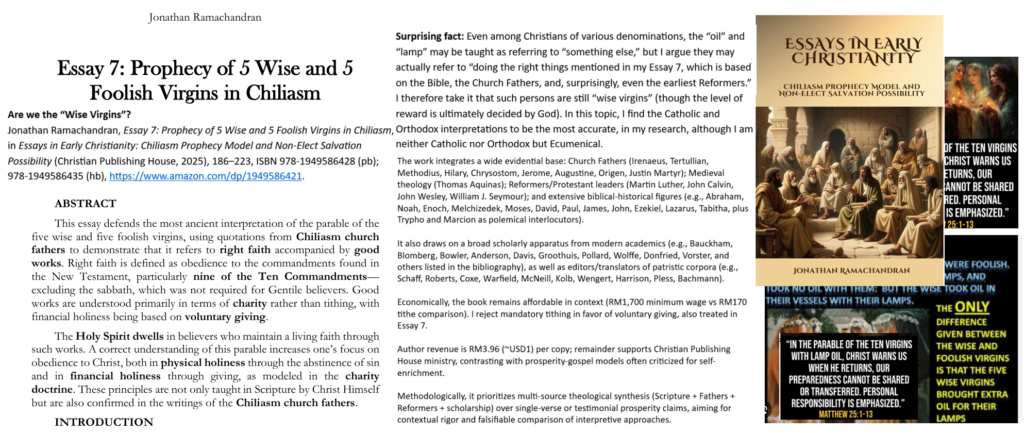
[Text] Are we the “Wise Virgins”?
Jonathan Ramachandran, Essay 7: Prophecy of 5 Wise and 5 Foolish Virgins in Chiliasm, in Essays in Early Christianity: Chiliasm Prophecy Model and Non-Elect Salvation Possibility (Christian Publishing House, 2025), 186–223, ISBN 978-1949586428 (pb); 978-1949586435 (hb), https://www.amazon.com/dp/1949586421.
Surprising fact: Even among Christians of various denominations, the “oil” and “lamp” may be taught as referring to “something else,” but I argue they may actually refer to “doing the right things mentioned in my Essay 7, which is based on the Bible, the Church Fathers, and, surprisingly, even the earliest Reformers.” I therefore take it that such persons are still “wise virgins” (though the level of reward is ultimately decided by God). In this topic, I find the Catholic and Orthodox interpretations to be the most accurate, in my research, although I am neither Catholic nor Orthodox but Ecumenical.
The work integrates a wide evidential base: Church Fathers (Irenaeus, Tertullian, Methodius, Hilary, Chrysostom, Jerome, Augustine, Origen, Justin Martyr); Medieval theology (Thomas Aquinas); Reformers/Protestant leaders (Martin Luther, John Calvin, John Wesley, William J. Seymour); and extensive biblical-historical figures (e.g., Abraham, Noah, Enoch, Melchizedek, Moses, David, Paul, James, John, Ezekiel, Lazarus, Tabitha, plus Trypho and Marcion as polemical interlocutors).
It also draws on a broad scholarly apparatus from modern academics (e.g., Bauckham, Blomberg, Bowler, Anderson, Davis, Groothuis, Pollard, Wolffe, Donfried, Vorster, and others listed in the bibliography), as well as editors/translators of patristic corpora (e.g., Schaff, Roberts, Coxe, Warfield, McNeill, Kolb, Wengert, Harrison, Pless, Bachmann).
Economically, the book remains affordable in context (RM1,700 minimum wage vs RM170 tithe comparison). I reject mandatory tithing in favor of voluntary giving, also treated in Essay 7.
Author revenue is RM3.96 (~USD1) per copy; remainder supports Christian Publishing House ministry, contrasting with prosperity-gospel models often criticized for self-enrichment.
Methodologically, it prioritizes multi-source theological synthesis (Scripture + Fathers + Reformers + scholarship) over single-verse or testimonial prosperity claims, aiming for contextual rigor and falsifiable comparison of interpretive approaches.