Thought: Toward a Revised Abstract of Non-Elect Salvation Possibility (NESP) Paper with Methodological Defense
By Jonathan Ramachandran (14 April 2026).
When reviewers of my NESP paper cite a methodological error based on their view that it should include the original context—such as the topic at the time the quote was made, the historical setting, other secondary scholars, and alternative interpretations of that same quote (if they exist)—I respond as follows:
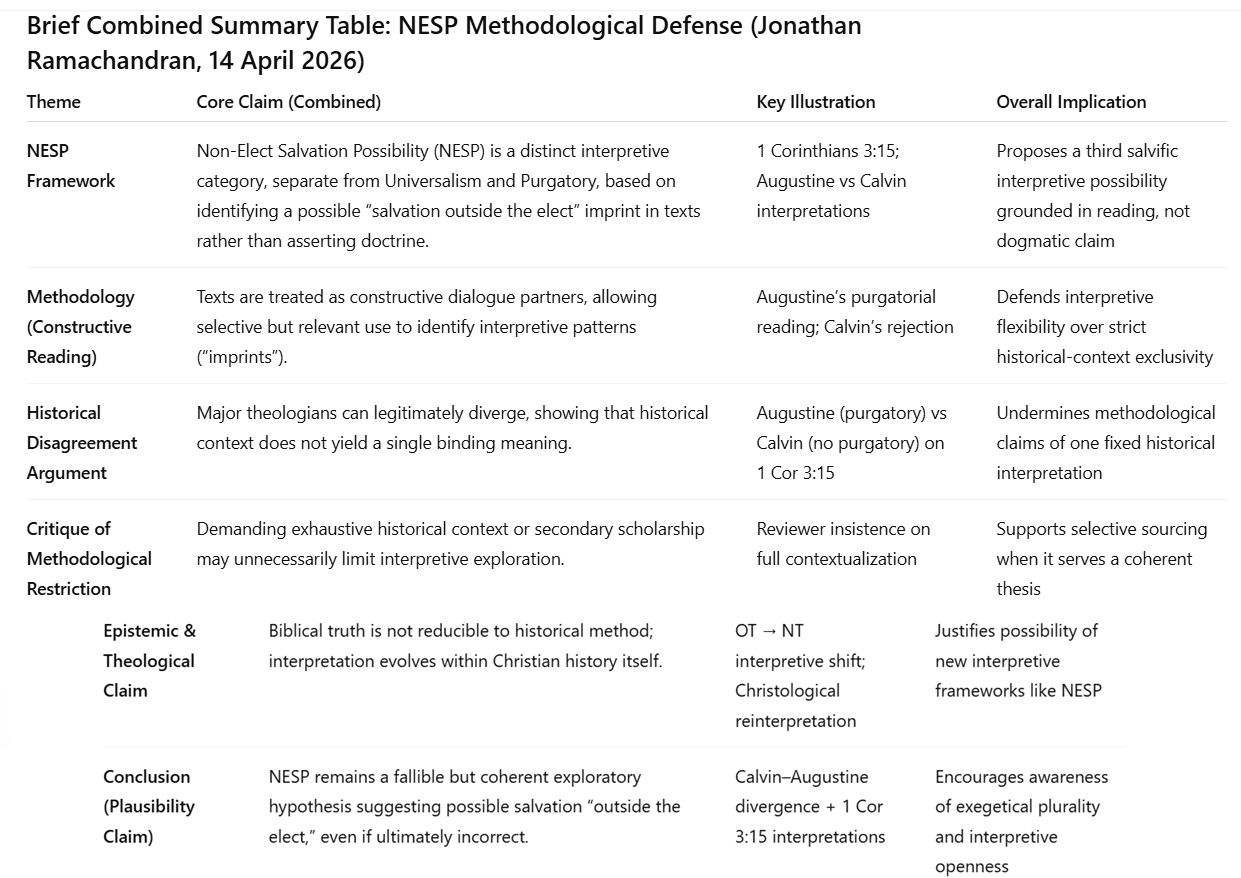
Nothing mentioned by the reviewers offsets the constructive interpretation given. In other words, regardless of the historical method or the context in which a quote is taken—whether from a Church Father, a Bible verse, or a non-canonical writing—the common ground is that they support an imprint or some aspect of non-elect salvation. This does not mean that those writings agree in any way with the interpretive mode of Chiliasm or with my new assertions (assuming none expressed them in this way previously).
How so? Let me give an example. When The Shepherd of Hermas speaks about those who are saved but not placed in the tower, this reflects an imprint of non-elect salvation, as they are distinguished from those within the tower (who represent the elect). However, this same writing does not discuss Chiliasm or the distinction between earthly and heavenly domains of salvation. This is why your reviewers repeatedly argue that the historical method or context is different and therefore cannot be linked.
That is precisely where I disagree. From Hermas or any other writing, I am only citing the imprint that someone is saved outside the elect, whether directly or indirectly. For example, references such as the “sheep of another fold,” or those saved after and before the thousand years—as mentioned by Irenaeus—suggest that two categories of the righteous may be possible. Likewise, even if earlier non-Chiliast fathers did not describe Gentile sheep as the “other fold” (as later fathers did), but instead as “spotted” or “colored,” these variations still leave interpretive room that supports my framework of non-elect salvation.
I approach this in a constructive mode, where historical writings function as conversational partners. If such an approach is not permitted, then one cannot even envision such a “possibility.” Historical quotes may indeed reflect an imprint of non-elect salvation without needing to state or agree with every related doctrinal aspect. A quote in writing A may differ in wording or emphasis from one in writing B. Some scholars use A to argue for Universalism, while others use B to argue for Purgatory, based on additional elements or characteristics found within those texts.
The difference in my case is that I argue for non-elect salvation, which is distinct from both Universalism and Purgatory. In all three cases, the argument rests on an interpretive possibility: that the original quote implies someone saved outside the elect—either explicitly or in a way that better fits those outside the elect than those within it—even if the original author may have intended it differently. Interpretations evolve over time. For example, John Calvin does not believe in Purgatory, whereas Augustine does, even though both engage with 1 Corinthians 3:15.
By your methodological standards, Calvin would be considered wrong for not adhering to Augustine’s earlier historical context. Yet this would imply that Calvin’s work should be dismissed on that basis alone—precisely the kind of argument your reviewers are making about my method. Calvin interprets those verses according to his own understanding, just as I am doing. Requiring me to incorporate figures like Augustine (even as an analogy) does not necessarily strengthen my case if my goal is to support a different interpretive framework.
This highlights the limitation of strict historical methodology, which your reviewers insist upon through reliance on secondary scholars or additional primary sources that do not advance my thesis. This is why I must be selective in my sources to support the interpretive framework I am proposing.
In short, the truth of Scripture need not be dependent on historical method alone. It is a fallacy to assume that all ancient interpretations must be followed uniformly. Even within Scripture itself, and in the ministry of Christ during His Incarnation, we see that many established interpretations—whether academic or historical—were shown to be incomplete or incorrect. For instance, they did not recognize that God has a Son, nor did they conceive of hell in terms resembling the account of Lazarus and the rich man, which is not vividly described in the Torah or Tanakh.
Therefore, my claim—that there exists a hidden interpretive mode through which one can identify such imprints and argue for a different possibility of non-elect salvation—is consistent with patterns already present in Christian history, particularly in the interpretive shift from Old Testament to New Testament understanding. Christ Himself demonstrated such a transition, though He is infallible, whereas I am not.
Thus, my proposal remains a fallible but legitimate interpretive attempt using ancient Christian writings. My aim is not to establish doctrine, but to explore possibility. Repeatedly appealing to the same restrictive historical methodology is not reflective of Christ’s own approach. Allowing constructive alternatives—even entirely new ones, such as mine—may fall outside your journal’s scope, but the method itself finds precedent in the interpretive developments seen within Christianity.
Conclusion
By reading this, readers may become more aware of the complex landscape surrounding what constitutes Biblical exegesis versus eisegesis.
Even when examining a single verse (1 Corinthians 3:15), John Calvin does not interpret it as supporting any form of posthumous salvation, whereas Augustine of Hippo, citing the same passage, clearly understands it as referring to purgatory (i.e., a form of salvation occurring after death and beyond judgment, not limited to this life).
For argument’s sake, if Calvin turned out to be right, then even Blessed Augustine would be wrong on this. In that case, my view of non-elect salvation possibility would not be entirely unreasonable, even if it were ultimately incorrect in a similar way. Can you see what I mean?
Consider:
“And let him not fancy that there are any purgatorial pains except before that final and dreadful judgment… the Catholic Christian by the inconsistency of his life has been as one building up wood, hay, stubble, upon it, they believe that he shall be saved by fire, in other words, that he shall be delivered after tasting the pain of that fire to which the wicked shall be condemned at the last judgment.”[1]
Interestingly, Augustine viewed purgatory as applying to believers who did not sufficiently practice what I often call the ‘charity doctrine’:
“It is a matter that may be inquired into, and either ascertained or left doubtful, whether some believers shall pass through a kind of purgatorial fire, and in proportion as they have loved with more or less devotion the goods that perish, be less or more quickly delivered from it… unless after suitable repentance their sins be forgiven them. When I say suitable, I mean that they are not to be unfruitful in almsgiving; for Holy Scripture lays so much stress on this virtue, that our Lord tells us beforehand, that He will ascribe no merit to those on His right hand but that they abound in it,”[2]
This demonstrates that what is often claimed as orthodox or part of historical theology—even in a single instance and based on one verse—can be understood through entirely different worldviews by these two giants of the faith.
It is widely recognized that Roman Catholics and the Orthodox generally do not accept Calvin (who is nevertheless a major figure for the Reformed tradition and many Protestants), while Augustine remains a universally respected authority embraced across mainstream Christianity.
Footnotes
[1] Augustine of Hippo, The City of God, Book 21, chap. 16 & 21, trans. Marcus Dods, in Nicene and Post-Nicene Fathers, 1st ser., vol. 2, ed. Philip Schaff (Buffalo, NY: Christian Literature Publishing Co., 1887), rev. and ed. Kevin Knight, New Advent, https://www.newadvent.org/fathers/120121.htm.
[2] Augustine of Hippo, Enchiridion on Faith Hope and Love, chap. 69, trans. J. F. Shaw, in Nicene and Post-Nicene Fathers, 1st ser., vol. 3, ed. Philip Schaff (Buffalo, NY: Christian Literature Publishing Co., 1887), rev. and ed. Kevin Knight, New Advent, https://www.newadvent.org/fathers/1302.htm.

Bibliography
Augustine of Hippo. Enchiridion on Faith, Hope, and Love. Chapter 69. Translated by J. F. Shaw. In Nicene and Post-Nicene Fathers, First Series, Vol. 3. Edited by Philip Schaff. Buffalo, NY: Christian Literature Publishing Co., 1887. Revised and edited by Kevin Knight. New Advent. https://www.newadvent.org/fathers/1302.htm.
Augustine of Hippo. The City of God. Book 21. Translated by Marcus Dods. In Nicene and Post-Nicene Fathers, First Series, Vol. 2. Edited by Philip Schaff. Buffalo, NY: Christian Literature Publishing Co., 1887. Revised and edited by Kevin Knight. New Advent. https://www.newadvent.org/fathers/120121.htm.
Last but not least, here are the LinkedIn articles I have written for further discussion and reference:
1) Faith and Charity or the Prosperity Gospel?—What Would Jesus Do (WWJD)?
https://www.linkedin.com/pulse/faith-charity-prosperity-gospelwhat-would-jesus-do-ramachandran-0boqc
2) Authority, Order, and Learning: Scripture, History, and the Transmission of the Bible
https://www.linkedin.com/pulse/authority-order-learning-scripture-history-bible-ramachandran-foi4c
3) Can one truly live by faith without practicing almsgiving, except in unavoidable circumstances, as with the thief on the cross?
https://www.linkedin.com/pulse/can-one-truly-live-faith-without-practicing-except-ramachandran-ynxvc
4) Why should this Christian theological journal paper be considered suitable for publication?
5) Can the Great Commission be fulfilled by those with imperfect English or even imperfect grammar in Hebrew or Greek?
6) Questions for the Spiritually or Psychologically Insightful
https://www.linkedin.com/pulse/questions-spiritually-psychologically-insightful-ramachandran-mjeoc
7) Is being a Christian in a non-Christian country associated with greater relative measure of faith and, consequently, greater eternal reward?
https://www.linkedin.com/pulse/being-christian-non-christian-country-associated-ramachandran-owrnc
8) Explore Free School Math Solutions by Jon — all learning resources and Facebook links are available on article here for easy access!
9) Explore Free Elementary School Math Olympiad Solutions by Jon — all learning resources and Facebook links are available on post here for easy access!
10) Free High School Math Olympiad by Jon: Problems 1–340, Solutions & Links
https://www.linkedin.com/pulse/free-high-school-math-olympiad-jon-problems-1340-ramachandran-tfiqc
11) Free High School Math Olympiad by Jon: Problems 341–545, Solutions & Links
https://www.linkedin.com/pulse/free-high-school-math-olympiad-jon-problems-341545-ramachandran-has7c
12) Common Fallacy: If You Are So Spiritually Wise, Why Are You Not a Millionaire or a Famous Pastor?
https://www.linkedin.com/pulse/common-fallacy-you-so-spiritually-wise-why-famous-ramachandran-ccgsc
13) What Cambridge, Harvard, and Oxford Haven’t Published: Prophetic or Mundane Interesting Coincidence in God’s Human Providential Will via Game Theory
14) Do you like any Pentecostal denomination or find common ground with them instead of opposing them only?
15) Azusa’s Paradox: Parham vs. Seymour, COGIC vs. AOG—Different Claims to the Holy Spirit or Contradicting Human Assumptions Using God’s Name?
16) Acknowledging Those Who Made My Biblical Scholarship Possible By Jonathan Ramachandran (26 February 2026)
17) Fruits of Non-Christianism, Secularism, and Pentecostalism: A Reflection on Faith, Truth, and Eternal Reward
https://www.linkedin.com/pulse/fruits-non-christianism-secularism-pentecostalism-ramachandran-i901c
18) Are you “High Class” or “Low Class”?
https://www.linkedin.com/pulse/you-high-class-low-jonathan-ramachandran-qf3cc
19) Who Dares to Nuke Israel? 3rd Temple Prophecy, Christian Chiliasm, and the Misunderstood Judgment of Zion
20) If I Die Tragically, Does That Prove My Theology Was Wrong? Would You Say the Same About Your Own Heroes?
21) Why Pentecostal Theology Grew Rapidly and Gained Support from Unbelieving Jews: Differences Between Christian Zionism and Jewish Zionism
22) A Simple Solution to the World’s Most Complex Religious Problem: The What, Who, Where, How, and Why of the Third Jewish Temple Construction
23) FAQ: What Is the Point of Your Book or Journal Publication If Scholars from Cambridge, Harvard, or Oxford—and Even Most Reformed or Pentecostals (from Opposite Theological Extremes)—Would Never Believe It?
https://www.linkedin.com/pulse/what-point-your-book-journal-publication-scholars-ramachandran-rbbnc
24) My NESP Paper, WTJ, and the Dynamics of Positive Rejection: A ‘Game Theory’ Perspective
https://www.linkedin.com/pulse/my-nesp-paper-wtj-dynamics-positive-rejection-game-ramachandran-ea4xc
25) The Personhood of the Holy Spirit and the Unity of the Trinity
26) Why are you angry with the Christian God when the man or woman making your work life miserable isn’t even Christian?
https://www.linkedin.com/pulse/why-you-angry-christian-god-when-man-woman-making-ramachandran-d4thc
27) Are you (Jonathan Ramachandran) saved according to Catholic, Reformed, and Chiliasm doctrines?
https://www.linkedin.com/pulse/you-jonathan-ramachandran-saved-according-catholic-ramachandran-qiuzc
28) Thought: Toward a Revised Abstract of Non-Elect Salvation Possibility (NESP) Paper with Methodological Defense
Thank you!
Regardless of Hillsong’s theology, which I disagree with a lot (prosperity gospel, feminism, etc.), I still like some of their songs, such as this one:
https://www.youtube.com/watch?v=nQWFzMvCfLE
Shalom.
#My ORCID Link: https://orcid.org/0009-0008-4669-1077
#GoogleScholar Link:
https://scholar.google.com/citations?hl=en&user=Bv7IFrAAAAAJ
#Academia Link:
https://independent.academia.edu/RamachandranJonathan
Note: Christian Publishing House (CPH) is publisher for the UASV Bible. About CPH: https://www.christianpublishers.org
Previous books, journal articles, and magazine articles published:
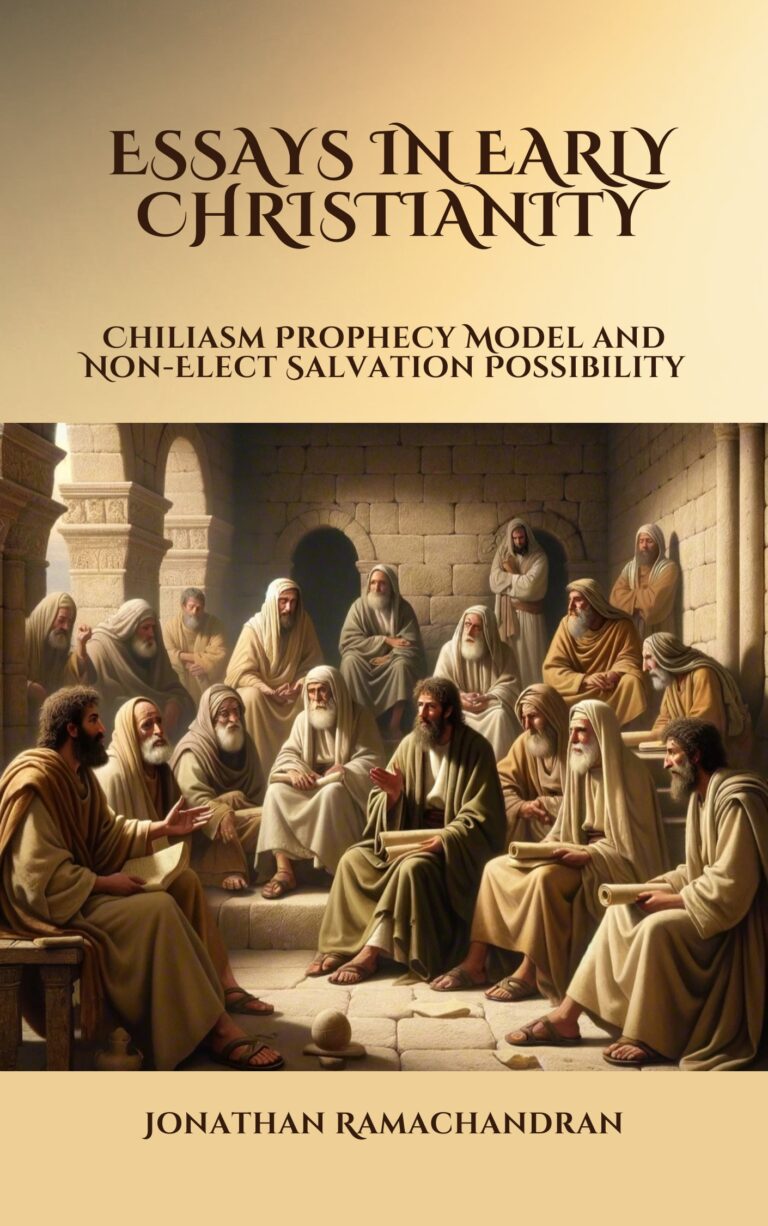
1) Jonathan Ramachandran, ESSAYS IN EARLY CHRISTIANITY: Chiliasm Prophecy Model and Non-Elect Salvation Possibility (Cambridge, OH: Christian Publishing House, July 13, 2025), ISBN 978-1949586435, https://www.amazon.com/dp/1949586421
2) Jonathan Ramachandran, HOPE BEYOND THE ELECT: Revisiting Early Christian Views on Prophecy and Salvation (Cambridge, OH: Christian Publishing House, June 6, 2025), ISBN 978-1949586411, https://www.amazon.com/dp/1949586405
3) Jonathan Ramachandran, “Non Elect Salvation Possibility,” American Journal of Biblical Theology (AJBT), vol. 26, no. 6 (February 9, 2025), https://www.biblicaltheology.com/Research/RamachandranJ01.pdf
4) Jonathan Ramachandran, “Thousand Year Gap for Prophecy in 1 Thessalonians 4:17 and 1 Corinthians 15:52 with Chiliasm Church Fathers,” Journal of Biblical Theology (JBT), vol. 8, no. 3 (June 1, 2025): 185–208, https://www.biblicaltheology.com/research.html. This article is identical to the version published in American Journal of Biblical Theology, vol. 26, no. 22 (June 1, 2025), https://www.biblicaltheology.com/Research/RamachandranJ02.pdf
5) Jonathan Ramachandran, “The Personhood of the Holy Spirit and the Unity of the Trinity,” JOY! Magazine, April 2026, theology section, 28–30, published by JOY! Magazine (Somerset West, Western Cape, South Africa), accessed April 3, 2026, https://joygifts.co.za/product/https-joygifts-co-za-joy-april-2026/.
A brief bio and photo.

Jonathan Ramachandran, B.Sc., Th.D. (Hon.), D.Div. (Hon.), D.Min. (Hon.) is an ecumenical Christian, Malaysian theologian, missionary blogger (https://www.anonymouschristian.org/), IMO coach, published author, and operations manager, integrating theology, mathematics, and ministry. He can be contacted at email ([email protected]) or phone (+6010-8803763)
Sample: I was trying to see how a well-established “Bible Society” might respond to my theological work, since it’s understood that they are well aware of both popular doctrine and lesser-known views. I believe these are honest comments, which I very much appreciate.
[email protected] wrote:
Dear Jonathan,
Thank you for reaching out! What a great resource it sounds like you have developed for people to learn more about scripture and our God.
Unfortunately, Bible Society and our publishing division aren’t currently accepting XX submissions as we focus on some major Bible development work and translation projects.
All the best with your resource!
Blessings,
Lisa
Donor Contact Team
P: 1300 BIBLES (1300 242 537)
Lvl 23, 100 Miller St, North Sydney NSW 2060| BIBLESOCIETY.ORG.AU


Source (Article titled “Thought: Toward a Revised Abstract of Non-Elect Salvation Possibility (NESP) Paper with Methodological Defense”), more details:
Thank you.