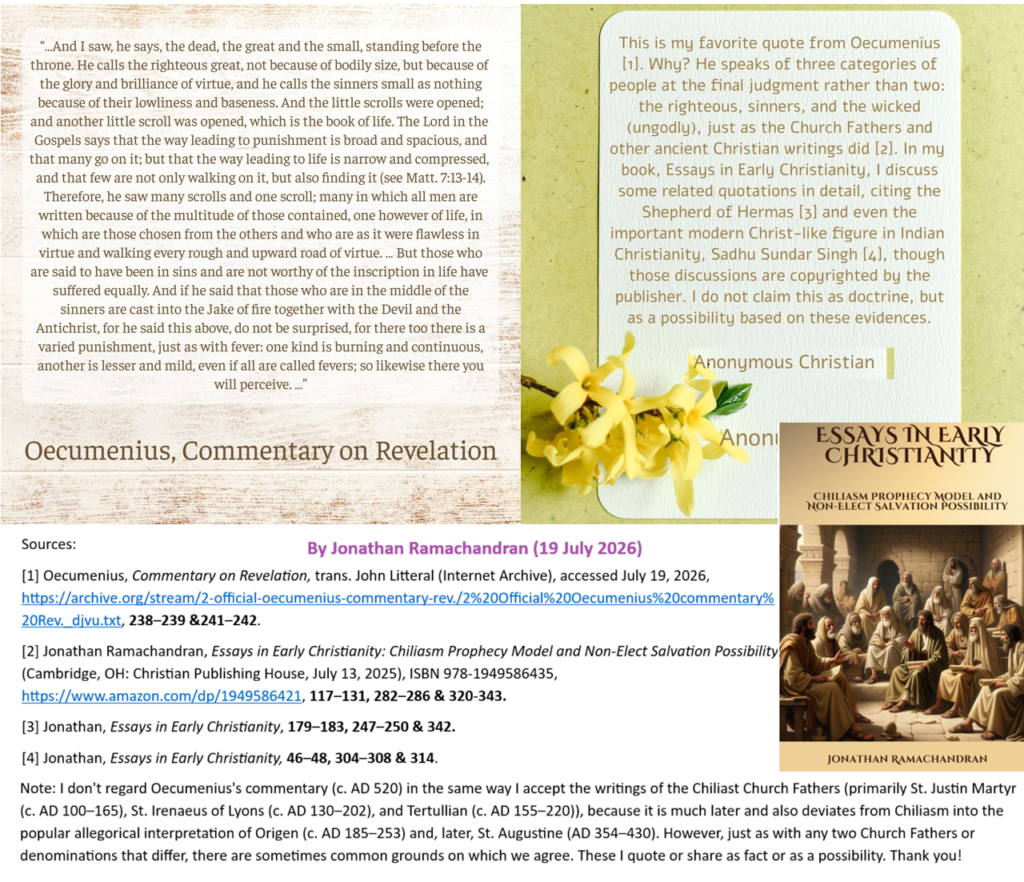
All about the Anonymous Christians and its author Jonathan Ramachandran
Jonathan Ramachandran is founder at AnonymousChristian.org which serves as a Christian Blog discussing the Greater Hope of Biblical Christianity in Christ Alone. He does not believe in any form of Unitarianism but strictly adheres to Lord Jesus Christ as the only Way, only Truth and only Life by which we hope and pray that most Men may eventually be Saved by His Mercy (if God Wills it). This is due to latest research as of year 2022 – 2024 with both Church Father quotes and early Christian writings which seem to echo Non-Elect Salvation Possibility as listed below:
Jonathan Ramachandran, B.Sc., Th.D. (Hon.), D.Div. (Hon.), D.Min. (Hon.)
Dr. Jonathan Ramachandran obtained his Honorary Doctor of Theology (Th.D.) from University of Jerusalem (UJ, Chennai, India, 20 August 2025; Reg. No.: 11230), Honorary Doctor of Divinity (D.Div.) from Triumphant Christian University of America (TCUA, Illinois, USA, 20 August 2025, Cert. ID.: 7704247) and Honorary Doctor of Ministry (D.Min.) from Open Christian University (OCU, California, USA, 31 August 2025, Cert. ID.: OCU250124/831208-14-6517MY).
To learn how I integrated Christian ministry with educational initiatives in a small, individual way by relative measure, please read this article for full details. Also, if you can refute all my theological points here, I will convert to your denomination. Source:
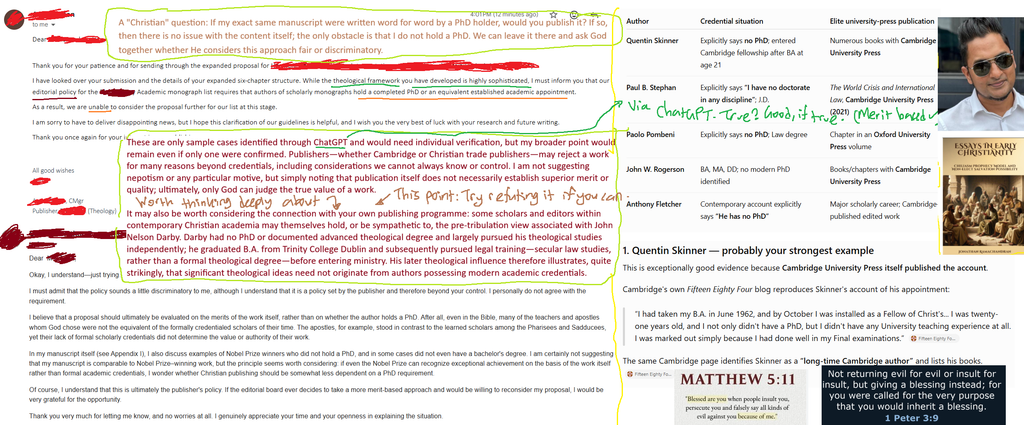
[Text] Biblical Contentment in Theology too – How?
No one can manipulate heavenly rewards (assuming one is saved), because God knows who truly discovered what. For example, in theology, if a claim you made turns out to be correct and you did not plagiarize anyone else—which can often be demonstrated if no prior publication (whether a book or journal article) exists before yours, thus removing even circumstantial evidence of copying—then the credit belongs to you.
Of course, the ultimate question is whether God finds your claim correct or not. Nevertheless, a journal article or book may contain multiple genuinely new insights or rediscoveries based on the Church Fathers that no other scholar had previously noticed or written about, meaning there is still a possibility of arriving at something true and original.
Feminism can also be discriminatory, just as male chauvinism can; I say this from my own experience. However, if one is right, God can reward not only the discovery itself but also the unjust discrimination endured. This is one example of what Christ meant in Matthew 5:10-12 when He spoke of a “great reward” for those who are “persecuted for righteousness’ sake” (imagine God in Flesh Himself calls something as “great” in this verse). Such persecution can include these kinds of experiences, especially since theology is directly concerned with Him.
“10 Blessed are those who are persecuted for righteousness’ sake, For theirs is the kingdom of heaven. 11 Blessed are you when they revile and persecute you, and say all kinds of evil against you falsely for My sake. 12 Rejoice and be exceedingly glad, for great is your reward in heaven, for so they persecuted the prophets who were before you.” (Matthew 5:10–12, NKJV)
Did you notice that Christ never promised any reward on earth, but only in heaven—and not both?
Latest Update (12 May 2026) for my NESP Article (to date: “still unpublished.”)
The Interdisciplinary Reception of My NESP Manuscript: From New Testament Studies (ZNW, Oxford, Cambridge) to Missiology (Mission Studies, Brill).
Disclaimer: I was hesitant to publish this journal response, but I put it up since I am constantly targeted by some racists, nepotists, or some strange people in some way, so in case I die—even by accident (who knows, or even murdered by those who don’t like me trying to publish my latest NESP paper), or in any other way—at least someone can inform the editor or try to help edit and publish it one day. It sounds silly, but I would rather say this than keep silent, since I am not saying anything wrong, just an honest opinion, right?
Again, although it has not yet been published in any journal, I am encouraged that my work has been positively received not only by the elite Zeitschrift für die neutestamentliche Wissenschaft (ZNW), but also by journals from adjacent fields such as Oxford’s Journal of Theological Studies and Cambridge’s New Testament Studies, as reflected in my other (primarily LinkedIn) articles discussing related comments and details, and now also by Mission Studies (Brill), whose field overlaps with my multidisciplinary paper. All LinkedIn Articles for proof details:
1) Title: Here is one of the best comments regarding my new “Imprint Hermeneutics” technique applied in my latest NESP paper by the elite theology journal ZNW
2) Title: When Oxford or Cambridge Understand or Misunderstand Me: An Interesting Status Update for My Most Recent Revision of the NESP Journal Paper
3) Title: The Interdisciplinary Reception of My NESP Manuscript: From New Testament Studies (ZNW, Oxford, Cambridge) to Missiology (Mission Studies, Brill).
4) Sample Quotes from these articles (briefly):
i) New Testament Studies (NTS, Cambridge University Press)
“This is a very interesting idea … But the main reason why the piece, we are afraid, is not suitable for NTS is its breadth, which in itself is attractive and interesting, but at NTS we are currently publishing pieces much more closely focused on the NT.”
ii) Journal of Theological Studies (JTS, Oxford University Press)
“Of the articles you have submitted to JTS in the last few years, this is, in my judgement, undoubtedly the best. It argues a precise (if flexible) thesis against the background of an articulate methodology and a clear historical-theological framework and goals. … but as it is, the material serves more of an illustrative dogmatic purpose, and I don’t think that JTS has the space available to publish work of this kind. I think that this article clearly belongs in a journal of evangelical theology, of ecclesiology (in a wide sense), or perhaps of Asian theology, … It is clearly of most relevance to contemporary debates on salvation and religious pluralism within the general evangelical tradition. I hope you will find a home for it there.”
iii) Zeitschrift für die Neutestamentliche Wissenschaft (ZNW, De Gruyter Brill)
“This is an interesting topic, and the approach is commendable. I would like to recommend and encourage the author to submit the essay to a suitable journal specializing in the theological interpretation and application of biblical texts” and Prof. Dr. Stefan Krauter’s personal remark: “I agree with them that this is an interesting an well written article and would also like to encourage you to submit it to a suitable journal.”
iv) Mission Studies (MIST, Brill)
“I feel that the manuscript has merit and would therefore be willing to take a fully revised version into consideration. …1. Our maximum word limit at the Journal is 6,600 words – therefore the article needs a strict edit down to the salient points it wishes to make (which do seem to be original and possibly worthy of publication). 2. We do not use the footnoting system as you have done, but rather the inline (author, date: page) system. Please consult the Author style guidelines … I look forward to possibly receiving the revised article.”
Even though I have been rejected so far, I feel strangely happy about such positive feedback from all these real geniuses in theology.
5) My LinkedIn Profile where all these can be found:
https://www.linkedin.com/in/jonathanramachandran
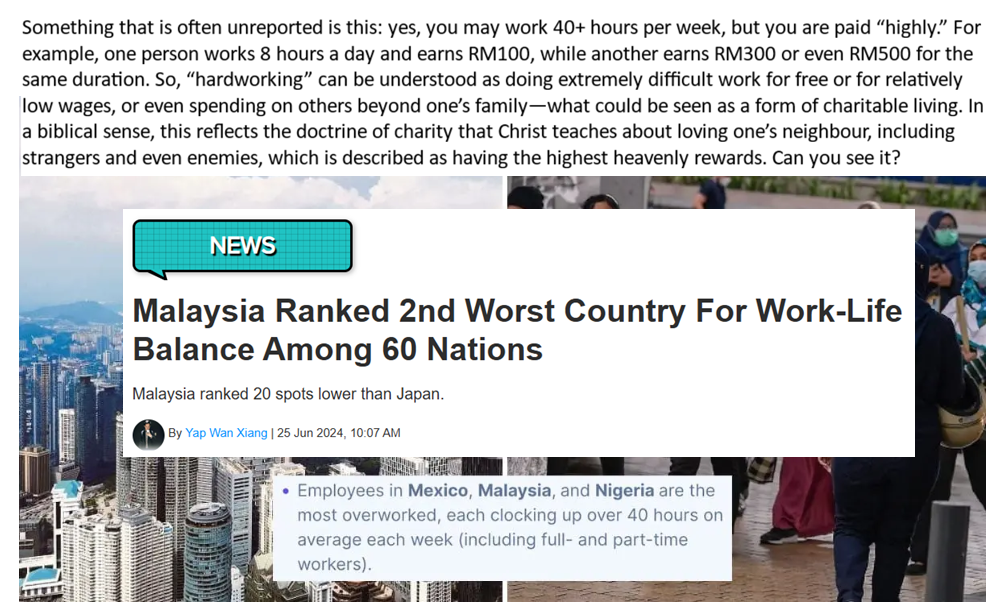
Another source:
TQ.
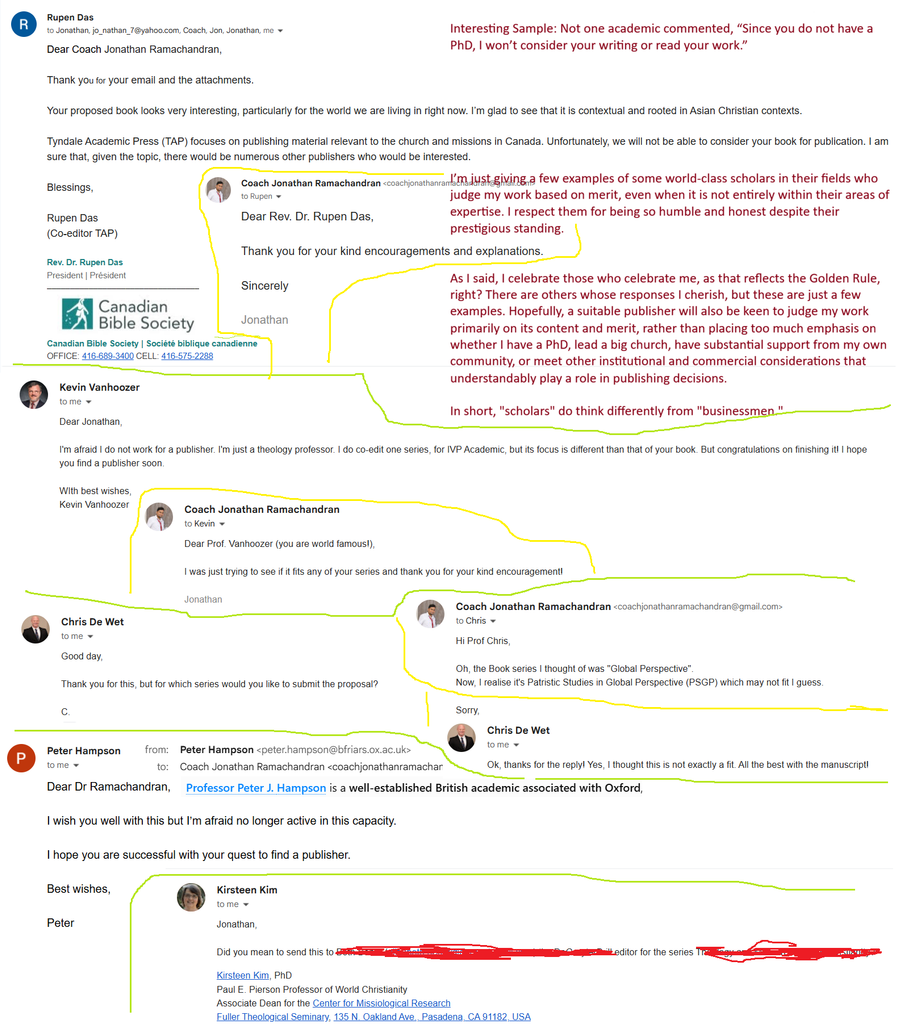
Editorial Verdict: Strong Scholarship, Wrong Journal Fit — by Elite Journal New Testament Studies (Cambridge University Press) regarding my “1000 Years” Paper
Background: I wrote some time ago about New Testament Studies (NTS)’s positive comments regarding my revised “NESP journal paper.” This, however, concerns a different paper — my “1000 Years” paper — which employs my new Imprint Hermeneutics technique. These are the only two journal papers I currently have and intend to publish using this method, since it has so far yielded only these two theological and eschatological possibilities. Some methods, after all, may produce only a limited number of results and nothing beyond them.
As always, if these conclusions are true, all glory goes to God; if false, they remain an intellectual exercise — albeit one that has at least elicited positive engagement from Cambridge-level (the real Cambridge) scholars and renowned professors. I do not think they would offer strong recommendations for something they considered nonsensical, methodologically incoherent, or incapable of generating any genuinely new meaning, even at a purely intellectual level — would they?
Details:
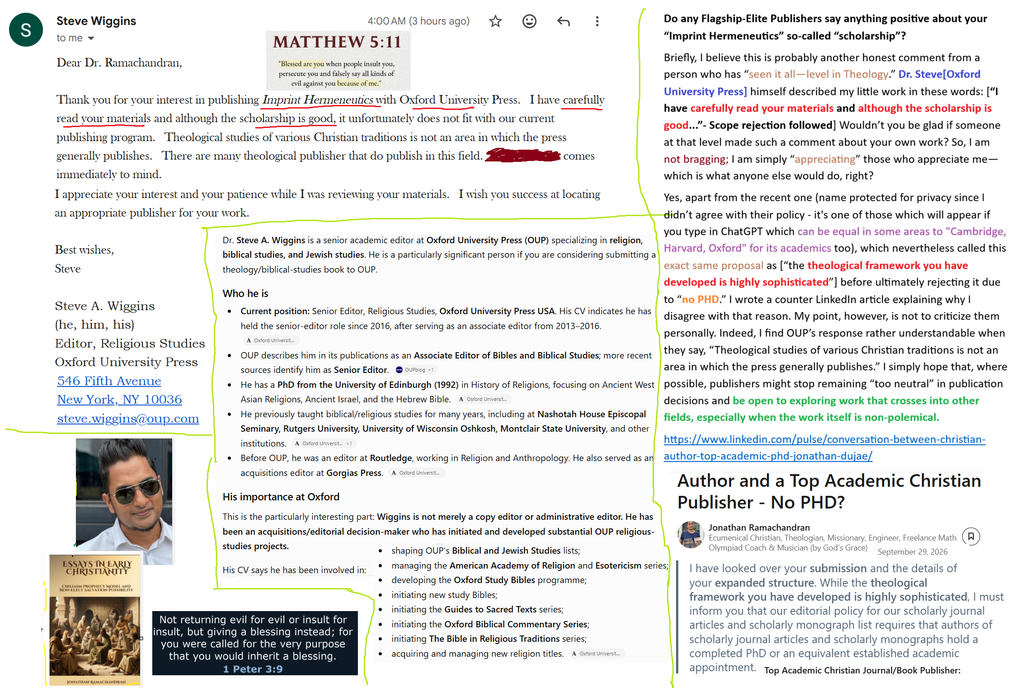
from: New Testament Studies <[email protected]>
reply-to: [email protected]
to: [email protected], [email protected]
subject: Decision on NTS-2026-0058 – New Testament Studies
Dear Dr. Ramachandran,
Your manuscript (ID NTS-2026-0058 entitled “Imprint Hermeneutics: A Thousand-Year Eschatological Gap for the Rapture in 1 Thessalonians 4:17 and Theosis in 1 Corinthians 15:52″) has now been reviewed and it will unfortunately not be possible to publish it in New Testament Studies.
The article makes a well-researched case for its thesis, but the mode of scholarship is not a good fit for NTS. Whereas we publish close textual work on the New Testament, you make a synthetic theological and hermeneutical proposal. That might work quite well in a theology journal, but it fits neither the nonsectarian readership of NTS nor the particular kinds of textual work that we publish. With all due respect, we think you might find a better fit with a different kind of journal.
Thank you for submitting your article to New Testament Studies, and we wish you well in your future scholarly work.
Yours sincerely,
Prof. Teresa Morgan (Editor)
Prof. Matthew Novenson (Associate Editor)
New Testament Studies
About: New Testament Studies (NTS), published by Cambridge University Press, is widely regarded as an elite, top-tier international journal in biblical and New Testament scholarship and is commonly considered among the top handful (roughly top 5–10) specialist journals in New Testament studies worldwide. As the official journal of the Studiorum Novi Testamenti Societas (SNTS), it is known for highly selective peer review, rigorous scholarship, and publication by leading scholars in the field. NTS is Q1-ranked and is indexed in major databases including Scopus, Web of Science / Arts & Humanities Citation Index, and ATLA Religion Database, reinforcing its strong global academic standing in the discipline.
What does it mean?
New Testament Studies declined the manuscript not for lack of scholarship, but for poor fit with the journal’s scope. While recognizing the article as well-researched and strongly argued, the editors judged it to be a synthetic theological and hermeneutical proposal rather than the close New Testament textual analysis that NTS publishes. They felt its approach better suits a theology journal, as it does not align with NTS’s nonsectarian readership or its established mode of textual scholarship. The editors closed respectfully, thanking the author and wishing success in future publication efforts.
ChatGPT analyzed the response and concluded: In essence, the editors are saying that your article is substantial and scholarly, but that it belongs to a different academic conversation from the one New Testament Studies typically hosts.

Source:
Thank you.
Here is one of the best comments regarding my new “Imprint Hermeneutics” technique applied in my latest NESP Journal paper by the elite theology journal ZNW
Yes, here’s an example of another top journal, comparable to Cambridge and Oxford journals in its field, providing comments on my paper. I appreciate the distinguished Professor’s honest and directive comments.
Stefan Krauter [email protected] wrote:
Dear Dr. Ramachandran,
Thank you again for submitting your article “Non-Elect Salvation Possibility (NESP): A Constructive Theological Proposal via Imprint Methodology for Asian Christianity and Beyond” to ZNW.
I am sorry to write you the the reviewers did not accept it for publication. Please find their main arguments below. I agree with them that this is an interesting an well written article and would also like to encourage you to submit it to a suitable journal.
All the best,
Stefan Krauter
From the reviews:
The submitted article addresses the theological question of whether there is a middle ground between universal salvation and strict traditional soteriology, which posits the damnation of the unchosen. It develops a model of evangelical hermeneutics that incorporates contextual insights from Asian Christianity. Numerous texts from the New Testament and from the history of its reception are (briefly) discussed.
This is an interesting topic, and the approach is commendable. However, it does not fit the profile of the ZNW. The ZNW is a New Testament journal that publishes specialized historical and philological articles on the study of New Testament texts. I would like to recommend and encourage the author to submit the essay to a suitable journal specializing in the theological interpretation and application of biblical texts.
Prof. Dr. Stefan Krauter
Ausserordentlicher Professor für Neutestamentliche Wissenschaft mit dem Schwerpunkt griechisch-römische Kultur
Prodekan Lehre
Universität Zürich
Theologische und Religionswissenschaftliche Fakultät
Kirchgasse 9
8001 Zürich
About: Zeitschrift für die Neutestamentliche Wissenschaft (ZNW), founded in 1900 and published by De Gruyter Brill (historically Walter de Gruyter), is one of the oldest and most prestigious journals in New Testament and early Christian studies. It specializes in New Testament exegesis, historical theology, textual criticism, philology, and historical-critical scholarship, publishing articles in German, English, and French. The journal is highly selective and widely respected in international biblical scholarship, especially within the German academic tradition.
ZNW is indexed in major scholarly databases including Web of Science (Arts & Humanities Citation Index/AHCI), Scopus, ATLA Religion Database, ERIH PLUS, SCImago, ProQuest, EBSCO, Dimensions, Religious and Theological Abstracts, and Index Theologicus. It commonly publishes work by senior professors, historical-critical scholars, philologists, and researchers from leading European and North American universities, particularly in areas such as Pauline studies, Gospel studies, Greek textual analysis, and early Christianity.
Historically, ZNW is associated with the German Protestant historical-critical academic tradition, although it functions primarily as an international scholarly journal rather than a confessional or denominational publication. Its long scholarly history, major indexing coverage, and strong academic reputation make it a highly respected journal in theology and biblical studies.
Conclusion
Did you know? There was a time when studying German was often essential for PhD work in Theology, especially in New Testament and historical-critical studies, because much foundational biblical scholarship in these fields was produced by German-speaking scholars, making German a key language for accessing core academic literature.
So, receiving positive feedback from ZNW, a leading journal in biblical and theological scholarship rooted in the German academic tradition, is truly humbling. Considering that I have no background in philology, it is remarkable that such experts are willing to read my work and provide frank feedback.
In this case, the ZNW reviewers indicated a scope mismatch and suggested submitting the paper to a more suitable journal. At the same time, they offered positive remarks on its quality, stating:
“This is an interesting topic, and the approach is commendable. I would like to recommend and encourage the author to submit the essay to a suitable journal specializing in the theological interpretation and application of biblical texts” and Prof. Dr. Stefan Krauter’s personal remark: “I agree with them that this is an interesting an well written article and would also like to encourage you to submit it to a suitable journal.”
Even though I have been rejected so far, I feel strangely happy about such positive feedback from all these real geniuses in theology.

Source:
Thank you for reading.
When Oxford or Cambridge Understand or Misunderstand Me: An Interesting Status Update for My Most Recent Revision of the NESP Journal Paper
Source:
Thank you.
Firstly, please find the responses from two “elite” (i.e., among the highest-level theological and academic journals for Christianity and in general, in the world; noting that there are others of comparable standing, though that is a separate topic) as they are presented below.
I also include a brief description of each journal so that, if the reader is unfamiliar with them, they can understand why these are considered elite venues where, at times, “gatekeeping” may also involve human judgment that only God can fully evaluate, though the reviewers may also be acting in good faith in their own way, simply because their criteria did not align with my journal paper’s unique and novel methodology and hermeneutical framework.
1) New Testament Studies (Cambridge University Press)
Dear Dr. Ramachandran,
Your manuscript (ID NTS-2026-0052 entitled “Non-Elect Salvation Possibility (NESP): A Constructive Theological Proposal via Imprint Methodology for Asian Christianity and Beyond”) has now been reviewed by our Editorial Board, and it will unfortunately not be possible to publish it in New Testament Studies.
This is a very interesting idea which no doubt deserves further development. It is, of course, always important to be clear how exactly one is doing biblical or NT-based theology, since these are highly contested fields, and the article could be clearer about its position in the field. It was also not clear to the readers how ‘imprint methodology’ is significantly different from the study of intertextuality; if it is, the difference and the significance of it would need to be clarified. On p. 2 etc it was also not clear what status is being given to NT texts – infallibility or not.
But the main reason why the piece, we are afraid, is not suitable for NTS is its breadth, which in itself is attractive and interesting, but at NTS we are currently publishing pieces much more closely focused on the NT.
Thank you for submitting your article to New Testament Studies, and I wish you well in your future scholarly work.
Yours sincerely,
Prof. Teresa Morgan (Editor)
Prof. Matthew Novenson (Associate Editor)
New Testament Studies
About: New Testament Studies, published by Cambridge University Press (CUP) and founded in 1954, is one of the world’s leading New Testament journals, Q1-ranked in religious studies and widely indexed in major scholarly databases including Scopus, Web of Science (Arts & Humanities Citation Index – AHCI), ATLA Religion Database, and other international theological indexing services. It has an estimated h-index ~29 based on citation tracking databases. The journal attracts leading international New Testament scholars, including specialists in Greek textual criticism, Second Temple Judaism, Pauline studies, and early Christianity from institutions such as Cambridge, Oxford, major German universities, and Ivy League divinity schools. It is known for extremely strict methodological gatekeeping, focusing on tightly defined historical-critical New Testament research, with an estimated 3–8% acceptance rate, and frequent desk rejection for submissions outside narrowly defined NT exegetical scope.
2) Journal of Theological Studies (Oxford University Press)
Dear Dr Ramachandran,
Thank you for the article, “Non-Elect Salvation Possibility (NESP): A Constructive Theological Proposal via Imprint Methodology for Asian Christianity and Beyond”, which you submitted to the Journal of Theological Studies a few days ago. I have now had an opportunity to read this.
Of the articles you have submitted to JTS in the last few years, this is, in my judgement, undoubtedly the best. It argues a precise (if flexible) thesis against the background of an articulate methodology and a clear historical-theological framework and goals.
Nonetheless, I am afraid that, like your previous submissions, this article is not well suited to publication in a historical-critical journal such as JTS. The main body of it is too general a survey of biblical and historical material, much of which is very well known, to make a good claim for space in JTS. If this historical material were organized, for example, in support of the interpretation of a particular biblical passage, it might be publishable as a contribution to reception history or critical hermeneutics; but as it is, the material serves more of an illustrative dogmatic purpose, and I don’t think that JTS has the space available to publish work of this kind.
I think that this article clearly belongs in a journal of evangelical theology, of ecclesiology (in a wide sense), or perhaps of Asian theology, though the orientation of the article to specifically Asian contexts would probably in that case require more emphasis. It is clearly of most relevance to contemporary debates on salvation and religious pluralism within the general evangelical tradition. I hope you will find a home for it there.
I am sorry to have to disappoint you yet once more. JTS receives many more articles than we are able to publish, particularly in the field of New Testament interpretation, which are based on highly specialized original research, and we are often in the position of having to reject good, theologically interesting, work.
With best wishes,
Yours sincerely,
Dr Graham Gould
The Journal of Theological Studies
About: Journal of Theological Studies, published by Oxford University Press (OUP) and founded in 1899, is one of the oldest and most prestigious international journals in theology and religious studies, consistently ranked in Q1 categories and indexed in major academic databases including Scopus, Web of Science (Arts & Humanities Citation Index – AHCI), ATLA Religion Database, and other major theological and humanities indexing systems. It has an estimated h-index ~22 according to citation-based academic metrics. The journal publishes senior scholars from leading global institutions such as Oxford, Cambridge, and major international divinity schools, covering historical theology, patristics, biblical studies, and doctrinal development. Its editorial standards are highly selective, with an estimated 5–10% acceptance rate, and it prioritises rigorous historical-theological and philological argumentation over broad constructive or systematic theological synthesis.
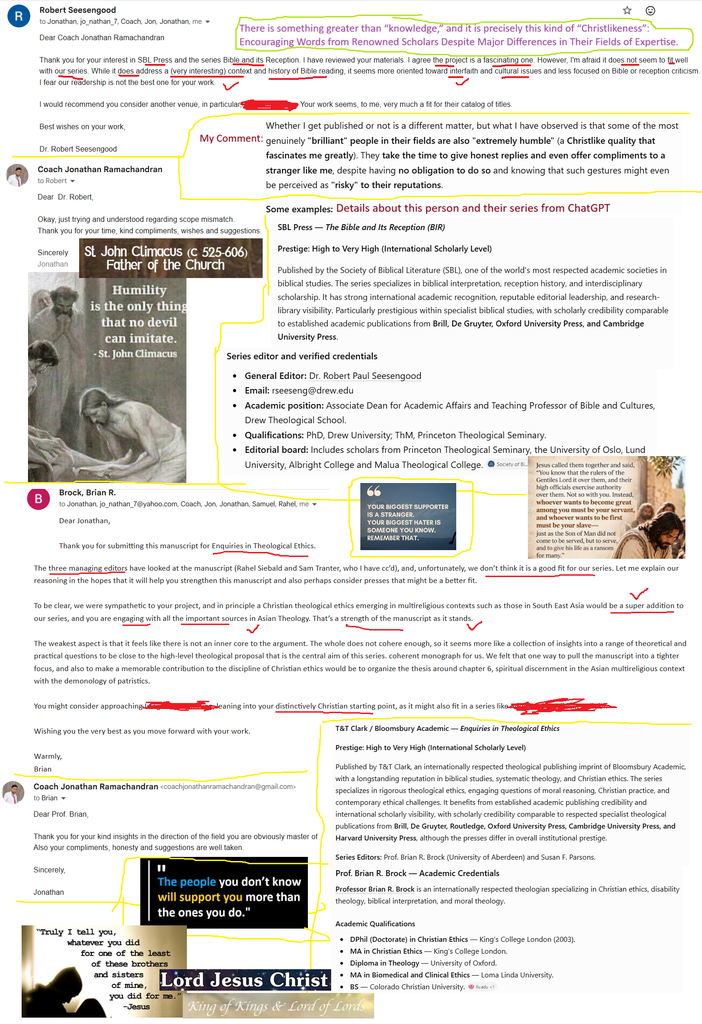
Please notice carefully that neither of them said that my method is already known, not scholarly, nor that it is nothing new, stupid, or equivalent (can you see it?).
I show my response to NTS below, but not to JTS, because the former offered some criticism of my manuscript while the latter did not. Consider:
Dear Honorable Editors,
Thank you for your careful review of my manuscript, “Non-Elect Salvation Possibility (NESP): A Constructive Theological Proposal via Imprint Methodology for Asian Christianity and Beyond.” I am grateful for the time and thoughtful engagement given by the Editorial Board.
I appreciate your recognition that the proposal is “interesting” and worthy of further development. Your comments regarding methodological clarity, particularly in relation to the status of New Testament texts, the distinction between imprint methodology and intertextuality, and the article’s overall breadth, are helpful and well taken.
By way of clarification, the study operates within a constructive theological mode rather than a strictly historical-critical one. “Imprint methodology” is intended not as a form of intertextuality, which typically traces literary or textual dependence, but as a framework for identifying conceptual continuities that emerge through later theological developments, even where such meanings are not demonstrably present in the original historical context. In this sense, it treats earlier texts and traditions as dialogical partners that contribute to the formation of theological possibilities rather than as sources whose meanings are exhausted by authorial intent or original setting.
Relatedly, the article maintains a distinction between infallible primary revelation and fallible interpretive proposals. The New Testament texts are treated as authoritative within the Christian canon; however, the conclusions drawn in the article—particularly NESP—are not presented as doctrinal claims, but as exploratory theological possibilities grounded in perceived canonical patterns.
I also acknowledge the concern regarding the article’s breadth. The intention was to situate NESP within a wider theological and intercultural framework, especially in relation to Asian Christianity. However, I understand that this scope may not align with the more textually focused remit of New Testament Studies. A more narrowly focused version—concentrating, for example, on a specific New Testament passage or a tightly defined exegetical problem—may be more appropriate for your journal, and I will take this into consideration in future revisions.
Thank you again for your engagement and for the constructive feedback. I remain encouraged to refine the proposal further and to pursue publication in a venue aligned with its methodological and thematic scope.
Yours sincerely,
Jonathan Ramachandran
Summary
The responses from the two journals reflect a difference in scope and methodological expectations rather than a clear misunderstanding or flaw in my work. The Journal of Theological Studies recognizes the clarity, structure, and originality of my proposal, affirming that it is my strongest submission to date. Its rejection is based not on weakness, but on fit—specifically, that my work is too constructive and doctrinally oriented for a strictly historical-critical journal.
The response from New Testament Studies, by contrast, raises questions about methodological clarity, particularly regarding how Imprint Hermeneutics differs from intertextual approaches. However, this appears less a rejection of the idea itself and more a reflection of their expectation for narrowly focused, text-critical New Testament scholarship, which differs from my broader constructive theological aim.
Conclusion
In conclusion, the feedback received suggests that my NESP proposal is methodologically coherent and theologically meaningful as it stands, even if it does not align with the specific scope of certain journals. The Journal of Theological Studies in particular affirms its quality and recommends submission to a more theologically oriented venue, which indicates that the work is already at a strong academic level.
If this entirely new method is not accepted by other journals for similar reasons—which remains to be seen as I continue submitting—or if it is accepted in line with the recommendation of JTS’s distinguished editor, Dr. Graham Gould, then I will likely proceed toward publishing it as a short academic book, or possibly pursue both routes in parallel. I will take time to consider these options carefully.
Ultimately, this process reflects not a failure of the method, but the reality that innovative frameworks often require the right intellectual context to be received and evaluated differently.
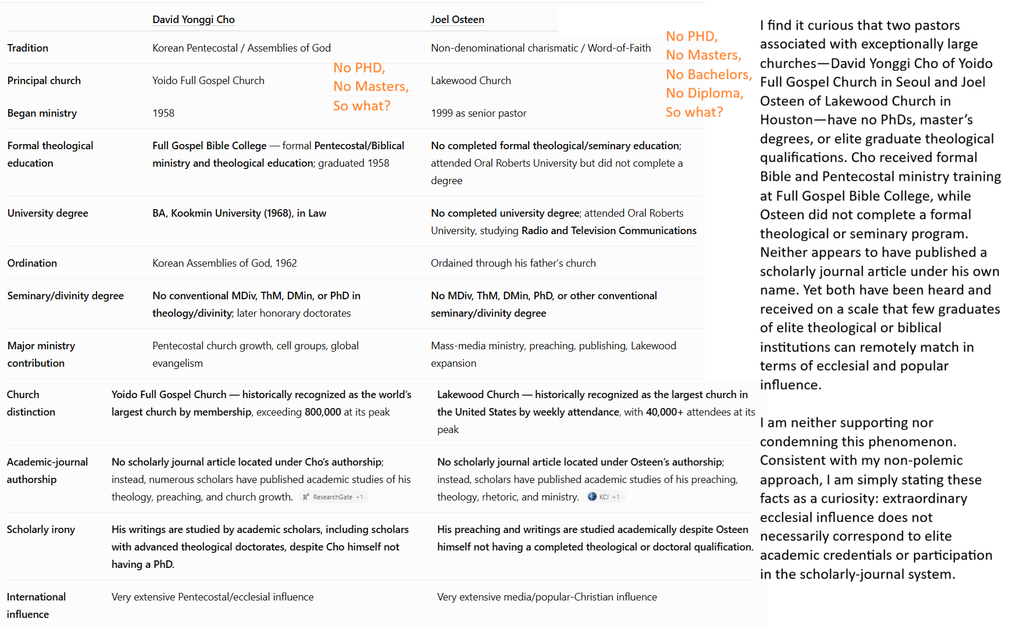
My confessional view: Some of the greatest discoveries in history, including Nobel Prize–winning breakthroughs, were made by individuals with only undergraduate education—or even no university degree at all[1] [2] [3] [4] [5].
This reminds us that truth, insight, and meaningful contribution are not confined to formal credentials.
By the same reasoning, even in Theology, who can say with certainty? On Judgment Day, it may be revealed that some of the most accurate understandings came from individuals without formal theological training.
Example: Many apostles of Christ were not academicians nor learned in Scripture.
Academic titles can provide structure and depth, but they do not hold a monopoly on wisdom. History repeatedly shows that extraordinary insight can emerge from unexpected places. These examples prove that transformative discoveries are not limited to PhD holders. Bachelor’s degrees, master’s degrees, or even self-education have all led to breakthroughs that changed the world.
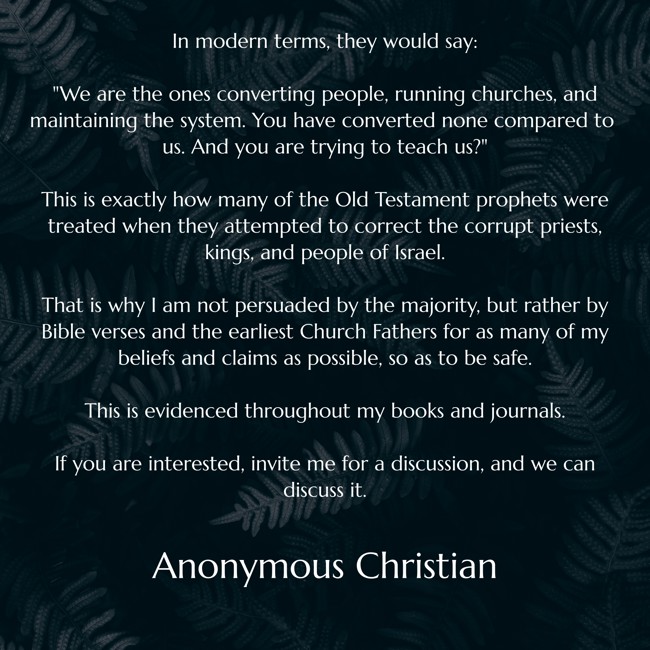
My point in bringing these facts up is not to claim that I am correct, but rather to suggest that it may be “anyone” (even without any journal publication at all) who could also be more accurate than Cambridge or Oxford journals on certain theological beliefs—something only God can ultimately judge. However, we can acknowledge and explore possibilities, as Jeremiah 23:36–40 allows, provided they are framed as “possibilities,” since judgment applies only to doctrinal claims we originate and assert as certain, but which may turn out to be wrong.
P/S: Images from the original email screenshot.

P/S2: A Premier-Level Framing of My Position
1. What the Oxford Response Actually Affirms
The response from the Oxford University Press journal Journal of Theological Studies (JTS) does not identify any flaw in my argument or method. Instead, it makes a scope judgment:
- It explicitly describes my article as:
- “the best” among my submissions
- “precise,” “articulate,” and methodologically clear
- The rejection is based on genre mismatch, not error:
- JTS prioritizes historical-critical, text-focused exegesis
- My work is constructive, synthetic, and doctrinally exploratory
👉 Conclusion:
JTS clearly recognizes the strength, coherence, and originality of my method but declines it because it does not align with its narrowly defined historical-critical scope.
2. What the Cambridge Response Actually Signals
The response from Cambridge University Press journal New Testament Studies (NTS) highlights two points:
- Conceptual categorization issue
- The editors attempt to relate Imprint Hermeneutics to “intertextuality” because that is a familiar category within their framework
- Scope mismatch
- NTS prioritizes closely focused New Testament studies
- My paper is broad, synthetic, and theological
👉 Conclusion:
NTS does not reject the idea as invalid but evaluates it through existing methodological categories and ultimately finds it outside its scope of publication.
3. My Core Methodological Contribution
My central claim stands clearly:
Imprint Hermeneutics is not a variant of intertextuality because it does not depend on demonstrable textual relationships, authorial intent, or literary dependence. Instead, it identifies post-canonical theological possibilities through conceptual “imprints” that emerge across the tradition, independent of direct textual linkage.
This establishes a distinct methodological category:
| Method | Basis | Goal |
| Historical-critical | Original context | Recover authorial meaning |
| Intertextuality | Textual relationships | Trace literary dependence |
| Imprint Hermeneutics | Conceptual resonance across time | Generate new theological possibilities |
👉 This positions my work as a constructive theological innovation, not a misapplication of existing methods.
[1] Koichi Tanaka —Japanese electrical engineer who developed soft laser desorption for mass spectrometry, enabling advanced analysis of large biomolecules and contributing to modern biotechnology and protein research. He received the 2002 Nobel Prize in Chemistry. Shimadzu Corporation, “Nobel Soul,” Shimadzu Corporation, accessed May 5, 2026, https://www.shimadzu.com/about/nobel/noblesoul/index.html.
[2] Tu Youyou —Chinese pharmaceutical chemist who discovered artemisinin, a highly effective antimalarial drug derived from traditional Chinese medicine, dramatically reducing malaria deaths worldwide. She was awarded the 2015 Nobel Prize in Physiology or Medicine. Good News Network, “She Had No Medical Degree or PhD but Just Won Nobel Prize for Medicine,” Good News Network, accessed May 5, 2026, https://www.goodnewsnetwork.org/she-had-no-medical-degree-or-phd-but-just-won-nobel-prize-for-medicine/.
[3] Jack Kilby —American electrical engineer who invented the integrated circuit (microchip), laying the foundation for modern computing and electronics. His work earned him the 2000 Nobel Prize in Physics. The Nobel Prize, “Jack Kilby – Facts,” NobelPrize.org, accessed May 5, 2026, https://www.nobelprize.org/prizes/physics/2000/kilby/.
[4] Michael Faraday — English scientist who discovered electromagnetic induction and made major contributions to electrochemistry, forming the basis for electric motors and generators despite having little formal education. Encyclopaedia Britannica, “Michael Faraday,” Encyclopaedia Britannica, accessed May 5, 2026, https://www.britannica.com/biography/Michael-Faraday.
[5] Claude Shannon —American mathematician and engineer who founded information theory and showed how Boolean algebra could be applied to electrical circuits, establishing the theoretical foundation of modern digital computing. Wikipedia contributors, “A Symbolic Analysis of Relay and Switching Circuits,” Wikipedia, accessed May 5, 2026, https://en.wikipedia.org/wiki/A_Symbolic_Analysis_of_Relay_and_Switching_Circuits. MIT Libraries, “A Symbolic Analysis of Relay and Switching Circuits,” MIT DSpace, accessed May 5, 2026, https://dspace.mit.edu/handle/1721.1/11173.
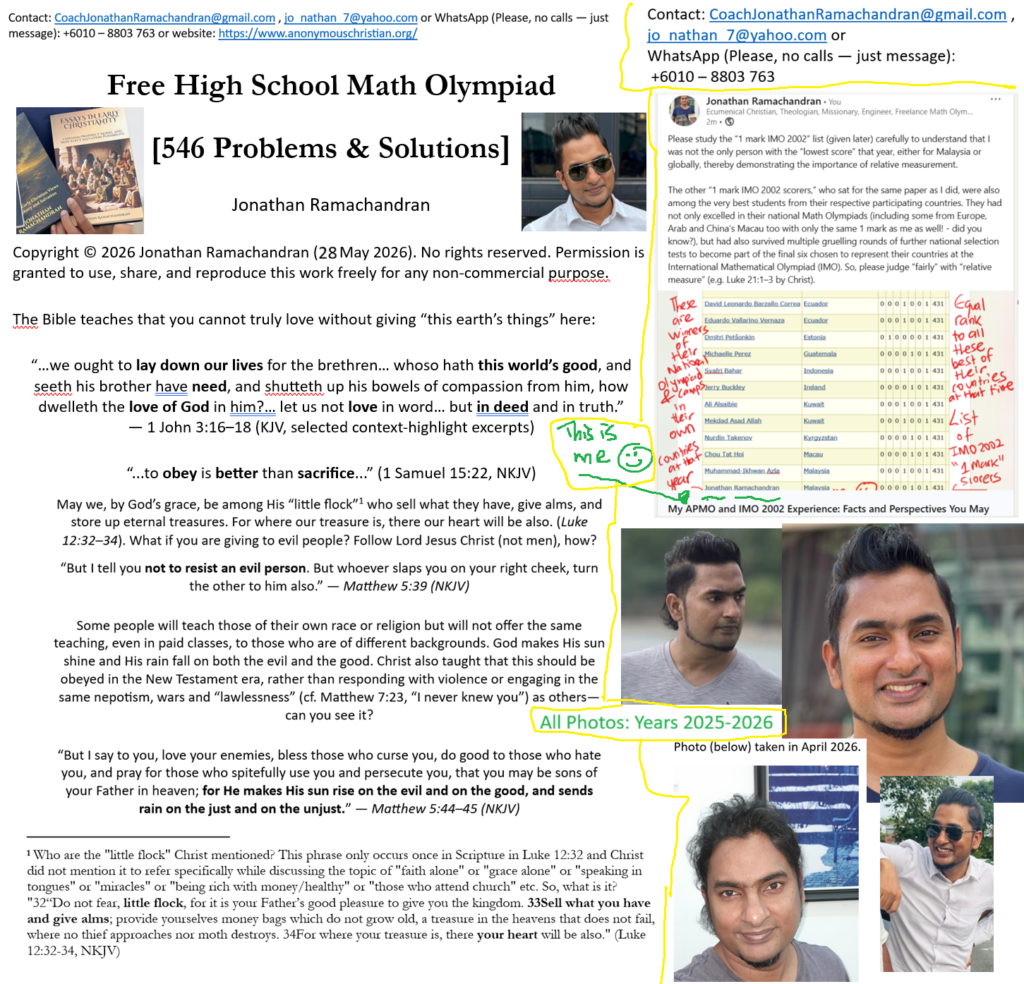
Sample of Merit and Excellence in International Mathematical Olympiad (IMO) History
I am using mathematics and education alone as examples since they are more objective and less opinion-based in marking, especially when population ratio is also included for context. The IMO depends mainly on paper, pen, logic, and reasoning, making it one of the cleanest and cheapest academic competitions. Apart from theology — which is more subjective since only God can fully judge — mathematics is among the purest fields for measuring merit.
From this perspective, one could say that God gives different gifts and abilities to people, and achievement may reflect how those talents are developed and used.
In many other industries, nepotism and favoritism can take place, where people may ignore better candidates in jobs or salary considerations and instead choose those of their own race, religion, or similar background. This is common worldwide. As Christians, however, we ought to be different by striving to judge people fairly based on merit, character, and integrity rather than favoritism.
1) China — Population: ~1.41 billion. Highest IMO achievement: 1st place, achieved multiple times. China is the most dominant country in IMO history with 25 overall titles.
2) India — Population: ~1.46 billion. Highest IMO achievement: 4th place in 2024, India’s best-ever result.
3) Israel — Population: ~10 million. Highest IMO achievement: 6th place in 2025, Israel’s best-ever finish despite a much smaller population.
Example: I don’t think many — or even any — enemies of Israel have ever achieved a higher result than Israel here (at IMO), despite having much larger populations or other advantages, including possible nepotism factors. The more merit-based individuals within those populations (while others may still act through favoritism unless there are other reasons) usually succeed within their own contexts as well.
For those who do not know, even having a PhD in mathematics is no guarantee of being able to solve Math Olympiad problems, especially at the national level and beyond, which shows why it is called the “Math Olympics.”
For Indians, remember that most — if not all — of those Indian IMO participants are not even from “your subrace,” which should silence any “internal racism.” Can you see it?
Old Testament Bible verses also echo this idea here (notice that the higher officials are often corrupt while the righteous generally suffer in such situations):
“Then I returned and considered all the oppression that is done under the sun: And look! The tears of the oppressed, But they have no comforter— On the side of their oppressors there is power, But they have no comforter. … If you see the oppression of the poor, and the violent perversion of justice and righteousness in a province, do not marvel at the matter; for high official watches over high official, and higher officials are over them.” (Ecclesiastes 4:1, 5:8, NKJV)
Yes, being successful on earth without merit is not necessarily God’s approval, as He does not always intervene in every case, leaving final judgment — including Hell — for the afterlife (as Christ taught in Gospel of Luke 16).
Just like Israel, be a “spiritual Israel,” where even if you are discriminated against — whether by your own race, religion, or even by feminists — the rewards for endurance in Christ are eternal. Verse:
“10Blessed are those who are persecuted for righteousness’ sake, For theirs is the kingdom of heaven. 11Blessed are you when they revile and persecute you, and say all kinds of evil against you falsely for My sake. 12Rejoice and be exceedingly glad, for great is your reward in heaven, for so they persecuted the prophets who were before you.” Matthew 5:10-12, NKJV)
Thank you for reading.
By Jonathan Ramachandran on 7 May 2026.

Source:
TQ.
When Merit Is Ignored: Psalm 9:17–18, Justice, and the Fate of the Wicked
I used to wonder why the Gospel does not easily penetrate certain people groups until I understood these Bible verses:
“17 The wicked shall be turned into hell,
And all the nations that forget God.
18 For the needy shall not always be forgotten;
The expectation of the poor shall not perish forever.”
(Psalm 9:17–18, NKJV)
Game Theory aspect:
There are some cultures (and perhaps even entire nations) where people think something like this: “Who cares about that minority Christian man asking for a merit-based position and salary, even if he represented the country at the IMO after defeating all the other students in that year’s National Math Olympiad — including students from the same country who later performed better than him at the IMO, showing that question types and luck also play a role? If I instead favor a wealthy majority race with at least some consideration of merit, the nation’s economy may improve. These minorities bring no economic benefit even if helped, so let us ignore them.”
I believe such people groups become resistant to believing the Gospel, in light of Psalm 9:17–18. In the passage, the “wicked” and the “nations that forget God,” who are turned into “hell” (Sheol/Hades), are contrasted with the “poor” and needy who are neglected or forgotten in the immediate context. This suggests that the passage especially concerns poor people who are rejected despite merit. Of course, not all poor people are necessarily righteous either, as Scripture gives other examples and reasons elsewhere.
Caution: sometimes a merit-based achiever is discriminated against even within his own race for being a Christian. Therefore, this same condemnation applies not only to majority races that discriminate against him, but also to members of his own race who do the same. That is why such people become unable to truly believe the Gospel, because no one can deceive God. Such a level of non-racial thinking, fairness, and merit-based judgment without partiality is required of a Christian.
Some may appear to be Christians, but if they are racist or nepotistic, they too are false, according to the lawlessness condemned in the Great Denial passage (Matthew 7:20–24). This statement does not exempt or support me either, because I also must not practice nepotism or partiality.
But since “no prophecy of Scripture is of any private interpretation” (2 Peter 1:20, NKJV), am I twisting this verse to fit my own agenda of forcing Christians and non-Christians to give me a merit-based job or salary?
It is not just about me, but about every discriminated person. For if Hell were not eternal, many people would not even care about justice; and for those who have lost opportunities in life because of nepotism, no lesser punishment would seem fitting unless their oppressors likewise faced Hell.
The testimony of these two great giants of the faith — instead of following any “clowns of faith” — namely Blessed Tertullian (a Chiliast Church Father, Father of Latin Christianity, and founder of Western theological scholarship), together with Blessed Augustine of Hippo (a non-Chiliast Church Father and Doctor of the Church, probably among the most influential Christian thinkers in history after Christ and His Apostles), clearly shows below that my earlier interpretation of Psalm 9:17–18 is correct. Consider:
i) St. Augustine of Hippo
However, this interpretation is not based merely on personal emotion, because even Blessed Augustine of Hippo, in his Exposition on Psalm 9, interprets Psalm 9:17–18 in a way connected to divine judgment upon those who oppress, neglect, or forget God while the poor and afflicted await justice.
All quotes for Augustine are from this source:
Augustine of Hippo, “Exposition on Psalm 9” trans. anonymous scholar, in Nicene and Post-Nicene Fathers, First Series, vol. 8, ed. Philip Schaff (Buffalo, NY: Christian Literature Publishing Co., 1888), revised and edited for New Advent by Kevin Knight, https://www.newadvent.org/fathers/1801009.htm.
Point 17 fits most directly:
“Let the sinners be turned into hell: that is, let them be given into their own hands, when they are spared, and let them be ensnared in deadly delight. All the nations that forget God.”
This especially supports the idea that those who persist in sinful oppression, corruption, partiality, or selfish injustice become trapped by their own evil desires and are ultimately judged by God.
Point 18 also strongly fits:
“For there shall not be forgetfulness of the poor man to the end… but the patience of the poor shall not perish forever.”
This supports the belief that God does not permanently ignore those who suffer unjustly, including those neglected, rejected, or discriminated against despite merit.
Point 16 further reinforces this:
“In the works of his own hands has the sinner been caught.”
This suggests that sinners are judged through the very corruption and injustice they themselves practice.
Point 13 is also relevant:
“The punishment of the slayers shall be made manifest… He has not forgotten the cry of the poor.”
This aligns with the idea that divine justice eventually answers the cries of those who suffer oppression or wrongful treatment.
Finally, Point 10 connects suffering with God’s refuge for the afflicted:
“And the Lord has become a refuge to the poor… an Helper in due season, in tribulation.”
Altogether, these passages support the broader principle that God judges injustice, remembers the afflicted, and condemns persistent wickedness and partiality. However, Augustine’s focus is primarily spiritual and moral — concerning pride, oppression, sin, and forgetfulness of God — rather than specifically employment systems, race, or economic merit structures in the modern sense.
ii) Tertullian
In this regard, the testimony of Blessed Tertullian is often cited in connection with Psalm 9:17–18, where divine judgment is described alongside God’s remembrance of the poor and oppressed.
All quotes for Tertullian are from this source:
Tertullian, Against Marcion, Book IV, “Chapter 14,” trans. Peter Holmes, in Ante-Nicene Fathers, vol. 3, ed. Alexander Roberts, James Donaldson, and A. Cleveland Coxe (Buffalo, NY: Christian Literature Publishing Co., 1885), revised and edited for New Advent by Kevin Knight, https://www.newadvent.org/fathers/03124.htm.
He explicitly quotes the passage:
“The wicked shall be turned into hell, even all the nations that forget God; because the needy shall not always be forgotten; the endurance of the poor shall not perish forever.”
This is then reinforced in his wider exposition on divine justice, where he highlights God’s opposition to injustice and partiality:
“Woe unto them that decree unrighteous decrees; for in their decrees they decree wickedness, turning aside the needy from judgment, and taking away their rights from the poor of my people.”
He also emphasizes God’s active concern for the oppressed:
“Deliver the poor, and rid the needy out of the hand of the wicked.”
And further describes God’s restorative justice toward those who are socially humbled:
“He raises up the needy from off the ground, and out of the dunghill exalts the poor; that He may set him with the princes of His people (that is, in His own kingdom), and on thrones of glory (even royal ones).”
Taken together, these passages present a consistent theme: God judges systems and individuals who persist in injustice, neglect the needy, or distort fairness, while also remembering and ultimately exalting those who are oppressed or disregarded. This includes those who may remain poor and afflicted in this life, even suffering discrimination or lack of recognition on earth, yet are lifted by God into eternal honor and reward in His kingdom.
Summary
Notice that in each of these quotations, the merit-based poor righteous person dies “poor” but still goes to heaven. God does not necessarily save him on earth or make him rich in this life. Meanwhile, the rich and wicked person who oppressed him dies “rich on earth” but ends up in “hell.” Can you see it?
I repeat: if you go to hell and your pastor did not teach you this “merit-based treatment of the poor,” please do not blame me. I have already warned you not only with my own words (which are insignificant compared to the actual biblical text in Psalm 9), but also with supporting interpretations from both Tertullian and Augustine of Hippo, whose writings further reinforce this interpretation through their agreement with the same scriptural themes.
When I say that we suffer as “spiritual Israel,” doing good earlier and then suffering for righteousness in order to maximize heavenly rewards (Matthew 5:10–12), I am not referring to or endorsing the killing of Palestinians. As I have clearly explained in my other writings, I do not support such actions. I follow the “good” aspects associated with Israel and reject the bad.
Source:
https://www.linkedin.com/pulse/when-merit-ignored-psalm-91718-justice-fate-wicked-ramachandran-s16vc
Thank you for reading.


[Text] Simple thoughts: If the leaders of your community are “gangsters,” “drunkards,” “womanizers,” etc.—people whose actions you know are done in “secret”—yet they are the “richest” and hold “ruling positions,” then which “god” gave them such “prosperity”?
Imagine standing before the real God on Judgment Day, and He thunders: “If you knew and supported such corrupt leaders, tell Me now.” If lying would send you immediately to eternal Hell, how many people (even Christians) could give the right answer without being condemned, knowing that the real God cannot be tricked?
God is not interested in long prayers, rituals of sacrifice, or those who say they are only interested in “worship” (even Christians) more than in “judgment” through words, since only law enforcement can carry out “action.”
“To do justice and judgment is more acceptable to the LORD than sacrifice.” (Proverbs 21:3, KJV)
“Thus says the LORD: ‘Execute judgment and righteousness, and deliver the plundered out of the hand of the oppressor… nor shed innocent blood in this place.’” (Jeremiah 22:3, NKJV)
From Nobel-Level Discoveries to Theology: Great Truths Can Emerge Without Formal Degrees
Some of the greatest discoveries in history, including Nobel Prize–winning breakthroughs, were made by individuals with only undergraduate education—or even no university degree at all.
This reminds us that truth, insight, and meaningful contribution are not confined to formal credentials.
By the same reasoning, even in Theology, who can say with certainty? On Judgment Day, it may be revealed that some of the most accurate understandings came from individuals without formal theological training. Example: Many apostles of Christ were not academicians nor learned in Scripture.
Academic titles can provide structure and depth, but they do not hold a monopoly on wisdom. History repeatedly shows that extraordinary insight can emerge from unexpected places.

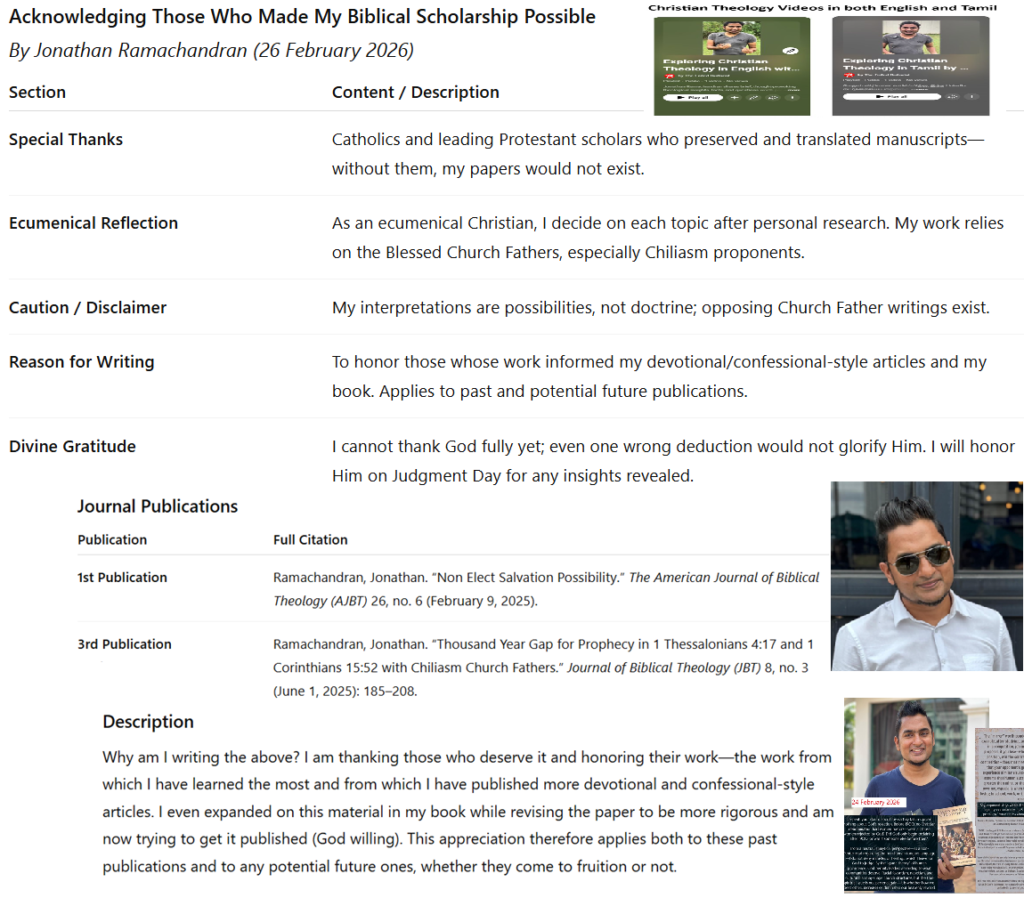
Acknowledging Those Who Made My Biblical Scholarship Possible
By Jonathan Ramachandran (26 February 2026)
Special thanks to Catholics and leading Protestant scholars who preserved and translated these manuscripts—without their work, none of my journal papers would have been possible.
Although I may not agree with all of their doctrinal points—as an ecumenical Christian, I decide on each topic for myself after personal research and reflection—without their work, my contributions would be “nothing.”
My work does not stand independently of the Blessed Church Fathers, whom the Lord has chosen from the very beginning of the Church (especially those who held Chiliasm), even before the Church was divided into various denominations.
Caution: This does not mean that my interpretation must be 100% correct, since opposing writings and interpretations of the Church Fathers exist; ultimately, we must let God decide.
Why am I writing the above? I am thanking those who deserve it and honoring their work—the work from which I have learned the most and from which I have published more devotional and confessional-style articles. I even expanded on this material in my book while revising the paper to be more rigorous and am now trying to get it published (God willing). This appreciation therefore applies both to these past publications and to any potential future ones, whether they come to fruition or not.
I repeat: I cannot thank God yet, because if even one part of my deductions is wrong, how could that bring glory to Him? Therefore, I prefer to leave the “thank you note” as it is and will honor God fully on Judgment Day for any parts—especially the “new insights,” if any—that He revealed to me. Hence, I present all of this as a “possibility and not doctrine,” to be safe.
Previous Journal Publications
i) 1st Publication
Ramachandran, Jonathan. “Non Elect Salvation Possibility.” The American Journal of Biblical Theology (AJBT) Vol 26, no. 6 (9 February 2025).
www.biblicaltheology.com/Research/RamachandranJ01.pdf
ii) 2nd Publication
Ramachandran, Jonathan. “Thousand Year Gap for Prophecy in 1 Thessalonians 4:17 and 1 Corinthians 15:52 with Chiliasm Church Fathers.” The American Journal of Biblical Theology (AJBT) Vol 26, no. 22 (1 June 2025).
www.biblicaltheology.com/Research/RamachandranJ02.pdf
iii) 3rd Publication (3-level peer review)
Ramachandran, Jonathan. “Thousand Year Gap for Prophecy in 1 Thessalonians 4:17 and 1 Corinthians 15:52 with Chiliasm Church Fathers.” Journal of Biblical Theology (JBT) Vol 8, no. 3 (1 June 2025): 185-208.
https://www.biblicaltheology.com/research.html
Purchase link:
https://www.amazon.com/Journal-Biblical-Theology-Number-September/dp/B0FG1GPNSY/
Biblical Principles
1️⃣ Render honor to whom honor is due
Romans 13:7 (NKJV):
“Render therefore to all their due: taxes to whom taxes are due, customs to whom customs, fear to whom fear, honor to whom honor.”
2️⃣ Consider others better than yourself
Philippians 2:3 (NKJV):
“Let nothing be done through selfish ambition or conceit, but in lowliness of mind let each esteem others better than himself.”
3️⃣ Meditate on what is true, noble, right, pure, lovely, admirable
Philippians 4:8 (NKJV):
“Finally, brethren, whatever things are true, whatever things are noble, whatever things are just, whatever things are pure, whatever things are lovely, whatever things are of good report, if there is any virtue and if there is anything praiseworthy—meditate on these things. “
P/S: Books
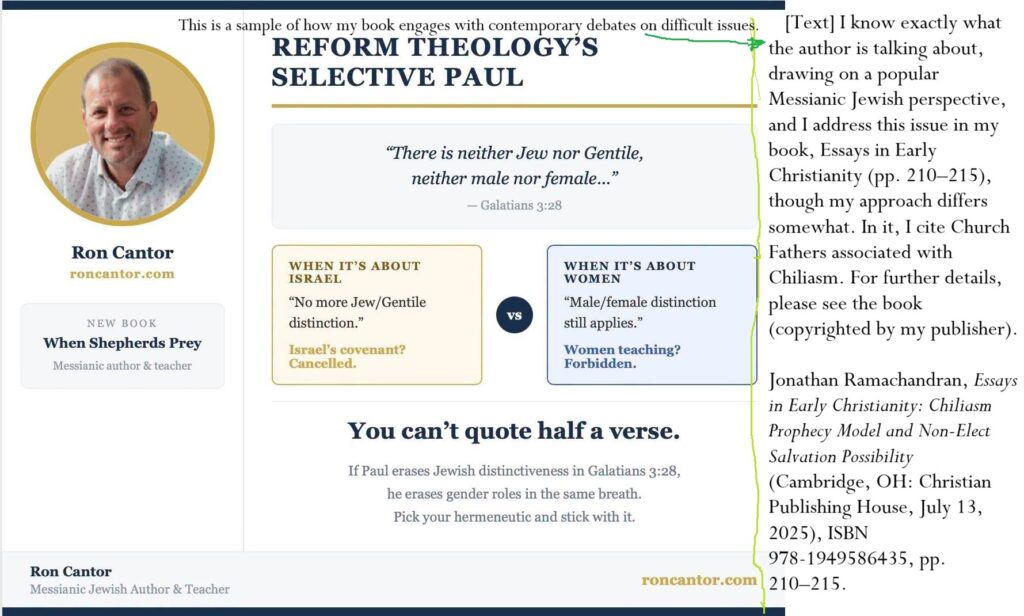
- Ramachandran, Jonathan. Essays in Early Christianity: Chiliasm Prophecy Model and Non-Elect Salvation Possibility. Cambridge, Ohio, USA: Christian Publishing House, 2025. https://www.amazon.com/dp/1949586421.
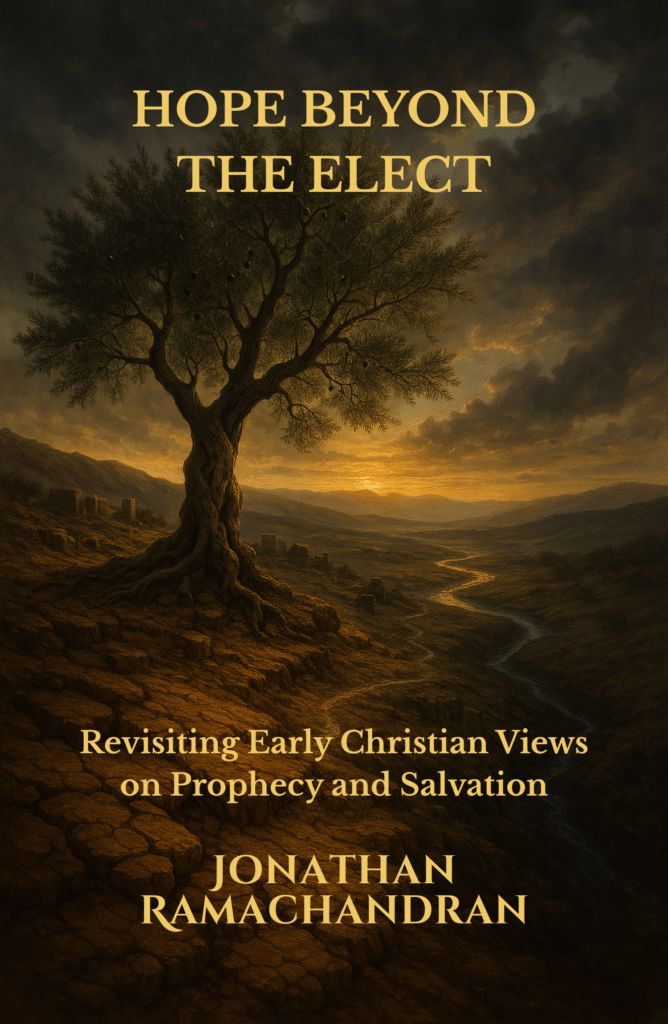
- Ramachandran, Jonathan. Hope Beyond the Elect: Revisiting Early Christian Views on Prophecy and Salvation. Cambridge, Ohio, USA: Christian Publishing House, 2025. https://www.amazon.com/dp/1949586405
Thank you!
Here’s a fast fact regarding the books:
The author (Jonathan Ramachandran) does not claim that there is necessarily salvation outside the elect, but rather explores it as a possibility rather than a doctrine, since it cannot be confirmed with certainty. He does so due to evidence in early Christian writings that sometimes point to the possibility of Non-Elect Salvation (NESP).
There are also other themes discussed throughout the book in detail, including Chiliasm—which may be overlooked in much of contemporary Christian scholarship due to the dominance of the allegorical view—apart from NESP. Some of these ideas are also presented across his blogs, such as a literal 1,000-year eschatology of the Millennial Reign, Antichrist prophecy, the Charity Doctrine in the context of sanctification, the renewal of the old earth and old heavens in the first resurrection (distinguished from the later final new heavens and new earth), patristic quotes that are often overlooked or rarely cited in these contexts, and more.
Explore to find out!
Source link: https://www.anonymouschristian.org/christian-books/
P/S 2: Magazine Publications
- Ramachandran, Jonathan. “The Personhood of the Holy Spirit and the Unity of the Trinity.” JOY! Magazine, April 2026, theology section, 28–30. Published by JOY! Magazine (Somerset West, Western Cape, South Africa). Accessed April 3, 2026. https://joygifts.co.za/product/https-joygifts-co-za-joy-april-2026/.
Work and Ministry Details (by God’s mercy, regardless of personal right or wrong):
Jonathan Ramachandran,
B.Sc., Th.D. (Hon.), D.Div. (Hon.), D.Min. (Hon.)
My CV (14 September 2025) Link:
https://drive.google.com/file/d/19YuhL31EpC4l3JnHcbbQNio-ueogAEXQ/view?usp=sharing
My Honorary Doctorates Defense Link (explanation in pdf file):
https://drive.google.com/file/d/1dLffkOnLe8BPz9vd3RMPbhZmn6puY7op/view?usp=sharing


Other Book details:
1) ESSAYS IN EARLY CHRISTIANITY: Chiliasm Prophecy Model and Non-Elect Salvation Possibility
i) Paperback
Print length : 432 pages
ISBN-10 : 1949586421
ISBN-13 : 978-1949586428
ii) Hardcover
Print length : 432 pages
ISBN-10 : 194958643X
ISBN-13 : 978-1949586435
2) HOPE BEYOND THE ELECT: Revisiting Early Christian Views on Prophecy and Salvation
i) Paperback
Print length : 182 pages
ISBN-10 : 1949586405
ISBN-13 : 978-1949586404
ii) Hardcover
Print length : 182 pages
ISBN-10 : 1949586413
ISBN-13 : 978-1949586411
P/S: What are the typical sales figures for academic books published by university presses, including leading ones?
- ChatGPT said this:
Realistic sales numbers (based on academic publishing data)
Using data from academic monograph studies and comparable presses:
🎓 Typical academic monograph sales (important baseline)
- Many academic books sell:
- 200–500 copies lifetime (common)
- 500–1000 copies (good)
- 1000+ copies (strong success)
👉 This is across academia.
Do lecturers “force” students to buy “their own” books?
✔️ Yes — but only in limited cases.
2. Is ChatGPT’s conclusion here supported by reliable empirical studies? Yes. Example evidence:
“Most commercial presses and university presses indicate sales of print copies (whether hardback or paperback) to be below 400 copies per title over the first 3 years, with the majority of commercial presses identifying ‘less than 200’ as the most usual level. Interestingly, the larger commercial presses give ‘less than 200 copies’ as their average volume sale, whereas the larger university presses give ‘200 to 400 copies’.”
Source: Philip Shaw, Angus Phillips, and Maria Bajo Gutiérrez, “The Death of the Monograph?” Publishing Research Quarterly 38, no. 2 (2022): 382–95, https://doi.org/10.1007/s12109-022-09885-2, https://pmc.ncbi.nlm.nih.gov/articles/PMC9071244/
Conclusion
People don’t mind spending money on an expensive meal—even more than the cost of an academic book (theological or otherwise)—but they hesitate to spend on books, especially from authors whose work teaches them something for the first time (something they might initially deny, but God will reveal). Some even pretend they “heard it from someone of their own race first,” which God may also reveal as false unless it’s true.
My point: Spend money on academic books, especially in Christian theology (full disclosure: I’m biased—I’ve spent five-digit sums on books in the past, only to have them ruined by termites, long story!). Do this especially to authors when you learn something new that no one else has emphasized to you, and it will be fair.


[Text] In the meantime (a Christian page posted this) … My view? I can remain neutral and allow God to judge. As a first line of accountability, a Christian making a supernatural claim should be willing to say, “If the supernatural claim I am making is false, may I be cast into hell.” Without the seriousness of judgment, people may feel less accountable for what they assert.
Even then, I am not obligated to accept their claims.

Last but not least, here are the LinkedIn articles I have written for further discussion and reference:
1) Faith and Charity or the Prosperity Gospel?—What Would Jesus Do (WWJD)?
https://www.linkedin.com/pulse/faith-charity-prosperity-gospelwhat-would-jesus-do-ramachandran-0boqc
2) Authority, Order, and Learning: Scripture, History, and the Transmission of the Bible
https://www.linkedin.com/pulse/authority-order-learning-scripture-history-bible-ramachandran-foi4c
3) Can one truly live by faith without practicing almsgiving, except in unavoidable circumstances, as with the thief on the cross?
https://www.linkedin.com/pulse/can-one-truly-live-faith-without-practicing-except-ramachandran-ynxvc
4) Why should this Christian theological journal paper be considered suitable for publication?
5) Can the Great Commission be fulfilled by those with imperfect English or even imperfect grammar in Hebrew or Greek?
6) Questions for the Spiritually or Psychologically Insightful
https://www.linkedin.com/pulse/questions-spiritually-psychologically-insightful-ramachandran-mjeoc
7) Is being a Christian in a non-Christian country associated with greater relative measure of faith and, consequently, greater eternal reward?
https://www.linkedin.com/pulse/being-christian-non-christian-country-associated-ramachandran-owrnc
8) Explore Free School Math Solutions by Jon — all learning resources and Facebook links are available on article here for easy access!
9) Explore Free Elementary School Math Olympiad Solutions by Jon — all learning resources and Facebook links are available on post here for easy access!
10) Free High School Math Olympiad by Jon: Problems 1–340, Solutions & Links
https://www.linkedin.com/pulse/free-high-school-math-olympiad-jon-problems-1340-ramachandran-tfiqc
11) Free High School Math Olympiad by Jon: Problems 341–545, Solutions & Links
https://www.linkedin.com/pulse/free-high-school-math-olympiad-jon-problems-341545-ramachandran-has7c
12) Common Fallacy: If You Are So Spiritually Wise, Why Are You Not a Millionaire or a Famous Pastor?
https://www.linkedin.com/pulse/common-fallacy-you-so-spiritually-wise-why-famous-ramachandran-ccgsc
13) What Cambridge, Harvard, and Oxford Haven’t Published: Prophetic or Mundane Interesting Coincidence in God’s Human Providential Will via Game Theory
14) Do you like any Pentecostal denomination or find common ground with them instead of opposing them only?
15) Azusa’s Paradox: Parham vs. Seymour, COGIC vs. AOG—Different Claims to the Holy Spirit or Contradicting Human Assumptions Using God’s Name?
16) Acknowledging Those Who Made My Biblical Scholarship Possible By Jonathan Ramachandran (26 February 2026)
17) Fruits of Non-Christianism, Secularism, and Pentecostalism: A Reflection on Faith, Truth, and Eternal Reward
https://www.linkedin.com/pulse/fruits-non-christianism-secularism-pentecostalism-ramachandran-i901c
18) Are you “High Class” or “Low Class”?
https://www.linkedin.com/pulse/you-high-class-low-jonathan-ramachandran-qf3cc
19) Who Dares to Nuke Israel? 3rd Temple Prophecy, Christian Chiliasm, and the Misunderstood Judgment of Zion
20) If I Die Tragically, Does That Prove My Theology Was Wrong? Would You Say the Same About Your Own Heroes?
21) Why Pentecostal Theology Grew Rapidly and Gained Support from Unbelieving Jews: Differences Between Christian Zionism and Jewish Zionism — Before Calling Me a False Prophet, Please Read This First
22) A Simple Solution to the World’s Most Complex Religious Problem: The What, Who, Where, How, and Why of the Third Jewish Temple Construction
23) FAQ: What Is the Point of Your Book or Journal Publication If Scholars from Cambridge, Harvard, or Oxford—and Even Most Reformed or Pentecostals (from Opposite Theological Extremes)—Would Never Believe It?
https://www.linkedin.com/pulse/what-point-your-book-journal-publication-scholars-ramachandran-rbbnc
24) My NESP Paper, WTJ, and the Dynamics of Positive Rejection: A ‘Game Theory’ Perspective
https://www.linkedin.com/pulse/my-nesp-paper-wtj-dynamics-positive-rejection-game-ramachandran-ea4xc
25) The Personhood of the Holy Spirit and the Unity of the Trinity
26) Why are you angry with the Christian God when the man or woman making your work life miserable isn’t even Christian?
https://www.linkedin.com/pulse/why-you-angry-christian-god-when-man-woman-making-ramachandran-d4thc
27) Are you (Jonathan Ramachandran) saved according to Catholic, Reformed, and Chiliasm doctrines?
https://www.linkedin.com/pulse/you-jonathan-ramachandran-saved-according-catholic-ramachandran-qiuzc
28) Thought: Toward a Revised Abstract of Non-Elect Salvation Possibility (NESP) Paper with Methodological Defense
Thank you!
#My ORCID Link: https://orcid.org/0009-0008-4669-1077
#GoogleScholar Link:
https://scholar.google.com/citations?hl=en&user=Bv7IFrAAAAAJ
#Academia Link:
https://independent.academia.edu/RamachandranJonathan
Note: Christian Publishing House (CPH) is publisher for the UASV Bible. About CPH: https://www.christianpublishers.org
A YouTube Video Explaining Jonathan’s Publications and Ministry

Video Details:-
i) YouTube link:
ii) Download this Video link
https://drive.google.com/file/d/1HwmtKk-fhxiaXIZ4oJxkkaRfwFzMLFpI/view?usp=sharing
iii) Download the Powerpoint in this Video link
Thank you!


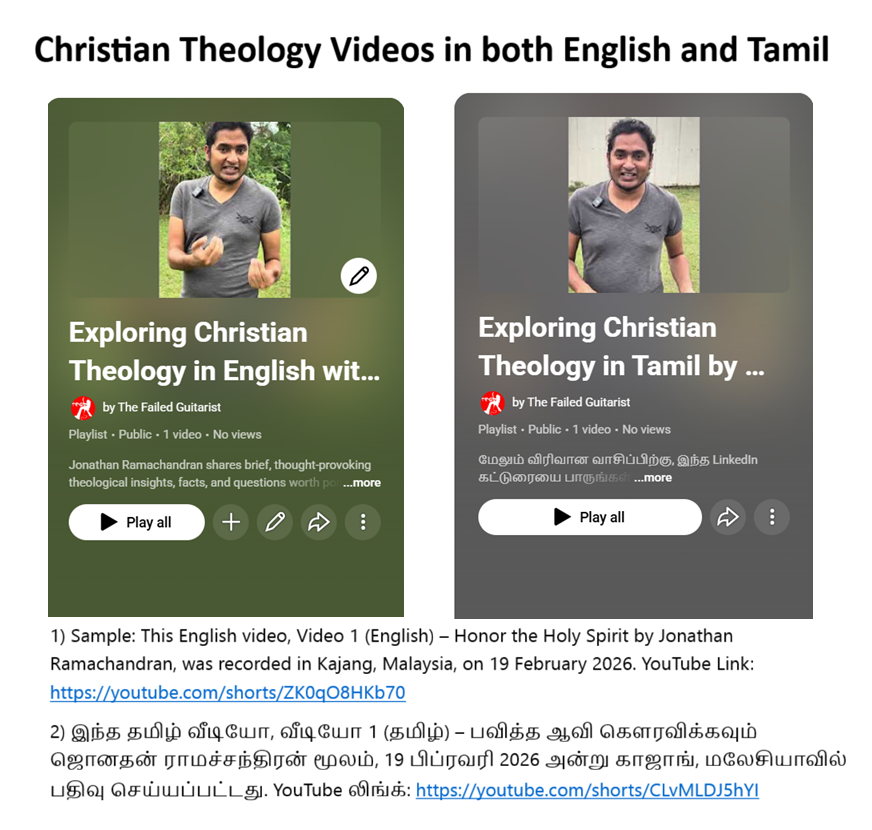
Christian Theology Videos in both English and Tamil
1) English
About (Exploring Christian Theology in English): Jonathan Ramachandran shares brief, thought-provoking theological insights, facts, and questions worth pondering—be sure to check them out!
1.1) YouTube Playlist (“Exploring Christian Theology in English with Jonathan”):
https://youtube.com/playlist?list=PLaeVcfrWAwrwuLQNK-lE01x4Y6hjj2k5P&si=62aQNcsUQ1zg_JSn
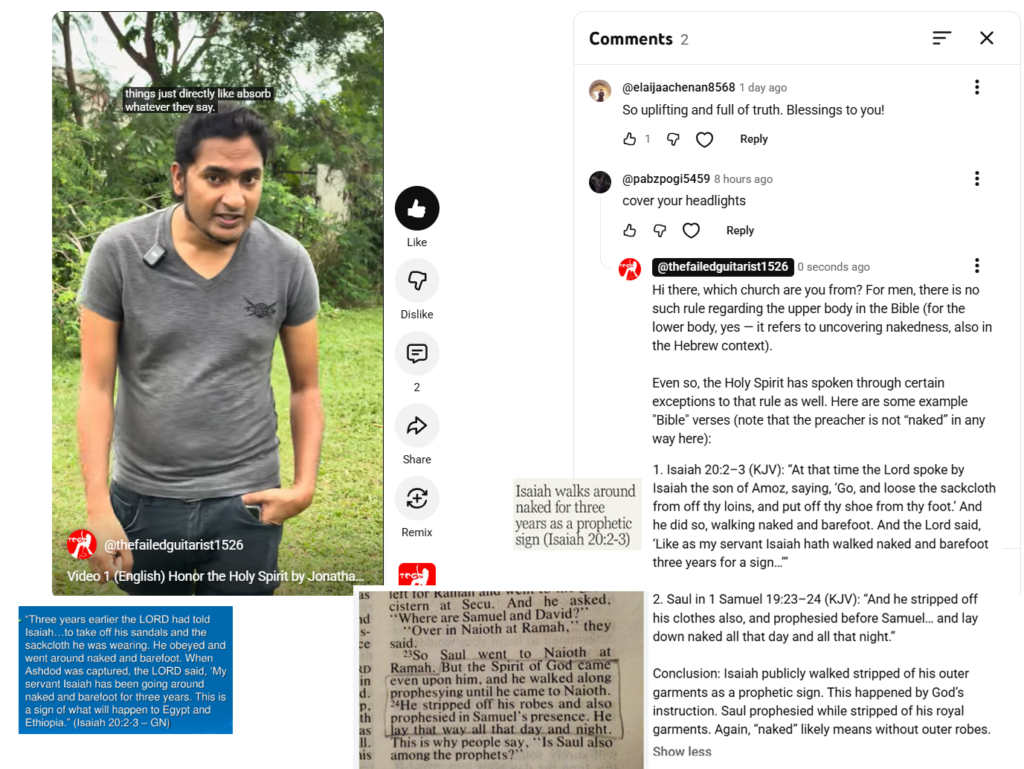
1.2) Sample: This English video, Video 1 (English) – Honor the Holy Spirit by Jonathan Ramachandran, was recorded in Kajang, Malaysia, on 19 February 2026. YouTube Link:
2) Tamil
(தமிழில் கிறிஸ்தவ தத்துவம் ஆராய்தல்) பற்றி:
ஜொனதன் ராமச்சந்திரன் சிறிய, சிந்தனையை தூண்டும் தத்துவக் கருத்துகள், உண்மைகள் மற்றும் கவனிக்கத் தகுந்த கேள்விகளை பகிர்கிறார்—கண்டிப்பாக பாருங்கள்!
2.1) YouTube Playlist (“Exploring Christian Theology in Tamil with Jonathan”):
https://youtube.com/playlist?list=PLaeVcfrWAwrxr6fKBzASbAx_eOzG8oFmz&si=bMpm6xSazDM3cPYK
2.1) YouTube பிளேலிஸ்ட் (“ஜொனதன் உடன் தமிழில் கிறிஸ்தவ தத்துவம் ஆராய்தல்”):
2.2) This Tamil video, Video 1 (Tamil) – Honor the Holy Spirit by Jonathan Ramachandran, was recorded in Kajang, Malaysia, on 19 February 2026. YouTube Link:
https://youtube.com/shorts/CLvMLDJ5hYI
2.2) இந்த தமிழ் வீடியோ, வீடியோ 1 (தமிழ்) – பவித்த ஆவி கௌரவிக்கவும் ஜொனதன் ராமச்சந்திரன் மூலம், 19 பிப்ரவரி 2026 அன்று காஜாங், மலேசியாவில் பதிவு செய்யப்பட்டது. YouTube லிங்க்:
https://youtube.com/shorts/CLvMLDJ5hYI
Disclaimer: I cannot read Tamil (sorry) and so, I used ChatGPT to translate the above.

**Abstract
This paper studies an entirely new concept which is non elect salvation. I invented the academic term “Non Elect Salvation” to denote this possibility. The idea is that there is a salvation outside of the Christian Salvation (which is the well known Elect Salvation) and it differs in the time which it occurs (second resurrection), the final abode (final new earth), the judgment it endures (saved by fire, purified, sanctified) and even the type of bodily resurrection (terrestrial) which entails it. The recipients of this salvation could include both fallen Christians as well as non-Christians. A structure of proof is presented based on the fundamental notion of “no prophecy is of any private interpretation” (2 Peter 1:20) where the Chiliasm Church Fathers St. Justin of Rome (Justin Martyr) and St. Irenaeus of Lyons are primarily consulted followed by Tertullian, St. Methodius of Olympus and St. Victorinus of Pettau too. Where there is difference in their writings, I prefer to stick to St. Justin and St. Irenaeus for accuracy because they are earlier and boast of a closer relationship to the lineage of the Blessed apostles themselves. A key point to note is the challenge to the popular modern view that 1 Corinthians 15:50 – 52 refers to rapture but these Chiliasm fathers seem to point to 1000 years in human body first before a change into no more flesh and blood (or angelic) at the end of the Millennial Reign and other aspects are presented to match it.
We know that Apostles and Prophets have zero prophecy error according to say Deuteronomy 18:20 – 22 and that Jeremiah 23:36 allows prophecy error if one claimed it’s one’s own attempt (example in an academic PHD) but if one claims Prophecy from the LORD directly, an error merits some type of eternal condemnation/judgment as contrasted in Jeremiah 23:37 – 40.
Here are links for free pdf download for some of these booklets:
Moravians to John Wesley Methodist Some Historical Highlights. Link for free PDF:
https://drive.google.com/file/d/1M8OoA98wDrcBMsJMaLeAj-S-3fGMqKkk/view?usp=drive_link
Christian Missiology – Why Japan was Evangelized so late and so Little – didn’t God Love Japan – Proof of Human Freewill. Link for free PDF:
https://drive.google.com/file/d/1sm9WRFFh-KmonWj8kdCRikORSqCOyhTO/view?usp=sharing
Christian Asceticism and Charity Doctrine Link. Link for free PDF:
https://drive.google.com/file/d/1vW9eWK65-uqFDXbOAGjd-1RMpewdMu4-/view?usp=sharing
Presidents of the USA – Which type of Christian. Link for free PDF:
https://drive.google.com/file/d/1at0aQKfg-_5aXrWQ8qEMyj6zVSoH9zAE/view?usp=sharing
Christian Doctrine – Celibacy vs Marriage to Tithes vs Charity Doctrine and 5 Wise Virgins – A Survey. Link for free PDF:
https://drive.google.com/file/d/1hkvWCIWdpXQEfpLjuuDF1XgfJVx6Sk0f/view?usp=sharing
Possibility not Doctrine – Does Christ Words in Matthew 19 point to Elect vs Non Elect Salvation. Link for free PDF:
https://drive.google.com/file/d/1nLRJBXSU8iWlTMrIP6LzmHsk1F5CM_Vf/view?usp=sharing
Keep Sabbath or not for Gentile believers to Non Elect Salvation Possibility Comments by Jonathan. Link for free PDF:
https://drive.google.com/file/d/1Ok-fiaxPWosbrqz4s5acEbvd6jm0dnDT/view?usp=sharing
Jewish Believers are not same as Gentile Believers in NT Laws and neither is Male vs Female by Jonathan. Link for free PDF:
https://drive.google.com/file/d/1ibDfGXxugAB10t6cL9w7B7DpBqeiSHRV/view?usp=sharing
My Secular Songs and Christian Songs I have worked with by God’s Grace is listed in this link:
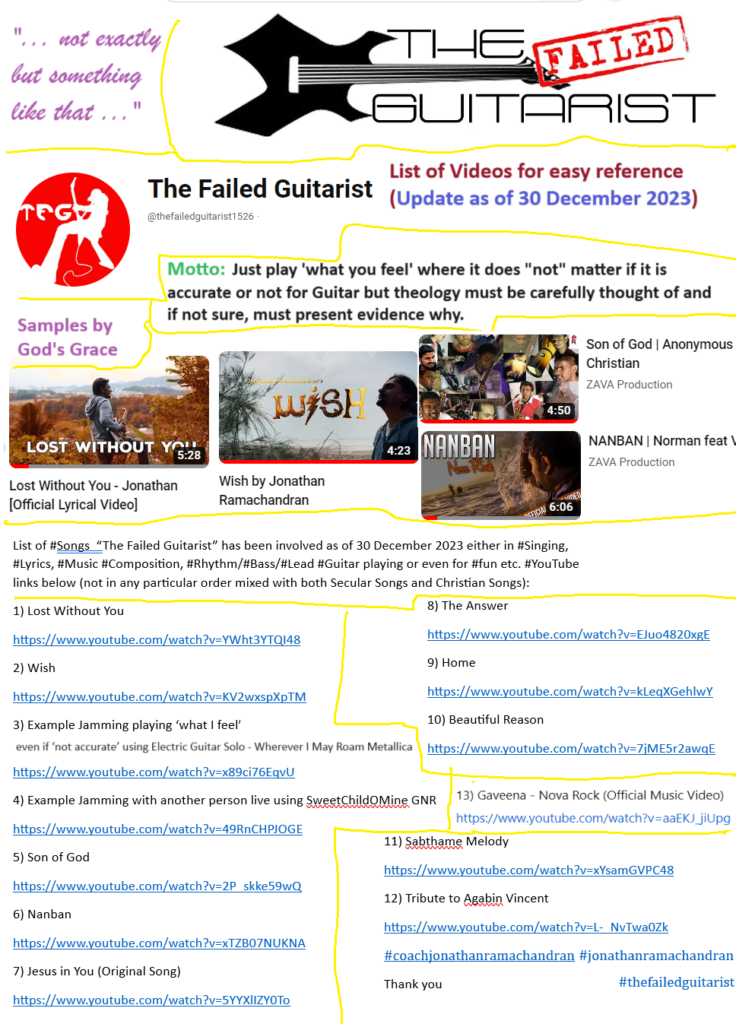
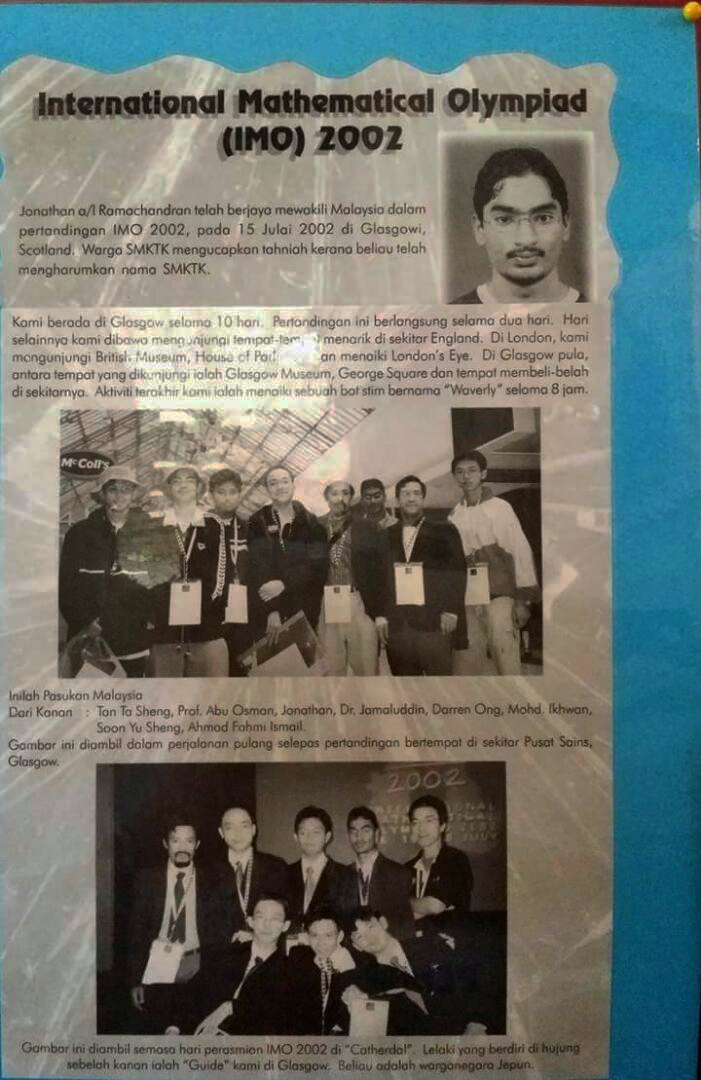
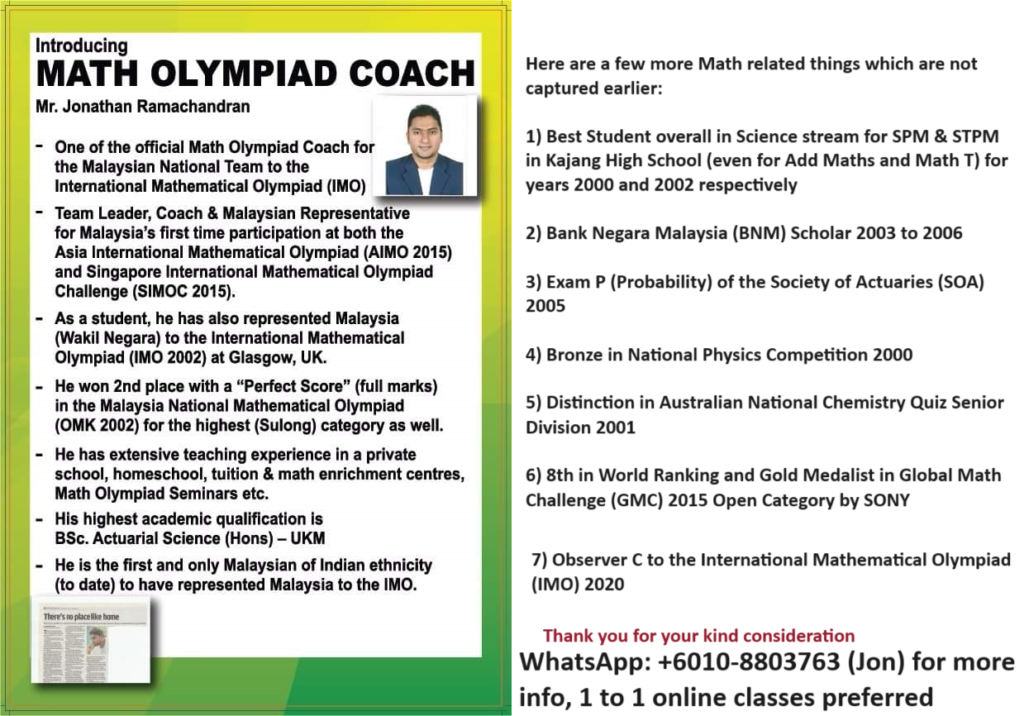



Advertisement.
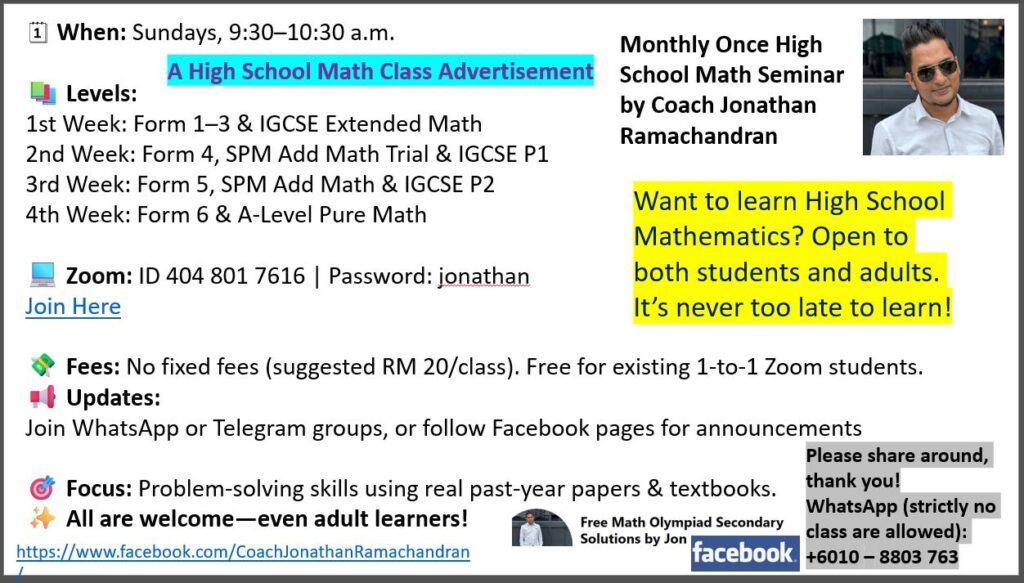
Want to Learn High School Mathematics? Open to both students and adults. It’s never too late to learn!
A High School Math Class Advertisement: Monthly Once High School Math Seminar by Coach Jonathan Ramachandran
Full info pack (pdf) link:
https://drive.google.com/file/d/1B94xrDLiyMgYtkZJw1Ivkv8_vDftKAr5/view?usp=sharing
🗓 When: Sundays, 9:30–10:30 a.m.
📚 Levels:
- 1st Week: Form 1–3 & IGCSE Extended Math
- 2nd Week: Form 4, SPM Add Math Trial & IGCSE P1
- 3rd Week: Form 5, SPM Add Math & IGCSE P2
- 4th Week: Form 6 & A-Level Pure Math
💻 Zoom: ID 404 801 7616 | Password: jonathan
💸 Fees: No fixed fees (suggested RM 20/class). Free for my existing 1-to-1 Zoom students.
🎯 Focus: Problem-solving skills using real past-year papers & textbooks.
✨ All are welcome—even adult learners! (class language: English)
About Coach Jonathan Ramachandran:
IMO coach for Malaysia, educator, and published theologian.
Graduate in Actuarial Science, Bank Negara scholar, experienced in private Math tutoring.
Holder of honorary doctorates in Theology, Divinity, and Ministry.
📢 Updates:
i) Facebook
– Personal: https://www.facebook.com/jonathan.ramachandran/
– Free High School Math Olympiad Page: https://www.facebook.com/CoachJonathanRamachandran/
– Free Elementary School Math Olympiad Page:
https://www.facebook.com/profile.php?id=100057109853813
– Free School Math Olympiad Page: https://www.facebook.com/profile.php?id=100070978834712
ii) WhatsApp group invite link (Group: Math Class Once a Month by JR):
https://chat.whatsapp.com/JSYUhcrxelpLoiuQ8dYAMZ
iii) Telegram group invite link (Group: Math Class Once a Month by JR): https://t.me/+-nlwUBCZSqgyMzJl
Special rule: Please DO NOT phone call me at any time. Any enquiries must be made publicly in these groups. I will not entertain any private WhatsApp messages, except for 1-to-1 class sign-up enquiries, which have separate details. Anyone who ignores this will be permanently blocked.
Please share around, thank you!
Jonathan
WhatsApp (strictly no class are allowed): +6010 – 8803 763
#CoachJonathanRamachandran #Math #MathOlympiad #SPM #STPM #ALevels #SchoolMath #PT3 #HighSchool #Mathematics #Adult and #Students #All are #Welcome.
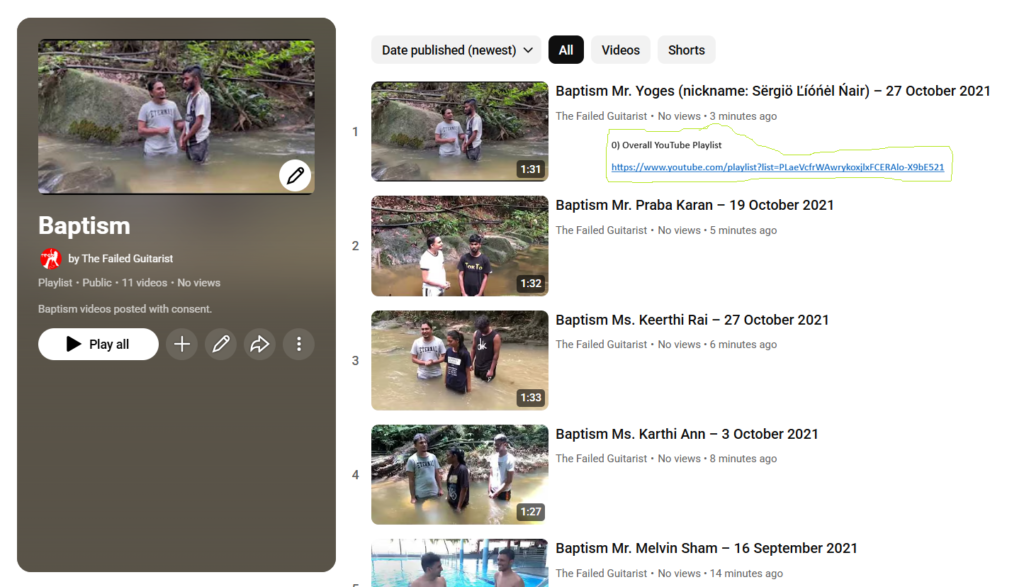
List of Baptism Videos (YouTube links):
0) Overall YouTube Playlist
1) Baptism Mr. Raja Singham – 23 February 2020
2) Baptism Mr. Vickram – 23 February 2020
3) Baptism Mr. Adrian Dinesh Raj – 25 February 2020
4) Baptism Mr. Yehohanan Yuhisern – 11 June 2020
5) Baptism Ms. Anna – 10 October 2020
6) Baptism Mr. Ganesan (Sean) – 21 April 2021
7) Baptism Mr. Melvin Sham – 16 September 2021
8) Baptism Mr. Uren Raj – 1 October 2021
9) Baptism Ms. Karthi Ann – 3 October 2021
10) Baptism Mr. Praba Karan – 19 October 2021
11) Baptism Ms. Keerthi Rai – 27 October 2021
12) Baptism Mr. Yoges (nickname: Sërgiö Ľíóńėl Ńair) – 27 October 2021
Praise God!
Theological Points to consider:
“35Then Philip opened his mouth, and beginning at this Scripture, preached Jesus to him. 36Now as they went down the road, they came to some water. And the eunuch said, “See, here is water. What hinders me from being baptized?” 37Then Philip said, “If you believe with all your heart, you may.” And he answered and said, “I believe that Jesus Christ is the Son of God.”38So he commanded the chariot to stand still. And both Philip and the eunuch went down into the water, and he baptized him.” (Acts 8:35 – 38, NKJV)
“In the seventh century the Fourth Council of Toledo (633) approved the use of a single ablution in baptism, as a protest against the false trinitarian theories of the Arians, who seem to have given to the threefold immersion a significance which made it imply three natures in the Holy Trinity.” [William Fanning, “Baptism: Matter and Form of the Sacrament,” in The Catholic Encyclopedia, vol. 2 (New York: Robert Appleton Company, 1907), transcribed for New Advent by Charles Sweeney, S.J., ecclesiastical approbation: Nihil Obstat 1907, Remy Lafort, S.T.D., Censor; Imprimatur +John M. Farley, Archbishop of New York, http://www.newadvent.org/cathen/02258b.htm]
St. Augustine of Hippo (c. 400 AD) affirms that both customs are valid, emphasizing the unity of baptism quoting Cyprian by stating that “all baptisms” types held by the Church (not heretics) at that time were valid which certainly includes “single immersions” too as we see from other quotes here:
“And so also in the epistle which he wrote to Magnus, when he was asked whether there was any difference in the efficacy of baptism by sprinkling or by immersion, “In this matter,” he says, “I am too modest and diffident to prevent any one … subject of the identity of all baptisms what must be acknowledged everywhere to be the custom of the universal Church, …” [Augustine of Hippo, On Baptism, Against the Donatists (Book VI), chap. 7, translated by J.R. King and revised by Chester D. Hartranft, in Nicene and Post-Nicene Fathers, First Series, vol. 4, ed. Philip Schaff (Buffalo, NY: Christian Literature Publishing Co., 1887), revised and edited for New Advent by Kevin Knight, http://www.newadvent.org/fathers/14086.htm]
Pope Gregory the Great I (c.590-604 AD) confirms that “single immersion baptism” is valid always.
“Or, if any one should perhaps think that this is done out of veneration for the supreme Trinity, neither so is there any objection to immersing the person to be baptized in the water once, …;” [Gregory the Great, Book I, Letter 43, to Leander, Bishop of Hispalis (Seville), translated by James Barmby, in Nicene and Post-Nicene Fathers, Second Series, vol. 12, ed. Philip Schaff and Henry Wace (Buffalo, NY: Christian Literature Publishing Co., 1895), revised and edited for New Advent by Kevin Knight, http://www.newadvent.org/fathers/360201043.htm]
A new believer may be baptized by other believers as God leads. However, I am also aware that baptism is not my primary ministry, which is the sharing of the Blessed Scriptures of the Bible. As even the blessed Apostle St. Paul himself baptized very few people, he wrote:
“Now I say this, that each of you says, ‘I am of Paul,’ or ‘I am of Apollos,’ or ‘I am of Cephas,’ or ‘I am of Christ.’ Is Christ divided? Was Paul crucified for you? Or were you baptized in the name of Paul? I thank God that I baptized none of you except Crispus and Gaius, lest anyone should say that I had baptized in my own name. Yes, I also baptized the household of Stephanas. Besides, I do not know whether I baptized any other. For Christ did not send me to baptize, but to preach the gospel, not with wisdom of words, lest the cross of Christ should be made of no effect.” — The Blessed and Great St. Paul the Apostle of Christ (1 Corinthians 1:12–17, NKJV)
Please feel free to contact us if you wish to be baptized by us (confidentiality assured). No money or tithes are charged. Alternatively, you may kindly contact the nearest church to you for baptism.
List of Baptism Videos (YouTube links):
0) Overall YouTube Playlist
https://www.youtube.com/playlist?list=PLaeVcfrWAwrykoxjlxFCERAlo-X9bE521
1) Baptism Mr. Raja Singham – 23 February 2020
2) Baptism Mr. Vickram – 23 February 2020
3) Baptism Mr. Adrian Dinesh Raj – 25 February 2020
4) Baptism Mr. Yehohanan Yuhisern – 11 June 2020
https://youtube.com/shorts/ZNZGgyRvQXQ?feature=share
5) Baptism Ms. Anna – 10 October 2020
6) Baptism Mr. Ganesan (Sean) – 21 April 2021
7) Baptism Mr. Melvin Sham – 16 September 2021
8) Baptism Mr. Uren Raj – 1 October 2021
9) Baptism Ms. Karthi Ann – 3 October 2021
10) Baptism Mr. Praba Karan – 19 October 2021
11) Baptism Ms. Keerthi Rai – 27 October 2021
12) Baptism Mr. Yoges (nickname: Sërgiö Ľíóńėl Ńair) – 27 October 2021
Praise God!
Fast fact: In general, I liked my teachers in school, and they liked me too since I did okay academically and didn’t give them any headaches.
I just found this old email from my former high school teacher from those days. Nostalgic.
I just want to point out that for all subjects other than Math, I learned them by attending school. For Math, I learned it before school itself from my father. As for Math Olympiad, it was 100% self-study through a few books that my dad purchased (which was actually quite late — I was about 16 or 17 the first time I saw a Math Olympiad question in my life!).
I also did not attend any tuition or systematic classes for it, and the internet was rare back then. A mathematician by the name of Dr. Jim Wilson was the only one who replied to my random email asking for a solution in those days!
“in everything give thanks; for this is the will of God in Christ Jesus for you.” (1 Thessalonians 5:18, NKJV)
“Wealth makes many friends, But the poor is separated from his friend.” (Proverbs 19:4, NKJV)
Email content [text]:
From: lee li cheng [[email protected]]
To: me · Sun, Jun 14, 2009 at 11:34 PM
“hi jonathan , you were probably surprised i smsed u. Well the last time i met u was in kajang AOG after the service. That time i brought my eldest son Irving to meet u and also to enquire bout actuarial sc. After that he left for USA to do actuarial sc in the university of Wisconsin, Madison. He has since graduated – that was end of last year and currently working in Public Bank.
How are u?? I heard a little about u from Miss Heng that u are working in an offshore co. How do u like your work and what is your job specification? Anything to do with actuarial science? Do u like what u’re doing?
Irving doesn’t quite like what he’s doing as it involves selling. Too bad he graduated during the midst of a recession. Malaysian economic scenario is pretty bad . A lot of retailers are winding up. Even CIMB is downsizing 100plus branches nationwide. I told my son to work on first . No time to be choosy. Insurance companies are not expanding in malaysia, so no new recruitment. In US a few even went bust. AIG for instance. So Jonathan can u help find out whether there’s any job opportunity in your company or other companies that u may know of. Appreciate it very much.
A little update on Kajang High School. Well En Nik Mat is now the new HM. i’m sure u know him. Most of your teachers are still around. Who was your Chemistry teacher? Pang, Chew or Chang. Pang has retired, Chang was diagnosed with cancer and is on a 1 year MC, so only Chew is still around. The students we have nowadays aren’t so bright and has to be spoon fed. It’s hard to get a brilliant math student. so we miss people of your calibre.
Do keep in touch.”

Regardless of Hillsong’s theology, which I disagree with a lot (prosperity gospel, feminism, etc.), I still like some of their songs, such as this one:
https://www.youtube.com/watch?v=nQWFzMvCfLE
Shalom.


I like the Pro-Chancellor, Mr. Ebenezer, and his distinguished team because they are not only nice and welcoming to me, but also to other Christians—even at this ecumenical worship event—which is very cool of them (Romans 13:7: “Give to everyone what you owe them… if honor, then honor.”).
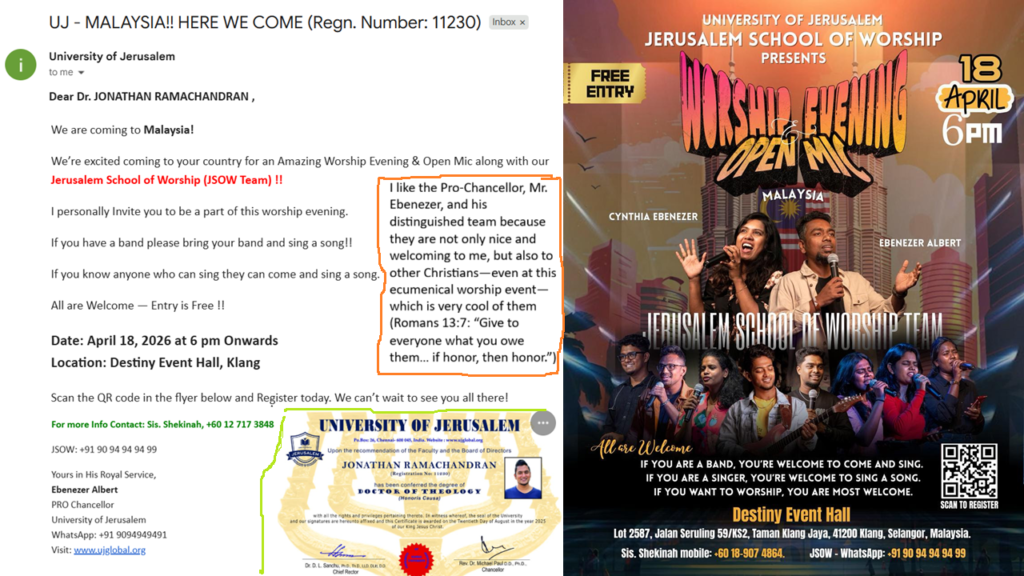
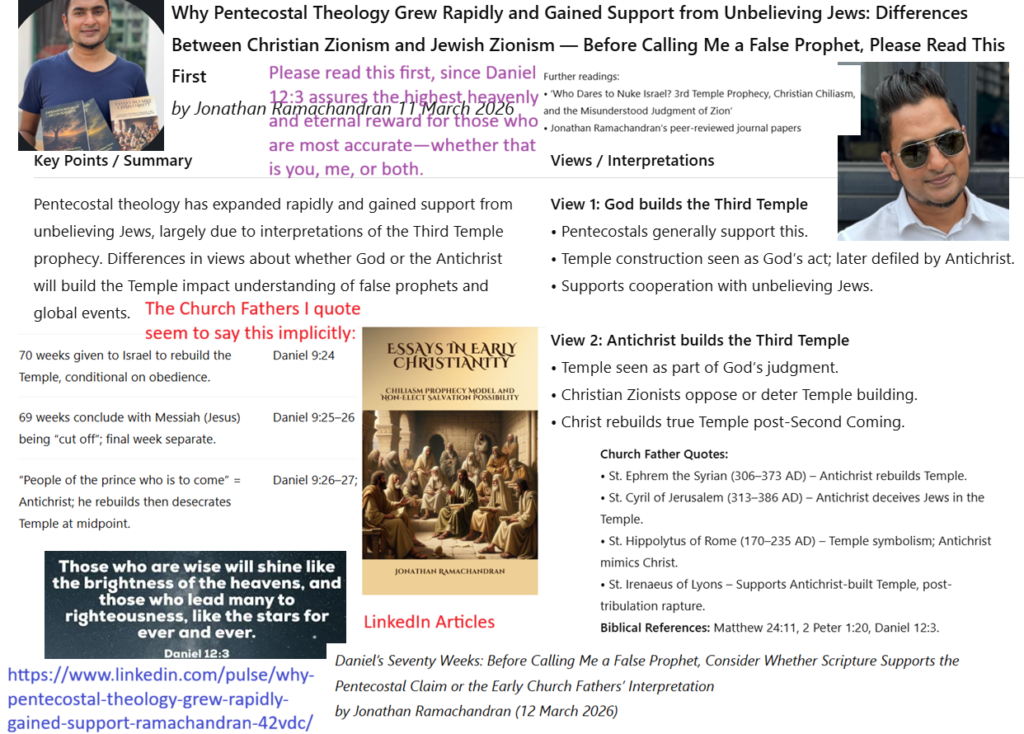
[Text] I thought that I was submitting a more magazine-friendly version of my article, since I am too lazy to write a formal journal-paper type. The difference is only in the format and not the content, where additional content for the comparative study of perspectives would need to be included in journals. I have already chosen all the key Christian traditions and don’t like the draggy part, and I aim more at sharing my interpretive contributions, if any. Anyway, I’m just trying, and regardless, I am content whether it is eventually accepted somewhere or not.
Jon Dykstra [email protected] wrote:
“Hi Jonathan,
Thanks for your submission. This is, in size, far beyond anything we publish, and in a more… academic format than we publish as well. So we can’t use it… though I enjoyed reading it myself.
Jon Dykstra
Editor
Reformed Perspective
“Celebrating God’s Truth””
Info from ChatGPT: The email [email protected] belongs to Reformed Perspective, a legitimate Canadian magazine focused on Reformed (Calvinist) Christian theology, culture, and commentary. Founded in 1982, it publishes a bi-monthly print magazine and regular online articles aimed mainly at Reformed Christian communities. Its print circulation is roughly 10,000–13,000 households, with additional reach through its website and social media, giving it a moderate niche readership rather than a large mainstream audience. Overall, it is a respectable but specialized publication known primarily within Reformed church circles.

[Text] A Thought to Ponder: A Christian page posted this. This is not only a “Jewish” problem, since even within Christianity’s denominations and other belief systems, each “monetarily successful” person often assumes that he already has a “personal experience” with “God” and therefore never considers that he might be wrong on any doctrinal point. Only God knows, topic by topic, who is more accurate—even among the saved. Thus, Daniel 12:3 prophesies a higher heavenly glory for those who are more accurate, beyond the lesser glory of the stars given to those who turn many to righteousness, since their doctrinal accuracy is lower (implied).


The “academic match” in my book, which seems to correspond to the “Near Death Experience (NDE) image claimed by this Facebook page,” is a Spirit World vision described by the famous Sadhu Sundar Singh (a modern, non-Pentecostal Indian Christian who claimed to have supernaturally encountered Christ, among other experiences) on pages 46–48 (including footnotes 140–147).
Link:
Jonathan Ramachandran, Essays in Early Christianity: Chiliasm Prophecy Model and Non-Elect Salvation Possibility (Cambridge, OH: Christian Publishing House, July 13, 2025), 235, ISBN 13 978 1949586428, ISBN 10 1949586421, https://www.amazon.com/dp/1949586421
Sundar Singh’s testimony seems credible, especially considering that he was once wealthy and initially hated Christianity, yet he soon converted and lived penniless—by faith, “literally”—without accepting any salary or “love gifts,” except what was necessary for immediate needs as he travelled. He preached the Gospel throughout his life, rejected marriage offers from wealthy European women, and declined opportunities to settle in Europe as a preacher, before his mysterious disappearance in the Himalayas around 1929.
Yes, my Non-Elect Salvation Possibility (NESP) model matches his description perfectly—strangely, especially when compared to the ancient Shepherd of Hermas writings, all of which are discussed in my book. I could be wrong, and all of this could be “false,” but I am treating it academically and as a “possibility” only, based on such evidence and claims.


[Text] Clever observation. This is a complex issue. Even Jews who reject the Deuterocanonical books as Scripture still recognize the events described in them as historical occurrences, including the period between the prophet Malachi and Christ.
In John 10, Christ is present in the temple during the ‘Feast of Dedication’ (Hanukkah), which originates from the same historical events described in the Books of the Maccabees. These books contain ideas related to post-mortem purification, sometimes compared to the concept of Purgatory.
While Lord Jesus neither explicitly affirmed nor denied such a concept, the fact that the Apostle John mentions the feast may suggest a more neutral or even positive acknowledgment of the historical and religious context.
I discuss this in my book. Details (around Page 235):
Jonathan Ramachandran, Essays in Early Christianity: Chiliasm Prophecy Model and Non‑Elect Salvation Possibility (Cambridge, OH: Christian Publishing House, July 13, 2025), 235, ISBN‑13 978‑1949586428, ISBN‑10 1949586421, https://www.amazon.com/dp/1949586421
Sample article mentioning “Purgatory”:
https://www.linkedin.com/pulse/what-point-your-book-journal-publication-scholars-ramachandran-rbbnc
Clarification: Is the author trying to increase book sales—and therefore make more money—by making all of this up?
What could be (not necessarily) the most common “prophecy” for the days just before and after public holidays? You guessed it—the “MC Prophecy” (i.e., Medical Certificate leave).
Have you ever seen someone who takes no holidays or only a minimum number of holidays, even when they have both the money and the time? If that person is a Christian who freely follows Gospel commands—such as preaching or doing Biblical work, including acts of charity without pay—that may be why their reward in heaven is very great, as the Most Blessed Lord Jesus Christ taught in Matthew 19:21–24 to the rich man, calling him to follow Him.
In this context, Christ, in His perfection, was continually doing God’s work without salary, rather than taking holidays or collecting money for Himself; instead, resources were used for needs and for helping the poor, as recorded in the Gospel.
May God help us to believe wisely in this, lest we lose eternal rewards—even if we are saved. The rest of men are just playing “game theory” with one another when they disobey this, making each other’s lives difficult and thereby proving the falseness of the “god” they serve.


[Text] Prof. Bart (a renown Bible-scholar, but agnostic?) wrote:
“My argument in this book is that the impulse to help strangers in need is embedded in our western moral conscience because of the teachings of Jesus.” – Bart Ehrman
My comments:
This is 100% correct, since without Christ, no one has a perfectly pure morality to help strangers with complete genuineness and love in principle.
Simple proof: Can you provide a citation from your religion (or from a philosophical teacher before Lord Jesus) that teaches both “love your enemy” and the idea of letting others benefit from you (in work or daily life, even financially), instead of “cleverly” using others? Please include the specific verse or source. Proof verse:
“44But I say to you, love your enemies, bless those who curse you, do good to those who hate you, and pray for those who spitefully use you and persecute you,… 46For if you love those who love you, what reward have you? ” (Matthew 5:44, 46 NKJV)
Actually fulfilling this verse is another thing (“hardest”) but “heavenly reward” greatest too inclusive.
Loving fellow believers comes first, as Christ especially loved His followers. Loving those who love you is good; however, without also loving your enemies, the reward is lesser. As Christ taught, we are called not only to love fellow believers, but also to love our enemies; otherwise, the fullness of the heavenly reward is not realized.
That is why true Christians do not mind being taken advantage of financially, being underpaid, discriminated against, or being used in their jobs or daily lives—financially, even outside the family—since they are aiming for an “eternal” reward.
Therefore, I encourage you to be a Christian, because if you suffer without Christ, you will not receive these rewards. I also think that most non-Christians would not be willing to endure such things willingly, unless they have no choice, since their philosophies generally do not promise a reward for this kind of suffering.
Most people cannot even love those outside their family, race, or religion, and they cannot forgive those who wrong them—whether in work or daily life—often cutting off relationships. This does not fulfill Christ’s divine command (can you see it? May God help us).

My NESP Paper, WTJ, and the Dynamics of Positive Rejection: A ‘Game Theory’ Perspective
Cases of ‘Positive Rejections’ from Reputable Journals
Regarding examples of a “positive rejection” from respectable journals: I may not fully agree with the emphasis on “rigor in historical methodology,” as explained in this article, but I sincerely appreciate the editors taking the time to provide their thoughtful feedback on my paper(s):
https://www.linkedin.com/pulse/what-point-your-book-journal-publication-scholars-ramachandran-rbbnc
1) Journal of Early Christian History (RECH)
[email protected] wrote (partly):
“The article is clearly the fruit of considerable effort, broad reading, and a genuine desire to take early Christian millenarianism seriously as a historical and theological phenomenon. The author should be commended for working carefully through a wide range of patristic material, for engaging both lexical/grammatical resources and modern secondary literature, and for attempting to set out a coherent proposal rather than merely rehearsing existing debates. The tone remains irenic throughout, and the desire to do justice to neglected “Chiliasm Church Fathers” is understandable and, in itself, worthwhile. Nonetheless, in its present form the manuscript does not, in my view, meet the standards of historical and methodological rigor expected in a journal devoted to early Christian history, and I therefore cannot recommend it for publication.”
From [ChatGPT]: Journal of Early Christian History is a peer‑reviewed academic journal co‑published by Taylor & Francis (under Routledge) with links to the South African context and broadly focused on early Christian and Byzantine studies, New Testament studies, patristics, and related disciplines, appealing to both regional and international scholars. It is listed in the Emerging Sources Citation Index of the Web of Science Core Collection and carries bibliometric metrics such as an h‑index and SJR based on Scopus‑related data, with typical ranking in humanities/ religion fields (Q4–ESCI level), and has ISSN coverage reflecting its formal publication status.
2) International Bogoslovska smotra
International Bogoslovska smotra [email protected] wrote:
“Dear Mr Ramachandran,
Thank you for your interest in publishing in our journal. You are undoubtedly a prolific and serious author, but unfortunately, we cannot accept your articles for the peer review process.
Kind regards,
Danijel Tolvajčić, executive editor”
I think it may not fit their scope, rules, or current publishing needs. I do not ask further if they do not explain, as I respect their privacy and appreciate the compliment, which the distinguished editor did not need to give, as he could have simply said, “we cannot accept it for peer review,” as others have likely done before for similar reasons.
From [ChatGPT]: Bogoslovska Smotra – Ephemerides Theologicae Zagrabienses, published by the University of Zagreb Faculty of Catholic Theology, is a long-running, peer-reviewed theological journal with strong roots in Catholic scholarship and European academic tradition. Its strengths include systematic theology, biblical studies, patristics, and church history, with contributions from established scholars and a solid reputation within Central and Eastern European theological circles. It is indexed in Scopus, ERIH PLUS, and the ATLA Religion Database, reflecting good academic visibility and credibility in theology and religious studies.
Conclusion: Receiving positive feedback from top scholars is always uplifting, even if the paper is rejected. As explained in my earlier article, I am satisfied with the outcome either way, as I understand the fixed rules and methods they expect, particularly the need to remain “neutral and academic.”
More on the defense of my NESP paper is provided in my next response. If it is eventually republished, I will provide the source and make it available online so you can read it and judge for yourselves, while also showing both views here.
My Response to the World’s Leading Journal for Reformed Theology: Westminster Theological Journal (WTJ), Which Took Over Five Months to Consider My NESP Paper
Fast fact: Papers promoting women pastors over men, LGBTQ perspectives, or Universalism—even if published by Cambridge, Oxford, or Harvard—would not be published here either, since this is not a general academic journal but a strongly confessional one. To be fair, many WTJ articles likewise would never be published at Cambridge, Oxford, or Harvard, as they are too pro-Calvinist and confessional in nature (can you see the point?).
Also, Pentecostal or Charismatic perspectives—especially claims involving speaking in non-human languages—are immediately rejected as non-scholarly within WTJ’s confessional stance, which, as I understand it, is strongly Calvinistic and Reformed in bias. For example, trying to submit papers to WTJ that would normally fit the Journal of Pentecostal Theology or Pneuma would likely face similar obstacles. I share this to illustrate that my rejection can be seen in the broader context of Reformed versus Pentecostal doctrinal boundaries, which can influence how they reject each other—and me as well.
Regardless, it is still valuable to engage with them!
WTJ wrote:
“Dear Jonathan,
The referee was appreciative of the variety of sources used in your article. However, the following points were brought up which led to the paper’s rejection:
First, the concept of “Non-Elect Salvation” is presented as though it reflects a broadly attested interpretive tradition among early Christian writers. In the manuscript, figures such as Irenaeus of Lyons, Justin Martyr, Gregory of Nazianzus, and Augustine of Hippo are cited as supporting witnesses. However, the passages referenced generally do not demonstrate a coherent doctrine equivalent to the system proposed in the article. Instead, the argument often relies on interpretive extrapolation or the combination of isolated statements that were originally made in different contexts.
Second, the manuscript relies heavily on a wide range of non-canonical and pseudepigraphal texts—including 1 Enoch, Shepherd of Hermas, and Apocalypse of Peter—as if they carried comparable doctrinal authority to canonical Scripture. While these works have some historical value, the article does not sufficiently justify the methodological framework for integrating them alongside the canonical texts.
Third, the structure of the argument frequently moves from speculative interpretation to doctrinal conclusion without adequate justification.
Sincerely,
Randall Pederson
Managing Editor, WTJ”
From [ChatGPT]: The Westminster Theological Journal (WTJ), published by Westminster Theological Seminary since 1938, is a highly respected outlet in Reformed theology, known for rigorous scholarship, confessional depth, and influence in Calvinist and conservative Protestant circles. While it is indexed in some theological databases, it is not included in Scopus or Web of Science—though, frankly, its prestige within its community hardly depends on those metrics. Basically, they couldn’t care less about earthly ‘Scopus or Web of Science’ indexing for prestige, as the journal is highly confessional (in their view, I think).
My Reply: I am grateful for the referee’s careful reading of the manuscript and for the constructive criticisms offered. I respond to the main concerns below and clarify the intended scope and methodology of the article.
1. On the use of patristic sources and the claim of “Non-Elect Salvation”
I acknowledge the referee’s concern that the concept of “Non-Elect Salvation” may have been presented too strongly as a broadly attested and fully developed doctrine among early Christian writers such as Irenaeus of Lyons, Justin Martyr, Gregory of Nazianzus, and Augustine of Hippo.
My intention, however, was not to claim the presence of a formally articulated or systematized doctrine in these authors. Rather, I aim to identify recurring theological motifs—such as post-mortem purification, differentiated judgment, and the possibility of extended divine mercy—which, when considered cumulatively, may suggest a conceptual trajectory compatible with what I have termed “Non-Elect Salvation.”
I agree that the distinction between explicit doctrine and theological trajectory is important, but I present this only as a possibility, not as a doctrine.
2. On the use of non-canonical and pseudepigraphal texts
The referee rightly notes the manuscript’s engagement with texts such as 1 Enoch, Shepherd of Hermas, and the Apocalypse of Peter.
I clarify that these texts are not treated as possessing doctrinal authority equivalent to canonical Scripture. Rather, they are employed as witnesses to the broader conceptual and interpretive environment of early Judaism and Christianity. Their inclusion is intended to illuminate the range of eschatological expectations and theological possibilities circulating in early Christian contexts, some of which may have informed or paralleled patristic reflection.
This strengthens the paper’s methodological framework and supports the interpretation of canonical Scripture in light of NESP—not as a ‘private interpretation’ (since the context here is prophetic, based on the confessional imperative to obey 2 Peter 1:20)—but rather within a historical-theological framework, drawing on ancient, non-heretical Christian writings.
3. On the movement from speculative interpretation to doctrinal conclusion
I appreciate the concern that the argument may appear to move too quickly from interpretive suggestion to doctrinal assertion. I think that my intent is misunderstood here.
The aim is not to establish “Non-Elect Salvation” as a historically normative teaching of the early Church, but to explore whether certain underdeveloped or non-systematized strands within early Christian thought may support such a theological possibility.
In this respect, the patristic sources function not as definitive proof-texts, but as conversation partners in a broader constructive inquiry.
4. On methodological limitations and scope
I also acknowledge the limitations noted regarding engagement with primary texts in their original languages. Given my reliance on established scholarly translations, I recognize that the article is better suited to a constructive theological or historical-theological mode rather than a strictly philological one.
Regarding NESP, I acknowledge that the Patristic and early Christian evidence cited may not state the concept explicitly in the precise form I present. However, consider Purgatory: this is itself a historical theological claim derived from passages that do not explicitly name or define it, and most of the cited contexts do not directly address Purgatory as a topic. The underlying principle—that post-mortem salvation or purification is possible—serves as sufficient evidence for the doctrine’s conceptual existence.
By analogy, my historical-theological claim regarding NESP similarly stands. The distinction lies in its application: it concerns the broader non-elect, rather than the narrower application of Purgatory as understood today. While Protestant scholars may reject this on the grounds of Sola Scriptura or methodological rigor, within Catholic scholarship such arguments—grounded in careful interpretation of Patristic evidence, even without strict adherence to modern historical-critical methods—remain historically meaningful rather than purely speculative or constructive.
How I Understand the ‘Game Theory’ Aspect for My Journal Papers
Some might be afraid to offend Cambridge, Harvard, or Oxford, or to appear “less rigorous” in the eyes of other journals that have rejected my paper. However, as shown, this is only an opinion. These same journals (including Cambridge, Harvard, and Oxford) have even published pro-LGBTQ journal articles as “academically rigorous,” with Harvard, for example, claiming that “Jesus had a wife” through its well-known “women Bible professor” (as I showed with sources earlier).
This is despite, as I stated before, there being “no support from a single Church Father, because their writings do not support such nonsensical claims at all.” This suggests that what is defined as “academic rigor” is often just an opinion—based on quoting either “secondary sources (modern scholars)” or ancient non-Christian sources within non-Christian cultural contexts. From a Christian bias (like mine), I would not agree with this approach.
That could also be a primary “hidden” reason why my paper is rejected—it is too “pro–Church Fathers” and conservative, yet controversial in its claims. As a result, many may not want to “risk it.” Some could even be jealous (though this is not proven and is only my personal opinion), since controversial claims—if they turn out to be true on Judgment Day—could bring a greater “insight” reward (Daniel 12:3), as they are more “rare.”
Note: The journals (listed earlier) that provided positive feedback, even while rejecting my paper, would not care about the opinions of Cambridge, Harvard, or Oxford on certain topics either. This illustrates how subjective human nature can be.
Any journal that publishes my work could share in that same reward—whether for accuracy (if I am right) or for zeal (if I am wrong but had the right intentions supported by ancient Christian evidence). That is why I continue to try regardless, and I remain content either way.
Bottom line: this “confessional” overriding factor determines my motivation regardless of circumstances: with or without a journal paper, if what I claim (or any aspect of my research) turns out to be true, God will reward me for it. Conversely, even if institutions such as Cambridge, Oxford, or Harvard approve a work on any topic (e.g., LGBTQ), if it is wrong, there will likewise be no reward from God, and judgment awaits.
This applies to any incorrect detail (including my own, if present in my journals) that is taught beyond a “possibility” as established “doctrine,” as warned in Bible verses concerning doctrine. This reflects both the reward and the potential danger or risk, and explains why I follow this approach.
I speak this as a human (I could be wrong and chauvinistic, or may be revealing a deeper human psychological condition here): write your journal papers boldly, especially in support of patristics, even if accused of alpha-male syndrome, rather than being approved as a beta male—even with big physical muscles with an inherent “simp nature.”
It has already been prophesied that as in the days of Sodom and Gomorrah (Luke 17:28–30), so it will be in the days of the Son of Man, just before His coming (indicating, in my view, pro-LGBTQ and non-patriarchy culture as part of it); hence, you can call me a ‘bad boy of theology’ for this statement, but it is entirely biblical from Jesus Christ when rightly understood, especially in the context of pro-LGBTQ perspectives present in some ways (not all) within even the highest earthly academics of University of Cambridge, Harvard University, and University of Oxford during these ‘end times.’

FAQ: What Is the Point of Your Book or Journal Publication If Scholars from Cambridge, Harvard, or Oxford—and Even Most Reformed or Pentecostals (from Opposite Theological Extremes)—Would Never Believe It?
Reworded: If scholars from institutions such as Cambridge, Harvard, or Oxford would never accept what you wrote—and even most Reformed or Pentecostal theologians, who come from very different (or “opposite”) theological perspectives, would likely reject it—then what is the point of publishing the book or journal article in the first place?
Firstly, St. Augustine of Hippo strongly spoke against women pastors and women priests, unlike many Cambridge, Harvard, and Oxford scholars today who accept it, even though none of “their own earlier” scholars accepted it—just like the rest of “mainstream” Christianity—for thousands of years (showing that theology changes on other topics as well—so, were all those women before 1900 rejected by God just like me today in “reverse”?).
Problem: A Christian “History” journal rejected my paper, citing my “method” as the issue, meaning it is “not rigorous from a modern technical perspective.” My reply and explanation (added) follows next.
Someone wrote, “recast the project explicitly as a constructive theological essay with a more modest historical claim” and “or it could be reframed explicitly as a constructive theological proposal that uses patristic voices as conversation partners rather than as quasi-normative evidence for a single, recoverable “prophetic” reading” regarding my journal papers.
I am just going to add my brief reply here to illustrate the subjectivity of the reviewer’s claims: Precisely, this methodology misses the claim of a 1000-year gap between 1 Thess. 4:17 and 1 Cor. 15:52. Other top scholars, though rejecting my paper for using a similar methodological rule, nonetheless acknowledged that the Patristic evidence I cited—particularly from the Chiliasm Church Fathers—does say what I claim it says.
They simply want original language analysis, since it is mandatory for journals like theirs. Therefore, they suggested that I try journals which do not require this rule. I replied to them that such an analysis is beyond me, as I cannot read the original languages and must rely on leading translators. A paper with such limitations would therefore need to be of a different type.
Confessional perspective remains regardless (which is my hidden ultimate aim where the rest is just “game theory” to me): Thus, only on that day, by God, will it be decided or rewarded whether my claims were right or rightly written, and I can only try, while admitting this.
If it adds any weight, please remember that even St. Augustine of Hippo (the chief champion of faith, celebrated by John Calvin—who is often called the ‘king of systematic theology’ for the reformers) believed in Purgatory, though he held that it applied to the elect rather than to the non-elect in the context of a finite afterlife judgment.
Also, neither the Church Fathers nor the biblical writers followed the modern academic methodologies that you insist upon. I understand that such methods are important in the academic world today; however, my point is that strict adherence to them may sometimes miss certain truths, and unconventional methods can occasionally serve as exceptions in cases where new theological insights might be achieved.
This does not mean that I am necessarily right. In fact, I could be 100% doctrinally wrong in the strict sense regarding my papers. However, I have presented these ideas only as possibilities. If nothing else, there may still be some reward for the honesty of the attempt, especially since the patristic sources cited rely on high-quality translations that continue to be regarded as standard today.
If God wills, there may also be some reward for the zeal involved. Therefore, I am not discouraged either way, and those who engage with or assist in these papers may likewise receive some reward for their efforts for similar reasons.
Regarding NESP, I fairly understand that the Patristic and early Christian evidence cited may not spell it out explicitly in that exact way. However, for example, Purgatory is likewise a historical theological claim based on quotations that do not necessarily spell it out explicitly in that form, nor are most (if not all) of the cited contexts speaking directly about Purgatory as a topic.
This means the very idea of someone being saved post-mortem was considered evidence for the possibility of Purgatory.
Therefore, my historical-theological claim likewise stands. The only difference concerns how it is applied to the broader non-elect, rather than the more limited way Purgatory seems to be applied today. Protestants generally might reject it as neither Sola Scriptura nor historically grounded according to the methodology you claim must be used. However, for Catholic scholars, such arguments—even without those frameworks—are still considered historical rather than merely constructive.
Conclusion
A quick note: for some feminists, a woman pastor is always considered greater, even without any new significant theological insight that men had not already expressed “first”.
St. Augustine of Hippo (a non-Chiliast), regarded as “Spirit-filled,” believed in “purgatory”, “charity doctrine” (weighty “almsgiving” emphasis) and “opposed women pastors”. Also, there is no record of him speaking in “non-human language sounds” like some Pentecostals and Charismatics since 1900, nor are there prayers to the Virgin Mary or the saints in his writings that scholars widely acknowledge as authentic from his lifetime (please consider all these academically, since they are well known, and St. Augustine himself is often considered the “greatest theologian” of all time after the apostolic era.).
Is St. Augustine more “accurate” or scholars from Cambridge, Harvard and Oxford today? (my personal bias toward Chiliasm church fathers can be understood analogously).
Here’s a thought to ponder: This is not only a “Jewish” problem, since even within Christianity’s denominations and other belief systems, each “monetarily successful” person often assumes that he already has a “personal experience” with “God” and therefore never considers that he might be wrong on any doctrinal point. Only God knows, topic by topic, who is more accurate—even among the saved. Thus, Daniel 12:3 prophesies a higher heavenly glory for those who are more accurate, beyond the lesser glory of the stars given to those who turn many to righteousness, since their doctrinal accuracy is lower (implied).
This quote agrees 100% with the words of the Most Blessed Lord Jesus Christ. We are only able to act imperfectly, as much as God’s grace is given to us (contentment).
“Jesus said to him, “If you want to be perfect, go, sell what you have and give to the poor, and you will have treasure in heaven; and come, follow Me.”” (Matthew 19:21, NKJV)
More quotes to ponder in this “album”:
https://www.facebook.com/media/set/?set=a.10162362493507784&type=3
Thank you!
Game Theory in Publications – A Sample
Not every rejection is bad. Some occur simply because a work does not fit a journal’s timing or publication needs. What is rare, however, is when distinguished editors (especially from top academic institutions) do not shy away from offering genuine compliments.
These are not empty praises, but can be recognized by their honesty. After all, an editor could simply say, “Unfortunately, the work cannot be included in our current publication schedule.” Instead, some take the extra step to say, “Unfortunately, despite the high quality of the material, the work cannot be included in our current publication schedule.”
Alternative: Is this a standard rejection response for their rejected publications? I’m not sure, so I present this as something to “think about” in “game theory” terms.
Such sincerity stands out. As others have also shown, honesty in even small expressions carries value—much like the teaching that even “a cup of water given in His name” is not forgotten, when it is truly given with sincerity as Christ taught.
Who does not promote their own ministry work? Even the great Apostle St. Paul honestly admitted, under the inspiration of the Holy Spirit, in this Bible verse: “For I speak to you Gentiles; inasmuch as I am an apostle to the Gentiles, I magnify my ministry” (Romans 11:13, NKJV).
[the below is from ChatGPT]:
🎓 What it is
Fundação Editora da UNESP is the official publishing arm of São Paulo State University (UNESP)—one of Brazil’s major public universities.
- Founded in 1987, later became a foundation in 1996
- Publishes academic, scholarly, and intellectual works
- Has ~3,000 titles and millions of copies distributed
⭐ Prestige level (honest assessment)
✅ Strong points
- Reputable academic publisher in Brazil
- Connected to a major public university
- Has won respected Brazilian publishing awards like:
- Jabuti Prize (one of Brazil’s top literary awards)
- ABEU Prize for university presses
- Known for serious scholarly works, especially in humanities and social sciences
- International collaborations and academic distribution
👉 In Latin America / Brazil:
Well-regarded and credible

My analysis: they’re redirecting me to find a more accurate match for my topic, with the benefits of marketing and publicity factored in (kind of them, anyway—hopefully someone gets keen on my “controversial topics”).
mupress [email protected] wrote:
Dear Coach Ramachandran:
Thank you for thinking of Marquette University Press for your project.
The outline of your manuscript is both interesting and important, but the Press has to decline pursuing the venture with you. This is no reflection on your work.
There are other publishers more beneficial to contact, especially in the areas of marketing and publicity. There is a PDF from the Association of University Presses (AUP). It shows in grid form what member presses consider their areas of specialization. On the left-hand side you will see the subjects and across the top, the name of the university.
Here is a link: https://aupresses.org/resources/aupresses-subject-area-grid/
We wish you all the best on your forthcoming …!
Marquette University Press
[from ChatGPT]:
Marquette University Press, based in the United States, was founded in 1916 at Marquette University. Rooted in the Jesuit and Catholic tradition, it specializes in scholarly theology, philosophy, and humanities. The press is particularly known for its focus on Catholic theology, publishing series such as Marquette Studies in Theology and the Père Marquette Lecture in Theology, and contributing to academic journals like Philosophy & Theology. It is recognized as a reputable academic publisher serving scholars, graduate students, and research institutions.

Sample (I appreciate the comments, which I believe are an honest reflection):
[email protected] wrote:
Dear Jonathan,
Thank you for reaching out to Franciscan Publishing and for your manuscript submission. It is well researched and well written. However, as you will no doubt have seen from our website, we are a very niche publisher and publish exclusively on matters relating to Franciscan theology and spirituality. As such we are unable to take on your XX as we would not have the readership for your XX and would not be able to market it.
I am sorry but do hope, however, that you find the right publisher for your worthy work.
Kind regards,
Brenda
Dr Brenda Abbott | Director
a: The Franciscan Publishing Company Ltd
w: www.franciscanpublishing.com
Here’s a sample of one of their major work which has an attractive description which reads “Discover the rich legacy of Franciscanism in the British Isles with our new volume, a peer-reviewed collection of articles by a wide range of scholars.”
Note: Franciscanism is a spiritual and religious tradition within Christianity that follows the teachings and lifestyle of Saint Francis of Assisi (1181/82–1226).
Neither Martin Luther nor John Calvin were admirers of Saint Francis of Assisi in a devotional sense, but both respected him as a sincere Christian while rejecting the theological framework of Franciscanism. Several Protestants—such as John Wesley, Evelyn Underhill, and Dietrich Bonhoeffer—openly admired Saint Francis of Assisi for his simplicity, humility, and Christ-like life. Even Sadhu Sundar Singh admired him. I admire Saint Francis of Assisi because he lived out Matthew 19:21—“sell your possessions and give to the poor”—to a remarkable degree, especially in contrast to some proponents of the prosperity gospel.
Similarly, I do not take seriously rejections by various journals or publishers who have not lived out Matthew 19:21 to any significant degree—or worse, who covertly support the prosperity gospel (leaving judgment to God, I simply mean to show that I value different strengths, such as Franciscanism; accordingly, a positive comment from those who practice such levels of renunciation, or who support such people, carries more weight for me).

American Journal of Biblical Theology’s (AJBT) Call for Papers 2026.
Details:
1) Submission: https://biblicaltheology.com/submit.html
2) Website: https://biblicaltheology.com/
3) Past Papers: https://biblicaltheology.com/research.html
4) Bookstore: https://www.biblicaltheology.com/bookstore.html
5) Sample Listings:
i) AWOL (Ancient World Online archive listing)
https://ancientworldonline.blogspot.com/2011/07/open-access-journal-american-journal-of.html
or
https://isaw.nyu.edu/publications/awol-index/html/www.biblicaltheology.com/research-html.html
📌 Archived open-access journal listing (older directory entry)
ii) WorldCat (OCLC library catalog)
https://search.worldcat.org/title/45089779
or
Search term: “American Journal of Biblical Theology”
6) ChatGPT info: The American Journal of Biblical Theology (AJBT) is an open-access, online theological journal founded in 2000 and published in the United States, with ISSN 1531-7919. It focuses on biblical studies, including Old and New Testament research, theology, and scriptural interpretation, and publishes content on a frequent (weekly) basis, making it widely accessible to students, scholars, and independent researchers without subscription or publication fees. The journal has been in continuous operation for over two decades and provides a platform for theological scholarship and discussion, with some of its content associated with religion-focused databases such as ATLA and EBSCO through its companion print publication. Its longevity, accessibility, and consistent output make it a recognized outlet within independent and open theological publishing circles.
7) My Journals Papers here
i) 1st Publication
Ramachandran, Jonathan. “Non Elect Salvation Possibility.” The American Journal of Biblical Theology (AJBT) Vol 26, no. 6 (9 February 2025).
www.biblicaltheology.com/Research/RamachandranJ01.pdf
ii) 2nd Publication
Ramachandran, Jonathan. “Thousand Year Gap for Prophecy in 1 Thessalonians 4:17 and 1 Corinthians 15:52 with Chiliasm Church Fathers.” The American Journal of Biblical Theology (AJBT) Vol 26, no. 22 (1 June 2025). www.biblicaltheology.com/Research/RamachandranJ02.pdf
iii) 3rd Publication on a 3-level peer review as well
Ramachandran, Jonathan. “Thousand Year Gap for Prophecy in 1 Thessalonians 4:17 and 1 Corinthians 15:52 with Chiliasm Church Fathers.” Journal of Biblical Theology (JBT) Vol 8, no. 3 (1 June 2025): 185-208. https://www.biblicaltheology.com/research.html
Purchase link:
https://www.amazon.com/Journal-Biblical-Theology-Number-September/dp/B0FG1GPNSY/
Thank you!
P/S: Bible Verse to Ponder:-
“17So Jesus answered and said, “Were there not ten cleansed? But where are the nine? 18Were there not any found who returned to give glory to God except this foreigner?” 19And He said to him, “Arise, go your way. Your faith has made you well.”” (Luke 17:17-19, NKJV)


[Text] “The lepers were cleansed by the word of Christ, but only one returned to give thanks, showing that gratitude is more rare than healing.” – Unknown

Class Marketing – On Sunday (5 April 2026), I received some good news from a former student whom I have probably coached for the longest period. She did well in her A Levels (name withheld for privacy).
Briefly, I first taught her Olympiad Mathematics in person at her home when she was younger. She not only performed well in several Math contests, but eventually won the ASEAN Scholarship and went on to study in Singapore.
Later, we continued with paid online classes (I skipped teaching Statistics at A Levels onward, haha), and she continued to do well. Congratulations!
By Jonathan Ramachandran
She wrote: “Hi teacher Jon! Happy Easter 😀 hahaha thank you so much for helping me with math and I’ve gotten my A level results back and I did well 🙂 couldn’t hv done it without your help 🙏☺️”
I replied: “Hi XYZ, good to hear from you and Blessed Easter to you too! Good to hear you did well for your A Levels & all the best in your next course of life! 😇😎”
For one-to-one Zoom Math class enquiries (preferred), please contact me at +60108803763 (WhatsApp message preferred). Thank you.
Source (Article: “Free High School Math Olympiad by Jon: Problems 341–546, Solutions & Links”), link:
https://www.linkedin.com/pulse/free-high-school-math-olympiad-jon-problems-341545-ramachandran-has7c
Example Math Problem List indexing Pages:
1) Article: “Free High School Math Olympiad by Jon: Problems 1–340, Solutions & Links”
https://www.linkedin.com/pulse/free-high-school-math-olympiad-jon-problems-1340-ramachandran-tfiqc
2) Article: “Explore Free Elementary School Math Olympiad Solutions by Jon — all learning resources and Facebook links are available on post here for easy access!”
3) Article: “Explore Free School Math Solutions by Jon — all learning resources and Facebook links are available on article here for easy access!”
https://www.linkedin.com/pulse/free-high-school-math-olympiad-jon-problems-341545-ramachandran-has7c
Thank God!

Money Never Lies—It Reveals the Truth
By Jonathan Ramachandran (12 April 2026).
I know a man who previously worked as a Centre Manager for Math Olympiad teaching, and also as a teacher in international and private schools for IGCSE Extended Mathematics (handling an average of 20+ students across two classes). He also trained both teachers and students for private Math Olympiads or IMO camps—from upper elementary all the way to high school. Despite this, the maximum salary he was ever paid in a full-time position was only RM 3,000 to RM 3,500 per month.
This same man even represented his country at the International Math Olympiad and achieved a full score at the highest levels of the national Olympiad. Yet, he was still paid very little due to a lack of opportunities for high-paying jobs and was only hired at a much lower salary.
Therefore, those earning RM 6,000 to RM 8,000 as a “Trainee Teacher” are definitely fortunate, especially considering that this is not even a full teaching position with experience.
Some have said that salary differences may depend on race. I personally know a man who experienced a situation where a parent privately commented to him that a regular teacher (of a different race) was earning more than him in the same organization—even though he was the Centre Manager of their largest centre in the country. He had even coached that parent’s son, who later went on to attend a Cambridge preparatory school in the UK.
If any part of what I have shared is untrue, then I accept the consequences. Now, consider this: how many people can truly say they treat others equally in employment, rather than practicing favoritism or nepotism?
That is life, but all rewards will come in the afterlife, as these Bible verses remind us:
“I returned and saw under the sun that—
The race is not to the swift,
Nor the battle to the strong,
Nor bread to the wise,
Nor riches to men of understanding,
Nor favor to men of skill;
But time and chance happen to them all.”
(Ecclesiastes 9:11, NKJV)
Even if one must work as a “slave,” there is no need to worry, as God promises a heavenly inheritance for Christians:
“Bondservants, obey in all things your masters according to the flesh, not with eyeservice, as men-pleasers, but in sincerity of heart, fearing God. And whatever you do, do it heartily, as to the Lord and not to men, knowing that from the Lord you will receive the reward of the inheritance; for you serve the Lord Christ.”
(Colossians 3:22–24, NKJV)
Job Advertisement Details (posted around 11 April 2026):
Trainee Teacher
The International School of Kuala Lumpur (ISKL)
Kuala Lumpur City Centre, Kuala Lumpur
Teaching – Secondary (Education & Training)
Full time
RM 6,000 – RM 8,000 per month
Source:
or
https://my.jobstreet.com/international-school-jobs/in-Kuala-Lumpur
Some people think they are generous because they spend a portion of their money here and there. But the deeper point is this: I know a man who gave a great deal of money to others in order to fulfill the Gospel’s commands on charity. However, those who received it often used the money for themselves—their parents, their families, and personal needs—yet failed to deliver the work that had been paid for. In other cases, they contributed very little, if anything, toward Gospel-related causes, as far as I know.
Others may appear to spend a lot, but their giving is often symbiotic or transactional. For example, “You help me with need A, and I give you money for need B,” even if it is not explicitly stated. This kind of exchange often happens within circles such as employees, family members, or spouses, but rarely extends to outsiders where there is no personal benefit, nor toward genuine Gospel-centered charity or ministry.
In the end, the trail of money will reveal the truth of how each of us has lived. May we reflect on ourselves before life is over, as every Christian ought to strive to be wiser.
Conclusion
You can see that it is harder for a discriminated-against Christian not only to earn a higher salary, but even, if he or she does, to give it as charity or for ministry in order to fulfill God’s commands. Hence, the Lord Jesus Christ taught the following: everything can be transformed into “heavenly inheritance,” making every unjust suffering more than worthwhile in eternity—this is what the Apostle Paul meant earlier in Colossians 3:22–24.
“Here’s the lesson: Use your worldly resources to benefit others and make friends. Then, when your possessions are gone, they will welcome you to an eternal home.” (Luke 16:9, NLT)
Thank you
Source:
https://www.linkedin.com/pulse/money-never-liesit-reveals-truth-jonathan-ramachandran-9jobc


I was trying to see how a well-established “Bible Society” might respond to my theological work, since it’s understood that they are well aware of both popular doctrine and lesser-known views. I believe these are honest comments, which I very much appreciate.
[email protected] wrote:
Dear Jonathan,
Thank you for reaching out! What a great resource it sounds like you have developed for people to learn more about scripture and our God.
Unfortunately, Bible Society and our publishing division aren’t currently accepting XX submissions as we focus on some major Bible development work and translation projects.
All the best with your resource!
Blessings,
Lisa
Donor Contact Team
P: 1300 BIBLES (1300 242 537)
Lvl 23, 100 Miller St, North Sydney NSW 2060| BIBLESOCIETY.ORG.AU


My First Theology Article! Published in JOY! Magazine (Christian): “The Personhood of the Holy Spirit and the Unity of the Trinity” — featured in their 20th Anniversary issue for Good Friday & Easter 2026!
For me, this is a great honor, since they are so established in the publishing world. Yet the JOY! Team—and especially its Managing Editor, Ms. Gillian Fraser—is so humble in her email (shown later; I’m sharing the email details in the “LinkedIn Article” specifically because she requested it be promoted for the Gospel!)
“Render therefore to all their due: … honor to whom honor.” (Romans 13:7, NKJV)
Article (link): https://www.linkedin.com/pulse/my-first-theology-article-published-joy-magazine-holy-ramachandran-jmspe
How to cite? [Chicago/Turabian Style]
Footnote
Jonathan Ramachandran, “The Personhood of the Holy Spirit and the Unity of the Trinity,” JOY! Magazine, April 2026, theology section, 28–30, published by JOY! Magazine (Somerset West, Western Cape, South Africa), accessed April 3, 2026, https://joygifts.co.za/product/https-joygifts-co-za-joy-april-2026/.
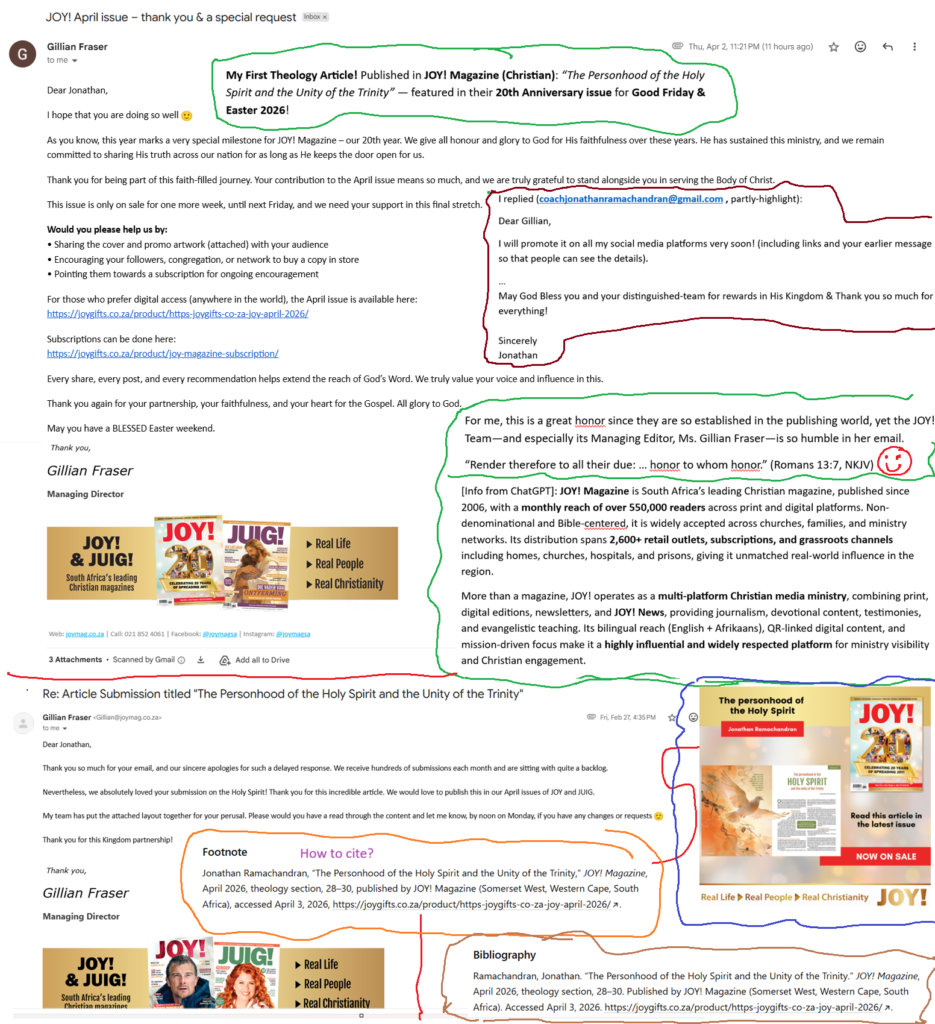
Finally, some news worth reading in the “Charity Doctrine” context—minus the “political motives.” I’m conservative (not liberal) on most topics, but on this financial issue, I agree with Mr. Bernie Sanders. You will understand it if, one day, you or the breadwinner of your household suddenly lose your job and your family becomes homeless, or if someone in your family (you, your mother, father, brother, sister, son, daughter, grandmother, grandfather, or a close relative—since people often care more when it affects those close to them) dies or falls critically ill and you can no longer afford the treatment.
Strangely, it is often only then that most people begin to look for “God” and “charity,” rather than even the “church,” especially when they find themselves on the “receiving end” after having never given much (or anything) to charity. Even many prosperity gospel churches or pastors will not give a cent of church money to help you, and some may even say that you or your family member are cursed with a fatal disease.
Link:
https://malaysia.news.yahoo.com/benefit-bernie-sanders-wealth-tax-122441933.html

My Theological View: Remember: what was bad for Him became good for us. We lived off the suffering that happened to the Most Blessed Savior, gaining profit and good from it. Never forget King Lord Jesus!

Am I a Heretic? Exploring “Salvation Outside Christianity”: Selected Quotations from Leading Asian and Malaysian Theologians
Dr. Edmund Chia offers an interesting perspective on “Asian Theology.” Note: I am an ecumenical Christian (not a “Roman” Catholic), but I can still appreciate many aspects of that tradition. Consider these quotes from his well-known book (in his own words):
“… Aside from the bishops, Asian theologians have also played key roles in the development of Asian Theology. The more well known among them, especially for their published works, are Aloysius Pieris (An Asian Theology of Liberation), Michael Amaladoss (The Asian Jesus; Liberation Theologies From Asia), Virginia Fabella (Asian Christian Spirituality; Third World Women Doing Theology), Marianne Katoppo (An Asian Woman’s Theology), Kosuke Koyama (Water Buffalo Theology), Felix Wilfred (Asian Public Theology; The Oxford Handbook of Christianity in Asia), and Mary John Mananzan (Woman, Religion and Spirituality in Asia). It would be safe to say that Pieris, Amaladoss, Fabella, Katoppo, Koyama, Wilfred, and Mananzan are indeed the “patriarchs” and “matriarchs” of Asian Theology.” … not all theologians from Asia who teach or write are actually engaging in Asian Theology. Likewise, not all theological institutions and seminaries in Asia teach Asian Theology. Ironically, some of them, as the aphorism goes, are even “more Roman than Rome.” … Appreciating this new context makes it difficult to continue with assertions that Christians are the only ones who will be saved and that people of other religions are doomed to eternal hellfire. In fact, even asking if salvation is possible for those who have not embraced the Christian faith is deemed inappropriate. …” – Dr. Edmund Chia from Malaysia [1]
Source (footnote):
[1] Edmund Kee-Fook Chia, “Introduction,” in Asian Christianity and Theology: Inculturation, Interreligious Dialogue, Integral Liberation, ed. Edmund Kee-Fook Chia (London: Routledge, 2022), vii–viii, 94.
Who is he?
Edmund Kee-Fook Chia is on the Faculty of Theology and Philosophy of Australian Catholic University and serves as Honorary Fellow at the University of Divinity (Melbourne) and Visiting Researcher at Radboud University Nijmegen (Netherlands). He previously headed the interreligious dialogue office of the Asian Bishops (1996–2004) and taught at Catholic Theological Union in Chicago, USA (2004–2011). He is the author of World Christianity Encounters World Religions (2018) and editor of Confucianism and Christianity (2021) and Interfaith Dialogue: Global Perspectives (2016).

Professor Phan has made a statement that many Christians would find shocking, reflecting his commitment to religious pluralism. While I am open to this idea in a limited sense through my concept of Non-Elect Salvation Possibility (NESP), I do not agree with all his logic for it. My point is that even highly respected theologians—particularly from Asia (see his credentials below, as well as his reputable book and journal publishers)—seriously consider such “possibilities.” Therefore, I should not be regarded as a heretic for exploring these ideas as possibilities rather than established doctrine, even if my perspective differs significantly from his. Consider the following in his own words:
“… (1) Jesus as the unique and universal savior does not exclude the possibility of non-Christians being saved.12 (2) This fact does not exclude the possibility of non-Christian religions functioning as “ways of salvation” insofar as they contain “elements of truth and of grace.”13 (3) These two possibilities are realized by the activities of both the Logos and the Holy Spirit. …” – Prof. Peter Phan from Vietnam [2]
Source (footnote):
[2] Peter C. Phan, “Multiple Religious Belonging: Opportunities and Challenges for Theology and Church,” Theological Studies 64, no. 3 (2003): 500, https://doi.org/10.1177/004056390306400302.
Who is he? (from a 2003 description):
PETER C. PHAN is professor and chair of Catholic social thought at Georgetown University and a past president of the Catholic Theological Society of America. He received the S.T.D. degree from the Salesian Pontifical University in Rome, and the Ph.D. and D.D. degrees from the University of London. Internationally recognized for his writings on inculturation and interreligious dialogue, he has published recently Christianity with an Asian Face: Asian Theology in the Making (Orbis, 2003) and In Our Tongues: Perspectives on Mission and Inculturation from Asia (Orbis, 2003). He is currently completing a book tentatively entitled Handbook to Roman Catholic Theology (Westminster John Knox).

Conclusion
So, if you choose to boycott me, please be consistent and boycott them as well for similar reasons. My NESP journal paper differs in content and reasoning from theirs, which I can explain to anyone interested. This is discussed in detail in my book Essays in Early Christianity [3]. If you believe I have copied anyone, please provide specific quotations as evidence, because I have not.
Source (footnote):
[3] Jonathan Ramachandran, ESSAYS IN EARLY CHRISTIANITY: Chiliasm Prophecy Model and Non-Elect Salvation Possibility (Cambridge, OH: Christian Publishing House, July 13, 2025), ISBN 978-1949586435, https://www.amazon.com/dp/1949586421.

Thank you
This is a photo of me with a Pentecostal (or Charismatic) church leader, Mr. Ebenezer Albert from Chennai, Tamil Nadu, India, taken recently on 18 April 2026 in Klang, Malaysia. I attended their worship conference (“Open Mic” by Jerusalem School of Music, JSOW), and I share this to show that I am “ecumenical” and engage well with Protestants too, even when I do not agree with all doctrinal points—just as I do with Catholics.

Source (LinkedIn Article titled “Am I a Heretic? Exploring “Salvation Outside Christianity”: Selected Quotations from Leading Asian and Malaysian Theologians“):
Thank you
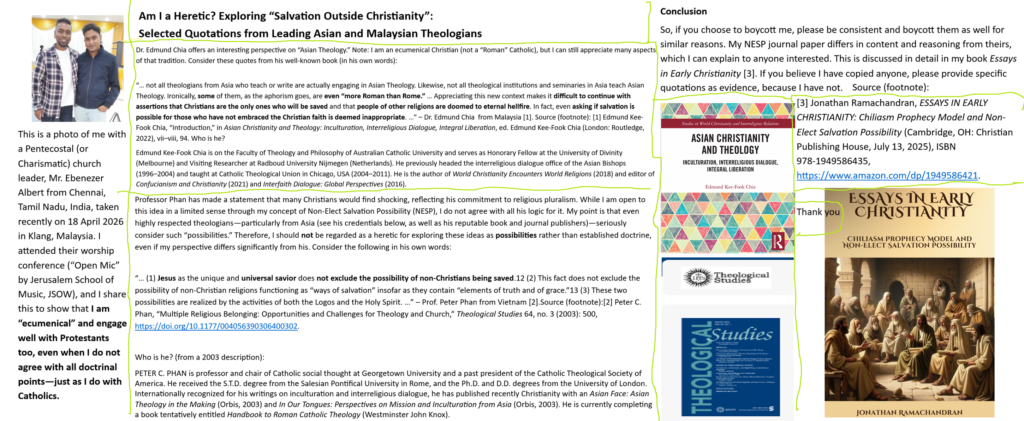

Between Truth and Possibility: The Place of New Interpretations
When a new technique is presented that produces interpretations different from known ones, it does not necessarily mean it is true; however, it can still be considered a valid possibility or an intellectual exercise, regardless of whether it is right or wrong—so long as it is not presented as certain doctrine, since judgment is reserved for those who claim certainty and are later proven wrong.
I replied this to a journal:
Dear ABC,
Please send this to your journal editor:
It’s a new technique, and your journal isn’t ready for it (which is why no such interpretation exists elsewhere using their claimed methodology) and is therefore speaking in conventional terms. Biblical truths cannot be discerned through academic technique alone, but also through Scriptural precedent that includes devotional as well as interpretive “imprint” approaches, as seen in the transition from the Old Testament to the New Testament.
For example, one cannot conclusively demonstrate through conventional methods and the rigor of the Torah and Tanakh alone that God has a literal Son rather than reference to “Israel as son” (both true, one literal and the other allegorical), or that the depiction of the afterlife (Hell) in the parable of the rich man and Lazarus is as described. These were part of the Old Testament’s interpretive baseline, which Christ expanded upon through fuller revelatory “imprints.” The distinction, however, is that His revelation is regarded as infallible, whereas later interpretations based on such imprints may remain fallible when presented as such.
What is the point of claiming your method if it cannot use the Old Testament to demonstrate those New Testament insights through the conventional techniques you propose? If it can, please show me two examples from those mentioned here, and I will change my mind. Therefore, actual biblical interpretation employs the very method I described, which is absent from your journal.
I repeat: Allowing constructive alternatives—even entirely new ones, such as mine—may fall outside your journal’s scope, but the method itself finds precedent in the interpretive developments seen within Christianity.
Thank you for letting me know.
No worries.
Sincerely
Jonathan
Source:

When reviewers of my NESP paper cite a methodological error based on their view that it should include the original context—such as the topic at the time the quote was made, the historical setting, other secondary scholars, and alternative interpretations of that same quote (if they exist)—I respond as follows:
By reading this, readers may become more aware of the complex landscape surrounding what constitutes Biblical exegesis versus eisegesis. Even when examining a single verse (1 Corinthians 3:15), John Calvin does not interpret it as supporting any form of posthumous salvation, whereas Augustine of Hippo, citing the same passage, clearly understands it as referring to purgatory (i.e., a form of salvation occurring after death and beyond judgment, not limited to this life).
For argument’s sake, if Calvin turned out to be right, then even Blessed Augustine would be wrong on this. In that case, my view of non-elect salvation possibility would not be entirely unreasonable, even if it were ultimately incorrect in a similar way. Can you see what I mean?
Source (Article titled “Thought: Toward a Revised Abstract of Non-Elect Salvation Possibility (NESP) Paper with Methodological Defense”), more details:
Thank you for reading!
nderstanding the Divide Between Theological, Academic, and Mixed Journals: Scope and Audience Issue via my Journal Paper by Top Journals
[I believe these are very honest comments, which I respect in return.]
1) Catholic Biblical Quarterly (CBQ)
CBQ General Editor ([email protected]) Wrote:
You have sent me two sets of revised manuscripts in XXX. The issue with your submissions is that we do not publish articles on these theological topics. Although they have roots in interpretations of the biblical texts, our journal is written by and for academic biblical scholars. I do not know enough about Chiliasm (nor would anyone on our board) to be able to assess the value of these submissions, and your articles would not find the audience you are addressing if published in CBQ. The pieces remain a discussion of theological principles and not of biblical texts. I hope that you can find a venue for your work, but CBQ is not the appropriate journal.
Sincerely,
Dr. Corrine Carvalho
2) Numen: International Review for the History of Religions
[from: Ülo Valk [email protected] reply-to: Ülo Valk [email protected]] wrote:
Ref.: Your submission (NU-1663)
Dear Dr. Ramachandran,
I regret to inform you that your manuscript cannot be accepted for publication in Numen. As you open the Numen web site, you can rear our basic principle, “The approach of the journal to the study of religion is strictly non-confessional.” Hence, we cannot consider your article, but it might be of great interest to journals in the field of theology.
Thank you for having considered Numen for publication of your research.
I wish youl all the best in your acacemic endeavours.
Yours sincerely,
Ülo Valk
Editor in Chief
Numen
3) Are these Top Journals? [info from ChatGPT]:
Catholic Biblical Quarterly (CBQ): Published by the Catholic Biblical Association of America and distributed through academic press channels, Catholic Biblical Quarterly is a leading specialist journal in biblical studies. It carries strong prestige in scriptural, exegetical, and theological scholarship, especially within Christian and Jewish Bible-focused academia. Indexed in Web of Science and core religion databases such as ATLA—and, in some years, Scopus—it is widely read within biblical studies but has a more specialized than interdisciplinary reach.
Numen: International Review for the History of Religions: Published by Brill on behalf of the International Association for the History of Religions, Numen is one of the most prestigious journals in comparative and historical religious studies. Indexed in Web of Science and Scopus, it enjoys broad international visibility and interdisciplinary readership. Its reputation is especially strong for theoretical, cross-cultural, and non-confessional scholarship, making it influential across humanities and social science discussions of religion.
4) Issue in layman’s terms:
These editors are saying that the submitted work discusses religious doctrines and theological ideas rather than analyzing sacred texts or religion through academic methods. A theological journal focuses on questions of belief and doctrine—what should be believed—while an academic journal studies religion critically, historically, or comparatively without taking a confessional stance. Mixed journals may allow both approaches, but only when framed appropriately. The rejection is therefore about scope and audience, not necessarily the quality or importance of the work.
Thank you
Source (Article titled “Understanding the Divide Between Theological, Academic, and Mixed Journals: Scope and Audience Issue via my Journal Paper by Top Journals”):
Thank you

How can we say that the Bible contains the very words of God if there are places where we don’t know what those words *are*. [via Prof. Bart Ehrman]
Strangely, the Bible itself asked that question first:
“How can you say, ‘We are wise, and the law of the LORD is with us’? Look, the false pen of the scribe certainly works falsehood.” (Jeremiah 8:8, NKJV)
The reason is that God allows free will, though still under His control. Therefore, the existence of variant manuscripts supports the truth of this verse. As such, we may consider different possibilities regarding those passages. However, the parts that remain consistent may be regarded as the preserved Word of God.
The meaning of the verse (its interpretation) is another matter altogether—namely, it could be allegorical, literal, both, or even something entirely new. All of these can be true as well. This pattern can be seen in the transition of Christian hermeneutics from the Old Testament to the New Testament through Christ Himself, particularly in the way He quoted Scripture.
Thus, when we think in this way, we are also “following Christ.” The difference is that we cannot determine with absolute certainty which possibilities are 100% true or not. Holding this tension, I believe, is the most honest position—and one that God rewards when one is right.
Thank you for reading.

The most beautiful story in history is not written with ink, but in blood—yes, the Blood of God.
Ephesians 1:7 (KJV):
“In whom [Most Blessed Lord Jesus Christ] we have redemption through His Blood, the forgiveness of sins, according to the riches of His Grace.”


Question 173: “Has anyone else ever received a notification from LinkedIn that says, ‘You have one of the most-viewed profiles’?
Reply 173:
I’m not sure whether LinkedIn’s algorithm is telling the truth or not, because my network is quite small and my posts usually receive no reactions. Regardless, I will continue to share the Gospel (which consists of most of my social media posts, not just on LinkedIn). If it is true, I’m grateful for the opportunity to do so—whether people respond or not is between them and God.” I beg the visitors, “please believe in Lord Jesus Christ!” Profile Link:
https://www.linkedin.com/in/jonathanramachandran
Thank you!
“Note: I am seeing this notification for the first time on 23 April 2026.”
ChatGPT Said: It’s technically true, but only in a limited, algorithm-defined sense.
On LinkedIn, the notification “You have one of the most-viewed profiles” means:
- Your profile views are higher than many other users in a comparison group
- It is based on recent activity (a short time window)
- The “most-viewed” label is relative, not absolute
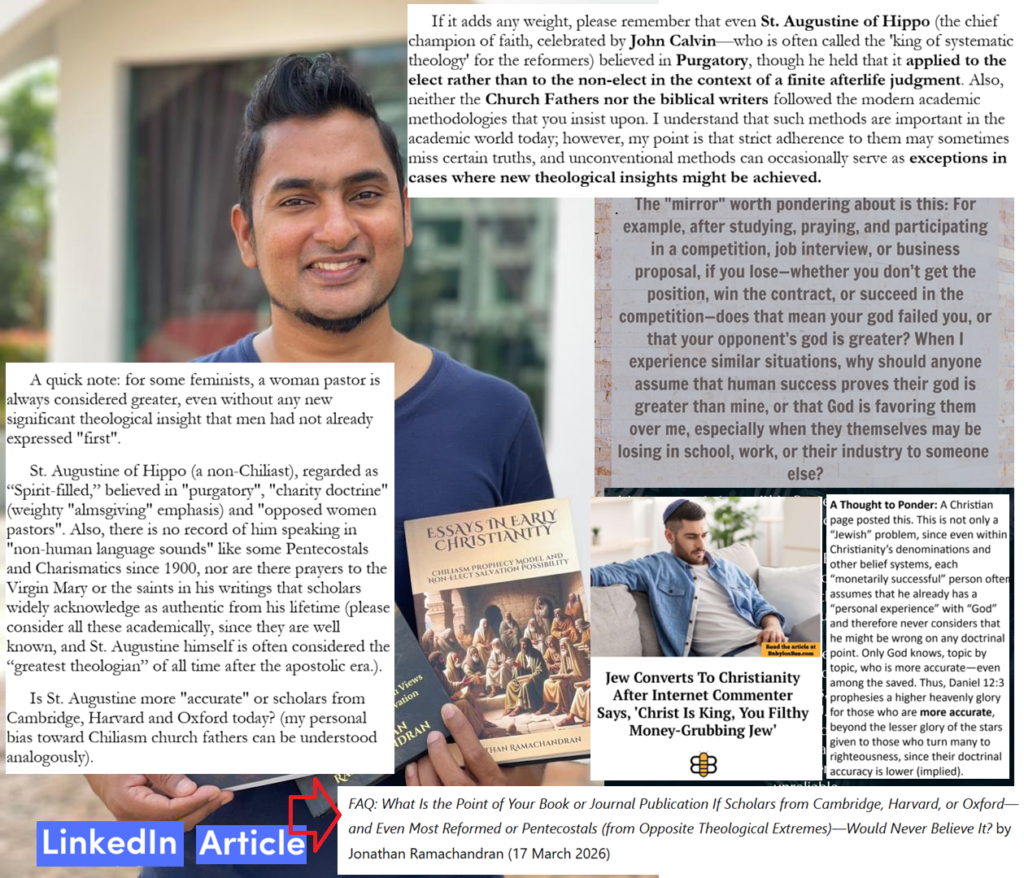
New Book: Thank God Regardless Math, Merit, and Being Unapologetically Christian
Hi there!
Please feel free to share this with anyone and download a copy for your own good self as well.
Please note that any new revisions, updates, or replacements of this book will be placed in this freely shared folder. Please share this link as well which contains the free pdfs:
i) Google Drive Folder:
https://drive.google.com/drive/folders/1d0go0yKivMwt7mseVcJucot_E56h1po7?usp=sharing
New Free Book (Chicago format + Google Drive):
Jonathan Ramachandran, Thank God regardless: Math, merit, and being unapologetically Christian (5 Loaf 2 Fish Publications, 31 May 2026), https://drive.google.com/drive/folders/1d0go0yKivMwt7mseVcJucot_E56h1po7?usp=sharing.
ii) Google Books Link:
https://books.google.com.my/books/about?id=3KPfEQAAQBAJ
New Free e-book (APA format + Google Books):
Ramachandran, J. (2026). Thank God regardless: Math, merit, and being unapologetically Christian. 5 Loaf 2 Fish Publications. https://books.google.com.my/books/about?id=3KPfEQAAQBAJ.
Title: Thank God Regardless Math, Merit, and Being Unapologetically Christian
Author: Jonathan Ramachandran
Language: English
Book Identifier: GGKEY:FUQZWA76N7G
Publisher: 5 Loaf 2 Fish Publications
Pages: 95
Release Date: 31 May 2026
Book Description: The following reflections are shared with gratitude to God for all outcomes—whether success or failure—as part of a broader testimony on learning, teaching, and Christian perspective in everyday life.
They are written not to exalt personal achievement, but to highlight that value, worth, and reward are ultimately defined differently in Scripture than in worldly systems. In particular, academic results, recognition, workplace outcomes, or social approval do not determine a person’s standing before God. Rather, what matters is faithfulness, obedience, and the use of whatever God has entrusted to each individual.
This text also brings together experiences from teaching mathematics and mentoring students, alongside reflections on fairness, recognition, and the challenges of working in imperfect human systems. It further connects these observations with biblical teachings on stewardship, charity, suffering, and eternal reward. Thank you
Jonathan
31 May 2026
Source:
https://www.linkedin.com/pulse/new-book-thank-god-regardless-math-merit-being-jonathan-ramachandran-9vinc
As seen in the example of the Virgin Mary herself, she was neither a Prophetess like Deborah, nor a Judge of Israel (Judges 4:4), nor a deacon for women’s ministry like Phoebe (Romans 16:1–2), nor a wealthy believing businesswoman like Lydia (Acts 16:14–15, 40), yet she is considered the greatest among women because of obedience in virtue, being called “blessed among women” and praised for believing and submitting to God’s word — something only God can judge perfectly (Luke 1:28, 38, 42, 45).
Source:
Jonathan Ramachandran, Thank God Regardless: Math, Merit, and Being Unapologetically Christian (5 Loaf 2 Fish Publications, May 31, 2026), 83, https://books.google.com.my/books/about?id=3KPfEQAAQBAJ.
Similarly, you may be better than me or even any pastor with the biggest church in terms of virtue-context and receive a greater reward in heaven through obedience (Matthew 20:26–28; Matthew 25:21).
Thanks again.
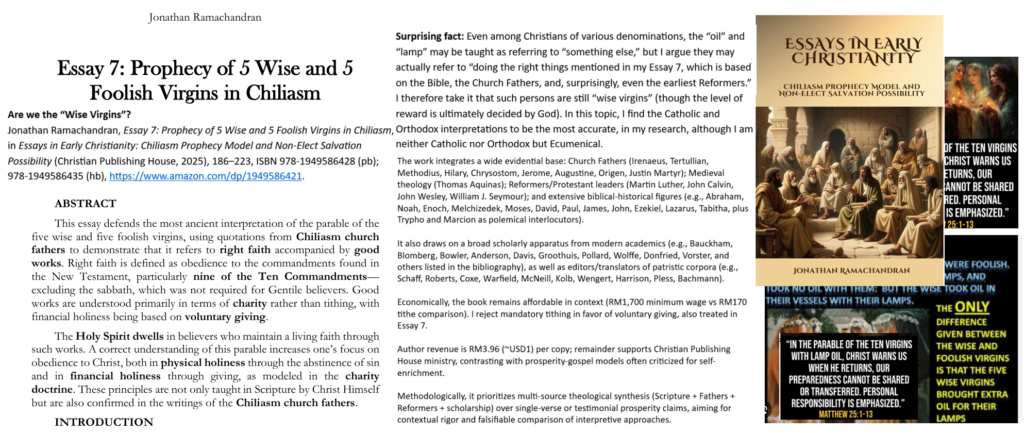
[Text] Bill Gates has his own individual right to live as he chooses. I am not attacking his freedom, but rather using him as a prime and “honest” example (since he himself confessed) that being the “richest” — or even close to it — does not necessarily mean a person is “good.” As you can see, even those who are “unfaithful in marriage and commit sexual immorality by Bible standards” can still be “wealthy and healthy.” Can you see the point?
The same is true even across churches, regardless of denomination (e.g., remember the world biggest AOG church head’s money-case, Singapore biggest church’s money-case or the Gateway Church founder’s sexual-case, etc.). Judgment belongs to the next world and to God. Therefore, all we need to do is remain “holy regardless,” even if we are the “poorest.” Even outside Christianity, I see the same in many cases (God knows).
Free High School Math Olympiad (546 Problems & Solutions): 1430-Page Complete Collection of 2020–2026 Olympiad Mathematics Solutions by Jonathan Ramachandran (Free PDF Download)
Hi there!
Please feel free to share this with anyone and download a copy for your own good self as well.
i) Google Drive Folder:
https://drive.google.com/drive/folders/1d0go0yKivMwt7mseVcJucot_E56h1po7?usp=sharing
New Free Book (Chicago format + Google Drive):
Jonathan Ramachandran, Free High School Math Olympiad: 546 Problems & Solutions (5 Loaf 2 Fish Publications, 28 May 2026), https://drive.google.com/drive/folders/1d0go0yKivMwt7mseVcJucot_E56h1po7?usp=sharing.
ii) Google Books Link:
https://books.google.com.my/books/about?id=eaHdEQAAQBAJ
New Free e-book (APA format + Google Books):
Ramachandran, J. (2026). Free high school math olympiad: 546 problems & solutions. 5 Loaf 2 Fish Publications. https://books.google.com.my/books/about?id=eaHdEQAAQBAJ.
Title: Free High School Math Olympiad [546 Problems & Solutions]
Author: Jonathan Ramachandran
Language: English
Book Identifier: GGKEY:Q0U3ZAQ31Y2
Publisher: 5 Loaf 2 Fish Publications
Pages: 1430
Release Date: 28 May 2026
Book Description: I wrote this book using actual photographs of mathematical problems and solutions, principally arising from the years 2020 through approximately 2025–2026. It contains free secondary-level Mathematical Olympiad questions and solutions, discussed at my leisure for the benefit of anyone interested.
Unless otherwise stated, all solutions are my own, and I apologize in advance for any possible errors. The questions are drawn from a variety of sources. My principal contribution is the solution component, preserved in handwritten form within images (usually dated), often in response to questions personally asked via WhatsApp or through my Facebook pages. Some questions are also publicly available online as sample problems from various prestigious international Mathematical Olympiad competitions.
The chief aim of this book is to fulfill the command of Our Most Blessed Lord Jesus Christ concerning the Doctrine of Charity.
Thank you
Jonathan
28 May 2026
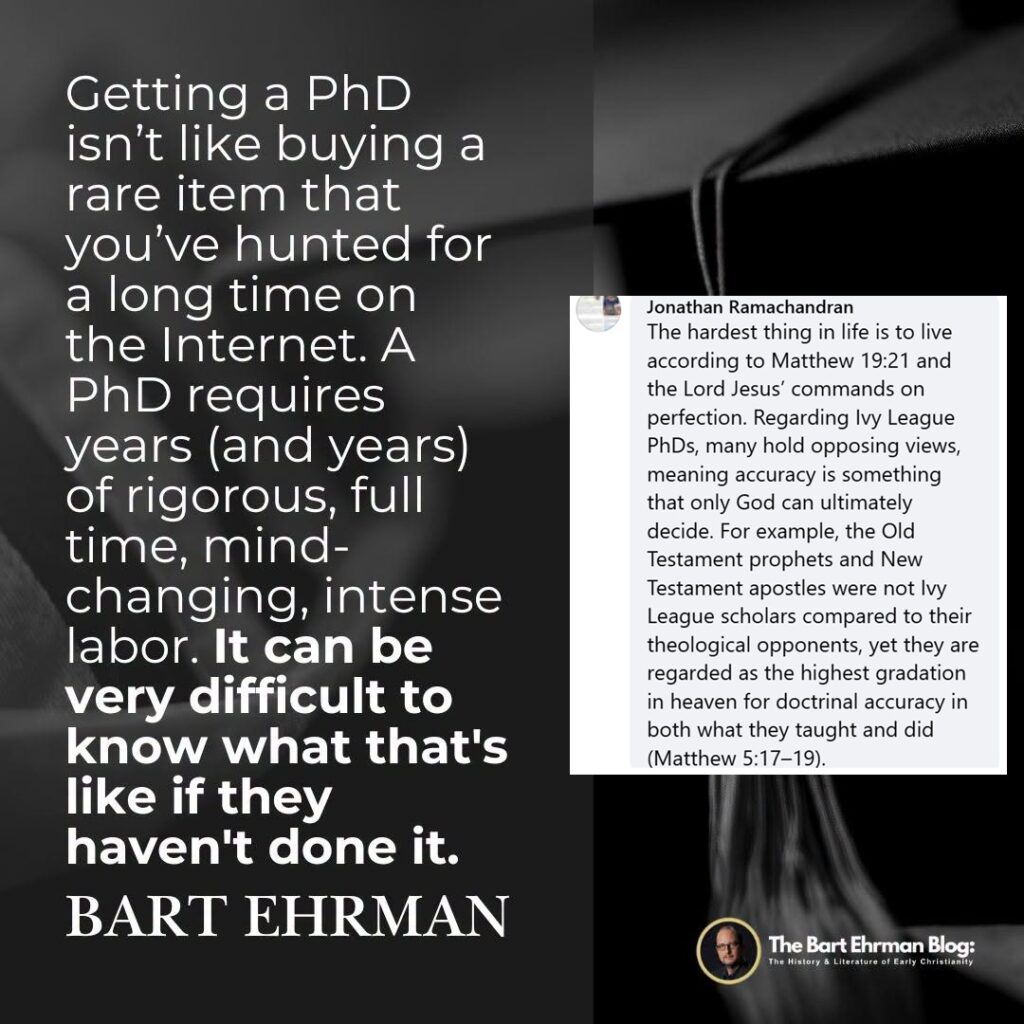
————————————————————————————————————
“More than that, I count all things to be loss in view of the surpassing value of knowing Christ Jesus my Lord, for whom I have suffered the loss of all things, and count them but rubbish so that I may gain Christ,” – Apostle Paul to the Ekklesia (called out ones) in Philippi (Philippians 3:8)
The rest have chosen to remain Anonymous as it was in History!