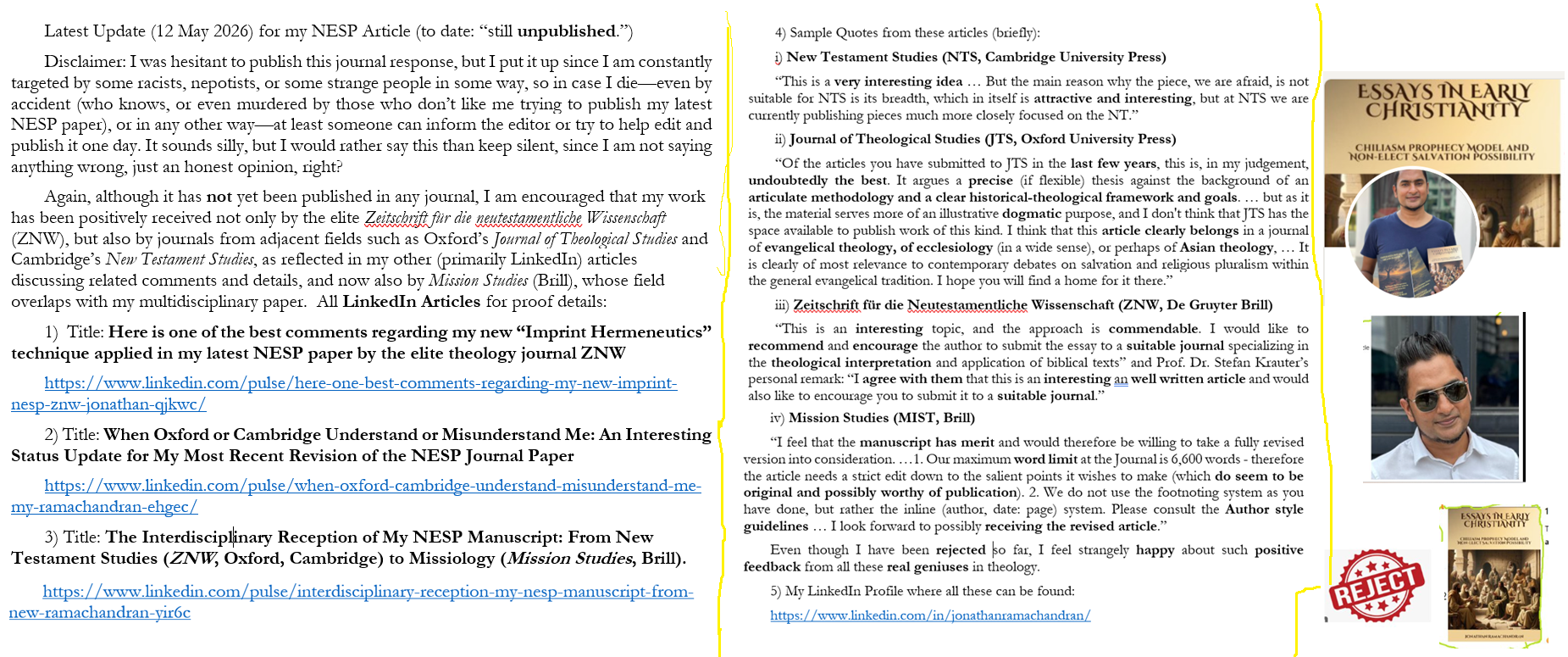
The Interdisciplinary Reception of My NESP Manuscript: From New Testament Studies (ZNW, Oxford, Cambridge) to Missiology (Mission Studies, Brill).
Positive Editorial Feedback from Mission Studies (Brill) on My NESP Manuscript: A Flagship Journal Assessment with Interdisciplinary Scope.
Disclaimer: I was hesitant to publish this journal response, but I put it up since I am constantly targeted by some racists, nepotists, or some strange people in some way, so in case I die—even by accident (who knows, or even murdered by those who don’t like me trying to publish my latest NESP paper), or in any other way—at least someone can inform the editor or try to help edit and publish it one day. It sounds silly, but I would rather say this than keep silent, since I am not saying anything wrong, just an honest opinion, right?
The journal Mission Studies informed me that my submitted article (MIST-1584) is not yet suitable for peer review in its current form, but it is still considered potentially publishable after some revisions.
Importantly, none of the academic content itself has been rejected. The issue lies entirely in formal and technical requirements set by the journal, specifically word limit restrictions and referencing/formatting style, which I have not previously worked with in this form.
Key points from the editor:
- The manuscript is not rejected on substance, and the editor acknowledges that it contains original material with potential for publication.
- However, it must be substantially revised and resubmitted as a new paper.
Required changes are strictly formal:
- The article must be reduced to the 6,600-word limit, focusing only on core arguments.
- The referencing system must be changed from footnotes to author–date in-text citations, following Brill journal guidelines.
My personal consideration and concern:
My main hesitation is that I do not want to pursue publication— even if it is accepted by a top-tier, flagship journal in the field (comparable in reputation within its domain to institutions like Cambridge, Oxford, or Harvard-level standards in its area)—if doing so would require me to cut or lose significant portions of my content.
At the same time, I also recognise that I am not particularly strong in formal academic editing or restructuring, and I find this type of rewriting demanding and somewhat difficult, so there is also a tendency to avoid the effort unless it is necessary or unless there are no better publishing pathways available, especially since my paper could also be published in a different or related field due to its interdisciplinary approach.
At the same time, I am genuinely pleased and encouraged that the core content itself is seen as potentially publishable at this level, which is already a significant positive validation of the work.
Next steps outlined by the journal:
- I would need to resubmit the article as a completely new submission through their system.
- I must also include a point-by-point response to the editor’s comments in a cover letter.
In my reply, I acknowledged the feedback, expressed appreciation, and indicated that I will reflect on whether and how to proceed given the required structural and formatting revisions.
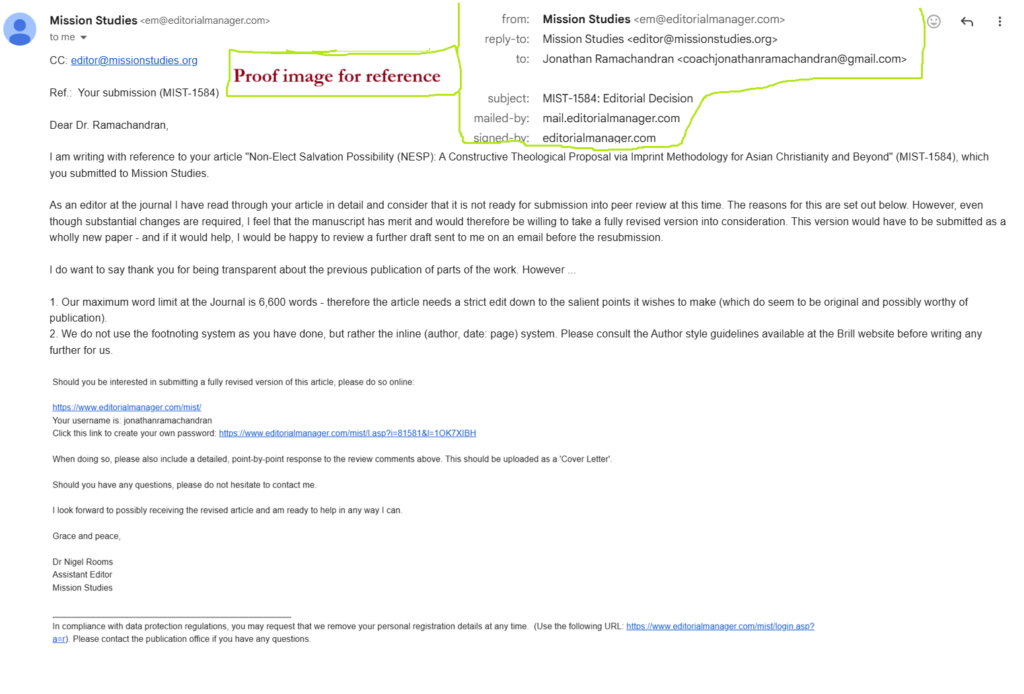
1) Mission Studies wrote this to me
from: Mission Studies <[email protected]>
reply-to: Mission Studies <[email protected]>
to: Jonathan Ramachandran <[email protected]>
Ref.: Your submission (MIST-1584)
Dear Dr. Ramachandran,
I am writing with reference to your article “Non-Elect Salvation Possibility (NESP): A Constructive Theological Proposal via Imprint Methodology for Asian Christianity and Beyond” (MIST-1584), which you submitted to Mission Studies.
As an editor at the journal I have read through your article in detail and consider that it is not ready for submission into peer review at this time. The reasons for this are set out below. However, even though substantial changes are required, I feel that the manuscript has merit and would therefore be willing to take a fully revised version into consideration. This version would have to be submitted as a wholly new paper – and if it would help, I would be happy to review a further draft sent to me on an email before the resubmission.
I do want to say thank you for being transparent about the previous publication of parts of the work. However …
1. Our maximum word limit at the Journal is 6,600 words – therefore the article needs a strict edit down to the salient points it wishes to make (which do seem to be original and possibly worthy of publication).
2. We do not use the footnoting system as you have done, but rather the inline (author, date: page) system. Please consult the Author style guidelines available at the Brill website before writing any further for us.
Should you be interested in submitting a fully revised version of this article, please do so online:
https://www.editorialmanager.com/mist/
Your username is: jonathanramachandran
Click this link to create your own password: https://www.editorialmanager.com/mist/l.asp?i=81581&l=1OK7XIBH
When doing so, please also include a detailed, point-by-point response to the review comments above. This should be uploaded as a ‘Cover Letter’.
Should you have any questions, please do not hesitate to contact me.
I look forward to possibly receiving the revised article and am ready to help in any way I can.
Grace and peace,
Dr Nigel Rooms
Assistant Editor
Mission Studies
2) My Reply
Dear Dr Nigel Rooms,
Oh, that’s quite some changes required in the manuscript and so, let me think about it.
I appreciate the positive feedback and details shared.
Kind regards,
Jonathan
3) About
Mission Studies is a top-tier international missiology journal with rigorous peer review and strong global scholarly influence. While it is not equivalent to Oxford, Cambridge, or Harvard journals in overall institutional branding or cross-disciplinary impact, it is considered peer-comparable in quality and selectivity within its field of missiology and world Christianity.
Published by Brill and anchored in the International Association for Mission Studies (IAMS), it operates within an elite global scholarly network and regularly features contributions from leading scholars associated with major institutions such as Oxford, Cambridge, Edinburgh, Harvard, and Yale-linked theological circles.
It occupies a near-flagship position in the field, publishing high-level theoretical, constructive, and interdisciplinary scholarship on mission, world Christianity, and intercultural theology.
The journal attracts contributions from internationally recognized scholars based at institutions such as the University of Edinburgh, Oxford Centre for Mission Studies, and Fuller Theological Seminary, and is particularly known for advancing conceptual and framework-building work in missiology rather than purely descriptive or historical studies.
In terms of academic visibility, it is strongly indexed across major scholarly databases, including Scopus, the Web of Science Emerging Sources Citation Index (ESCI), the ATLA Religion Database, ERIH PLUS, and other key theological indexing systems such as Index Theologicus (IxTheo). This gives it both global citation visibility and strong disciplinary authority within theology and religious studies.
Although official acceptance rates are not published, it is considered highly competitive, with an estimated acceptance rate of roughly 10–20%, making it a selective journal where originality, methodological clarity, and contribution to global missiological debates are essential for publication success.
Conclusion
Again, although it has not yet been published in any journal, I am encouraged that my work has been positively received not only by the elite Zeitschrift für die neutestamentliche Wissenschaft (ZNW), but also by journals from adjacent fields such as Oxford’s Journal of Theological Studies and Cambridge’s New Testament Studies, as reflected in my other (primarily LinkedIn) articles discussing related comments and details, and now also by Mission Studies (Brill), whose field overlaps with my multidisciplinary paper.
P/S: All LinkedIn Articles for proof details:
1) Title: Here is one of the best comments regarding my new “Imprint Hermeneutics” technique applied in my latest NESP paper by the elite theology journal ZNW
2) Title: When Oxford or Cambridge Understand or Misunderstand Me: An Interesting Status Update for My Most Recent Revision of the NESP Journal Paper
3) Title: The Interdisciplinary Reception of My NESP Manuscript: From New Testament Studies (ZNW, Oxford, Cambridge) to Missiology (Mission Studies, Brill).
4) Sample Quotes from these articles (briefly):
i) New Testament Studies (NTS, Cambridge University Press)
“This is a very interesting idea … But the main reason why the piece, we are afraid, is not suitable for NTS is its breadth, which in itself is attractive and interesting, but at NTS we are currently publishing pieces much more closely focused on the NT.”
ii) Journal of Theological Studies (JTS, Oxford University Press)
“Of the articles you have submitted to JTS in the last few years, this is, in my judgement, undoubtedly the best. It argues a precise (if flexible) thesis against the background of an articulate methodology and a clear historical-theological framework and goals. … but as it is, the material serves more of an illustrative dogmatic purpose, and I don’t think that JTS has the space available to publish work of this kind. I think that this article clearly belongs in a journal of evangelical theology, of ecclesiology (in a wide sense), or perhaps of Asian theology, … It is clearly of most relevance to contemporary debates on salvation and religious pluralism within the general evangelical tradition. I hope you will find a home for it there.”
iii) Zeitschrift für die Neutestamentliche Wissenschaft (ZNW, De Gruyter Brill)
“This is an interesting topic, and the approach is commendable. I would like to recommend and encourage the author to submit the essay to a suitable journal specializing in the theological interpretation and application of biblical texts” and Prof. Dr. Stefan Krauter’s personal remark: “I agree with them that this is an interesting an well written article and would also like to encourage you to submit it to a suitable journal.”
iv) Mission Studies (MIST, Brill)
“I feel that the manuscript has merit and would therefore be willing to take a fully revised version into consideration. …1. Our maximum word limit at the Journal is 6,600 words – therefore the article needs a strict edit down to the salient points it wishes to make (which do seem to be original and possibly worthy of publication). 2. We do not use the footnoting system as you have done, but rather the inline (author, date: page) system. Please consult the Author style guidelines … I look forward to possibly receiving the revised article.”
Even though I have been rejected so far, I feel strangely happy about such positive feedback from all these real geniuses in theology.
5) My LinkedIn Profile where all these can be found:
https://www.linkedin.com/in/jonathanramachandran
Here’s a motivational quote about the Church Father Origen of Alexandria.
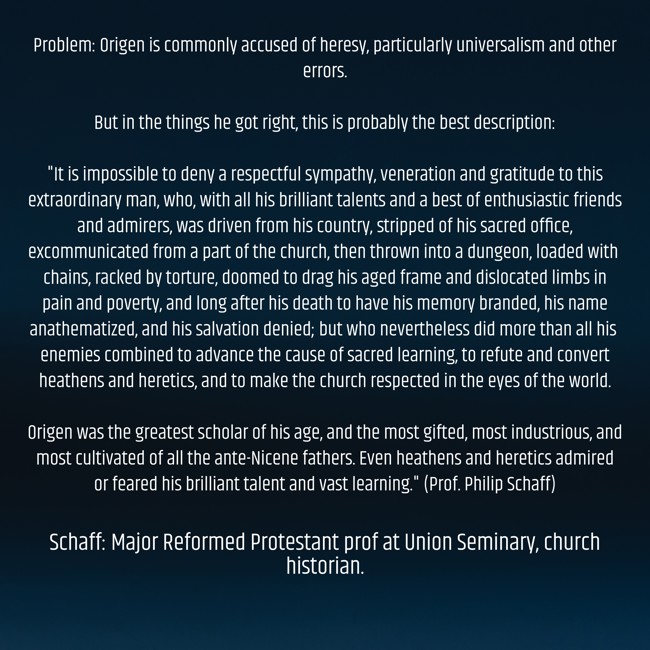
[Text] Problem: Origen is commonly accused of heresy, particularly universalism and other errors.
But in the things he got right, this is probably the best description:
“It is impossible to deny a respectful sympathy, veneration and gratitude to this extraordinary man, who, with all his brilliant talents and a best of enthusiastic friends and admirers, was driven from his country, stripped of his sacred office, excommunicated from a part of the church, then thrown into a dungeon, loaded with chains, racked by torture, doomed to drag his aged frame and dislocated limbs in pain and poverty, and long after his death to have his memory branded, his name anathematized, and his salvation denied; but who nevertheless did more than all his enemies combined to advance the cause of sacred learning, to refute and convert heathens and heretics, and to make the church respected in the eyes of the world.
Origen was the greatest scholar of his age, and the most gifted, most industrious, and most cultivated of all the ante-Nicene fathers. Even heathens and heretics admired or feared his brilliant talent and vast learning.” (Prof. Philip Schaff)
Source:
Philip Schaff, History of the Christian Church, vol. 2: Ante-Nicene Christianity, A.D. 100–325 (Grand Rapids: Christian Classics Ethereal Library, electronic ed.), accessed May 20, 2026, https://www.ccel.org/ccel/schaff/hcc2.all.html.
Philip Schaff was a German-born Reformed Protestant theologian and professor of church history at Union Theological Seminary in New York, a leading 19th-century scholar who systematized Christian history for modern academic study and helped shape English-speaking Protestant scholarship.