
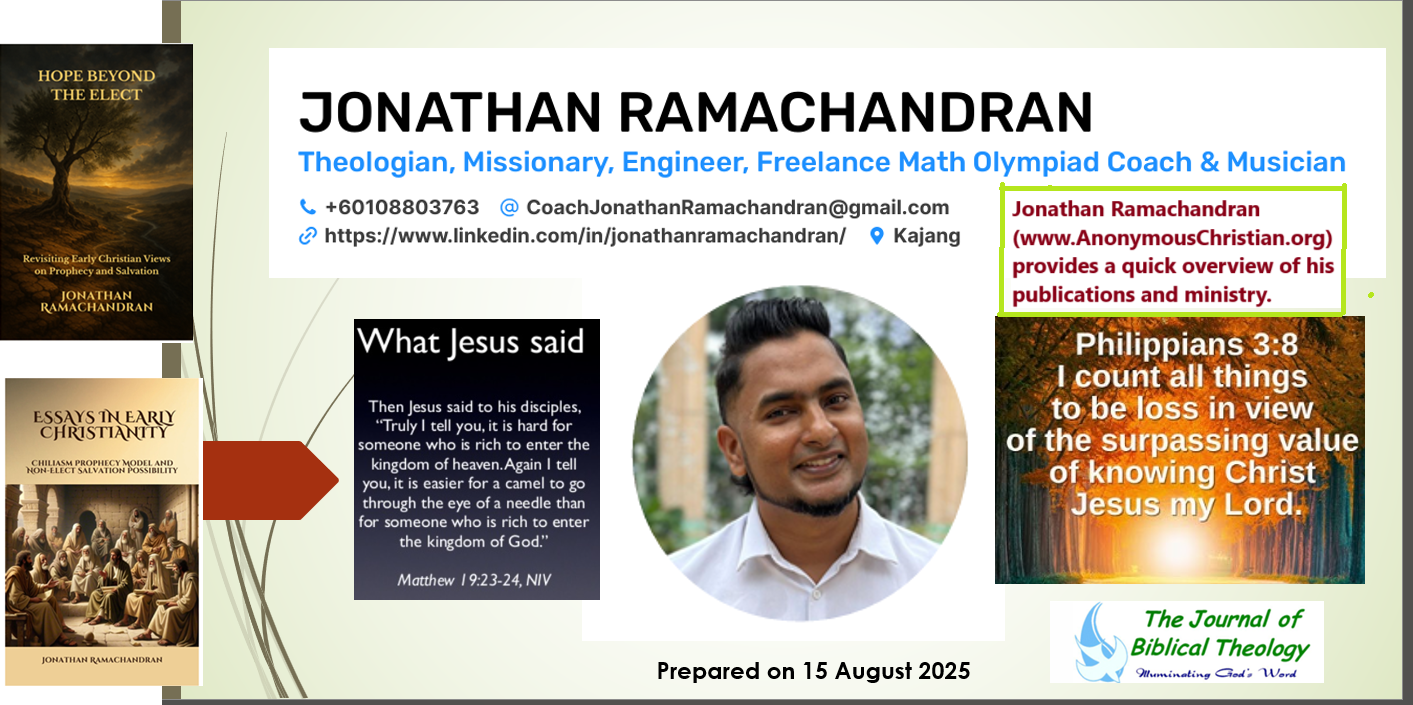
A YouTube Video Explaining Jonathan’s Publications and Ministry
Jonathan Ramachandran provides a quick overview of his publications and ministry.
Video Details:-
i) YouTube link:
ii) Download this Video link
https://drive.google.com/file/d/1HwmtKk-fhxiaXIZ4oJxkkaRfwFzMLFpI/view?usp=sharing
iii) Download the Powerpoint in this Video link
Thank you!
My CV (22 July 2025) Link:
https://drive.google.com/file/d/1PIGhZIauswvIVlE_poOrt4tI4shYVcTi/view?usp=sharing
My Books:-
1) English Version:
Ramachandran, Jonathan. HOPE BEYOND THE ELECT: Revisiting Early Christian Views on Prophecy and Salvation. Cambridge, Ohio, USA: Christian Publishing House, 6 June 2025. (182 Pages).
Links: https://www.amazon.com/dp/1949586405 (Amazon)
https://books.google.cl/books/about?id=_d1jEQAAQBAJ&redir_esc=y (Google E-Book)
https://www.goodreads.com/book/show/235829454-hope-beyond-the-elect (GoodReads)
https://www.christianpublishers.org/product-page/hope-beyond-the-elect-revisiting-early-christian-views-on-prophecy-and-salvation (CPH Bookstore: Under apocalyptic/eschatology and theology genres)
2) Academic Version (in English too):
Ramachandran, Jonathan. ESSAYS IN EARLY CHRISTIANITY: Chiliasm Prophecy Model and Non-Elect Salvation Possibility. Cambridge, Ohio, USA: Christian Publishing House, 13 July 2025. (432 Pages).
Links: https://www.amazon.com/dp/1949586421 (Amazon)
https://play.google.com/store/books/details?id=0rpwEQAAQBAJ (Google E-Book)
https://www.christianpublishers.org/product-page/essays-in-early-christianity-chiliasm-prophecy-model-and-non-elect-salvation (Christian Publishing House Bookstore)

2) Journals
i) 1st Publication
Ramachandran, Jonathan. “Non Elect Salvation Possibility.” The American Journal of Biblical Theology (AJBT) Vol 26, no. 6 (9 February 2025).
www.biblicaltheology.com/Research/RamachandranJ01.pdf
ii) 2nd Publication
Ramachandran, Jonathan. “Thousand Year Gap for Prophecy in 1 Thessalonians 4:17 and 1 Corinthians 15:52 with Chiliasm Church Fathers.” The American Journal of Biblical Theology (AJBT) Vol 26, no. 22 (1 June 2025). www.biblicaltheology.com/Research/RamachandranJ02.pdf
iii) 3rd Publication on a 3-level peer review as well
Ramachandran, Jonathan. “Thousand Year Gap for Prophecy in 1 Thessalonians 4:17 and 1 Corinthians 15:52 with Chiliasm Church Fathers.” Journal of Biblical Theology (JBT) Vol 8, no. 3 (1 June 2025): 185-208. https://www.biblicaltheology.com/research.html
About the Author
JONATHAN RAMACHANDRAN
Theologian, Missionary, Engineer, Freelance Math Olympiad Coach & Musician
Jonathan Ramachandran is a self taught theological enthusiast who loves the Chiliasm Church Fathers and tries to understand Prophecy of the Bible with their writings. He has published with the Journal of Biblical Theology (JBT, 3 levels of peer reviews), the American Journal of Biblical Theology (AJBT, 2 levels of peer reviews) and also with Christian Publishing House (CPH, Cambridge, Ohio, USA). He runs his theology blog being a freelance missionary of tentmaker style at www.AnonymousChristian.org and lives in Malaysia where he is an operations manager for an engineering company.
Jon is a freelance preacher who is active both online and offline who has baptized some of his students into Christianity. His varied full time working experience includes working with Christian ministries dealing with charity, seismic engineering, educational centre management, teaching Math at schools (elementary and high school with a competition touch) and is one of Malaysia’s International Mathematical Olympiad (IMO) coaches.
Other Book details:
1) ESSAYS IN EARLY CHRISTIANITY: Chiliasm Prophecy Model and Non-Elect Salvation Possibility
i) Paperback
Print length : 432 pages
ISBN-10 : 1949586421
ISBN-13 : 978-1949586428
ii) Hardcover
Print length : 432 pages
ISBN-10 : 194958643X
ISBN-13 : 978-1949586435
2) HOPE BEYOND THE ELECT: Revisiting Early Christian Views on Prophecy and Salvation
i) Paperback
Print length : 182 pages
ISBN-10 : 1949586405
ISBN-13 : 978-1949586404
ii) Hardcover
Print length : 182 pages
ISBN-10 : 1949586413
ISBN-13 : 978-1949586411
#My ORCID Link: https://orcid.org/0009-0008-4669-1077
#GoogleScholar Link:
https://scholar.google.com/citations?hl=en&user=Bv7IFrAAAAAJ
#Academia Link:
https://independent.academia.edu/RamachandranJonathan
Note: Christian Publishing House (CPH) is publisher for the UASV Bible. About CPH: https://www.christianpublishers.org
Question 53
I cannot accept you because you are not ordained nor are a member of a formal Christian denomination being “ecumenical Christian”.
My Reply 53
Formal Pastor Ordinations – Human FreeWill or God’s Will?
1) Fast fact
To begin, remember that a “Pastor” or “Priest” ordination from one denomination may not be recognized in another (e.g., Protestant vs Catholic vs Orthodox), even within Protestantism itself (e.g., Reformed vs Pentecostal/Charismatic). So, which one did God choose?
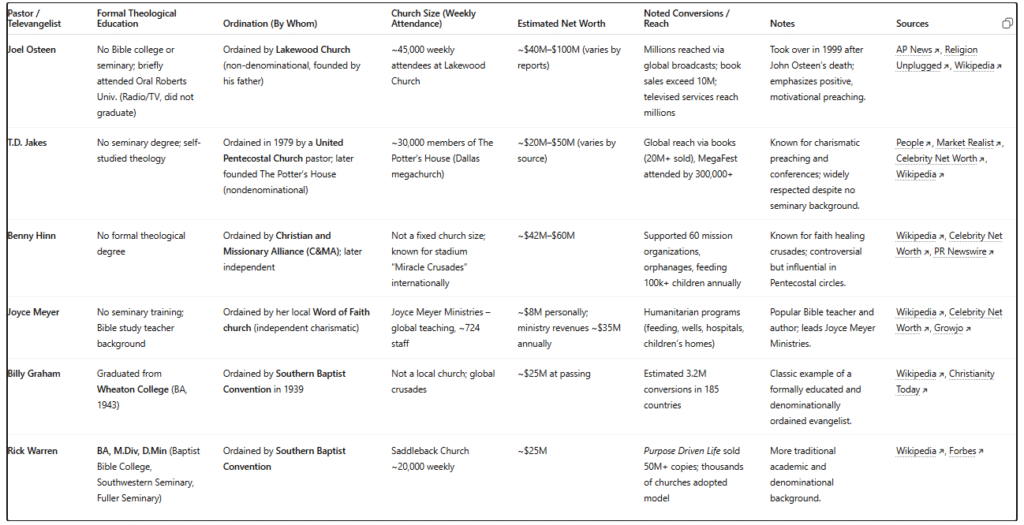
2) Since “what the rich says is wisdom” to “many modern Christians,” and some don’t recognize Church fathers’ writings, I show their own “biggest soul winners – Pastors” who they look up to in this writing (table image shown as well) to demonstrate that “their God” chose all of these “without any proper formal pastoral ordinations.”
This is significant because, virtually often in Christian ministry hiring, you will hear someone say, “Person A is not formally ordained by our Church or denomination, but Person B is, and thus it is God’s Will to choose Person B”. Do you see it? This means that some of the world’s largest churches, as measured by a single pastor listed here, would not be hired into these formal Christian ministries of various denominations because they do not meet the “denominational ordination criteria at all,” but perhaps these are only applied to discriminate the poor, but because these are super-rich Christians, their preachings, books, and so on are accepted by those “same denominations” (a contradiction indeed).
3) For instance, in Malaysia, the Association for Theological Education in South East Asia (ATESEA) accredits Seminari Theoloji Malaysia (STM), whilst the Asia Theological Association (ATA) accredits Bible College of Malaysia (BCM).
So, God divided the church by forming two distinct bodies here, as well as various denominations or even other accreditation bodies around the world? No! My point is that all of these examples of “human freewill” are true. It is all “free will” when you “choose” the “church you attend,” the “pastor you follow,” or even “whom you hire for work/ministry.” God’s Will is determined on that day for those who “obey His Commands,” which is all about “accuracy,” and He will decide on that day for this part because true Christians can be found at all levels of truth and error across all denominations (I believe in this).
Conclusion
Notice that “none” of Joel Osteen, T.D. Jakes, Benny Hinn, Joyce Meyer, or even Billy Graham (who studied anthropology, not theology, at Wheaton College) has any “seminary or Bible school training at all”. What then makes their “ordination” legitimate? I mean, practically any of your local pastors would tell you that God only ordains those who attend formal seminaries or Bible schools as “pastor,” right? However, this runs counter to the most well-known “soul winners” in Christianity in recent years, who are also “richest” in comparison to your local pastors or leaders, isn’t that right? Why didn’t God make a “bigger soul-winner” out of “your denominations or ordained pastors” if God decreed Bible school or seminary as a “must” and looked down on people who didn’t have it?
My position is straightforward, as this recent video explains, and it is based on a quote from St. Clement of Rome, a direct disciple of the apostle St. Peter, who said that any minority can be correct and that the majority of the church, including its pastors, can be incorrect. God does not step in to correct this most of the time, allowing for human free will (which is proven by thousands of denominations worldwide). Therefore, I don’t despise “ordained” denominations or “non-ordained” people since God will reward those who are more accurate in this regard. Link:
https://youtu.be/tbeHe7EVcMw
In this Bible verse, the Most Blessed Holy Spirit of God warned via Apostle St. James a long time ago that “rich in faith” does “not equal rich in money”:
“2For if there should come into your assembly a man with gold rings, in [a]fine apparel, and there should also come in a poor man in [b]filthy clothes, 3and you [c]pay attention to the one wearing the fine clothes and say to him, “You sit here in a good place,” and say to the poor man, “You stand there,” or, “Sit here at my footstool,” 4have you not [d]shown partiality among yourselves, and become judges with evil thoughts? 5Listen, my beloved brethren: Has God not chosen the poor of this world to be rich in faith and heirs of the kingdom which He promised to those who love Him? 6But you have dishonored the poor man.” (James 2:2 – 6, NKJV)
I mean if a person has more faith in God means he must become richer in money, then doesn’t that contradict this verse above which states that the “poor” here are “rich in faith” in comparison to the “rich man with money”? Hence, let God decide who had “more faith” (accuracy) on that day and let’s not confuse it nor mix with “money” since the “Bible” reveals it here.
Last but not least, how often have you seen a poor man allowed to preach or become a leader in any of these megachurches and the topic is “not money blessings”? Thus, do the approval of masses matter? I mean, even if you disagree with any of the “pastors” featured in the graphic, they still have more converts and money than you and me, right? So, does the approval of the “majority wrong” matter in your opinion, given that you may disagree with some of their doctrines? Example: Joel Osteen speaks in tongues but Billy Graham did “not” speak in tongues.
For those who are not interested in theology, you can follow “dirty dancing & lyrics of pop stars and rappers” who advocate “drunkenness, promiscuity, sensuality, double meanings, gangsterism, drugs, or other vices” and are far richer and have more fans than all of this (rhetoric speech to help the mind “see”).
Note: this table (in image) is generated using ChatGPT on 21 August 2025 (sources listed too).
Question 56
How do different interpretations of Christianity influence views on race and nationalism, and why do these interpretations vary?
My Reply 56
What you believe in regard to “God’s Will is” in this area will determine how you behave in regard to all human relations. I will explain in simple terms highlighting some common traits:
- Racism
If you believe that “God’s Will” is people of the same race should only marry their own race, then you will grow to be a racist.
Many years ago, a local preacher near me preached something similar, and I left that church. Why? Those who feel such are usually from a “rich-race” or “more gifted race” in terms of “money, good looks, educational prowess, technological achievements, etc.” and so do not want their offspring to marry people from races who are inferior in these earthly qualities. Such thoughts do not come from God, but from normal human psychology, which is understandable but not loving.
What’s Biblical then? Did you know that Moses (the Lawgiver) himself had an “Ethiopian” wife (and not a Jewish wife only)? Yes, both the high priest Aaron and his worship leader sister Miriam criticized Moses in a racist manner for this as the Bible records:
“Then Miriam and Aaron spoke against Moses because of the Ethiopian woman whom he had married; for he had married an Ethiopian woman.” (Numbers 12:1, NKJV)
To recap, GOD grew so enraged by their racism and even the fact that they talked against Moses (who is God’s favorite here) that He came down from Heaven and judged both Miriam and Aaron, causing Miriam to become leprous and Aaron was begging for his life! Ironically, Moses prayed for the forgiveness of those racists, and after some judgments, God spared them. God detests racism, so avoid it! (all of this can be read in “Numbers 12” Old Testament Bible book).
God prohibited interracial marriages on the sole reason if these foreign women caused them to go after “other gods”:
“26Did not Solomon king of Israel sin by these things? Yet among many nations there was no king like him, who was beloved of his God; and God made him king over all Israel. Nevertheless pagan women caused even him to sin. 27Should we then hear of your doing all this great evil, transgressing against our God by marrying pagan women?” (Nehemiah 13:26 – 27, NLKJV)
So, God only prohibited interracial marriages for the reason if they led you away to serve “other gods”. This means any marriage within Christianity regardless of race is by choice. This can be seen in the Jewish lineage preservation for purity of the line of David which only lasted to fulfill the promise of Christ being born as a Messiah but even this lineage has Gentiles in it and so, it was never a racist thing, and here’s an example scholarly research highlighting this point, to quote:
“Matthew, however, includes Gentile women in his narrative of Jesus’ ancestry. These Gentiles include Tamar, 1:3; Rahab, 1:5; Ruth, 1:5; and the wife of Uriah (Bethsheba). Tamar was, possibly, a Canaanite (see Gen 38). Rahab was a Canaanite from Jericho (Josh 2:1; 6:25).” – John Appiah [source: https://noyam.org/wp-content/uploads/2020/06/ERATS0320ART1.pdf (https://noyam.org/wp-content/uploads/2020/06/ERATS0320ART1.pdf), Page 96]
2. Nationalism
“26For [k]you see your calling, brethren, that not many wise according to the flesh, not many mighty, not many [l]noble, are called. 27But God has chosen the foolish things of the world to put to shame the wise, and God has chosen the weak things of the world to put to shame the things which are mighty; 28and the [m]base things of the world and the things which are despised God has chosen, and the things which are not, to bring to nothing the things that are, 29that no flesh should glory in His presence. ” (1 Corinthians 1:26 – 29, NKJV)
Your next question on “nationalism” can be handled in a similar manner, which revolves around survival and the necessity to build financial stability so that oneself and one’s family are safe in the presence of other unfortunate people. These are unfortunate because they may not be as smart as you in terms of obtaining money, nor may they be willing to engage in certain forms of bribery or even race-based biased decisions on which many job-hiring and financial success in this world are dependent, and so, the end goal of “family” living comfortably through these income motivates such “nationalists” to justify their actions as “noble.” We are all guilty of this to some level, intentionally or unknowingly, in our jobs, whether in the private or public sector, which provide us with income, but what we do next with the money we make is totally up to us.
Truth: “God’s Will” is to maintain “holy” and “Charity Doctrine,” which is “financial holiness” (including avoiding excessive hoarding of “wealth” and “luxury” in these “last days” [New Testament times]):
“Pure and undefiled religion before God and the Father is this: to visit orphans and widows in their trouble, and to keep oneself unspotted from the world. … 1Come now, you rich, weep and howl for your miseries that are coming upon you! 2Your riches [a]are corrupted, and your garments are moth-eaten. 3Your gold and silver are corroded, and their corrosion will be a witness against you and will eat your flesh like fire. … 5You have lived on the earth in pleasure and [c]luxury; you have [d]fattened your hearts [e]as in a day of slaughter.“ (James 1:27, 5:1 -3 , 5, NKJV)
Also, in these “last days” context (New Testament timeline onward), such “prosperity living” is sin as apostle St. James writes here in James 5:1–3 which ends in their “flesh eaten by fire” (hell) just like having many wives or concubine even was not sin in the Old Testament (as Israelites did have that) but in these “last days” these are also “sin” likewise. Examples: ‘Keturah became Abraham’s second wife after Sarah died. She is recorded as a wife in Genesis 25:1 but is recorded as a concubine in I Chronicles 1:32. Genesis 25:6 suggests that Keturah was Abraham’s concubine. 10 Concubines are King David’s unnamed concubines. They are mentioned in 2 Samuel 15:16, 2 Samuel 16:22, and 2 Samuel 20:3.
The “Financial Holiness Test”: By the end of a Christian’s life, it is good for him to give/share while working (“higher relative measure” especially when he/she had less) and will some money to family vs charity or ministry to complete this righteousness (if had more at the end of life). Although those with little are excluded from many requirements, they still have to make a voluntary donation, even if it is little but significant in comparison because of their lower income, smaller life savings, or even harder-earned income as a result of being a minority or experiencing racial, religious, linguistic, or denominational bias.
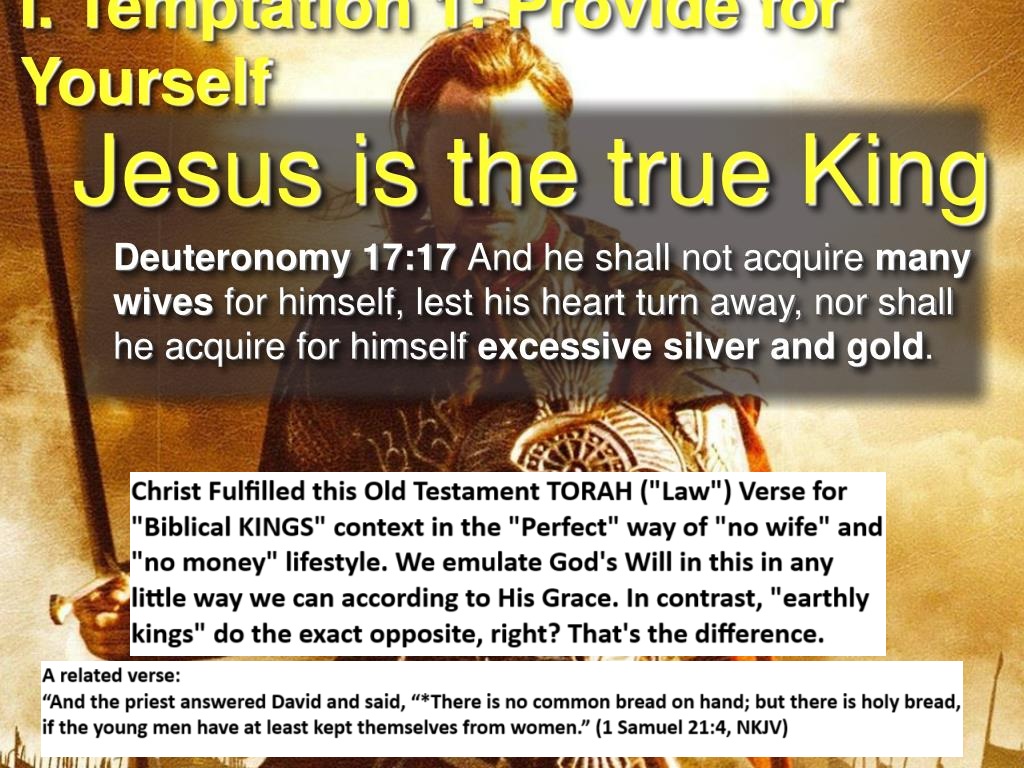
If it is “not sin” to accumulate “wealth as much as possible”, then this “Torah” (Law) verse from the Old Testament itself has “no meaning” especially in the “context of leadership” (meaning if a “God endorsed king” cannot be overly rich, then how can “pastors/priests/bishops/deacons/presbyters” be “rich in money” likewise?), verse:
“15you shall surely set a king over you whom the Lord your God chooses; one from among your brethren you shall set as king over you; you may not set a foreigner over you, who is not your brother. 16But he shall not multiply horses for himself, nor cause the people to return to Egypt to multiply horses, for the Lord has said to you, ‘You shall not return that way again.’ 17Neither shall he multiply wives for himself, lest his heart turn away; nor shall he greatly multiply silver and gold for himself.” (Deuteronomy 17:15 – 17, NKJV)
Christ Fulfilled this Old Testament TORAH (“Law”) Verse for “Biblical KINGS” context in the “Perfect” way of “no wife” and “no money” lifestyle. We emulate God’s Will in this in any little way we can according to His Grace. In contrast, “earthly kings” do the exact opposite, right? That’s the difference. A related verse:
“And the priest answered David and said, “There is no common bread on hand; but there is holy bread, if the young men have at least kept themselves from women.” (1 Samuel 21:4, NKJV)
Where’s the threshold? Only God knows and that’s why “Perfection” in this “finance area of God’s Will” is in this direction as Lord Jesus Christ taught which ends in “permanent heavenly treasures (or more of it)” and thus the loses are eternal if we live carelessly in this regard (no matter what ‘other ministry we do’) since this was uttered to a “10 commandment keeping person” but yet “lacked this”:
“18He said to Him, “Which ones?” Jesus said, “‘You shall not murder,’ ‘You shall not commit adultery,’ ‘You shall not steal,’ ‘You shall not bear false witness,’ 19‘Honor your father and your mother,’ and, ‘You shall love your neighbor as yourself.’ ” 20The young man said to Him, “All these things I have kept [g]from my youth. What do I still lack?” 21Jesus said to him, “If you want to be perfect, go, sell what you have and give to the poor, and you will have treasure in heaven; and come, follow Me.” 22But when the young man heard that saying, he went away sorrowful, for he had great possessions. 23Then Jesus said to His disciples, “Assuredly, I say to you that it is hard for a rich man to enter the kingdom of heaven. 24And again I say to you, it is easier for a camel to go through the eye of a needle than for a rich man to enter the kingdom of God.” (Matthew 19:18 – 24, NKJV)
“For this you know, that no fornicator, unclean person, nor covetous man, who is an idolater, has any inheritance in the kingdom of Christ and God.” (Ephesians 5:5, NKJV)
What’s the threshold that defines someone is covetous? No one can tell except God but Christ pointed this to a rich man who generally kept the 10 commandments and holiness commands of the Torah (meaning “financial holiness” is absent which makes a person “unsaved” from some threshold onward here). Next, beyond being saved, Christ revealed the “hundredfold” highest level reward which included the context of doing one or more of these things (including “financial holiness” context of “leaving house and lands” for the Gospel or “significant relationships” such as leaving the “safety” of family say due do doctrinal stances or in becoming a Christian to even “leaving wife” [can mean “remain unmarried too” as apostle St. Paul expounds in 1 Corinthians 7** too to focus more on Gospel work]:
“27Then Peter answered and said to Him, “See, we have left all and followed You. Therefore what shall we have?” 28So Jesus said to them, “Assuredly I say to you, that in the regeneration, when the Son of Man sits on the throne of His glory, you who have followed Me will also sit on twelve thrones, judging the twelve tribes of Israel. 29And everyone who has left houses or brothers or sisters or father or mother [h]or wife or children or [i]lands, for My name’s sake, shall receive a hundredfold, and inherit eternal life. 30But many who are first will be last, and the last first” (Matthew 19:27 – 30, NKJV)
Let’s take heed that this is how the “many who are first will be last, and the last first” as Christ Prophesies here and so, may we attain to “God’s Will” in this too by His Grace. Note that “many” (not few) though saved may seem like “first” on earth but in the end, may be “last” in heavenly ranking for failure to do one of these things mentioned here. Can you “see” it “as it is written”?
**Verses:
“32But I want you to be without [b]care. He who is unmarried [c]cares for the things of the Lord—how he may please the Lord. 33But he who is married cares about the things of the world—how he may please his wife. 34There is a difference between a wife and a virgin. The unmarried woman cares about the things of the Lord, that she may be holy both in body and in spirit. But she who is married cares about the things of the world—how she may please her husband. 35And this I say for your own profit, not that I may put a leash on you, but for what is proper, and that you may serve the Lord without distraction. 36But if any man thinks he is behaving improperly toward his [d]virgin, if she is past the flower of youth, and thus it must be, let him do what he wishes. He does not sin; let them marry. 37Nevertheless he who stands steadfast in his heart, having no necessity, but has power over his own will, and has so determined in his heart that he will keep his [e]virgin, does well. 38So then he who gives [f]her in marriage does well, but he who does not give her in marriage does better.” (1 Corinthians 7:32 – 38, NKJV)
Conclusion
Why is determining “God’s Will” important in daily living itself? Christ Warned against those who “convert many” but into “wrong doctrinal living of lawlessness” which encompass all areas of life:
“21“Not everyone who says to Me, ‘Lord, Lord,’ shall enter the kingdom of heaven, but he who does the will of My Father in heaven. 22Many will say to Me in that day, ‘Lord, Lord, have we not prophesied in Your name, cast out demons in Your name, and done many wonders in Your name?’ 23And then I will declare to them, ‘I never knew you; depart from Me, you who practice lawlessness!’” (Matthew 7:21 – 23, NKJV)
May God help us to really do His Will, as you can see in the famous “Great Denial” verses above, it is the “many” (some type of “majority” not “minority”) who succeeded in “converting many” and even in finance of daily life, as evidenced by these verses here, which means that being chosen on earth in regard to “success” and “blessings” do not indicate “God’s Will.” “God’s Will” is explained in the immediate verse next to avoiding “lawlessness” through “living His Commands,” which include being a “non-racist” to “financial holiness” as well:
“24“Therefore whoever hears these sayings of Mine, and does them, I will liken him to a wise man who built his house on the rock:” (Matthew 7:24, NKJV)
Here’s a quote from my recent book to help understand this better:
“As many church fathers have pointed out, the 144,000 are unmarried, and how many people in history who have converted many to Christianity were virgins and Jewish by descent? Is there a single example of such a person inside our own church or denomination? This, combined with the terms “no deceit” and “without fault,” which are used in these verses to characterize them, shows that the quantity of converts in our church does not determine one’s proximity to God, but rather accurate prophetic and doctrinal truth. This is because we can hardly think of anyone who converted many people to Christianity that fits this scriptural description. This is consistent with both the prophecy of St. Clement of Rome (page 11) and Daniel 12:3.” [1]
Peace to you
[1] Ramachandran, Jonathan. ESSAYS IN EARLY CHRISTIANITY: Chiliasm Prophecy Model and Non-Elect Salvation Possibility. (Cambridge, Ohio, USA: Christian Publishing House, 13 July 2025): page 386. ISBN 9781949586435. Link: https://www.amazon.com/dp/1949586421
#CoachJonathanRamachandran #HopeBeyondtheElectBook #JonReply53 @highlight .
Indexing post listing all questions (including this):
https://www.facebook.com/jonathan.ramachandran/posts/pfbid0HWHCP8EYSphob2z9T4HGAZAfFSg2VdJWui4BjhbpmMAdHaC5AbFJeuMNcSUDigWkl
TQ.
Question 58
Why are you not a Pentecostal? You are not saved!
My Reply 58
A Brief Pentecostal Historical Note:-
For starters, “speaking in tongues” is not synonymous with “born again” because if it is, then anyone who is born again must speak in tongues, yet none of the reformers did (i.e. neither Martin Luther, John Calvin or even John Wesley spoke in tongues; so, are they not “born again”?). Here are Bible scriptures that state that “not all Christians speak in tongues” (but they are “born again,” correct? because if not, how are they “saved or Christians”?
“30Do all have gifts of healings? Do all speak with tongues? Do all interpret? 31But earnestly desire the [i]best gifts. And yet I show you a more excellent way.” (1 Corinthians 12:30 – 31, NKJV)
In short, “speaking in tongues” (talking about the real type here which God alone knows) is just a “gift” and is not mandatory for all Christians as a proof of being “born again” as some claim and err.
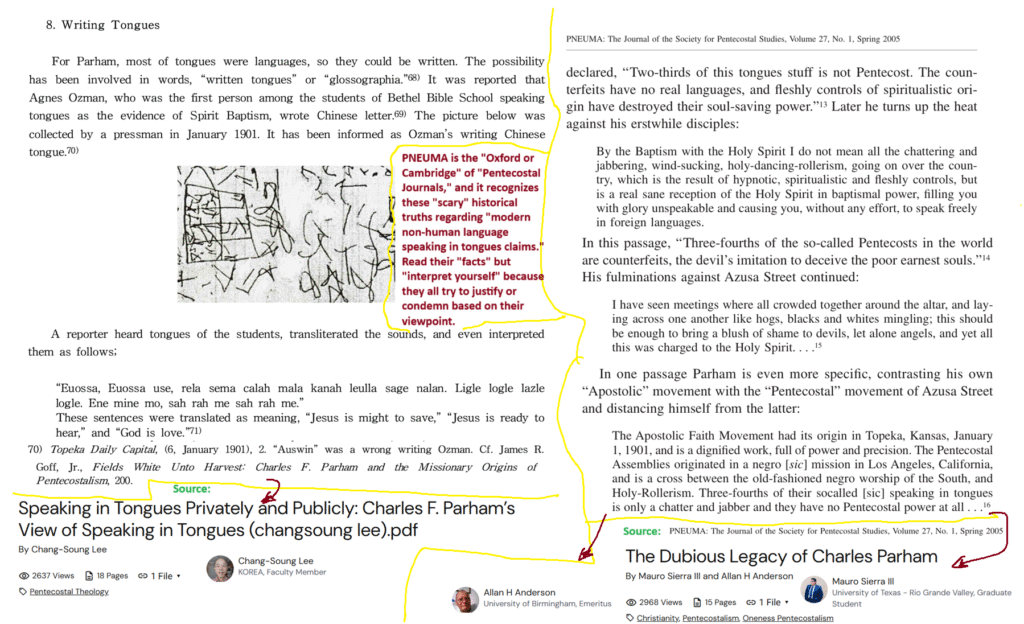
Note: PNEUMA is the “Oxford or Cambridge” of “Pentecostal Journals,” and it recognizes these “scary” historical truths regarding “modern non-human language speaking in tongues claims.” Read their “facts” but “interpret yourself” because they all try to justify or condemn based on their viewpoint.
Their “father,” Charles Parham, through whom the ‘first case of it occurred,’ meaning that the Holy Spirit chose a man to do it who later renounces all these “other ways doing it,” even using strong phrases like “devil,” “holy-jabbering,” “holy-dancing,” etc. I’ve also added a privately produced essay here (picture) to demonstrate how other Pentecostals do not exhibit these facts, despite the fact that both are quoting the same Parham’s books’, but at least ‘the Chinese writing claim’ is admitted here. How trustworthy or harmful is this? As long as I remain impartial and avoid taking any chances, you make the decision. The founder himself carried out all of this in the first incidence (not to mention the sodomy case Parham confessed to with a young Jewish lad after all this gifting etc. – separate tale).
What’s my point? If you can accept God using this man to start your Pentecostal movement with all of this, don’t judge other Christians who refrain because we all have sins, but these are pretty extreme and could indicate God’s judgment on the movement in the beginning, or whether it is true, God will show one day. Those who remain neutral are exempt, but those who participate may receive reward if right and punishment if wrong (no partiality with God), especially as it concerns the claim of the “Holy Spirit,” which even states that no forgiveness is granted if blasphemed against (Matthew 12:30-32). Conversion numbers “do not” matter because even Roman Catholics and Orthodox have more converts than the 100-year-old Pentecostals who consider each other as unsaved, correct?
Links for free pdfs quoted here (parts in image):
1) Lee, Chang-Soung. “Speaking in Tongues Privately and Publicly: Charles F. Parham’s View of Speaking in Tongues (Changsoung Lee).Pdf,” n.d. in Academia.edu
2) Sierra III, Mauro, and Allan Anderson. “The Dubious Legacy of Charles Parham,” n.d. in PNEUMA: The Journal of the Society for Pentecostal Studies, Volume 27, No. 1, Spring 2005.
https://www.academia.edu/10825872/The_Dubious_Legacy_of_Charles_Parham
Shalom
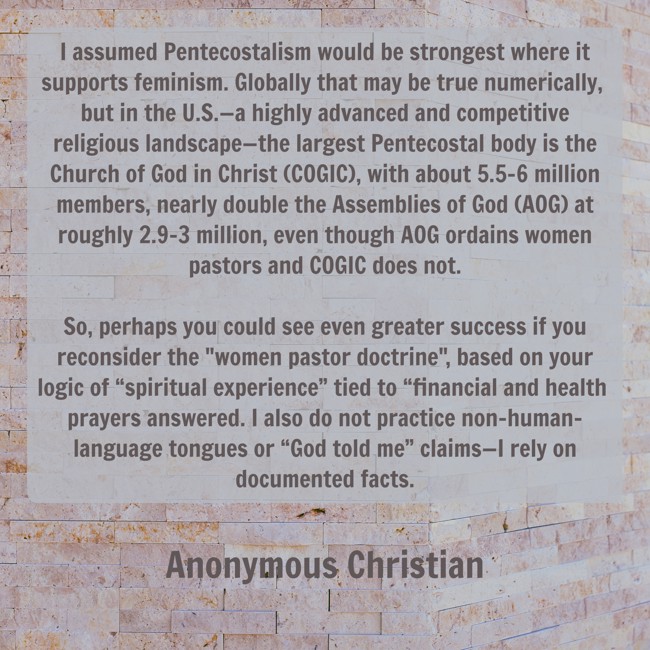
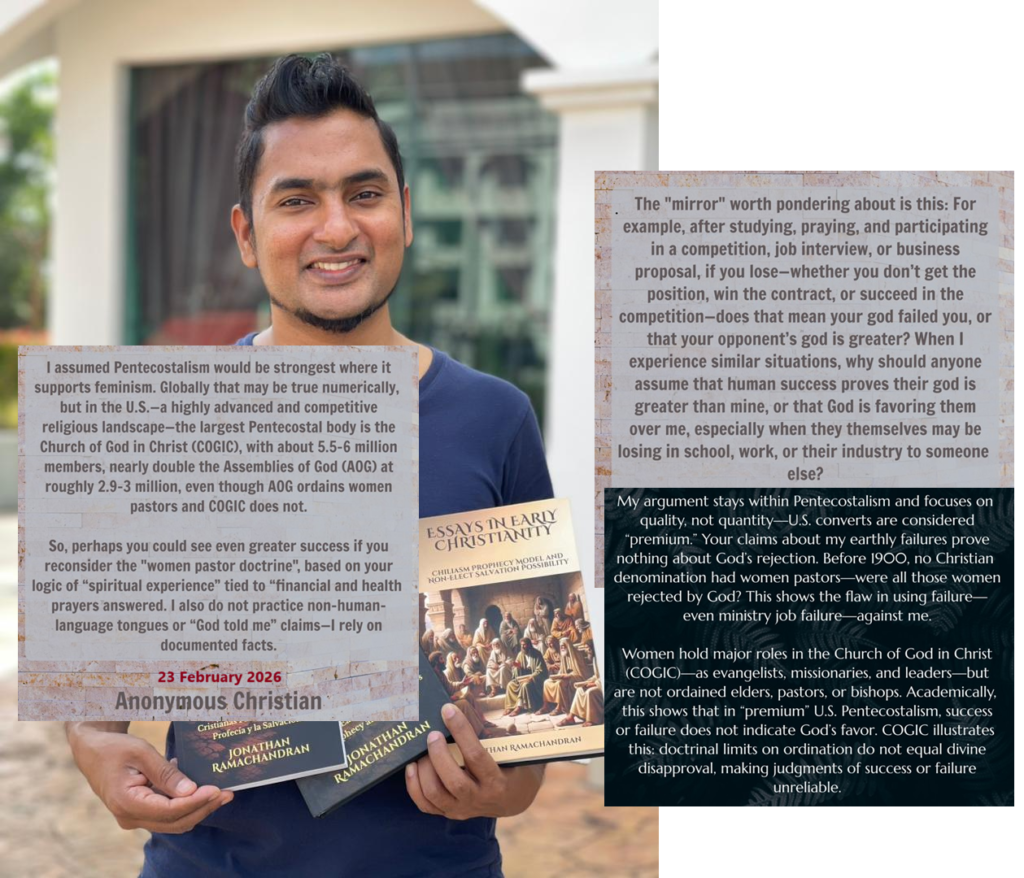
[Text] I assumed Pentecostalism would be strongest where it supports feminism. Globally that may be true numerically, but in the U.S.—a highly advanced and competitive religious landscape—the largest Pentecostal body is the Church of God in Christ (COGIC), with about 5.5–6 million members, nearly double the Assemblies of God (AOG) at roughly 2.9–3 million, even though AOG ordains women pastors and COGIC does not.
So, perhaps you could see even greater success if you reconsider the “women pastor doctrine”, based on your logic of “spiritual experience” tied to “financial and health prayers answered. I also do not practice non-human-language tongues or “God told me” claims—I rely on documented facts.
Are We Holy? – Financial Holiness with New Testament Context – No Short Cuts
Starter: I cannot feel envious of you because I, too, cannot be excessively wealthy according to all of these Bible texts. The only people who can be jealous of each other’s wealth are those who have no understanding of these Biblical restraints and aspects of financial holiness because only they can accumulate wealth without limit and enjoy it in any way they want without believing in any rules that limit either of these aspects. Are you able to “see” it? My goal is to preach, and after that it is up to you and God, as this verse indicates the “watchman principle”:
“18When I say to the wicked, ‘You shall surely die,’ and you give him no warning, nor speak to warn the wicked from his wicked way, to save his life, that same wicked man shall die in his iniquity; but his blood I will require at your hand. 19Yet, if you warn the wicked, and he does not turn from his wickedness, nor from his wicked way, he shall die in his iniquity; but you have delivered your soul.” (Ezekiel 3:18 – 19, NKJV)
Firstly, why is this important? I will quote from my recent book this reason:
“You cannot love God more without knowing more accurately about Him, which is what Theology aims to do. Some Christians reject theology and prefer worship etc. but Christ Himself clearly refuted this and said that accurate theology is more important than even worshipping God when He declared, “in vain they worship Me, Teaching as doctrines the commandments of men” (Mark 7:7, NKJV). Where the threshold is for our worship to be vain or still accepted but lesser in value, God alone knows.” [1]
[1] Ramachandran, Jonathan. ESSAYS IN EARLY CHRISTIANITY: Chiliasm Prophecy Model and Non-Elect Salvation Possibility. (Cambridge, Ohio, USA: Christian Publishing House, 13 July 2025): page 415. ISBN 9781949586435. Link: https://www.amazon.com/dp/1949586421
Indeed, this discussion is important because, if not understood correctly, many Christians may find themselves sinning against each other through incorrect assumptions and practices in financial areas, which, if not careful, may condemn them to Hell for “lawlessness” (Matthew 7:21-24). Furthermore, it teaches you not to discriminate or presume that a person who is “poor” financially does not imply that he is doctrinally wrong/sinful, nor that being “rich with money” implies that a person is faithful or right doctrinally with God. Let’s begin.
We may have attended church our entire lives, but we have rarely heard a sermon about financial holiness. We are often taught that if we give, everything will be well. Few have investigated the Biblical meanings associated with it, despite the fact that the Lord Jesus Christ has spoken extensively on the subject. Let us look at what the Bible says about money, wealth, and becoming affluent so that we are not doomed to hell as a result. If a pastor or Christian claims differently, show them these verses and ask, “Can we ignore all of these in God’s Word?”
1) Do Riches and Honor prove who is faithful to God?
“Both riches and honor come from You, And You reign over all. In Your hand is power and might; In Your hand it is to make great And to give strength to all.” (2 Chronicles 29:12, NKJV)
The scripture above indicates that God bestows riches and honor, correct? So, if you are discriminated against in a job interview or at a lower salary, or if you are not promoted in a government or private sector posting because of racism, religion-based bias, denominational bias (in some cases), or another type of nepotism, will you say your enemies’ promotion in income and/or salary or high position (grade) is due to God?
Also, there are usually many more “unbelievers” in that same company, business area, or even government agency that are “richer,” have “higher salaries,” and “higher job ranking positions” than you (a Christian), right? So, can we use 2 Chronicles 29:12 to argue that God was unquestionably responsible for all of this financial success? If so, despite your faith, you are not even No. 1 in your company, industry, or organization, implying that it did not make you wealthier than all those unbelievers, because not all of us (Christians) are CEOs in our companies, correct? You can’t ask me the same question because I don’t believe in faith being related to money in any way, as I’ll demonstrate with verses soon.
In Christ’s temptation, we notice that only the “Devil” gave “money & honor” if you worship Satan, implying that God does not practice this manner; verse:
“5[d]Then the devil, taking Him up on a high mountain, showed Him all the kingdoms of the world in a moment of time. 6And the devil said to Him, “All this authority I will give You, and their glory; for this has been delivered to me, and I give it to whomever I wish. 7Therefore, if You will worship before me, all will be Yours.” (Luke 4:5 – 7, NKJV)
Note: A temptation is only “real” if the offer is “real,” which means that if Satan lied here, Christ is not being tempted because the offer cannot occur. Because it is possible, but Christ rejects it, it demonstrates that He has resisted Satan’s temptations.
2) Faith is not linked to money in any way, proof?
The method of proof is surprisingly easy. All we need to do is show that God distributes wealth randomly (general rule), only gives wealth directly in special cases and also allows both Christians and non-Christians to be rich (meaning “money” is not a unique reward of any faith for if so, then no unbeliever should be rich either). Here it is:
i) God distributes riches randomly (general rule) —> “time and chance” (probabilistic game theory)
“I returned, and saw under the sun, that the race is not to the swift, nor the battle to the strong, neither yet bread to the wise, nor yet riches to men of understanding, nor yet favour to men of skill; but time and chance happeneth to them all.” (Ecclesiastes 9:11, NKJV)
For example, in this “Bible” verse (not my opinion), observe that “riches” do “not” belong to men of “understanding,” implying that those who are wealthy may not understand the Bible correctly, and those who understand the Bible better are unlikely to be wealthy. Can you “see” it as “it is written” in this case? As a result, instead of listening to “rich pastors/preachers,” consider listening to a “poor pastor/preacher” who may have a more true “biblical understanding.”
ii) God only gives riches directly in certain circumstances —> example: “Jabez Prayer”
“9Now Jabez was more honorable than his brothers, and his mother called his name [c]Jabez, saying, “Because I bore him in pain.” 10And Jabez called on the God of Israel saying, “Oh, that You would bless me indeed, and enlarge my [d]territory, that Your hand would be with me, and that You would keep me from evil, that I may not cause pain!” So God granted him what he requested.” (1 Chronicles 4:9 – 10, NKJV)
iii) God enables both Christians and non-Christians to be wealthy (indicating that “money” is not a unique reward for any faith; if it were, no unbeliever would be wealthy)
Compare:
– Jacob (Israel) was very rich:
“As a result, Jacob became very wealthy, with large flocks of sheep and goats, female and male servants, and many camels and donkeys.” (Genesis 30:43, NLT)
– Esau was also “rich” when he met Jacob (Israel) at old age:
“8Then Esau said, “What do you mean by all this company which I met?” And he said, “These are to find favor in the sight of my lord.” 9But Esau said, “I have enough, my brother; keep what you have for yourself.” 10And Jacob said, “No, please, if I have now found favor in your sight, then receive my present from my hand, inasmuch as I have seen your face as though I had seen the face of God, and you were pleased with me. 11Please, take my blessing that is brought to you, because God has dealt graciously with me, and because I have [a]enough.” So he urged him, and he took it.” (Genesis 33:8 – 11, NKJV)
This is significant because, according to the New Testament, Esau is most likely a candidate for hellfire, but he is also “rich”, verse:
“lest there be any fornicator or profane person like Esau, who for one morsel of food sold his birthright.” (Hebrews 12:16, NKJV)
Note: This is an essential subject since failing to comprehend it prevents the Gospel from reaching the “unbelieving rich.” I mean, because they’re wealthier than you, they don’t listen to a “poor Christian” about Gospel principles and so believe they’re saved when they’re not. Removing money from the faith equation can help people recognize that they must repent and believe in Christ regardless.
3) Do not judge a person’s spiritual state based on whether he receives “money blessings” or not
I will quote for this also from my book [2]:
God cannot be predicted and that’s why He is God. Sometimes, God judges evil on this earth itself. However, at other times, we may see a man suffering the things which usually happens to a wicked as some call it ‘karma’ these days but in reality, that man could be the good guy relatively as opposed to the rich or not suffering man who could be the “real wicked”, Bible verses (it takes a wisdom at the level of King Solomon to reveal this in God’s Gift to him):
“that there are just men to whom it happens according to the work of the wicked; again, there are wicked men to whom it happens according to the work of the righteous.” (Ecclesiastes 8:14, NKJV).
Why? For the righteous there is an eternal reward even if you suffer as a ‘working-slave’ unjustly due to biased human systems (e.g. Colossians 3:22 -24) while for the wicked, even if they were king-level prosperity on earth leading to a peaceful non-disease death, their end is still utter destruction with
terrors in the Spirit World!, Bible verses:
“3For I was envious of the boastful, When I saw the prosperity of the wicked. 4For there are no [a]pangs in their death, But their strength is firm. 5They are not in trouble as other men, Nor are they plagued like other men. … 7Their [b]eyes bulge with abundance; They have more than heart could wish. 12Behold, these are the ungodly,” Who are always at ease; They increase in riches. … 16When I thought how to understand this, It was [e]too painful for me— 17Until I went into the sanctuary of God; Then I understood their end. 18Surely You set them in slippery places; You cast them down to destruction. 19Oh, how they are brought to desolation, as in a moment! They are utterly consumed with terrors.” (Psalm 73:3–5, 7, 12, 16 – 19, NKJV)
Conclusion here: You cannot judge anyone’s spiritual state based on how much money they have in this life? or based on how healthy they are? either since these are not universal indicators according to Holy Scripture.
Only God knows who is faithful and who is not. Indeed, for the New Testament, Christ also revealed that the “Sons of Light” are generally “less shrewd” when compared to the “sons of this world” when dealing with “money things” or just “secular matters in general” and so, the “prosperity gospel” claims are all false since some good Christians can be rich while others poor but none are promised either via some “faith or formula” but rather only “time and chance”, Bible verses:
“And it is true that the children of this world are more shrewd in dealing with the world around them than are the children of the light.” (Luke 16:8, NLT)
[2] Ramachandran, Jonathan. ESSAYS IN EARLY CHRISTIANITY: Chiliasm Prophecy Model and Non-Elect Salvation Possibility. (Cambridge, Ohio, USA: Christian Publishing House, 13 July 2025): pages 419-420. ISBN 9781949586435. Link: https://www.amazon.com/dp/1949586421
Notice how the Bible verses in Psalm 73 describe the “ungodly” (wicked) to “increase in riches” (money blessings so easily) and also that they’re “healthy” (no sickness till death), implying that these are not always “blessings of God” as frequently believed because even the wicked reach to them. Do you see it?
4) Does the term “Abrahamic Promise” in New Testament context suggest that those of faith become wealthy on earth, or that wealthier Christians are closer to Christ? No!
St. Irenaeus plainly states that this prophecy is only after the first resurrection, and that this secret was not disclosed earlier, leading many Jews to believe it is applicable to the earth today. Christ revealed this correction to His followers, who then disclosed it to the early Church elders in apostolic succession. So, the Holy Spirit cannot be instructing believers in the prosperity gospel which is the opposite way, right? As a result, I avoid such teachings and favor St. Irenaeus, who is “safe”. Again, I will quote from my book for this part [3]:
“cursed shall be he who shall curse you, and blessed shall be he who shall bless you. Genesis 27:28-29 If any one, then, does not accept these things as referring to the appointed kingdom, he must fall into much contradiction and contrariety, as is the case with the Jews, who are involved in absolute perplexity. For not only did not the nations in this life serve this Jacob; but even after he had received the blessing, he himself going forth [from his home], served his uncle Laban the Syrian for twenty years; Genesis 31:41 and not only was he not made lord of his brother, but he did himself bow down before his brother Esau, upon his return from Mesopotamia to his father, and offered many gifts to him. Genesis 33:3 Moreover, in what way did he inherit much grain and wine here, he who emigrated to Egypt because of the famine which possessed the land in which he was dwelling, and became subject to Pharaoh, who was then ruling over Egypt? … The predicted blessing, therefore, belongs unquestionably to the times of the kingdom, when the righteous shall bear rule upon their rising from the dead; when also the creation, having been renovated and set free, shall fructify with an abundance of all kinds of food, from the dew of heaven, and from the fertility of the earth: as the elders who saw John, the disciple of the Lord, related that they had heard from him how the Lord used to teach in regard to these times, and say” (St. Irenaeus of Lyons, Against Heresies, Book 5, Chapter 33, Points 2-3. www.newadvent.org/fathers/0103533.htm)
The prophecies of prosperity gospel theology are predicated on the idea that the Abrahamic promise is fulfilled in this world as well. But according to the Chiliasm prophetic model based on Irenaeus’s statement above, this Abrahamic Promise alludes to the Millennial reign following the First Resurrection, where Christians will receive compensation for all of their suffering in this world, rather than the present, which is also what the Jews believe and err. Irenaeus points that the Lord taught these things and it was not his opinion. So, this refutes any Christian claiming that them being rich on earth now proves that they are fulfilling the Abrahamic promise while discriminating those who are poor to feel lower in the Kingdom unnecessarily based on earthly blessings now which is by time and chance (Ecclesiastes 9:11). Apart from that, the-Pentecostal movement’s overall belief in fulfilling Abrahamic Promise on earth today when you are affluent as a show of large faith loses its sting and, worse, becomes perilous in light of the Chiliasm prophecy quotation by St. Irenaeus here, which contradicts all of that.
[3] Ramachandran, Jonathan. ESSAYS IN EARLY CHRISTIANITY: Chiliasm Prophecy Model and Non-Elect Salvation Possibility. (Cambridge, Ohio, USA: Christian Publishing House, 13 July 2025): pages 355-356. ISBN 9781949586435. Link: https://www.amazon.com/dp/1949586421
5) But didn’t Christ teach that “those who seek the Kingdom of God” will become rich?
This is an example of half-quoting the verse and out of its context. What did Lord Jesus really say?
– Context: Christ did not guarantee “being rich,” but rather “daily needs met,” especially as the initial recipients of this message were all “poor Christians,” with no one becoming a millionaire by following Christ himself! Verse:
“19“Do not lay up for yourselves treasures on earth, 20but lay up for yourselves treasures in heaven 33But seek first the kingdom of God and His righteousness, and all these things shall be added to you.” (Matthew 6:19, 20, 33, NKJV)
In this same Sermon, Christ is instructing them to ”not” to lay up treasure on earth but in heavens instead which would be contradictory if He meant for them to be “rich” on earth, right?
– The proper meaning by Christ is seen when quoting this verse in full (instead of “half-quoting it”) as this part is recorded by Luke as follows:
“But seek the kingdom of God, and all these things shall be added to you. Do not fear, little flock, for it is your Father’s good pleasure to give you the kingdom. Sell what you have and give alms; provide yourselves money bags which do not grow old, a treasure in the heavens that does not fail, where no thief approaches nor moth destroys. For where your treasure is, there your heart will be also. Let your waist be girded and your lamps burning” (Luke 12:31 – 35, NKJV)
This fact I have discussed in detail in my book as well [4]. This is a prophecy by Christ. Those who “seek God” will not only have “all these things added to them,” but His “little flock” will be distinctively identifiable with the “Charity Doctrine Lifestyle” of “sell what you have and give alms,” as Lord Jesus teaches here. His “little flock” will be rewarded proportionally with “treasure in heaven” based on how much “giving of money etc.” they practice. Remember that a ‘small giving’ that barely converted anyone can be “bigger” than a rich’s giving that converts or feeds many, as Christ commended in the “relative measure” principle, and so, no one is at any advantage or disadvantage due to wealth because God rewards fairly based on this (yes, He counts like this perfectly!), verse:
“Truly I [Jesus] say to you that this poor widow has put in more than all; 4for all these out of their abundance have put in offerings [b]for God, but she out of her poverty put in all the livelihood that she had.” (Luke 21:3 – 4, NKJV).”
[4] Ramachandran, Jonathan. ESSAYS IN EARLY CHRISTIANITY: Chiliasm Prophecy Model and Non-Elect Salvation Possibility. (Cambridge, Ohio, USA: Christian Publishing House, 13 July 2025): pages 198-200. ISBN 9781949586435. Link: https://www.amazon.com/dp/1949586421
In this Bible verse, the Most Blessed Holy Spirit of God warned via Apostle St. James a long time ago that “rich in faith” does “not equal rich in money”:
“2For if there should come into your assembly a man with gold rings, in [a]fine apparel, and there should also come in a poor man in [b]filthy clothes, 3and you [c]pay attention to the one wearing the fine clothes and say to him, “You sit here in a good place,” and say to the poor man, “You stand there,” or, “Sit here at my footstool,” 4have you not [d]shown partiality among yourselves, and become judges with evil thoughts? 5Listen, my beloved brethren: Has God not chosen the poor of this world to be rich in faith and heirs of the kingdom which He promised to those who love Him? 6But you have dishonored the poor man.” (James 2:2 – 6, NKJV)
I mean if a person has more faith in God means he must become richer in money, then doesn’t that contradict this verse above which states that the “poor” here are “rich in faith” in comparison to the “rich man with money”? Hence, let God decide who had “more faith” (accuracy) on that day and let’s not confuse it nor mix with “money” since the “Bible” reveals it here.
Last but not least, how often have you seen a poor man allowed to preach or become a leader in any of these megachurches and the topic is “not money blessings”? Thus, do the approval of masses matter? I mean, even if you disagree with any of the “pastors” featured in the graphic, they still have more converts and money than you and me, right? So, does the approval of the “majority wrong” matter in your opinion, given that you may disagree with some of their doctrines? Example: Joel Osteen speaks in tongues but Billy Graham did “not” speak in tongues.
6) Who is having clean income?
Let’s see a brief list of money sins first (are we doing any of these?):
“Those who lend money without charging interest, and who cannot be bribed to lie about the innocent. Such people will stand firm forever.” (Psalm 15:5, NLT)
“19“You shall not charge interest to your brother—interest on money or food or anything that is lent out at interest. 20To a foreigner you may charge interest, but to your brother you shall not charge interest,” (Deuteronomy 23:19-20, NKJV)
“12If he has oppressed the poor and needy, … 13If he has exacted usury Or taken increase— Shall he then live? He shall not live! If he has done any of these abominations, He shall surely die; His blood shall be upon him.” (Ezekiel 18:12, 13, NKJV)
As Christ extends His Law in the New Testament, He forbids the practice of “usury or interest” even toward “enemies” and instructs us to “lend” (give money) to “enemies even” (I repeat) in order to be “Sons of God” without “hoping to receive anything in return” (i.e., It is permissible to be cheated financially, whether through a lower wage due racial/religion/denominational bias or non-job-hire or allowing others to spend your money, because we cannot predict who would cheat us or if the money will be used for a genuine need or lied to be used for some luxury or sin), verse:
“32“But if you love those who love you, what credit is that to you? For even sinners love those who love them. 33And if you do good to those who do good to you, what credit is that to you? For even sinners do the same. 34And if you lend to those from whom you hope to receive back, what credit is that to you? For even sinners lend to sinners to receive as much back. 35But love your enemies, do good, and lend, [h]hoping for nothing in return; and your reward will be great, and you will be sons of the Most High. For He is kind to the unthankful and evil.” (Luke 6:32-35, NKJV)
I reiterate, being tricked monetarily is OK, as apostle St. Paul maintains in verse following, implying that the Holy Spirit does not prohibit this, but as Christians, we receive a heavenly reward for it (so, good always wins):
“7Now therefore, it is already an utter failure for you that you go to law against one another. Why do you not rather accept wrong? Why do you not rather let yourselves be cheated? 8No, you yourselves do wrong and cheat, and you do these things to your brethren! 9Do you not know that the unrighteous will not inherit the kingdom of God? Do not be deceived. ” (1 Corinthians 6:7-9, NKJV)
Aside from avoiding the specified financial transgressions, the charity doctrine part of “given his bread to the hungry and covered the naked with clothing” is a general trait of those “saved” in the next verse:
“16Has not oppressed anyone, Nor withheld a pledge, Nor robbed by violence, But has given his bread to the hungry And covered the naked with clothing; 17Who has withdrawn his hand from [f]the poor And not received usury or increase, But has executed My judgments And walked in My statutes— He shall not die for the iniquity of his father; He shall surely live!” (Ezekiel 18:16-17, NKJV)
The “Financial Holiness Test”: By the end of a Christian’s life, it is good for him to give/share while working (“higher relative measure” especially when he/she had less) and will some money to family vs charity or ministry to complete this righteousness (if had more at the end of life). Although those with little are excluded from many requirements, they still have to make a voluntary donation, even if it is little but significant in comparison because of their lower income, smaller life savings, or even harder-earned income as a result of being a minority or experiencing racial, religious, linguistic, or denominational bias.
If it is “not sin” to accumulate “wealth as much as possible”, then this “Torah” (Law) verse from the Old Testament itself has “no meaning” especially in the “context of leadership” (meaning if a “God endorsed king” cannot be overly rich, then how can “pastors/priests/bishops/deacons/presbyters” be “rich in money” likewise?), verse:
“15you shall surely set a king over you whom the Lord your God chooses; one from among your brethren you shall set as king over you; you may not set a foreigner over you, who is not your brother. 16But he shall not multiply horses for himself, nor cause the people to return to Egypt to multiply horses, for the Lord has said to you, ‘You shall not return that way again.’ 17Neither shall he multiply wives for himself, lest his heart turn away; nor shall he greatly multiply silver and gold for himself.” (Deuteronomy 17:15 – 17, NKJV)
Notice that “multiply horses” context here can relate to any multiplication of earthly possessions in abundance which is not God’s Will for a Christian. Hence Christ warned:
“15And He said to them, “Take heed and beware of [c]covetousness, for one’s life does not consist in the abundance of the things he possesses.” 21“So is he who lays up treasure for himself, and is not rich toward God.”” (Luke 12:15, 21, NKJV)
Question on “nationalism” can be handled in a similar manner, which revolves around survival and the necessity to build financial stability so that oneself and one’s family are safe in the presence of other unfortunate people. These are unfortunate because they may not be as smart as you in terms of obtaining money, nor may they be willing to engage in certain forms of bribery or even race-based biased decisions on which many job-hiring and financial success in this world are dependent, and so, the end goal of “family” living comfortably through these income motivates such “nationalists” to justify their actions as “noble.” We are all guilty of this to some level, intentionally or unknowingly, in our jobs, whether in the private or public sector, which provide us with income, but what we do next with the money we make is totally up to us as Christ Himself Says next:
“But rather give alms of such things as you have; then indeed all things are clean to you.” (Luke 11:41, NKJV)
Perfection, of course, is living penniless, but none of us, except a few, have lived it; this intriguing fact by Christ, I have also explored thoroughly in my book. [5]:
“If you want to be perfect, go, sell what you have and give to the poor, and you will have treasure in heaven; and come, follow Me.” But when the young man heard that saying, he went away sorrowful, for he had great possessions” (Matthew 19:21-22, NKJV)
[5] Ramachandran, Jonathan. ESSAYS IN EARLY CHRISTIANITY: Chiliasm Prophecy Model and Non-Elect Salvation Possibility. (Cambridge, Ohio, USA: Christian Publishing House, 13 July 2025): pages 198-200, 225-232. ISBN 9781949586435. Link: https://www.amazon.com/dp/1949586421
Truth: “God’s Will” is to maintain “holy” and “Charity Doctrine,” which is “financial holiness” (including avoiding excessive hoarding of “wealth” and “luxury” in these “last days” [New Testament times]):
“Pure and undefiled religion before God and the Father is this: to visit orphans and widows in their trouble, and to keep oneself unspotted from the world. … 1Come now, you rich, weep and howl for your miseries that are coming upon you! 2Your riches [a]are corrupted, and your garments are moth-eaten. 3Your gold and silver are corroded, and their corrosion will be a witness against you and will eat your flesh like fire. … 5You have lived on the earth in pleasure and [c]luxury; you have [d]fattened your hearts [e]as in a day of slaughter.“ (James 1:27, 5:1 -3 , 5, NKJV)
Also, in these “last days” context (New Testament timeline onward), such “prosperity living” is sin as apostle St. James writes here in James 5:1–3 which ends in their “flesh eaten by fire” (hell) just like having many wives or concubine even was not sin in the Old Testament (as Israelites did have that) but in these “last days” these are also “sin” likewise. Examples: ‘Keturah became Abraham’s second wife after Sarah died. She is recorded as a wife in Genesis 25:1 but is recorded as a concubine in I Chronicles 1:32. Genesis 25:6 suggests that Keturah was Abraham’s concubine. 10 Concubines are King David’s unnamed concubines. They are mentioned in 2 Samuel 15:16, 2 Samuel 16:22, and 2 Samuel 20:3.
Remember that, of all the people mentioned in the New Testament, Corenelius, a man noted for his prayer and alms was the only one to whom God sent an angel to convert him. This means that those who practice charity doctrine (“alms”) are best invited into the Christian faith because, even on Judgment Day (in Matthew 25, God asks what one has done when He was hungry, thirsty, naked, and a stranger among the poor rather than church attendance, tithes, worship, or anything else, implying that the former is of utmost importance, as many church fathers have pointed out too):
“30So Cornelius said, [i]“Four days ago I was fasting until this hour; and at the ninth hour I prayed in my house, and behold, a man stood before me in bright clothing, 31and said, ‘Cornelius, your prayer has been heard, and your [j]alms are remembered in the sight of God. ” (Acts 10:30-31, NKJV)
In short, there are no short-cuts in financial holiness as God is no respecter of any persons.
Conclusion
In the demand to “fight for the faith,” a specific “charity doctrine” instruction is given to the “rich” for sanctification unto “eternal life” (context), implying that it may not pertain to us “poor” who do not have much or even saved up enough for old age, do not have a pension or family assistance, etc. Here, verse: (God knows and will judge fairly):
“12Fight the good fight of faith, lay hold on eternal life, to which you were also called and have confessed the good confession in the presence of many witnesses. … 17Command those who are rich in this present age not to be haughty, nor to trust in uncertain riches but in the living God, who gives us richly all things to enjoy. 18Let them do good, that they be rich in good works, ready to give, willing to share, 19storing up for themselves a good foundation for the time to come, that they may lay hold on eternal life.” (1 Timothy 6:12,17-19, NKJV)
Notice that this “charity doctrine giving” for the “rich” is mandated at the “rich level of good works, ready to give, willing to share,” implying that God will judge it at a higher standard and so notify them, and our part is complete. Also, people who do not obey these financial precepts when they are wealthy did “not” struggle for the Christian religion in this regard and so, let God judge their end. Indeed, God has already stated that the overall objective of life is not to be rich or boast in earthly skills, but rather to “know Him more accurately” (His Commandments, Doctrine, and Prophecy elements, which we strive for but only God chooses who is more accurate and rewards), verse:
“23Thus says the Lord: “Let not the wise man glory in his wisdom, Let not the mighty man glory in his might, Nor let the rich man glory in his riches; 24But let him who glories glory in this,
That he understands and knows Me, That I am the Lord, exercising lovingkindness, [j]judgment, and righteousness in the earth. For in these I delight,” says the Lord.” (Jeremiah 9:23 – 24, NKJV)
Indeed, no one is crowned unless their faith abides by the rules of Scripture, including all these financial rules in the Bible, verse:
“And also if anyone competes in athletics, he is not crowned unless he competes according to the rules.” (2 Timothy 2:5, NKJV)
Shalom!
Question 59
Abraham was rich and saved! So, I am like Abraham!
My Reply 59
I am going to tell you a mystery about Abraham and why he is called the “Father of Faith” and the “Friend of God” despite so many others in the timeline of human history .Father of Faith – The Untold Story of Abraham, Friend of God and His Charity Doctrine Lifestyle.
“For nothing is secret that will not be revealed, nor anything hidden that will not be known and come to light.” (Luke 8:17, NKJV)
“that it might be fulfilled which was spoken by the prophet, saying: “I will open My mouth in parables; I will utter things kept secret from the foundation of the world.”” (Matthew 13:35, NKJV)
1) Bible
i) Abraham (Abram) picked the less prosperous land, leaving Lot to choose the richer land. Charity Doctrine trait of letting others have the better thing even when it’s in your power to decide:
Abraham’s life shines with a spirit of generosity, rooted in humility and faith in God’s provision. When strife arose between his herdsmen and Lot’s because the land could not support both of their vast possessions, Abram said, “Please let there be no strife between you and me, and between my herdsmen and your herdsmen; for we are brethren. Is not the whole land before you? Please separate from me. If you take the left, then I will go to the right; or, if you go to the right, then I will go to the left” (Genesis 13:8–9). Though older and the one to whom God had promised the land, Abraham generously gave Lot the first choice, showing peace mattered more than possession.
ii) Abraham’s Charity Doctrine trait of risking his own to save others for the sake of justice:
Later, when Lot was taken captive, Abraham did not abandon him. Instead, “when Abram heard that his brother was taken captive, he armed his three hundred and eighteen trained servants who were born in his own house, and went in pursuit as far as Dan” (Genesis 14:14). With courage and sacrifice, “he brought back all the goods, and also brought back his brother Lot and his goods, as well as the women and the people” (Genesis 14:16). His generosity was not only material but protective, risking his life to rescue his kin.
iii) Abraham’s best Charity Doctrine part which echoes Christ’s commands to “love enemies even” beyond “family or own race only” with “money-giving & sharing”*:
Abraham’s heart for generosity extended beyond family. When three strangers appeared by his tent, “he ran from the tent door to meet them, and bowed himself to the ground, and said, ‘My Lord, if I have now found favor in Your sight, do not pass on by Your servant. Please let a little water be brought, and wash your feet, and rest yourselves under the tree. And I will bring a morsel of bread, that you may refresh your hearts’” (Genesis 18:2–5). Not knowing at first they were messengers of God, Abraham rushed to serve them the best he had, modeling a spirit of hospitality that treated strangers as honored guests.
Note: It is important to note that in these Biblical occurrences, Abraham and his wife prepared and distributed charity doctrine meals to strangers who passed by, but they did not participate. This is similar to fasting and giving others nice meals, something echoed by the Holy Spirit via prophet Isaiah later as part of the “true fast” willingly (where I have discussed other aspects of this in my book too [1]), verses:
“3‘Why have we fasted,’ they say, ‘and You have not seen? … 6“Is this not the fast that I have chosen: … 7Is it not to share your bread with the hungry, And that you bring to your house the poor who are [d]cast out; When you see the naked, that you cover him,” (Isaiah 58:3, 6, 7, NKJV)
[1] Ramachandran, Jonathan. ESSAYS IN EARLY CHRISTIANITY: Chiliasm Prophecy Model and Non-Elect Salvation Possibility. (Cambridge, Ohio, USA: Christian Publishing House, 13 July 2025): page 226-232. ISBN 9781949586435. Link: https://www.amazon.com/dp/1949586421
The Shepherd of Hermas has a strikingly similar passage:
“Having fulfilled what is written, in the day on which you fast you will taste nothing but bread and water; and having reckoned up the price of the dishes of that day which you intended to have eaten, you will give it to a widow, or an orphan, or to some person in want, and thus you will exhibit humility of mind… If you observe fasting, as I have commanded you, your sacrifice will be acceptable to God, and this fasting will be written down; and the service thus performed is noble, and sacred, and acceptable to the Lord.” (Shepherd of Hermas – Similitude Fifth, Chapter 3, Source: https://www.newadvent.org/fathers/02013.htm)
*As Christ extends His Law in the New Testament, He forbids the practice of “usury or interest” even toward “enemies” and instructs us to “lend” (give money) to “enemies even” (I repeat) in order to be “Sons of God” without “hoping to receive anything in return” (i.e., It is permissible to be cheated financially, whether through a lower wage due racial/religion/denominational bias or non-job-hire or allowing others to spend your money, because we cannot predict who would cheat us or if the money will be used for a genuine need or lied to be used for some luxury or sin), verse:
“32“But if you love those who love you, what credit is that to you? For even sinners love those who love them. 33And if you do good to those who do good to you, what credit is that to you? For even sinners do the same. 34And if you lend to those from whom you hope to receive back, what credit is that to you? For even sinners lend to sinners to receive as much back. 35But love your enemies, do good, and lend, [h]hoping for nothing in return; and your reward will be great, and you will be sons of the Most High. For He is kind to the unthankful and evil.” (Luke 6:32-35, NKJV)
iv) Abraham had some “Non-Elect Salvation” type requests in principle:
Even for the wicked, Abraham’s generosity took the form of intercession. As judgment loomed over Sodom, he pleaded with God: “Would You also destroy the righteous with the wicked? Suppose there were fifty righteous within the city; would You also destroy the place and not spare it for the fifty righteous that were in it? … Shall not the Judge of all the earth do right?” (Genesis 18:23–25). God answered, “If I find in Sodom fifty righteous within the city, then I will spare all the place for their sakes” (Genesis 18:26). Abraham’s compassion led him to stand in the gap, seeking mercy for others.
From giving up his rights to land, to risking his life in rescue, to welcoming strangers, and even interceding for the undeserving, Abraham’s generosity flowed from a heart anchored in faith. He trusted God so deeply that he could let go, give freely, and seek peace, embodying a model of generosity that blesses both family and strangers, the righteous and even the lost.
v) Christ gave a clear example of the rich man who went to Hell by mentioning Abraham himself who is in the saved regions with beggar Lazarus in the Spirit World to show that Abraham was not a rich man like the one who went to hell because he did not have charity doctrine but rather followed God’s commands on money as part of the message, verses:
“ 22So it was that the beggar died, and was carried by the angels to Abraham’s bosom. The rich man also died and was buried. 23And being in torments in Hades, he lifted up his eyes and saw Abraham afar off, and Lazarus in his bosom. 24“Then he cried and said, ‘Father Abraham, have mercy on me, and send Lazarus that he may dip the tip of his finger in water and cool my tongue; for I am tormented in this flame.’ 25But Abraham said, ‘Son, remember that in your lifetime you received your good things, and likewise Lazarus evil things; but now he is comforted and you are tormented.” (Luke 16:22-25, NKJV)
Note: Charity Doctrine lifestyle is clearly part of the “works of Abraham” which many did not practice and so, Christ condemned them:
“They answered and said to Him, “Abraham is our father.” Jesus said to them, “If you were Abraham’s children, you would do the works of Abraham.” (John 8:39, NKJV)
vi) From the first bishop of Jerusalem (St. James the Apostle), who is even known by tradition to spend the entire day in knees in prayer until his knee is said to be like a rock, the Holy Spirit echoes in Bible verses next that Charity Doctrine lifestyle is more important than “empty prayer without it,” indicating it to be the primary works of a living faith and even commending Abraham a short while later in the same breath as “friend of God”, verses:
“14What does it profit, my brethren, if someone says he has faith but does not have works? Can faith save him? 15If a brother or sister is naked and destitute of daily food, 16and one of you says to them, “Depart in peace, be warmed and filled,” but you do not give them the things which are needed for the body, what does it profit? 17Thus also faith by itself, if it does not have works, is dead. … 23And the Scripture was fulfilled which says, “Abraham believed God, and it was [j]accounted to him for righteousness.” And he was called the friend of God. 24You see then that a man is justified by works, and not by faith only.” (James 2:13-17, 23-24, NKJV)
Compare: In the meantime, many heretics in history have pedophiles or polygamists or even money-hoarders living in luxury with donation money as leaders of their respective cults instead of holy men who lived the charity doctrine lifestyle of faith like this.
2) Church Fathers
The Holy Spirit via the early fathers of the church has confirmed repeatedly what is written in the Bible verses quoted prior that Abraham who was rich even before God called him** had this most distinctive fruit of faith which is his eminent “Charity Doctrine Lifestyle”.
** The Bible calls Abraham rich (Genesis 13:2) and notes his father’s family served idols (Joshua 24:2), but the specific tradition of Abraham as a wealthy idol maker who smashed idols comes from Jewish midrash and tradition (in Midrash Genesis Rabbah 38:13), not Scripture.
Here are sample Church Fathers quotes for Abraham’s “Charity Doctrine Lifestyle” (I used ChatGPT to help me get this where some of the quotes by Chiliasm Church Fathers I am aware of it too):
- 1 Clement (c. A.D. 96) – 1 Clement, chapter 10
“On account of his faith and hospitality, a son was given him in his old age; and in the exercise of obedience, he offered him as a sacrifice to God on one of the mountains which He showed him.”
Link: https://ccel.org/ccel/clement_rome/first_epistle_to_the_corinthians/anf01.ii.ii.x.html
- Justin Martyr (mid-2nd c.) – Dialogue with Trypho, ch. 56
“For Abraham, when three men were staying with him, and he saw them eating, did not know that they were angels… and he hastened to fetch water and bread to set before them.”
Link: https://www.newadvent.org/fathers/01285.htm
- Irenaeus of Lyons (late-2nd c.) – Against Heresies, IV.16.2
“Abraham also, himself, without circumcision and without observance of Sabbaths, believed God, and it was imputed to him for righteousness; and he was called the friend of God because of his hospitality and the faith which he exercised.”
Link: https://www.ccel.org/fathers2/ANF-01/anf01-05.htm
- Clement of Alexandria (late-2nd – early-3rd c.) – Stromata IV.21
“Abraham also, called the friend of God, was justified not only by faith, but by hospitality, when he received angels.”
Link: https://www.newadvent.org/fathers/02094.htm
- Origen (early–mid-3rd c.) – Homilies on Genesis, Homily IV (on Gen. 18)
“See how great was Abraham’s eagerness for hospitality: he ran to the herd, he chose a calf, tender and good, he gave it to the servant to prepare quickly. Let us learn from this holy patriarch to serve strangers with a ready and eager spirit.”
Link: https://www.scribd.com/document/722452177/Origen-Homilies-on-Genesis-and-Exodus
- Ambrose of Milan (late-4th c.) – De Abraham, Book I, ch. 5
“Abraham, when he saw strangers, ran to meet them, and bowed himself down to the earth. He thought not of his own dignity, but of service; he hastened to provide water and bread, and placed before them what he had. In this he gave us an example of hospitality.”
Link: https://archive.org/details/deabrahamabramo0000ambr
- Ephrem the Syrian (4th c.) – Hymns on Abraham, Hymn III
“Hospitality was the treasure of Abraham; by it he pleased God and men. The feast he set before the angels became a table of blessing for all generations.”
Link: https://archive.org/download/syrarch334903/St.%20Ephrem%20the%20Syrian%20-%20Hymns%20on%20Paradise%20%28Sebastian%20Brock%29.pdf
- Basil the Great (4th c.) – Letter 42
“Do you not see how Abraham received strangers, and thereby received God Himself, showing us that in the guise of poor men the Lord is present?”
Link: https://www.newadvent.org/fathers/3202042.htm
- Gregory of Nazianzen (4th c.) – Oration 43, 34
“Abraham was great in faith, great in hospitality: he received angels, and worshiped the Majesty in them. Let us emulate his virtue in receiving strangers.”
Link: https://www.newadvent.org/fathers/310243.htm
- John Chrysostom (late-4th c.) – Homily 4 on Genesis 18
“Mark how he ran to meet the strangers, how he bowed down, how he hastened, how he prepared the meal himself. This promptness of Abraham is set before us as the pattern of hospitality, that we may not neglect strangers.”
Link: https://archive.org/details/homiliesongenesi0000john_q8s2
- Augustine of Hippo (late-4th – early-5th c.) – Sermon 2 on Psalm 32
“Abraham entertained angels unawares; in showing hospitality to men, he found God his guest. Let us not despise the poor and strangers, lest perhaps we despise Christ Himself.”
Link: https://www.ccel.org/ccel/schaff/npnf102.html

Conclusion
“but also to those who are of the faith of Abraham, who is the father of us all” (Romans 4:16, NKJV)
Now we see why God picked Abraham and promised him that his offspring would be like the stars of heaven, as well as the type of “Charity Doctrine Lifestyle Faith” in which God may have covertly participated (Genesis 18:1-3) and become his friend! Yes, in Genesis 18:1–3, Abraham receives the LORD (YHWH) appearing with two others (angels) in human form. Many Christian interpreters, especially in patristic tradition, understand this as a Christophany (an appearance of Christ before the Incarnation), verses:
“Then the LORD appeared to him by the terebinth trees of Mamre, as he was sitting in the tent door in the heat of the day. So he lifted his eyes and looked, and behold, three men were standing by him; and when he saw them, he ran from the tent door to meet them, and bowed himself to the ground, and said, ‘My Lord, if I have now found favor in Your sight, do not pass on by Your servant.’” (Genesis 18:1-3, NKJV)
This is the secret about Abraham, one that may only be surpassed by very few (if any, say the 12 great Apostles of the Lamb whose names are written on that City of God, yes not even Abraham’s name in Revelation 21:14 since they did the perfection of Matthew 19:27-30), and certainly by the Lord Jesus Christ alone who is the Author of Faith and lived His own Perfection of Matthew 19:20-21 which has no match whatsoever by anyone else, verses:
“Now the wall of the city had twelve foundations, and on them were the names of the twelve apostles of the Lamb.” (Revelation 21:14, NKJV)
“20The young man said to Him, “All these things I have kept [g]from my youth. What do I still lack?”21Jesus said to him, “If you want to be perfect, go, sell what you have and give to the poor, and you will have treasure in heaven; and come, follow Me.”.” (Matthew 19:20-21, NKJV)
“27Then Peter answered and said to Him, “See, we have left all and followed You. Therefore what shall we have?” 28So Jesus said to them, “Assuredly I say to you, that in the regeneration, when the Son of Man sits on the throne of His glory, you who have followed Me will also sit on twelve thrones, judging the twelve tribes of Israel. 29And everyone who has left houses or brothers or sisters or father or mother [h]or wife or children or [i]lands, for My name’s sake, shall receive a hundredfold, and inherit eternal life. 30But many who are first will be last, and the last first.” (Matthew 19:27-30, NKJV)
Yes, even the Abraham rejoiced to see Lord Jesus Christ who will surpass him beyond all this!
“Your father Abraham rejoiced to see My day, and he saw it and was glad.” (John 8:56, NKJV)
In light of all this, are we having a faith similar to Abraham? May God help us learn and to be better.
This is the mysterious “Apostolorum Partem,” (a reward region in the heavens) which he links to the greatest rewards of the Kingdom as taught by the Blessed Apostles and Most Blessed Lord Jesus Christ Himself as recorded majestically by the great father and doctor of the church next:
“If you will be perfect, go, sell all that you have, and distribute to the poor; and come, follow me; promising to those who would act thus, the portion belonging to the apostles (apostolorum partem).” “And He did not preach to His followers another God the Father, besides Him who was proclaimed by the law from the beginning; nor another Son… But He taught that they should obey the commandments which God enjoined from the beginning, and do away with their former covetousness by good works, and follow after Christ.” (St. Irenaeus of Lyons, first doctor of the church in order of time & father of Catholic theology — Against Heresies, Book IV, Chapter 7 (referring to “apostolorum partem”))
“I returned, and saw under the sun, that the race is not to the swift, nor the battle to the strong, neither yet bread to the wise, nor yet riches to men of understanding, nor yet favour to men of skill; but time and chance happeneth to them all.” (Ecclesiastes 9:11, NKJV)
For example, in this “Bible” verse (not my opinion), observe that “riches” do “not” belong to men of “understanding,” implying that those who are wealthy may not understand the Bible correctly, and those who understand the Bible better are unlikely to be wealthy. Can you “see” it as “it is written” in this case? As a result, instead of listening to “rich pastors/preachers,” consider listening to a “poor pastor/preacher” who may have a more true “biblical understanding.”
Shalom.
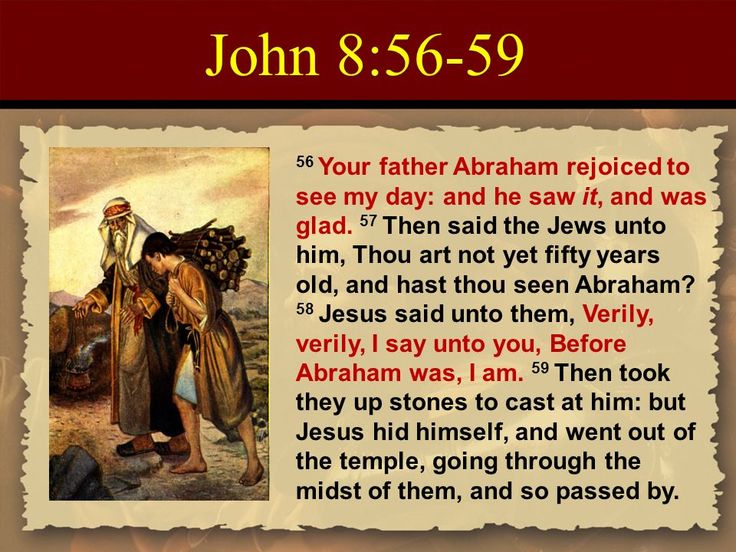
Question 66
It’s all about the money! I don’t care about your Christianity! Now, the United States is the richest and most economically powerful majority Christian country in the world. So, why not teach your “financial holiness” and fairness and equality principles there, given that I’m sure the United States does not treat other races/religions/languages fairly in general?
My Reply 66
As usual, I will speak with data and facts instead of just empty opinion based claims. Yes, nepotism exists anywhere in the world when some majority race/religion/language dominates something in some way. I will show that USA is not that bad compared to many other places in the world in “relative measure”.
Fact 1: Assume your motherland is country X. Now, given today’s free globe, and not by force, how many individuals in the world, if given a job and the average wage of your country X, would “willingly” relocate? Isn’t the USA a popular choice? This is significant since our forefathers were forced to migrate to particular nations due to harsh life situations, and we, too, do not want to return to our homelands knowing that the living standards are usually lower, right? So, a majority Christian country USA is top choice while those of us with no other choice have to survive in wherever we are.
That’s not necessarily a bad thing from a faith standpoint because if we are discriminated against for being vocal about our Christian faith, it’s like “living martyrdom” and God knows how to reward that in His Kingdom because it’s easier to live as a Christian in a place where the majority is Christian or where those of the same race as you have economic power and more difficult otherwise (the principle of relative measure, e.g. Luke 21:1 – 3).
Fact 2: Here’s an actual respectable research showing that the USA’s economic pie is shared pretty fairly across different races/religions/languages, especially when compared to many other “motherlands” where can they show a similar reliable statistic likewise showing how their homeland peoples have welcomed “strangers/foreigners” to have such “equal or good income opportunity”? So, who is a nepotist, racist, or bigot here in the United States or in those “motherlands”?
💰 U.S. Religious Groups Earning $100,000+ Annually
Millionaire / High-Income Distribution by Religion (U.S.)
Definition: Households earning $100,000 or more per year (proxy for high-income/millionaire households).
Jewish: 44%
Hindu: 36%
Episcopalian: 35%
Presbyterian: 31%
Evangelical Lutheran Church in America: 30%
United Methodist Church: 29%
Roman Catholic: 28%
Mainline Protestant: 27%
Religiously Unaffiliated: 26%
Buddhist: 25%
Muslim: 24%
Mormon: 23%
Black Protestant: 20%
Jehovah’s Witnesses: 4%
Church of God in Christ: 9%
National Baptist Convention: 9%
Source: https://www.pewresearch.org/short-reads/2016/10/11/how-income-varies-among-u-s-religious-groups/
Data meaning here (example): Example: Jewish Americans – 44% earning $100,000+ annually. Suppose there are 2 million Jewish American households in the U.S. (hypothetical for illustration). The statistic says 44% of Jewish American households earn $100,000 or more per year. This is a proportion of the total group, not the U.S. population.
Note: There’s no use in digging up Westerners’ “colonial past” (which was unbiblical) because it doesn’t exist anymore and none of those sorts are still living and dominating your motherlands, right?
Also, despite being a minority in terms of population size, Jews end up exceedingly affluent on a “fair economic turf” because they will invent something new or be a pioneer in some new endeavor via hard effort. Many others simply “copy” and sell Western and Jewish innovations, technology, etc. to generate money. Simply look at any list of innovations to learn who invented them and how others copied and profited from those originals. The Jews who sin are terrible, but the better ones are also very decent.
The percentages for each sub-group shown in this USA data earlier appear to be relatively close to one another, implying that income distribution at the top levels appears to be fair. So, in the “higher income levels”, USA as a Christian country seems to be pretty fair, isn’t it?
Fact 3: Let’s look at Malaysia’s official government data next.
Household Income by Ethnicity (Malaysia)
Ethnic Group Median Monthly Household Income (MYR)
Bumiputera 11,819
Chinese 16,392
Indian 13,272
Others 9,584
Source (combined): http://www.ceicdata.com/en/malaysia/household-income-and-basic-amenities-survey-monthly-gross-income-household-group-median-and-mean-by-ethnic-group/hibas-monthly-gross-income-median-top-20-bumiputera
Note: Median income figures cited for Malaysia (from DOSM, CEIC, etc.) represent household income, not individual income. Household income is total income of all members living in a single household. Includes salaries, business income, pensions, investments, etc., combined for everyone in that household. Example: A Malay household with 2 adults and 2 children earning RM2,500/month each adult → household income = RM5,000/month.
Top & Bottom Income Distribution by Ethnic Group
Chinese Malaysians: 56.5% of top 1% income earners
Bumiputera Malaysians: 70% of bottom 50% income earners
Source (combined): http://wid.world/news-article/income-inequality-and-ethnic-gaps-persist-in-malaysia-2016-2022
Careful interpretation: This evidence does not support the claim that bumiputera are poorer than Indians in general. Why? The median salary is lower because many bumiputera work in the government sector, whereas say Indians work in the private sector, usually on the lower pay jobs. However, government sector bumiputera personnel often receive a pension after retirement till death, implying that poorer Indians’ incomes do not equal that amount in total when averaged up over years of no income after retirement. Are you able to “see” it? The Chinese frequently have enough after retirement (compared to other races), as evidenced by simply glancing about in Malaysia at the elderly and their lives or bank balances.
Fact 4: How about a global millionaires survey?
Global Millionaires by Religion (2015)
According to a 2015 study by New World Wealth, the religious affiliations of the world’s 13.1 million millionaires were:
Christians: 56.2%
Muslims: 6.5%
Hindus: 3.9%
Jews: 1.7%
Other religions or no religion: 31.7%
Sources (Full Links)
https://newworldwealth.com/
https://media.enikonomia.gr/data/files/00d7237e8f03b3c7a94c0fdfb2431006.pdf
https://billhigh.com/culture/what-is-the-religion-of-millionaires/
https://populationeducation.org/world-population-by-religion-a-global-tapestry-of-faith/
https://www.lauramaigainor.com/post/does-believing-in-god-make-you-more-likely-to-be-a-millionaire-for-two-religions-maybe
https://time.com/3972744/china-india-millionaires-migration-report-wealth/
https://historyofislam.org/economy/
Conclusion
So, if money is an indicator of God’s approval, Christianity must be number one on a global scale in terms of “millionaires,” correct? If you do not believe that money is God’s approval, then you should not discriminate against or look down on poorer Christians around the world, right? The genuine Biblical stewardship regarding money and New Testament Commands regarding it, particularly by Lord Jesus Christ, I have already mentioned in a prior post, links:
i) Facebook
https://www.facebook.com/jonathan.ramachandran/posts/pfbid0aUcdQB7zhJ6oT5or2rHkiFdnpRmJVGoNR2oHazqjcf3ThJ3pDQX2VDRLjikcHHXel
and
https://www.facebook.com/jonathan.ramachandran/posts/pfbid021XKyU4c5sSfs29BQ3M6FCL56JAsFYPu4NtEnwvng4ab136HUF1rrHoNLCeLi4nNal
ii) Website
https://www.anonymouschristian.org/blog/are-we-holy-financial-holiness-with-new-testament-context-no-short-cuts/
What’s my point? It is not how much you earn, but how much “charity doctrine” you live out “willingly” that will distinguish Christ’s “little flock,” as He Himself prophesied straight here, verses:
“But seek the kingdom of God, and all these things shall be added to you. Do not fear, little flock, for it is your Father’s good pleasure to give you the kingdom. Sell what you have and give alms; provide yourselves money bags which do not grow old, a treasure in the heavens that does not fail, where no thief approaches nor moth destroys. For where your treasure is, there your heart will be also. Let your waist be girded and your lamps burning” – Most Blessed Lord Jesus Christ (Luke 12:31 – 35, NKJV)
“No one can serve two masters. Either you will hate the one and love the other, or you will be devoted to the one and despise the other. You cannot serve both God and money.”- Most Blessed Lord Jesus Christ (Matthew 6:24, NKJV)
“Heaven and earth will pass away, but My words will by no means pass away.”- Most Blessed Lord Jesus Christ (Matthew 24:35, NKJV)
This fact I have discussed in detail in my book as well [1].
[1] Ramachandran, Jonathan. ESSAYS IN EARLY CHRISTIANITY: Chiliasm Prophecy Model and Non-Elect Salvation Possibility. (Cambridge, Ohio, USA: Christian Publishing House, 13 July 2025): pages 198-200. ISBN 9781949586435. Link: https://www.amazon.com/dp/1949586421
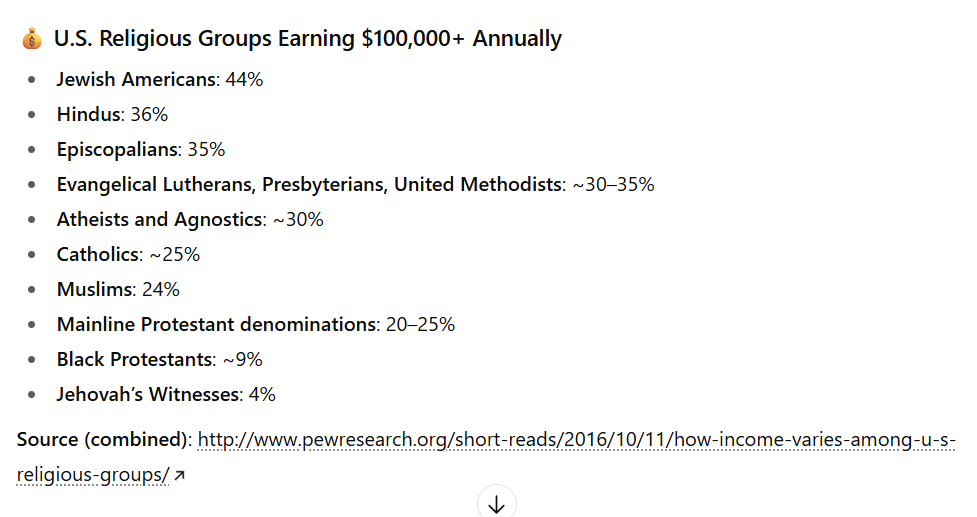
Question 68
“Nepotist Self Test (Numbers don’t lie): How much of money (possessions) do we give monthly and even overall in a lifetime to family, friends, same race/religion/language bias, church, ministry and beyond that to charity, strangers and enemies since Christ measures “faithfulness to God” based on this “money-spending”?”
My Reply 68
Christ taught that serving God with money included sharing “money” with others:
“Here’s the lesson: Use your worldly resources to benefit others and make friends. Then, when your possessions are gone, they will welcome you to an eternal home. 10“If you are faithful in little things, you will be faithful in large ones. But if you are dishonest in little things, you won’t be honest with greater responsibilities. 11And if you are untrustworthy about worldly wealth, who will trust you with the true riches of heaven? You cannot serve God and be enslaved to money.” (Luke 16:9, 10-11, 13, NLT)
Lord Jesus stressed “lend” (give money) not only to family, friends, or people of the same race/religion/language bias, church (or denomination exclusively), but even “enemies,” emphasizing the Charity Doctrine lifestyle here:
“32“But if you love those who love you, what credit is that to you? For even sinners love those who love them. 33And if you do good to those who do good to you, what credit is that to you? For even sinners do the same. 34And if you lend to those from whom you hope to receive back, what credit is that to you? For even sinners lend to sinners to receive as much back. 35But love your enemies, do good, and lend, [h]hoping for nothing in return; and your reward will be great, and you will be sons of the Most High. For He is kind to the unthankful and evil.” (Luke 6:32-35, NKJV)
*”Give money” can also include the context of giving job to those not of the same race/religion/language bias, church (or denomination exclusively), but even “enemies,” but freewill giving has its own distinctive greatness since you’re giving your hard earned money to someone who did not work nor benefit you financially even!
Apostle St. Paul also confirms that the “righteous” all have this general “Charity Doctrine” trait of “giving to the poor” quoting the old testament prophecy into the new testament here (for Christians), compare:
“ 9As it is written: “He has dispersed abroad, He has given to the poor; His righteousness endures forever.” (2 Corinthians 9:9, NKJV)
“9He has dispersed abroad, He has given to the poor; His righteousness endures forever; His [c]horn will be exalted with honor. 10The wicked will see it and be grieved; He will gnash his teeth and melt away; The desire of the wicked shall perish.” (Psalm 112:9-10, NKJV)
Remember that a ‘small giving’ that barely converted anyone can be “bigger” than a rich’s giving that converts or feeds many, as Christ commended in the “relative measure” principle, and so, no one is at any advantage or disadvantage due to wealth because God rewards fairly based on this (yes, He counts like this perfectly!), verse:
“Truly I [Jesus] say to you that this poor widow has put in more than all; 4for all these out of their abundance have put in offerings [b]for God, but she out of her poverty put in all the livelihood that she had.” (Luke 21:3 – 4, NKJV).
Notice that these are the things spoken of in Holy Scripture regarding money and so, let’s not be deceived otherwise! This is not to condemn anyone as I also am at the bottom and learning. It’s to bring awareness to “follow Christ” in these direct “commands” of his too as “it is written”.

TQ.
Question 69
I admire how active our political leaders are in human rights debates.
My Reply 69
This debate initiative looks more like “YYY Rights” rather than genuine “Human Rights.” Ask them to refute this: these same YYY discourage people from freely changing their religion but still claim to uphold “human rights,” which is contradictory.
The correct approach is to encourage freewill without prejudice. For example, ask how much of their monthly salary or organizational budgets are actually used to help non-YYY communities. In their own homeland region, how many non-YYY people are supported to live and thrive well?
This matters because if their philosophy of ZZZ (cause-and-effect belief like “Karma”) is taken seriously, it would imply they are “in the wrong” since other societies (such as in the West) display more inclusivity, assist multiple groups, and maintain higher living standards overall. The true measure of human rights is how well minority groups (especially in religion and race context) are given opportunities and treated fairly in that homeland.
Typically, majority groups tend to marginalize others (often informally [unwritten] but widely practiced), whereas healthier societies reduce this imbalance.
Verses Against Oppression, Racism & Bullying
1. Exodus 22:21 – “Do not mistreat or oppress a foreigner, for you were foreigners in Egypt.”
2. Leviticus 19:33–34 – “When a foreigner resides among you in your land, do not mistreat them. The foreigner residing among you must be treated as your native-born. Love them as yourself…”
3. Deuteronomy 10:17–19 – God defends the cause of the fatherless, the widow, and loves the foreigner. Israel is commanded to love the foreigner also.
4. Zechariah 7:10 – “Do not oppress the widow or the fatherless, the foreigner or the poor. Do not plot evil against each other.”
5. Malachi 3:5 – God warns He will bring judgment against those who oppress foreigners, widows, and orphans.
God specifically mentions bullying the “wage earner,” which means something like racism in the context of “employment” (say, some race/religion/language bias favor their own for opportunities and discriminate against the rest), or even “lower salary or no job-hire for minority races” practice, etc., (so, these are not ‘small sins’ but ‘leads to Hell [“judgment”]), verses for this:
“Then I will draw near to you for judgment; and I will be a swift witness against the sorcerers and against the adulterers and against those who swear falsely, and against those who oppress the wage earner in his wages, the widow and the orphan, and those who turn aside the alien and do not fear Me,” says the LORD of hosts.” (Malachi 3:5, NKJV)
All true prophets of God spoke of social justice aspects especially protecting the “foreigner (alien, non-native of a land) and poor” and so, false prophets teach otherwise:
“ 9“Thus says the Lord of hosts: ‘Execute true justice, Show [g]mercy and compassion Everyone to his brother. 10Do not oppress the widow or the fatherless, The alien or the poor.” (Zechariah 7:9-10, NKJV)
________________________________________
Examples of People Facing Prejudice
6. Numbers 12:1 – Miriam and Aaron spoke against Moses because he married a Cushite (African) woman.
7. John 4:9 – The Samaritan woman is shocked that Jesus, a Jew, speaks to her: “For Jews do not associate with Samaritans.”
8. Acts 6:1 – The Greek-speaking widows were being overlooked in daily food distribution compared to the Hebrew widows.
9. Acts 10:34–35 – Peter declares: “I now realize how true it is that God does not show favoritism but accepts from every nation the one who fears him and does what is right.”
10. James 2:1–4 – Rebuke against favoritism: showing partiality to the rich while dishonoring the poor.
________________________________________
Principles of Equality in Christ
11. Galatians 3:28 – “There is neither Jew nor Greek, slave nor free, male nor female, for you are all one in Christ Jesus.”
12. Ephesians 2:14 – Christ “has made the two groups one and has destroyed the barrier, the dividing wall of hostility.”
13. Colossians 3:11 – “Here there is no Gentile or Jew, circumcised or uncircumcised, barbarian, Scythian, slave or free, but Christ is all, and is in all.”
14. Micah 6:8 – “He has shown you, O mortal, what is good. And what does the Lord require of you? To act justly and to love mercy and to walk humbly with your God.”
So, who likes to “honor God” and “how” to “honor God”? Here’s the Bible Verse:
15. Proverbs 14:31 – “Whoever oppresses the poor shows contempt for their Maker, but whoever is kind to the needy honors God.”
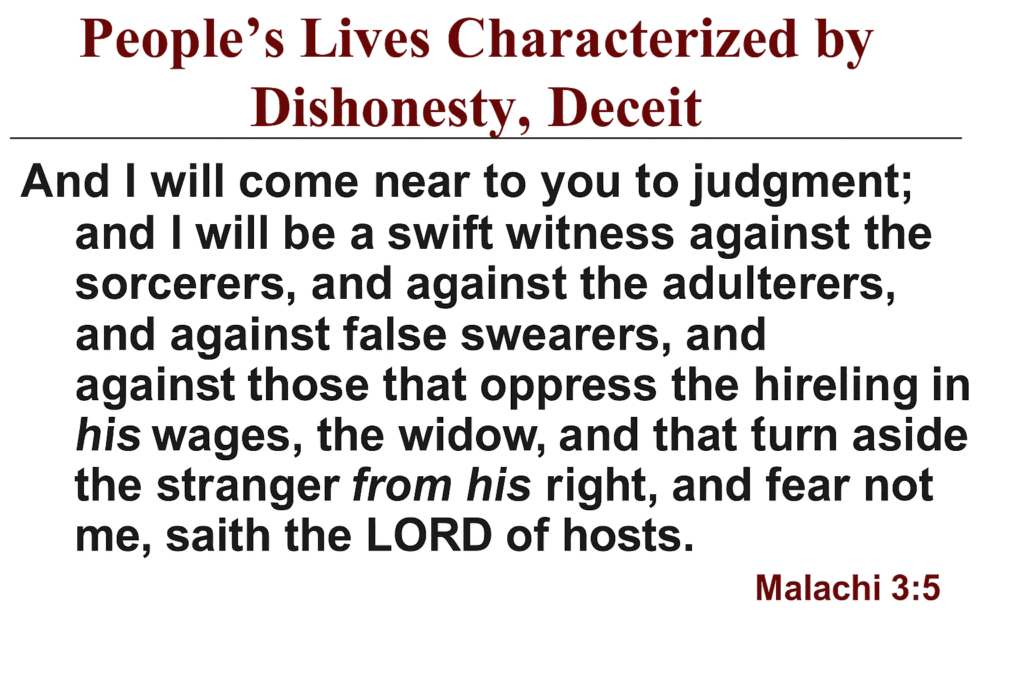
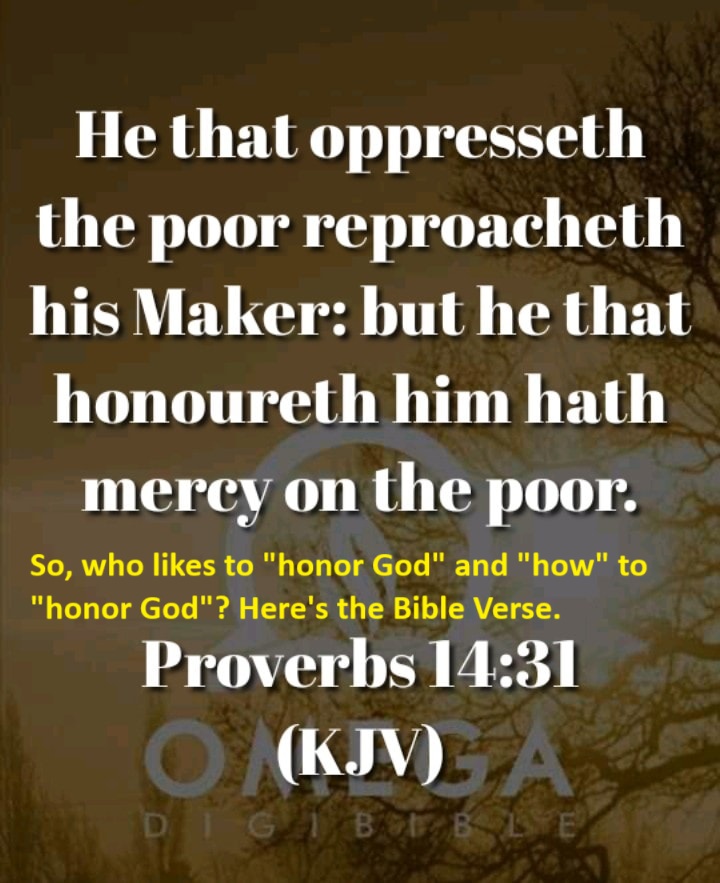
Question 72
What does it mean when Lord Jesus Said, “So likewise, whosoever he be of you that forsaketh not all that he hath, he cannot be my disciple.” (Luke 14:33, KJV)?
My Reply 72
Biblical Economics – The Untold Story of Abundant Life
Would God want you to be poor?
Why would Christ say this then, “Blessed are you poor, For yours is the kingdom of God. … 24“But woe to you who are rich, For you have received your consolation.” (Luke 6:20, 24, NKJV). If only “poor in spirit” is meant (Matthew 5:3), the comparison with the literal rich is unnecessary. So, the “poor in spirit” must refer to a specific type of believing rich.
To understand this, we must see the only command given beyond the holiness commands of Torah (Matthew 19:16-20) by Christ Himself which is “If you want to be perfect, go, sell what you have and give to the poor, and you will have treasure in heaven” (Matthew 19:21, NKJV) in order to attain to “spiritual perfection”. Yes, I did not achieve this due to my own selfish living but many of the Chiliasm Church Fathers and others I have quoted in my book [1] achieved this in some high degree as history testifies. So, just because I could not achieve it, Christ’s Words remain true regardless.
[1] Ramachandran, Jonathan. ESSAYS IN EARLY CHRISTIANITY: Chiliasm Prophecy Model and Non-Elect Salvation Possibility. Cambridge, Ohio, USA: Christian Publishing House, 13 July 2025. ISBN 9781949586435. Link: https://www.amazon.com/dp/1949586421
Also, if faith is linked to money and health, then why does the Bible also speak of the “Prosperity of the Wicked” (Psalm 73:3, NKJV) which has even the element of “7Their [b]eyes bulge with abundance; They have more than heart could wish.” (Psalm 73:7, NKJV) highlighting the common fallacy of linking earthly desires met as proof of “answered prayers or God’s approval” together with “no sickness in death nor in trouble like other men despite being evil” (Psalm 73:4-5) which could signify the typical earthly abundant life.
Now, the more curious part of the Bible here mentions these “rich ones” as “ungodly” but in the same breath stating “Who are always at ease; They increase in riches.” (Psalm 73:12, NKJV) refuting the new age law of attraction teachings nor the Prosperity Gospel versions that echo similarly where you’re chosen spiritually if you can make more money or equivalent.
Can the rich who are Christians with health and wealth be wrong?
Timothy was a true son of faith (1 Timothy 1:2) and God even caused extraordinary miracles through apostle Paul (Acts 19:11-12) but yet Timothy suffered illnesses which were treated with wine as medicine instead of getting instant healing (1 Timothy 5:23) and Paul himself had a strange “thorn in the flesh which originated with Satan” which Christ never allowed him to be healed of to keep him in check (2 Corinthians 12:7-8). So, healing or even wealth is sometimes not given even to those best in faith either so that they may more reward in heaven by enduring it rightly, Verses for this:
“7And lest I should be exalted above measure by the abundance of the revelations, a thorn in the flesh was given to me, a messenger of Satan to [b]buffet me, lest I be exalted above measure. 8Concerning this thing I pleaded with the Lord three times that it might depart from me. 9And He said to me, “My grace is sufficient for you, for My strength is made perfect in weakness.” Therefore most gladly I will rather boast in my infirmities, that the power of Christ may rest upon me. 10Therefore I take pleasure in infirmities, in reproaches, in needs, in persecutions, in distresses, for Christ’s sake. For when I am weak, then I am strong.” (2 Corinthians 12:7-10, NKJV)
In these same verses, Paul speaks of the Charity Doctrine Lifestyle of how real Christian leaders are servants in financial context as well where they try to use their income and ability to raise money not to pocket it as love offerings in the name of God for them & family only but rather to give it to other Christians too here as parents do for children analogy:
“And I will not be burdensome to you; for I do not seek yours, but you. For the children ought not to lay up for the parents, but the parents for the children. 15And I will very gladly spend and be spent for your souls; though the more abundantly I love you, the less I am loved. 16But be that as it may, I did not burden you. Nevertheless, being crafty, I caught you by cunning! 17Did I take advantage of you by any of those whom I sent to you?” (2 Corinthians 12:14-17, NKJV)
Look at these verses:
“17Because you say, ‘I am rich, have become wealthy, and have need of nothing’—and do not know that you are wretched, miserable, poor, blind, and naked— 18I counsel you to buy from Me gold refined in the fire, that you may be rich; and white garments, that you may be clothed, that the shame of your nakedness may not be revealed; and anoint your eyes with eye salve, that you may see.” (Revelation 3:17-18, NKJV)
Christ Said in these Revelation verses that these Christians (not unbelievers) are rich in earthly wealth and perfect in bodily health since they look at those outward signs and think that they are in need of nothing but yet do not realize that they are spiritual poor. Yet again we see here that having lots of money and being disease free does not necessarily indicate any closeness to God nor that these show His approval even in a Christian context! These Christians were lukewarm but that is a very broad definition which can include any sin including financial holiness.
In fact the phrase “white garments” can point to context of attaining to holiness commands while being “poor” (spiritually meant since these are said to be “rich” earthly wise first here) together with Christ’s exhortation to “buy gold refined in fire” can mean suffering for Christ in some way and not ease & prosperity which certainly can include His charity doctrine commands too since only this relates to being spiritually rich with “treasures in heaven” as His other words echo.
Is Charity Doctrine equivalent to martyrdom? Consider these verses:
“For whoever desires to save his life will lose it, but whoever loses his life for My sake will find it.” (Matthew 16:25, NKJV)
“Greater love has no one than this, than to lay down one’s life for his friends.” (John 15:13, NKJV)
“16By this we know love, because He laid down His life for us. And we also ought to lay down our lives for the brethren. 17But whoever has this world’s goods, and sees his brother in need, and shuts up his heart from him, how does the love of God abide in him? 18My little children, let us not love in word or in tongue, but in deed and in truth.” (1 John 3:16-18, NKJV)
Christ’s love is greatest and has no equal. To emulate Christ’s love, the Holy Spirit choses the Primary Charity Doctrine act of “sharing this world’s goods” as equivalent to “lay down our lives for others” to “follow Christ” in this which makes it curiously equal to the martyrdom phrase of “losing our life for Christ” literally here!
Is hoarding wealth a sin?
Christ Said those who hoard up for themselves are not rich toward God.
“So is he who lays up treasure for himself, and is not rich toward God.” (Luke 12:21, NKJV)
Apostle James echoes the same that it will “eat your flesh like fire” with the sole reason given that “such gold & silver hoarding” (in modern terms, money) is disallowed in these “last days” (covenantal new testament times meaning those of old testament who did the same are excused just like polygamy etc.) especially in the context of “living in luxury and pleasure” here:
“1Come now, you rich, weep and howl for your miseries that are coming upon you! 2Your riches [a]are corrupted, and your garments are moth-eaten. 3Your gold and silver are corroded, and their corrosion will be a witness against you and will eat your flesh like fire. You have heaped up treasure in the last days. 4Indeed the wages of the laborers who mowed your fields, which you kept back by fraud, cry out; and the cries of the reapers have reached the ears of the Lord of [b]Sabaoth. 5You have lived on the earth in pleasure and [c]luxury; you have [d]fattened your hearts [e]as in a day of slaughter. 6You have condemned, you have murdered the just; he does not resist you.” (James 5:1-6, NKJV)
Note: These verses are not condemning the Christian rich (context, James 2 onward) for unfair wages (James 5:4) or “murder” only (James 5:6) but also for “hoarding wealth” (James 5:3) and also “luxury” (James 5:5). To argue that it refers to only those who practice unfair wages then it must equivalently only refer to those who committed murder here since both are mentioned here which is absurd. The proper meaning is that the Bible verses here is mentioning these primary sins done by the rich at that time and each of these is sin individually especially in these “last days” or new testament timeline onward (James 5:3).
Can’t we save up for old age? Yes, you can. The Bible is speaking of “love your neighbour as yourself” context together with “love God” command alone is equal to fulfilling “all law” as Christ Said in Mark 12:29-31 & Matthew 22:36-40. So, if you use some of your hoarding up for yourself and others especially if beyond family too that can be loving others as yourself! Other ways can be like buying an equal meal of yours for others when you eat to sharing of other things likewise which are great ways for this but are often neglected due to lack of awareness.
This linking of the greatest commands to “love God & love your neighbour as yourself” to ‘charity doctrine’ is not a private nor a stretched out interpretation but rather what Christ Himself taught in the Parable of the Good Samaritan beyond his own race/religion/language bias toward his enemy even (a Jew) regarding ‘what to do for eternal life?’ (implying the “fruit” part) which ironically, was ignored by the church-attending/God-worshipping “Levite and Priest” even, verses:
“25And behold, a certain [h]lawyer stood up and tested Him, saying, “Teacher, what shall I do to inherit eternal life?” 26He said to him, “What is written in the law? What is your reading of it?” 27So he answered and said, “ ‘You shall love the Lord your God with all your heart, with all your soul, with all your strength, and with all your mind,’ and ‘your neighbor as yourself.’ ”28And He said to him, “You have answered rightly; do this and you will live.”29But he, wanting to justify himself, said to Jesus, “And who is my neighbor?”30Then Jesus answered and said: “A certain man went down from Jerusalem to Jericho, and fell among [i]thieves, who stripped him of his clothing, wounded him, and departed, leaving him half dead. 31Now by chance a certain priest came down that road. And when he saw him, he passed by on the other side. 32Likewise a Levite, when he arrived at the place, came and looked, and passed by on the other side. 33But a certain Samaritan, as he journeyed, came where he was. And when he saw him, he had compassion. 34So he went to him and bandaged his wounds, pouring on oil and wine; and he set him on his own animal, brought him to an inn, and took care of him. 35On the next day, [j]when he departed, he took out two denarii, gave them to the innkeeper, and said to him, ‘Take care of him; and whatever more you spend, when I come again, I will repay you.’ 36So which of these three do you think was neighbor to him who fell among the thieves?” 37And he said, “He who showed mercy on him.” Then Jesus said to him, “Go and do likewise.” (Luke 10:25-37, NKJV)
That’s why after Pentecost, the church had all possessions in common meaning their financial holiness is hitting the highest levels since those richer among them continued to work and supply to those poorer without arguing about who deserves more.
“44Now all who believed were together, and had all things in common, 45and [o]sold their possessions and goods, and divided[p] them among all, as anyone had need.” (Acts 2:44-45, NKJV)
“Now the multitude of those who believed were of one heart and one soul; neither did anyone say that any of the things he possessed was his own, but they had all things in common.” (Acts 4:32, NKJV)
Notice that this “Church donation money” was used for the “need” of every member of the church and not just for pastor’s needs only something which is almost non-existent in modern church practice. How is it fair to those who worked harder then? They gain more of eternal treasure in heaven since Christ Said that, “it is more blessed to give than to receive”.
In fact, in one of his last inspired Scripture sermons, apostle Paul clearly mentions this “inheritance among all those who are sanctified” (final heavenly reward context) which is only for those who are “sanctified” even in the financial holiness context of living out the ‘Charity Doctrine Lifestyle’ which is signified by the phrases “these hands have provided for my necessities, and for those who were with me … laboring like this, that you must support the weak … more blessed to give than to receive”, here:
“32“So now, brethren, I commend you to God and to the word of His grace, which is able to build you up and give you an inheritance among all those who are sanctified. 33I have coveted no one’s silver or gold or apparel. 34[i]Yes, you yourselves know that these hands have provided for my necessities, and for those who were with me. 35I have shown you in every way, by laboring like this, that you must support the weak. And remember the words of the Lord Jesus, that He said, ‘It is more blessed to give than to receive.’ ” (Acts 20:32-35, NKJV)
The same God who said “don’t store your treasure on earth but rather in heaven” (Matthew 6:19) cannot be whispering to say, “be rich and enjoy life with earthly luxury pleasure”, right? Also, the same God who said, “don’t love the things of this world” (1 John 2:15 next) cannot be saying, ‘buy a bigger house or bigger car or more of this and that increasing your desires more than your need (beyond the earlier functioning moderate house and car which you already have, right?)’
“Do not love the world or the things in the world. If anyone loves the world, the love of the Father is not in him.” (1 John 2:15, NKJV)
This is not a grey area or special case nor a small sin because the Bible actually says that “those who love the things of this world” which includes chiefly the “Prosperity Gospel” idea of “more wealth part beyond need” is indication of “not having the Love of the Father” in 1 John 2:15. So, how do such ones have the Holy Spirit and are saved?
Conclusion
“1And He looked up and saw the rich putting their gifts into the treasury, 2and He saw also a certain poor widow putting in two mites.[a] 3So He said, “Truly I say to you that this poor widow has put in more than all; 4for all these out of their abundance have put in offerings [b]for God, but she out of her poverty put in all the livelihood that she had.” (Luke 21:1-4, NKJV)
Christ did not condemn the poor widow who gave only 2 coins into the temple (church at that time) which hardly fed any nor impacted the finance of any missions or conversion works since it is “small in value” (thinking in analogy). But surprisingly, Christ Said that her giving is more than the “rich” (particularly mentioned) who “gave out of their abundance” (abundant life from an earthly perspective) in Luke 21:1-3.
So, this is fair “relative measure” principle which shows that final heavenly rewards and the “abundant life” Christ Spoke of is ‘spiritual and not earthly’ (John 10:10) indicating peace on earth amidst troubles or poverty even (“In the world you will have tribulation; but be of good cheer, I have overcome the world.” [John 16:33]). We know that the “abundant life” Christ spoke of is “not both earthly and spiritually” but “only spiritually” since His own words reveal this when He Said,
“15And He said to them, “Take heed and beware of [c]covetousness, for one’s life does not consist in the abundance of the things he possesses.” (Luke 12:15, NKJV).
Notice that Christ didn’t say that a dot of earthly possessions is part of “abundant life” in His own definition here meaning that’s not part of it at all.
Who are the “little flock” Christ mentioned? This phrase only occurs once in Scripture in Luke 12:32 and Christ did not mention it to refer specifically while discussing the topic of “faith alone” or “grace alone” or “speaking in tongues” or “miracles” or “being rich with money/healthy” or “those who attend church” etc. So, what is it?
Every righteous act has its reward if it applies in New Testament context but the “little flock” phrase Christ only applied to the “Charity Doctrine Sheep” (Luke 12:32-33, this is why I believe that Christians from any mainstream denominations which believe in the common Apostle’s Creed and Nicene Creed may be saved especially if they have this specific financial holiness fruit by relative measure, meaning for a married woman it can be raising kids too*), Verses:
“32“Do not fear, little flock, for it is your Father’s good pleasure to give you the kingdom. 33Sell what you have and give alms; provide yourselves money bags which do not grow old, a treasure in the heavens that does not fail, where no thief approaches nor moth destroys. 34For where your treasure is, there your heart will be also.” (Luke 12:32-34, NKJV)
Last but not least, I repeat here that Luke 12 seek kingdom of God context with “little flock” definition refers to Charity Doctrine Sheep by Christ.
*In the Bible, we find this description for financial holiness context for a “widow” even (which is largely a marginalised group who may either not even get a job easily or able to do tough physical job with low salaries only), verses:
“9Do not let a widow under sixty years old be taken into the number, and not unless she has been the wife of one man, 10well reported for good works: if she has brought up children, if she has lodged strangers, if she has washed the saints’ feet, if she has relieved the afflicted, if she has diligently followed every good work.” (1 Timothy 5:9-10, NKJV)
Notice that this description of a “Biblical Christian Widow” who may be helped with church money for their old age when she is unable to work is conditional to the financial holiness commands of “brought up children” (so, housewives can fulfill this too) where further by relative measure, meaning richer ones are also expected to “lodge strangers”, “relieved the afflicted” and to do “every other good work” which clearly includes the “Charity Doctrine” deeds beyond “family only” since this includes loving neighbours, strangers and enemies even with “money” (lend/give) without “expecting anything in return as Christ taught elsewhere here:
“32“But if you love those who love you, what credit is that to you? For even sinners love those who love them. 33And if you do good to those who do good to you, what credit is that to you? For even sinners do the same. 34And if you lend to those from whom you hope to receive back, what credit is that to you? For even sinners lend to sinners to receive as much back. 35But love your enemies, do good, and lend, [h]hoping for nothing in return; and your reward will be great, and you will be sons of the Most High. For He is kind to the unthankful and evil.” (Luke 6:32-35, NKJV)
So, if this level of financial holiness with Charity Doctrine giving is expected as “fruit of sanctification” unto eternal life out of a “widow”, then how about any other “man or woman” likewise? That’s why apostle Paul (the real preacher of “faith alone”) wrote these next “Charity Doctrine verses” of “do good, that they be rich in good works, ready to give, willing to share” at a ‘rich level beyond usual levels’ to the “rich” (implying relative measure that God requires more from those who have more too, Luke12:48) as part of the “fight the good fight of faith”, Verses:
“12Fight the good fight of faith, lay hold on eternal life, … 17Command those who are rich in this present age not to be haughty, nor to trust in uncertain riches but in the living God, who gives us richly all things to enjoy. 18Let them do good, that they be rich in good works, ready to give, willing to share, 19storing up for themselves a good foundation for the time to come, that they may lay hold on eternal life.” (1 Timothy 6:12, 17-19, NKJV)
Did you know apostle Paul himself practiced Charity Doctrine for “Sanctification” (“found me purified”) Context in verses next when he gave money and offerings not just to other churches but also to his own “nation” which consists of “unbelieving Jews”? Here’s that verse:
“17“Now after many years I came to bring alms and offerings to my nation, 18in the midst of which some Jews from Asia found me purified in the temple, neither with a mob nor with tumult.” (Acts 24:17-18, NKJV)
The phrase “found me purified” after this Charity Doctrine context means that this applies even after Christ’s Resurrection and in New Testament timeline for Sanctification where the giving can even include and be directed to “unbelievers” (like those Jews there) for alms toward Christians and non-Christians alike as Christ also directly taught this specific “Charity Doctrine(alms context)” in here:
“But give as alms those things that are within, and behold, everything is clean for you.” (Luke 11:41, ESV)
In regard to “jealousy”, maybe those Christian rich on earth who cannot attain to much treasures in heaven purposely discriminate those poorer Christians with Charity Doctrine since the latter may attain to “more eternal treasures” in heaven while the former only more perishable earthly treasures. So, being angry they discriminate the poorer ones and try to further practice non-job hire or bully them at work for such unfortunate ones whether in secular jobs or ministry jobs because they are “jealous” that those latter ones may attain to higher heavenly ranking or rewards (Matthew 5:19).
A final note in regard to heavenly ranking can be seen with the example of the 144000. Here’s a quote from my recent book to help understand this better:
“As many church fathers have pointed out, the 144,000 are unmarried, and how many people in history who have converted many to Christianity were virgins and Jewish by descent? Is there a single example of such a person inside our own church or denomination? This, combined with the terms “no deceit” and “without fault,” which are used in these verses to characterize them, shows that the quantity of converts in our church does not determine one’s proximity to God, but rather accurate prophetic and doctrinal truth. This is because we can hardly think of anyone who converted many people to Christianity that fits this scriptural description. This is consistent with both the prophecy of St. Clement of Rome (page 11) and Daniel 12:3.” [2]
[2] Ramachandran, Jonathan. ESSAYS IN EARLY CHRISTIANITY: Chiliasm Prophecy Model and Non-Elect Salvation Possibility. (Cambridge, Ohio, USA: Christian Publishing House, 13 July 2025): page 386. ISBN 9781949586435. Link: https://www.amazon.com/dp/1949586421
God is Fair because only in this manner we see that heavenly treasures is attainable by Charity Doctrine by “relative measure” (where no other righteous act is ever mentioned by Christ for it for if there were an alternative or other things important for this, He would have certainly mentioned it but He didn’t).
Contentment and Modern Strategy of Will writing: God knows who has more riches and who do not. So, it’s understandable that relatively poorer ones with smaller income, smaller bank balances, no pensionable jobs, smaller or no EPF based salaries etc. have higher relative measure in their giving. Likewise those having more of any of these including possessions can write a will at end of life in addition to their monthly or freewill giving to distribute to family, church or ministry or charity including causes to strangers too beyond race/language/denominational bias to “follow Christ” in His financial commands.
Apostle Paul himself with his miracle fruitiness great faith itself did not guarantee any money providence since he had times with more money vs times with lesser finances, verses:
“9The things which you learned and received and heard and saw in me, these do, and the God of peace will be with you. 10But I rejoiced in the Lord greatly that now at last your[c] care for me has flourished again; though you surely did care, but you lacked opportunity. 11Not that I speak in regard to need, for I have learned in whatever state I am, to be content: 12I know how to [d]be abased, and I know how to [e]abound. Everywhere and in all things I have learned both to be full and to be hungry, both to abound and to suffer need. 13I can do all things through [f]Christ who strengthens me. 14Nevertheless you have done well that you shared in my distress. 15Now you Philippians know also that in the beginning of the gospel, when I departed from Macedonia, no church shared with me concerning giving and receiving but you only.” (Philippians 4:9-15, NKJV)
In these Verses we see the Biblical Doctrine of contentment as the financial holiness state meaning the desire to have more and more money/wealth/possessions/luxury is not of God (verse 11). Time and chance regulates who becomes rich/poor (Ecclesiastes 9:11) as apostle Paul implies here he experienced both (verse 12) meaning his constant and great faith didn’t make him rich all the time nor did it spare him of financial sufferings (verse 12). The famous lingo of “I can do all things in Christ” doesn’t mean positive talk brings money since here it also refers to his financial difficulties and suffering state too meaning his faith is unaffected by earthly situations.
Basically, apostle Paul says that money wise we can be rich or poor independent of our faith since wealth is not guaranteed based on faithfulness to God and neither is poverty of suffering even “need-level”, [not wants] is a curse either (verses 11 – 12). The more important thing is “Charity Doctrine” as the dominant financial will of God (verse 10, 14) which is modelled empirically here as “Paul follows Christ” in order to have the “God of Peace” to be with us (verse 9) which some churches ignore even back then (verse 15) probably because they’re richer and so, don’t want the poorer ones to have same benefit as them or because the poorer ones may not be of their same race/language/denomination (in modern equivalence) and so, they prefer helping or spending money for evangelizing or helping their own kind only.
As we saw in other verses, if this is unchecked, can lead to hell since “treasure in heaven” links to “revealing heart” (Matthew 6:21, Luke 12:34) meaning a “good heart relatively” (since no one is absolutely God except God Alone, Matthew 19:17) will do more Charity Doctrine of “give to the poor” as Christ (not mere men) revealed in several key verses (Matthew 19:21, Luke 12:33, Luke 11:41) while in other cases can lead to eternal loss of rewards even if saved since Christ already warned, “Whoever therefore breaks one of the least of these commandments, and teaches men so, shall be called least in the kingdom of heaven” (Matthew 5:19, NKJV) which is found in the deeper “Great Commission” part of “teaching them to observe all things that I have commanded you” (Matthew 28:20, NKJV)
Remember, Christ didn’t say in the context of finance that ‘spiritual perfection’ is having ‘more money’ but rather the opposite of ‘more Charity Doctrine’ correcting ancient misconceptions here:
“Jesus said to him, “If you want to be perfect, go, sell what you have and give to the poor, and you will have treasure in heaven; and come, follow Me.” (Matthew 19:21, NKJV)
“But rather give alms [Charity Doctrine]** of such things as you have; then indeed all things are clean to you.” (Luke 11:41, NKJV)
**Emphasis mine.
“33Sell what you have and give alms; provide yourselves money bags which do not grow old, a treasure in the heavens that does not fail, where no thief approaches nor moth destroys. 34For where your treasure is, there your heart will be also.” (Luke 12:33-34, NKJV)
Comment: In short, if you want to see a person’s “heart”, see the level one lives their “Charity Doctrine Lifestyle” even in ‘secret’ as Christ Himself teaches here (not me) in Luke 12:33-34.
“Whoever therefore breaks one of the least of these commandments, and teaches men so, shall be called least in the kingdom of heaven; but whoever does and teaches them, he shall be called great in the kingdom of heaven.” (Matthew 5:19, NKJV)
In regard to the warning in the next Bible verse, I do not follow Prosperity Gospel preachers since they did not fulfil all these commands of Christ listed above when compared to the say, Chiliasm Church Fathers whose writings has become also my teacher together with the Primary Bible verses, here:
“My brethren, let not many of you become teachers, knowing that we shall receive a stricter judgment.” (James 3:1, NKJV)
Comment: some rich Bible teachers live beyond needs with too big salary and donation collections within Christianity and don’t need to work for the rest of their lives also but still continue to hoard for family etc. How does it align with financial holiness verses by Christ here? So, I avoid all these risky paths.
Here’s a largely ignored verse by Christ directly linking the faith of “letting go of possessions” (not getting richer or attaining to luxury, the opposite path) as a must condition for all his “disciples” (please recall that the ‘Great Commission’ call of Matthew 28:20 is to make “disciples” and so, must include Christ’s definitions first before other unwritten type of works which God may or may not approve but is based on human freewill to do something for God’s sake, right?), Verse (Luke 14:33) in a few translations here:
New International Version
In the same way, those of you who do not give up everything you have cannot be my disciples.
New Living Translation
So you cannot become my disciple without giving up everything you own.
English Standard Version
So therefore, any one of you who does not renounce all that he has cannot be my disciple.
King James Bible
So likewise, whosoever he be of you that forsaketh not all that he hath, he cannot be my disciple.
New King James Version
So likewise, whoever of you does not forsake all that he has cannot be My disciple.
New American Standard Bible
So then, none of you can be My disciple who does not give up all his own possessions.
A haunting question: How can a “disciple of Christ” say they’re fulfilling this verse if their possessions (skills, wealth etc.) are not used much in percentage or relative measure to fulfil some Commands of Christ? (As we have seen, especially when Lord Jesus Christ’s commands on possessions aspect is chiefly “Charity Doctrine Lifestyle”?) This is not to condemn anyone since I am not perfect either but to bring awareness so that we may truly strive to fulfil God’s Will in this financial areas as well without which there may be no entrance to heaven either (Matthew 7:20-24).
Lord Jesus Christ declared:
“Heaven and earth will pass away, but My words will by no means pass away.” (Matthew 24:35, NKJV)
May God help us to believe all these as it is Written especially in New Testament verses and practice it according to the measure of faith and grace given to us (Romans 12:3). Maranatha! Even so come Lord Jesus, Amen.
#CoachJonathanRamachandran #HopeBeyondtheElectBook #JonReply72 @highlight
Indexing post listing all questions (including this):
https://www.facebook.com/jonathan.ramachandran/posts/pfbid0HWHCP8EYSphob2z9T4HGAZAfFSg2VdJWui4BjhbpmMAdHaC5AbFJeuMNcSUDigWkl
TQ.
I even made a YouTube video to support my application [1].
Here’s my sample writing regarding “financial holiness”, link:
https://drive.google.com/file/d/1xWJfDy2AeUzQuJla1yPVkcQXnuCJxyzB/view?usp=sharing
[1] i) YouTube link
ii) Download this Video link
https://drive.google.com/file/d/1HwmtKk-fhxiaXIZ4oJxkkaRfwFzMLFpI/view?usp=sharing
iii) Download the Powerpoint in this Video link
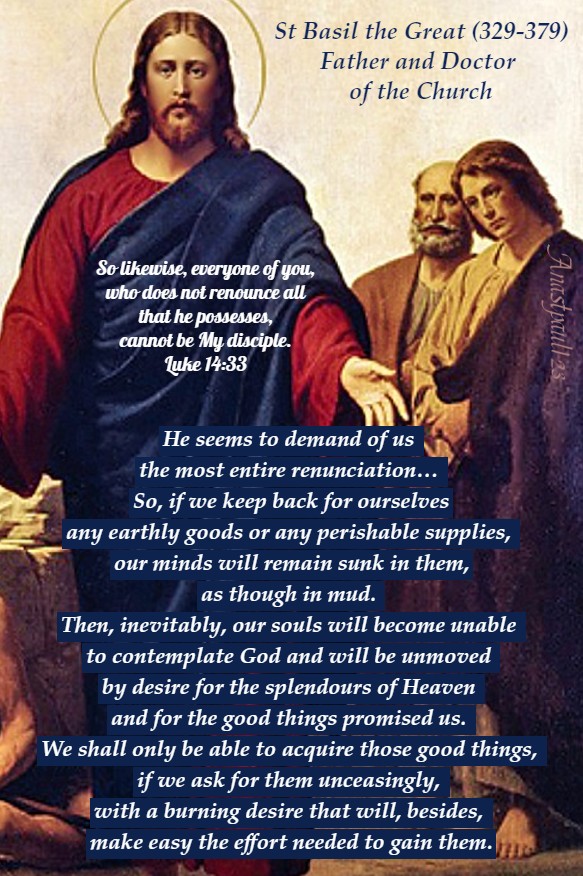
Azusa’s Paradox: Parham vs. Seymour, COGIC vs. AOG—Different Claims to the Holy Spirit or Contradicting Human Assumptions Using God’s Name?
You may think you’re a “premium” Pentecostal, based on this: the largest Pentecostal church in the United States that practices speaking in tongues is COGIC, yet it is often labeled “low class” rather than “high class” simply because its membership is predominantly Black and economically disadvantaged, rather than white or wealthy.
My reply: Remember: today’s women apostles, prophets, pastors, and missionaries owe their ministry to the Azusa Street Revival, led by William J. Seymour—an African American—so don’t look down on darker-skinned leaders.
Major Pentecostal problem: Charles Fox Parham was William J. Seymour’s early teacher in the Holiness‑Pentecostal tradition, and Seymour adopted Parham’s doctrine that speaking in tongues was the evidence of Spirit baptism; however, Parham eventually rejected the Azusa Street Revival and did not share Seymour’s inclusive approach to racial and gender roles in ministry. Seymour actively welcomed women into leadership at Azusa Street, where women served as preachers and ministers alongside men, which stood in contrast to the more conservative leadership norms associated with Parham’s circles.
Sources:
1. J. Creech, “Visions of Glory: The Place of the Azusa Street Revival in Pentecostal History,” Church History 65, no. 3 (1996): 405–24, notes that Seymour studied under Parham and embraced his doctrine of tongues (initial evidence of Spirit baptism) before leading the Azusa Street Revival. https://www.jstor.org/stable/3169938
2. Mookgo Solomon Kgatla, “The Influence of Azusa Street Revival in the Early Developments of the Apostolic Faith Mission of South Africa,” Missionalia 44, no. 3 (2015): 323–35, describes Seymour’s role at Azusa and his continuation of Pentecostal beliefs while emphasizing the interracial and inclusive character of the movement. https://missionalia.journals.ac.za/pub/article/download/156/135
3. “Azusa Street Revival,” Wikipedia, notes that when Parham visited the Azusa meetings in October 1906 he recoiled at their racial and charismatic character and withdrew his support, illustrating theological and cultural disagreements between Parham and Seymour. https://en.wikipedia.org/wiki/Azusa_Street_Revival
4. Edith L. Blumhofer (Harvard scholar), observes that early Pentecostalism was shaped by multiple influences, including Parham’s work and Seymour’s leadership at Azusa Street, with differing emphases on racial and social inclusion. https://en.wikipedia.org/wiki/Edith_L._Blumhofer
Questions to ponder: Why would the Holy Spirit use Charles Parham, a white man who first spoke in tongues but did not allow women pastors, and then use his student William J. Seymour, a Black man, to allow women pastors? Couldn’t the Holy Spirit have used just one of them so that this question in the Pentecostal context would have been resolved on day one? How does this align with 1 Corinthians 14:33—“God is not the author of confusion”—given that both Pentecostal streams have subsequently converted millions into their denominations, even after splitting?
Academic statement: If God worked through both Parham and Seymour—one opposing women pastors, the other supporting them—was such a contradiction in doctrine at the very inception of the Pentecostal movement a sign of God’s judgment, suggesting it may not be genuine, much like the confusion at the Tower of Babel? Let God decide, but we can ponder.
The largest Pentecostal denomination in the United States is the Church of God in Christ (COGIC), with about 6 million members—more than the Assemblies of God (AOG), which has only 2.9 to 3 million members, as noted earlier (as of 24 February 2026). Some dismiss it as “low class” because its majority membership has historically consisted of poorer African Americans.
You fail to recognize that William J. Seymour, the father of modern Pentecostalism and leader of the Azusa Street Revival, was never ordained by either COGIC or the Assemblies of God. You accuse me, saying, “I am not an ordained pastor like your women pastors,” yet the irony is clear: Seymour’s historic influence depended entirely on Spirit-led ministry, not denominational credentials. Pentecostals generally believe the revival was God-approved, and the Assemblies of God also emerged from this early movement, particularly through the practice of speaking in tongues that defined the Azusa meetings. Brief history:
William J. Seymour led the Azusa Street Revival in Los Angeles beginning in April 1906. At Azusa Street, gatherings were characterized by the experience of speaking in tongues and other charismatic manifestations, as seekers prayed for and received what participants described as the baptism in the Holy Spirit. Seymour himself is recorded as having spoken in tongues at Azusa after extended prayer, and many others at the meetings experienced glossolalia as part of this revival experience.
Source: EBSCO, Azusa Street Revival, Research Starters, describes how early attendees at Azusa Street, including Jennie Evans Moore and others, began speaking in tongues and how Seymour himself experienced and affirmed speaking in tongues at the revival, https://www.ebsco.com/research-starters/history/azusa-street-revival
Among those influenced by the revival was Charles Harrison Mason, who attended Azusa Street and then returned to Memphis to lead the Church of God in Christ into Pentecostal practice. According to historical summaries, Mason personally received the Pentecostal experience at Azusa and was among those who spoke in tongues under Seymour’s influence.
Source: Christian History Institute, Pentecostalism: William Seymour, details how Seymour and others spoke in tongues around April 1906 and highlights early participants like Charles H. Mason (who later integrated COGIC into Pentecostalism) and William Durham (who later influenced broader Pentecostal theology), https://christianhistoryinstitute.org/magazine/article/pentecostalism-seymour/
William H. Durham of Chicago, another participant in the early Pentecostal movement, also eventually visited the Azusa Street Mission. Evidence from revival history indicates that Durham received the baptism of the Holy Spirit and spoke in tongues in 1907 at Azusa under Seymour’s ministry before returning to Chicago, where he became a prominent early Pentecostal leader and later influenced the theology that contributed to the formation of the Assemblies of God (1914).
Source: Grace Communion International, William Seymour and the Rise of Pentecostalism, describes the beginnings of speaking in tongues among members of the revival and Seymour’s leadership role as the movement grew, https://www.gci.org/articles/william-seymour-and-the-rise-of-pentecostalism/
Thus, while Seymour was not ordained by either the Church of God in Christ (COGIC) or the Assemblies of God (AOG), the Azusa Street Revival directly affected leaders such as Mason and Durham. Mason’s Pentecostal experience under Seymour helped shape COGIC’s adoption of Pentecostal doctrine, whereas Durham’s later Pentecostal reception and theological development contributed to the emerging identity of the Assemblies of God.
Source: The Church in America Historical Notes, The Early Twentieth Century, reports that William H. Durham later received the baptism of the Holy Spirit and spoke in tongues in 1907 after attending the Azusa Mission, showing his direct Pentecostal experience connected to Seymour’s influence, https://www.tulsachristianfellowship.com/uploads/2/3/5/1/23513522/the_church_in_america__4__the_early_twentieth_century.pdf
Another historical issue concerns Charles F. Parham, often called the father of Pentecostalism and early mentor to Seymour, the father of modern Pentecostalism. Parham reportedly opposed aspects of the Azusa Street revival, including interracial worship, and criticized certain manifestations—especially non-human “tongues”—as excessive or even demonic, as noted in the famous biography written by his own wife.
Source: Sarah Parham (Parham’s own wife!), The Life of Charles F. Parham (Birmingham, AL: Commercial Printing Co., 1930), quoted in WhatSpirt8, Unity Publishing, n.d., accessed February 24, 2026, https://www.unitypublishing.com/NewReligiousMovements/WhatSpirt8.html, “I hurried to Los Angeles, and … I found conditions even worse than I had anticipated … spiritualistic controls, saw people practicing hypnotism at the altar over candidates seeking baptism, though many were receiving the real baptism of the Holy Ghost … Let me speak plainly with regard to the work as I have found it here. I found hypnotic influences, familiar spirit influences, spiritualistic influences, mesomeric influences, and all kinds of spells, spasms, falling in trances … The Holy Ghost does nothing that is unnatural or unseemly, and any strained exertion of body, mind or voice is not the work of the Holy Spirit, but of some familiar spirit, or other influence …”
Notably, the first widely recognized speaking-in-tongues incident in modern Pentecostal history—the experience of Agnes Ozman, reportedly speaking and writing in “Chinese”—occurred under Parham’s laying on of hands.
Source: Agnes Ozman, “Agnes Ozman’s ‘Chinese’ Writing,” Religion in Kansas Project (1901), accessed February 24, 2026, https://ksreligion.omeka.net/items/show/4487; this item includes the actual writing attributed to Ozman during the Topeka outpouring of 1901 and is linked to contemporaneous news reporting of the phenomenon, in which examples of her writing were published in newspapers such as the Topeka Daily Capital shortly after the event (see Topeka Daily Capital, January 6, 1901).
And Cecil M. Robeck, “The Origins of Modern Pentecostalism: Some Historiographical Issues,” in The Cambridge Companion to Pentecostalism, ed. Cecil M. Robeck, Jr. and Amos Yong (Cambridge: Cambridge University Press, 2014), https://doi.org/10.1017/CCO9780511910111.004
If these accounts are accurate, can the Holy Spirit truly be said to have been present in this first incident? (For those seeking scholarly rigor, ask your Pentecostal prophets, scholars, and geniuses to refute this.)[1] Few Bible colleges adequately address this history.
Source: Agnes Ozman, “Agnes Ozman’s ‘Chinese’ Writing,” Religion in Kansas Project (1901), accessed February 24, 2026, https://ksreligion.omeka.net/items/show/4487; this item includes the actual writing attributed to Ozman during the Topeka outpouring of 1901 and is linked to contemporaneous news reporting of the phenomenon, in which examples of her writing were published in newspapers such as the Topeka Daily Capital shortly after the event (see Topeka Daily Capital, January 6, 1901).
[1] Cecil M. Robeck, “The Origins of Modern Pentecostalism: Some Historiographical Issues,” in The Cambridge Companion to Pentecostalism, ed. Cecil M. Robeck, Jr. and Amos Yong (Cambridge: Cambridge University Press, 2014), https://doi.org/10.1017/CCO9780511910111.004
Sarah Parham—Charles Parham’s wife—never claimed to speak in tongues herself, yet she chronicled and supported her husband’s Pentecostal theology faithfully. Some claim her book is biased, but that often serves to downplay the fact that Parham opposed Azusa Street–style tongues.
Source: Sarah Parham, The Life of Charles F. Parham, quoted in The Charismatic Movement – La Vista Church of Christ, n.d., accessed February 24, 2026, https://www.lavistachurchofchrist.org/cms/the-charismatic-movement/, “Parham described many who ‘came through chattering, jabbering, speaking no language at all’ and noted that one of the elders at the mission was a hypnotist.”
Look at the first “Chinese” writing: does it truly resemble Chinese? Could the Holy Spirit have produced it? Let Him answer on that day. Even scholars who defend Parham must reckon with it, though few openly do.
Source: Agnes Ozman’s Handwriting, Topeka Daily Capital, January 6, 1901, archived at the Flower Pentecostal Heritage Center, accessed February 24, 2026, https://archives.ifphc.org/index.cfm?ArchiveGUID=786C5AB4-2705-4920-91A6-A5D300ABF4D8&FullTextIndex_SearchType=all&MaxRows=25&ResourceTypes=Books%2CPhotographs%2CAudio%2FVisual%2CRecord+Group%2CArtifacts%2CDocuments%2CPeriodicals&SearchCriteria=&Search_Creator=&SortedBy=Title&StartRow=1&fuseaction=research.showArchiveDetails&referrer=search.moreArchivesBySubject&search_ArchiveID=&search_Contributor=&search_Coverage=&search_CreatedBy=&search_Donor=&search_Identifier=&search_Language=&search_ModifiedBy=&search_Publisher=&search_Subject=Ozman%2C+Agnes+N.&search_Title=&search_Type=&search_referrer=search.moreArchivesBySubject
If Sarah had misrepresented her husband, would she not be in eternal Hell? I see no evidence of this. Her book affirms Pentecostal theology rather than undermines it, and her silence about personal tongues speaks volumes: she could have claimed the gift to bolster her husband’s ministry, yet she did not. That restraint is a mark of remarkable integrity.
Consider Parham himself. Scholars agree he opposed the Azusa Street revival. Is it plausible he would have declared, “Yes, the Holy Spirit is speaking here with Seymour, and therefore God is abandoning the ministry He used me to start”? Hardly. Parham wrote what he believed, and his wife, who loved him, faithfully recorded it—nothing more, nothing less. Their honesty, in context, speaks louder than any embellishment ever could.
Some argue that Seymour effectively replaced Parham in spiritual influence because of Parham’s racial views and theological disagreements regarding glossolalia within the Pentecostal context. Therefore, even if one belongs to a wealthy Pentecostal congregation today—such as within the Assemblies of God—and practices speaking in tongues, historically the movement traces back to Seymour, an African American minister. If Pentecostal experiences are considered authentic (academically speaking, without affirming or denying them here), then historically God used Seymour in the formation of the movement. This raises important questions about racial bias. If Pentecostalism’s origins are rooted in an African American leader, it would be inconsistent to diminish others today on the basis of race.
From a neutral, analytical perspective—as a non-Pentecostal Christian like myself regarding the non-human tongues language, and although I do not deny miracles or healings across denominations, which I remain neutral about and leave for God to judge on that day regarding which is true or not—one could argue that Seymour’s historical significance is substantial. God did not choose a European or Asian leader to initiate this revival movement, but instead used Seymour (a dark-skinned African by descent); from that revival emerged groups such as the Assemblies of God and others.
The broader question, then, is not about financial prosperity or institutional prestige. Rather, it concerns how we treat others. By the “game theory” of human providential will, God permits leaders according to what communities deserve, and issues such as racial favoritism, nepotism, or cultural bias may influence church structures more than believers realize. The real spiritual issue is not personal gain but whether changes in how we treat others might increase or diminish our heavenly reward.
The link: On the historical interaction between William J. Seymour and the Church of God in Christ (COGIC), see the account of Charles Harrison Mason’s visit to the Azusa Street Revival and his subsequent experience of the baptism of the Holy Spirit under Seymour’s preaching, which influenced the emerging Pentecostal identity of COGIC.
Source: C. J. Richmann, “Sanctification, Ecstasy, and War: The Development of American Pentecostal Eschatology, 1898–1950,” M.A. thesis, Luther Seminary, 2009, https://digitalcommons.luthersem.edu/cgi/viewcontent.cgi?article=1025&context=ma_theses; IL Hartsfield, “Holiness as Wholeness in Afro‑Pentecostal Tradition: A Theological Perspective,” Spiritus: ORU Journal of Theology, 2024, https://digitalshowcase.oru.edu/cgi/viewcontent.cgi?article=1345&context=spiritus; E.J. Hjalmeby, “Rhetorical History of Race Relations in the Early Pentecostal Movement, 1906–1916,” Baylor University digital repository, 2007, https://baylor-ir.tdl.org/bitstreams/287ec7ca-f3f0-42a8-8d60-a7d0d9ce96e6/download; Lewis Brogdon and Joe Creech, “Visions of Glory: The Place of the Azusa Street Revival in Pentecostal History,” Church History 65, no. 3, https://www.cambridge.org/core/journals/church-history/article/visions-of-glory-the-place-of-the-azusa-street-revival-in-pentecostal-history/CB9DEE820E250226ACE9F541E677B7F8
The largest Pentecostal denomination in the United States is this same Church of God in Christ (COGIC), with about 6 million members—more than the Assemblies of God (AOG), which has only 2.9 to 3 million members as of February 24, 2026. COGIC does not endorse women pastors, while AOG does.
So, did Mason receive the same Holy Spirit as Seymour? If yes, how can we explain that Mason opposed women pastors yet went on to form the largest Pentecostal denomination in U.S. history? Does this suggest that such conversions might be unreliable in the eyes of other Pentecostals? If so, the claim that the Holy Spirit directly communicates audibly to believers—through the heart, mind, or ears—appears to produce contradictions, even in cases of direct contact between leaders like Seymour (Azusa Street) and Mason (COGIC). Doesn’t this alone support the term “premium converts” I used earlier, assuming God truly chose Seymour? Pentecostal spiritual logic is highly contradictory and difficult to reconcile, given that it is based so heavily on claimed personal spiritual experiences, as I have demonstrated here with scholarly rigor.
For comparison, whether you quote David Cho Yonggi (South Korea) or Joel Osteen (USA) as leaders of some of the largest Pentecostal-type churches in the world, they all trace their origins to God using Seymour (an African American) as the chief leader of the Azusa Street Revival, with the same type of “non-human language” speaking in tongues. Yet none of them made a direct claim of Spirit baptism like Charles Harrison Mason, the founder of COGIC. If such connections do not prove the existence of “premium” converts, then even a non-Pentecostal could be considered a premium convert, based on greater doctrinal accuracy, even outside Pentecostalism. Let God decide. After all, Pentecostal churches often claim such experiences but may deny ministry credentials to those outside the movement—so I offer this as a scholarly response, grounded in the history of their own movement, to counter that claim.
| Region | Pentecostal & Charismatic | Non‑Pentecostal Protestant | Catholic | Orthodox | |
| USA | ~3% of adults | ~34% of adults | 19% of adults | 1% of adults | |
| Africa | ~15% of total population | ~42% of total population | 34% of total population | 8% of total population | |
| Asia‑Pacific | ~1% of total population | ~47% of total population | 46% of total population | 4% of total population | |
| Europe | ~1.5% of total population | ~14.5% of total population | ~40–50% of total population | ~20–30% of total population |
Notes:
1. Data from Pew Research Center estimates of regional Christian populations, Pentecostal/Charismatic vs non‑Pentecostal Protestant shares, and Catholic/Orthodox percentages. Percentages are approximate and rounded for clarity; in some cases, sub‑regional variation exists. [ChatGPT was used on 24 February 2026 to estimate this using the data source shown.]:
Pew Research Center, Global Christianity: A Report on the Size and Distribution of the World’s Christian Population (Washington, DC: Pew Research Center’s Forum on Religion & Public Life, December 19, 2011), https://www.pewresearch.org/religion/2011/12/19/global-christianity-movements-and-denominations/; Pew Research Center, Religious Landscape Study: Religious Identity 2023–24 (Washington, DC: Pew Research Center, 2025), https://www.pewresearch.org/religion/2025/02/26/religious-landscape-study-executive-summary/; Pew Research Center, “Regional Distribution of Christians: Americas, Sub‑Saharan Africa, Asia‑Pacific, Europe,” Global Christianity Regional Report, Pew Research Center, December 19, 2011, https://www.pewresearch.org/religion/2011/12/19/global-christianity-regions/
2. Summary (in words): In the United States, about 3% identify as Pentecostal or Charismatic, 34% as non-Pentecostal Protestants, 19% as Catholics, and 1% as Orthodox Christians. In Sub-Saharan Africa, 15% are Pentecostal/Charismatic, 42% non-Pentecostal Protestants, 34% Catholics, and 8% Orthodox. In Asia Pacific, 1% are Pentecostal/Charismatic, 47% non-Pentecostal Protestants, 46% Catholics, and 4% Orthodox. In Europe, 1.5% are Pentecostal/Charismatic, 14.5% non-Pentecostal Protestants, 40–50% Catholics, and 20–30% Orthodox. Figures are approximate, based on Pew Research Center studies.
If, as a Pentecostal or Charismatic, you now say that ‘the number of converts is not important,’ or that ‘high-quality converts with more accurate doctrine can be fewer in number,’ instead of your usual claim that women Pentecostal pastors are uniquely reaching the unreached—a task other denominations have done even more, both today and before 1900 when no women pastors existed—then why should I consider women pastors as producing higher-quality results when their output is the lowest in numbers and church history here?
If numbers don’t matter, then neither does my conversion—only accuracy does. Let God judge each person fairly, according to Daniel 12:3, and may nepotism based on these measures end. Also, in light of all these historical evidences and documented facts, am I to be labeled “demon-possessed” simply for raising these questions—especially by those who support women prophets and women pastors leading over men? For unbelievers, let their own gods create heaven and earth for them, especially if they hate Christianity. You reap what you sow, while I ask the Lord only for His mercy for those sincerely wrong, Christian or not, but God decides.
[Text] Azusa’s Paradox: Parham vs. Seymour, COGIC vs. AOG—Different Claims to the Holy Spirit or Contradicting Human Assumptions Using God’s Name?
COGIC, the largest U.S. Pentecostal church (more than AOG even), stems from Seymour and Azusa Street yet bans women pastors—Charles Mason was Spirit-baptized under Seymour, highlighting an internal contradiction from Pentecostalism’s birth. Parham, Seymour’s mentor, opposed interracial worship and “tongues,” revealing early tensions. If Pentecostals now claim numbers don’t matter, why exalt women pastors when their historical output is lowest? Seymour’s dark-skinned leadership sparked a global revival—divine choice, not human bias.
Your claims about my earthly failures prove nothing about God’s rejection. Before 1900, no Christian denomination had women pastors—were all those women rejected by God? This exposes the flaw in using failure—even ministry job failure—against me. Women hold major roles in COGIC—as evangelists, missionaries, and leaders—but are not ordained elders, pastors, or bishops. Academically, this shows that in “premium” U.S. Pentecostalism, success or failure does not indicate God’s favor.
[Text] The real test: doctrinal accuracy earns the highest rewards over sheer numbers (Daniel 12:3), in God’s judgment—not popularity, prestige, or nepotism. Please read my article on LinkedIn to see full details with proof sources.
I repeat: your claims about my earthly failures prove nothing about God’s rejection. Before 1900, no Christian denomination had women pastors—were all those women rejected by God? Did God only begin ordaining after 1900, or was it someone else before then? From a neutral, analytical perspective—as a non-Pentecostal regarding the non-human tongues language—I do not deny miracles or healings, which I leave for God to judge.
By the “game theory” of human providence, God permits leaders according to what communities deserve. Racial favoritism, nepotism, and cultural bias may shape church structures, but the true spiritual issue is not personal gain—it is whether how we treat others increases or diminishes our heavenly reward.
[1] Cecil M. Robeck, “The Origins of Modern Pentecostalism: Some Historiographical Issues,” in The Cambridge Companion to Pentecostalism, ed. Cecil M. Robeck, Jr. and Amos Yong (Cambridge: Cambridge University Press, 2014), https://doi.org/10.1017/CCO9780511910111.004
A Berean of Scripture vs. Reputation, Fear, and a Title-Oriented Society
Problem: Preachers are often afraid to admit mistakes in their sermons because they are human, especially after claiming, “God told me” for the message of the day. I mean, if God gives an inspired message, it should have zero error—whether in content or meaning. My point is that it’s okay to be human and make errors—and to admit them—rather than make divine claims of inspiration which, if wrong, risk breaking the 3rd of the Ten Commandments: ‘Thou shalt not take the name of the LORD thy God in vain’ (Exodus 20:7).
Issue: Recently, I spoke with a well-known theologian in Malaysia and asked why there are no interdenominational Bible discussion forums. He plainly answered that Bible schools, churches, pastors, and theologians here are generally not interested, as it’s not their culture—they might seem like they are getting “roasted” in a debate by someone else. This contrasts with the USA, where a scholar is respected in their field even if their points are not as strong as another’s on a specific topic, which sometimes can be subjective.
Disclaimer: I am not writing this to bad-mouth anyone. But if we become overly sensitive to anyone cross-examining our claims, we are not fulfilling this verse, as even the Apostle Paul’s sermons were examined. The Holy Spirit calls those who verify teachings “more noble” than those who just absorb whatever their pastor says:
“These were more noble than those in Thessalonica, in that they received the word with all readiness of mind, and searched the scriptures daily, whether those things were so.” (Acts 17:11, KJV)
Comment: That’s why in my journal papers, I present ideas as possibilities, building my case chiefly using Scripture and basing it on patristic writings, particularly Chiliasm authors (Justin, Irenaeus, Tertullian). I do not claim infallibility or inspiration, lest I be wrong and be condemned for breaking the 3rd Commandment of “taking God’s Name in vain.” If some parts or all of it turn out to be correct on Judgment Day, I would rather claim the reward from God, Who has shown unmerited mercy to me.
Sample: A Peculiar Thing Someone Said About Ephesians 4:26
Verse:
“Be ye angry, and sin not: let not the sun go down upon your wrath:” (Ephesians 4:26, KJV)
A leading pastor or scholar said verbally that the Greek here is different, implying that the phrase “sun go down” links to Joshua’s case, where God made the “sun stand still without setting for a long day” (Joshua 10:12–14). This suggests it is not necessarily about the literal one day. A question arises: can we link these two passages solely because of a similar phrase? Also, he was likely reiterating something another scholar or mentor had said, unless it was his original interpretation.
Reply: I was impressed by this example, as I had never heard it before. When I returned home, I searched online to trace the source but could not find anyone via ChatGPT. I could not ask the person directly, as he might feel offended if he realized I was checking his facts. Anonymity helps.
Solution: I am sharing how I personally fulfill Acts 17:11. I searched online and found that the key Church Fathers—who were proficient in Koine Greek and grounded in apostolic teaching—wrote that Ephesians 4:26 literally means not to let anger last beyond the day. This contradicts the modern scholar’s proposal. Compare:
- John Chrysostom, AD 407:
“Do you wish to have your fill of anger? One hour, or two or three is enough for you. But do not let the sun go down and leave you both as enemies. It was God’s goodness that did not leave us in anger. He did not let us part in enmity. He shed his light upon those of us who were sinners. So when evening is coming on, be reconciled. Quell the evil impulses while they are fresh. For if night overtakes you, the next day will not be enough time to extinguish the further evil which has been increasing overnight,”[1]
- Lactantius, AD 320:
“In time. God has enjoined us not to let the sun go down upon our wrath. For if His anger had been altogether immortal, there would be no place after a fault for satisfaction or kind feeling, though He Himself commands men to be reconciled before the setting of the sun,”[2]
- Tertullian of Carthage, AD 220:
“Expresses his meaning, (he says,) ‘Be ye angry, and sin not; Let not the sun go down upon your wrath.’ Be angry, our anger must not be maintained beyond sunset, as the apostle admonishes. If ‘the sun go down over our wrath’ we are in jeopardy. And (a right distinction it was); for John has here sanctioned it; in that there are some sins of daily committal, to which we all are liable: for who will be free from the accident of either being angry unjustly, and retaining his anger beyond sunset,”[3]
The person was a Calvinist and might therefore object that even these Church Fathers were not as proficient in Koine Greek as his lecturer, who likely taught that interpretation. I therefore checked John Calvin, and he too agrees with the Fathers on this point:
“26He enjoins accordingly, let not the sun go down upon your wrath. If at any time we happen to be angry, let us endeavor to be appeased before the sun has set,”[4]
In short, neither these Church Fathers nor John Calvin linked this verse to Joshua’s passage in their commentaries or usage.
Conclusion: If I don’t write about it, I am not sharing my process of fulfilling Acts 17:11 and Matthew 5:17–19, which command not only to ‘do’ (private study) but also to ‘teach’ (for others to consider), as applied in this case.
Yes, you may read my book and journal papers and write for or against it, even quoting me openly, as I am not sensitive. If I find time, I might respond where ambiguity exists. If I am wrong, I have no problem admitting it, since I have written against some church beliefs I once held, which changed after reading the Church Fathers.
Pastors who dislike people analyzing their sermons don’t understand this: imagine paying a preacher (salary, love offerings, etc.), but the preacher teaches inaccurate points that could cost your heavenly reward. Would you be happy? A key difference is that if a topic has more than one view, I mention it, present possibilities, and let readers make their own decisions and research. I take responsibility but do not take any money.
Those who are salaried in leadership should present accurate teachings and offer free sermons in writing and audio, since they have the resources to reach a broader audience. Leaders may fear people like me writing critiques, but if their points are correct or God-given, they will stand regardless.
Embracing this human approach is better than a man-made culture of refraining, which stands against Acts 17:11. As 1 Samuel 15:22 notes, “obedience is better than sacrifice” (relative principle, see Luke 21:1–3). Christ also said, “more is given, more is required” (Luke 12:48).
We cannot judge someone by pulpit size, number of baptisms, or full-time ministry hours—God rewards fairly according to circumstances (Philippians 4:11–13). Rewards are based on loving obedience (John 14:15; Matthew 5:19):
“19Whoever therefore breaks one of the least of these commandments, and teaches men so, shall be called least in the kingdom of heaven; but whoever does and teaches them, he shall be called great in the kingdom of heaven.” (Matthew 5:19, NKJV)
Closing Thought: If someone points out an error in a topic, it doesn’t mean your paper is wrong overall. Similarly, being right on one point does not mean you are right on all points. God decides; we can only be human and do our best to fulfill Acts 17:11 while doing His will, without taking offense.
[1] Catena Bible & Commentaries, commentary on Ephesians 4:26, CatenaBible.com, accessed January 17, 2026, https://catenabible.com/eph/4/26
[2] Ibid.
[3] Ibid.
[4] John Calvin, Calvin’s Commentary on the Bible, Ephesians 4:26, StudyLight.org, accessed January 17, 2026, https://www.studylight.org/commentary/ephesians/4-26.html
Jonathan Ramachandran, B.Sc., Th.D. (Hon.), D.Div. (Hon.), D.Min. (Hon.)
Dr. Jonathan Ramachandran obtained his Honorary Doctor of Theology (Th.D.) from University of Jerusalem (UJ, Chennai, India, 20 August 2025; Reg. No.: 11230), Honorary Doctor of Divinity (D.Div.) from Triumphant Christian University of America (TCUA, Illinois, USA, 20 August 2025, Cert. ID.: 7704247) and Honorary Doctor of Ministry (D.Min.) from Open Christian University (OCU, California, USA, 31 August 2025, Cert. ID.: OCU250124/831208-14-6517MY).
My CV (14 September 2025) Link:
https://drive.google.com/file/d/19YuhL31EpC4l3JnHcbbQNio-ueogAEXQ/view?usp=sharing
My Honorary Doctorates Defense Link (explanation in pdf file):
https://drive.google.com/file/d/1dLffkOnLe8BPz9vd3RMPbhZmn6puY7op/view?usp=sharing
TQ