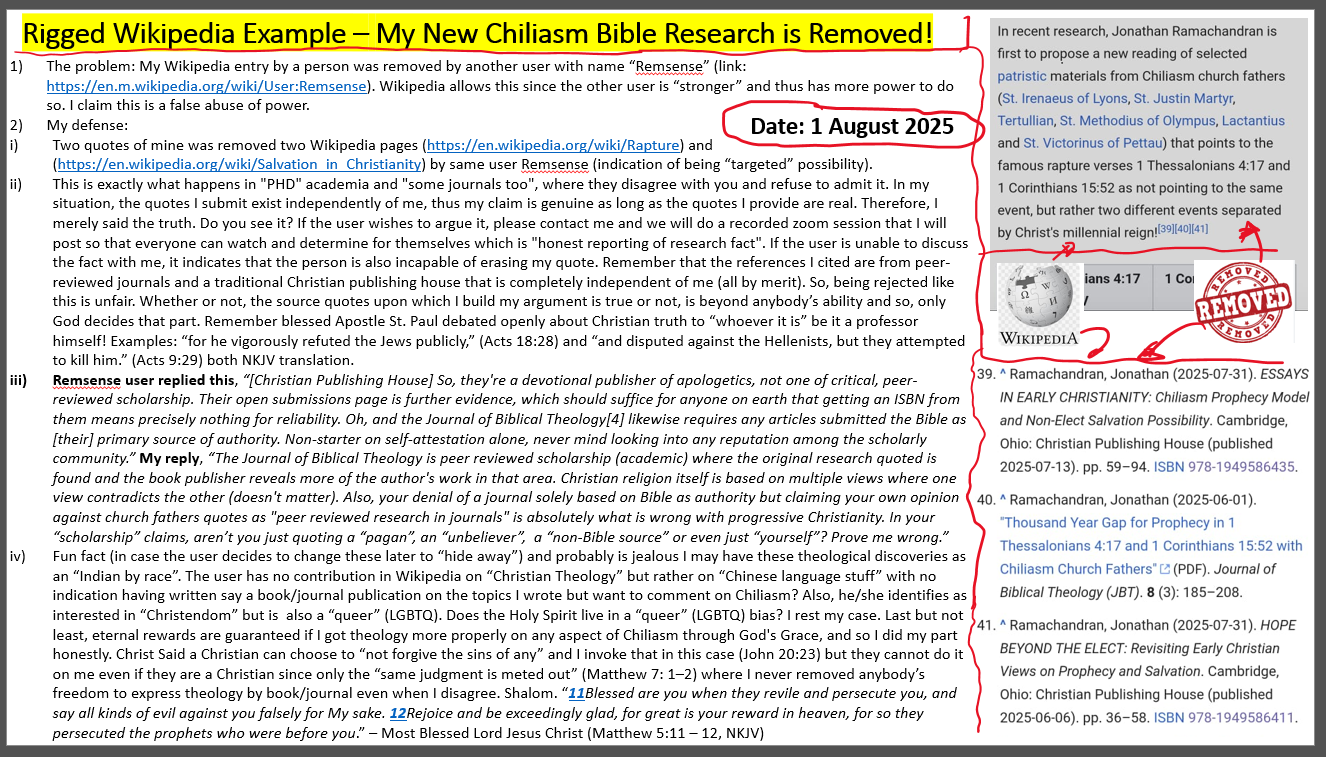
Rigged Wikipedia Example – My New Chiliasm Bible Research is Removed!
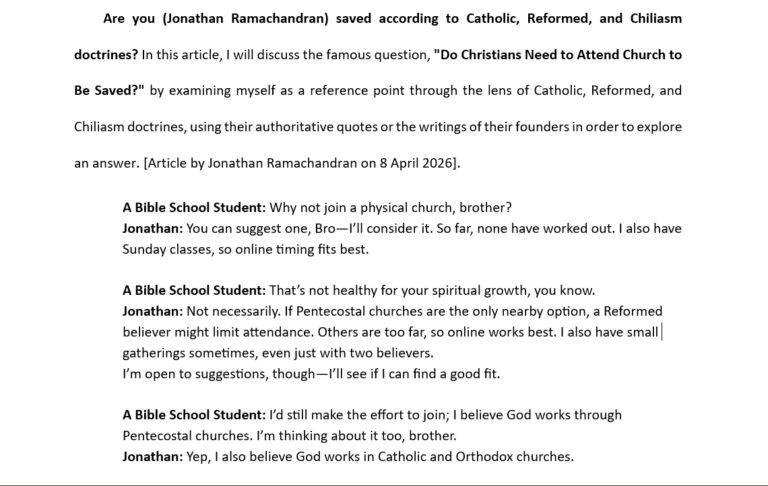
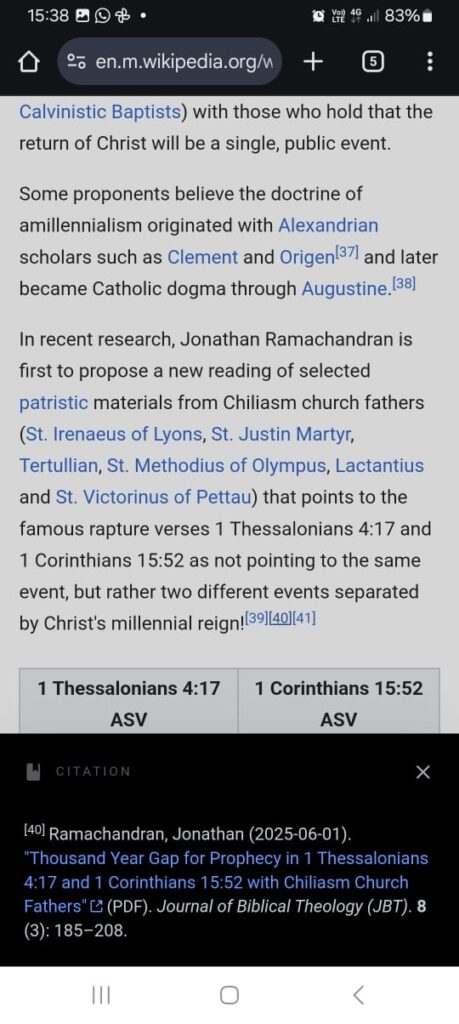
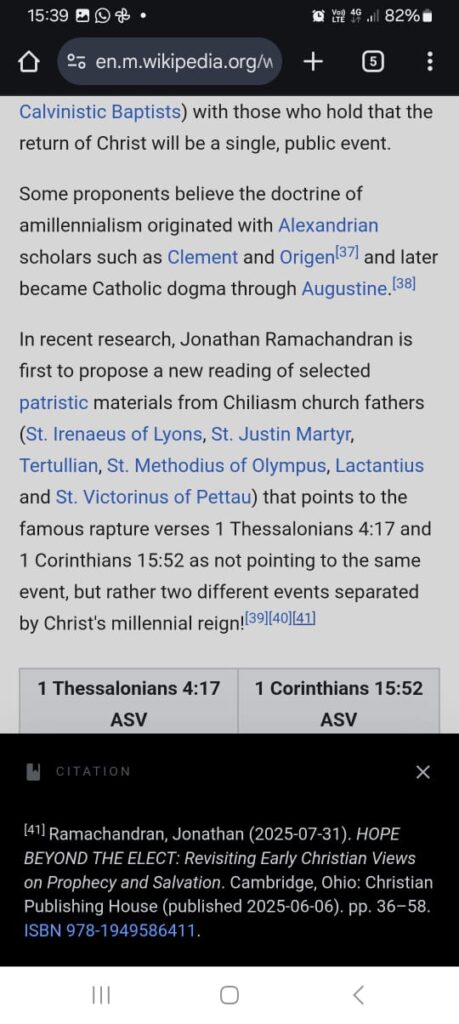
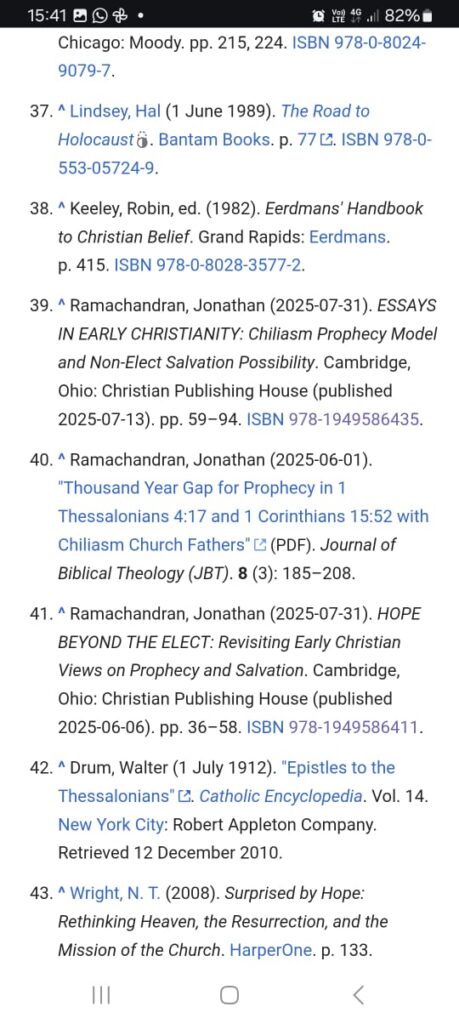
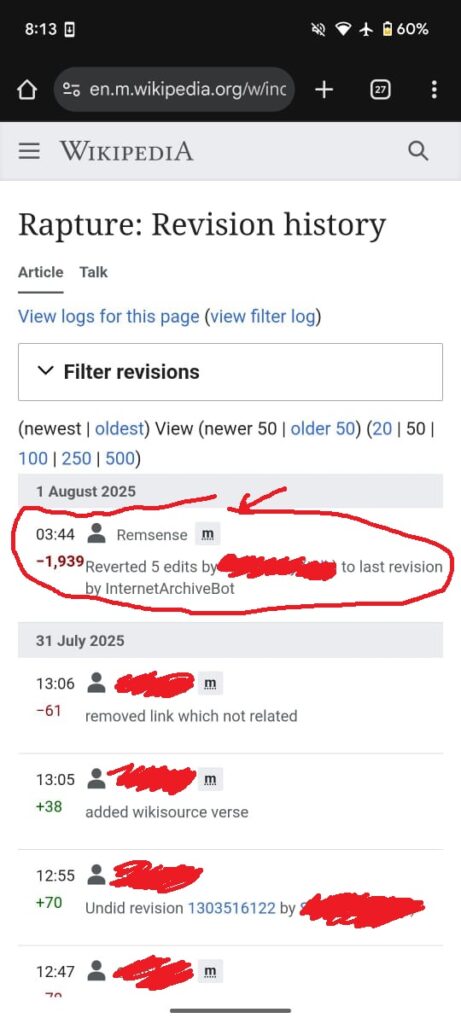
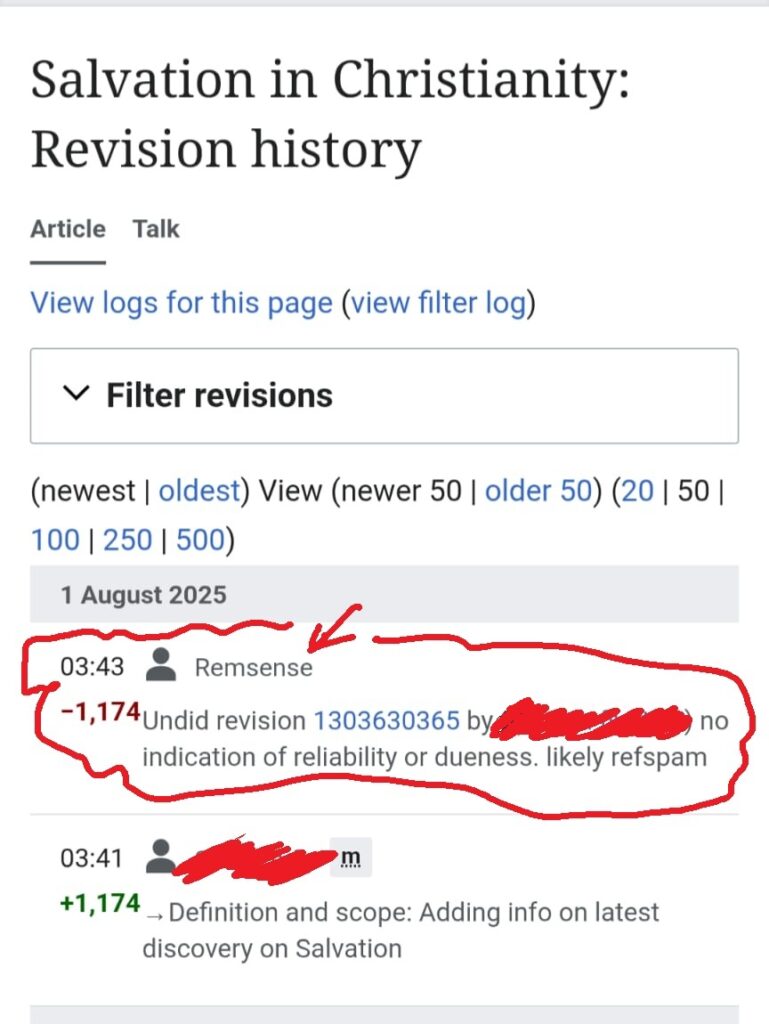
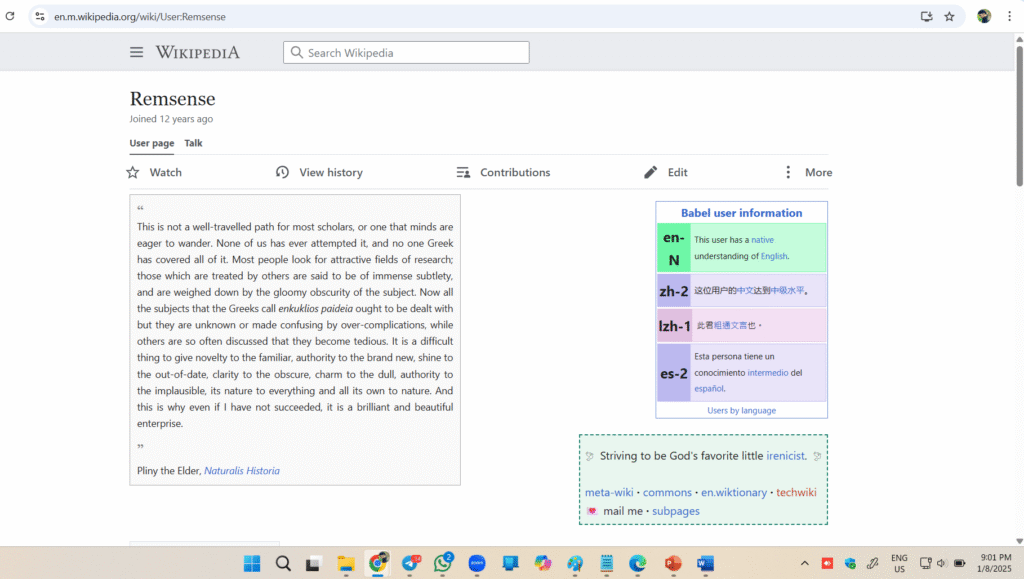
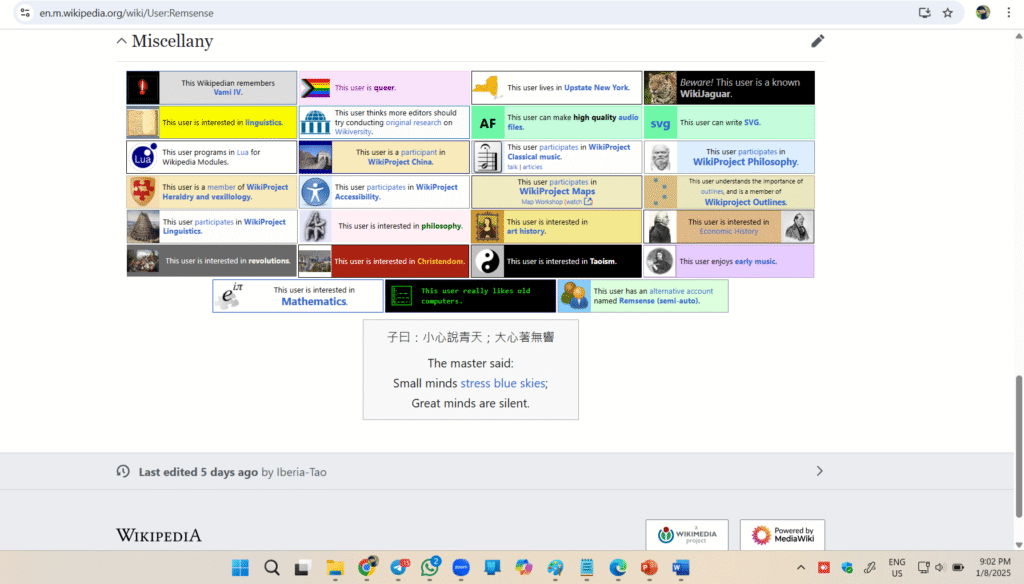
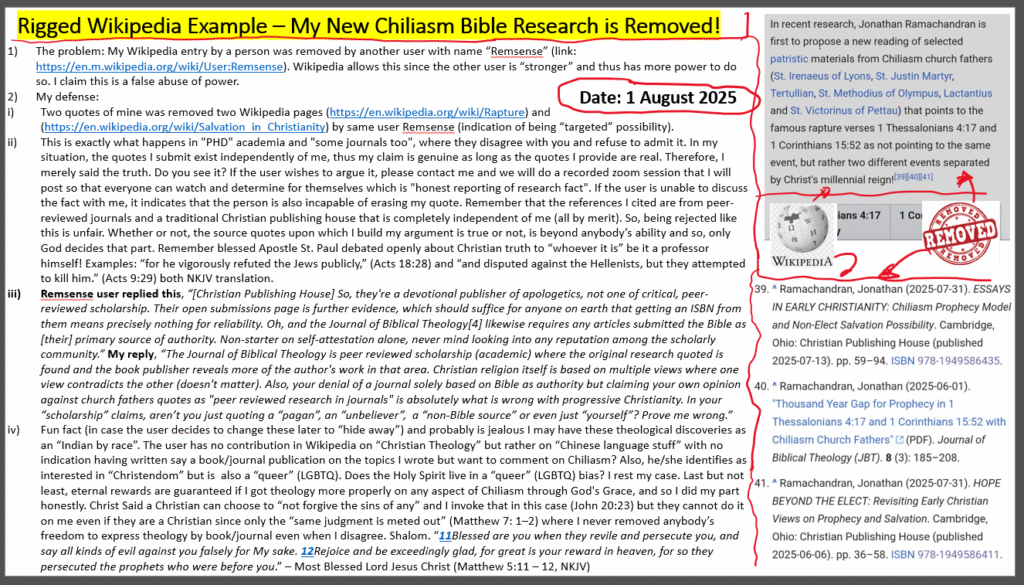
The problem: My Wikipedia entry by a person was removed by another user with name “Remsense” (link: https://en.m.wikipedia.org/wiki/User:Remsense). Wikipedia allows this since the other user is “stronger” and thus has more power to do so. I claim this is a false abuse of power.
My defense:
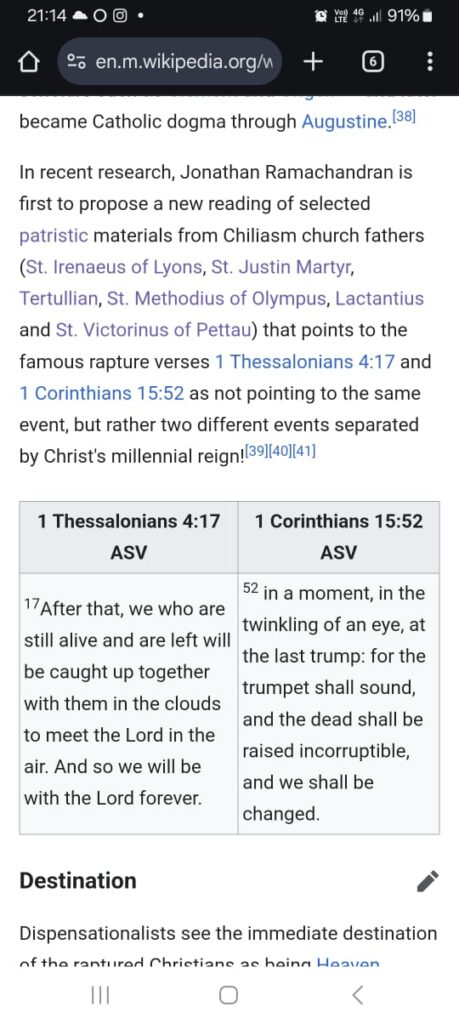
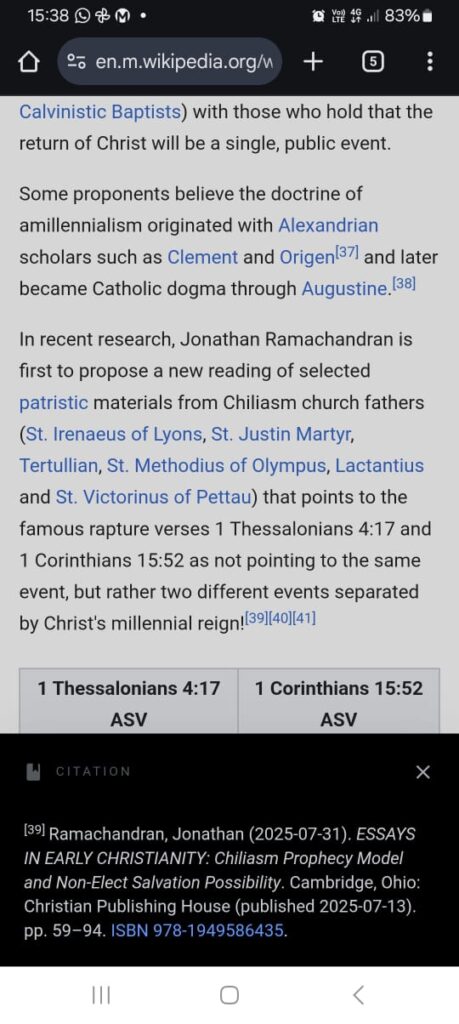
1) Two quotes of mine was removed two Wikipedia pages (https://en.wikipedia.org/wiki/Rapture) and (https://en.wikipedia.org/wiki/Salvation_in_Christianity) by same user Remsense (indication of being “targeted” possibility).
2) This is exactly what happens in “PHD” academia and “some journals too”, where they disagree with you and refuse to admit it. In my situation, the quotes I submit exist independently of me, thus my claim is genuine as long as the quotes I provide are real. Therefore, I merely said the truth. Do you see it? If the user wishes to argue it, please contact me and we will do a recorded zoom session that I will post so that everyone can watch and determine for themselves which is “honest reporting of research fact”. If the user is unable to discuss the fact with me, it indicates that the person is also incapable of erasing my quote. Remember that the references I cited are from peer-reviewed journals and a traditional Christian publishing house that is completely independent of me (all by merit). So, being rejected like this is unfair. Whether or not, the source quotes upon which I build my argument is true or not, is beyond anybody’s ability and so, only God decides that part. Remember blessed Apostle St. Paul debated openly about Christian truth to “whoever it is” be it a professor himself! Examples: “for he vigorously refuted the Jews publicly,” (Acts 18:28) and “and disputed against the Hellenists, but they attempted to kill him.” (Acts 9:29) both NKJV translation.
3) Remsense user replied this, “[Christian Publishing House] So, they’re a devotional publisher of apologetics, not one of critical, peer-reviewed scholarship. Their open submissions page is further evidence, which should suffice for anyone on earth that getting an ISBN from them means precisely nothing for reliability. Oh, and the Journal of Biblical Theology[4] likewise requires any articles submitted the Bible as [their] primary source of authority. Non-starter on self-attestation alone, never mind looking into any reputation among the scholarly community.” My reply, “The Journal of Biblical Theology is peer reviewed scholarship (academic) where the original research quoted is found and the book publisher reveals more of the author’s work in that area. Christian religion itself is based on multiple views where one view contradicts the other (doesn’t matter). Also, your denial of a journal solely based on Bible as authority but claiming your own opinion against church fathers quotes as “peer reviewed research in journals” is absolutely what is wrong with progressive Christianity.” In your “scholarship” claims, aren’t you just quoting a “pagan”, an “unbeliever”, a “non-Bible source” or even just “yourself”? Prove me wrong.”
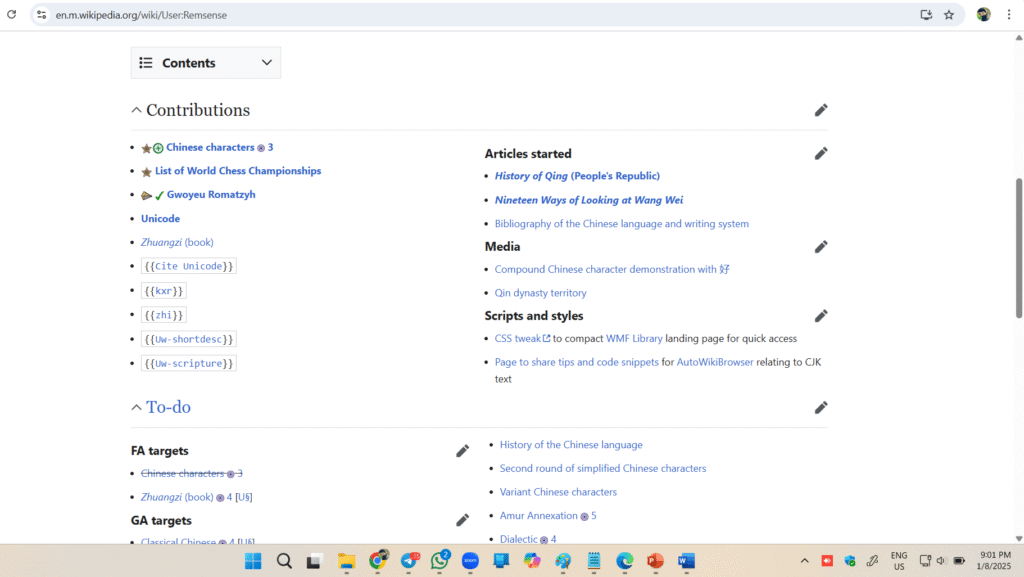
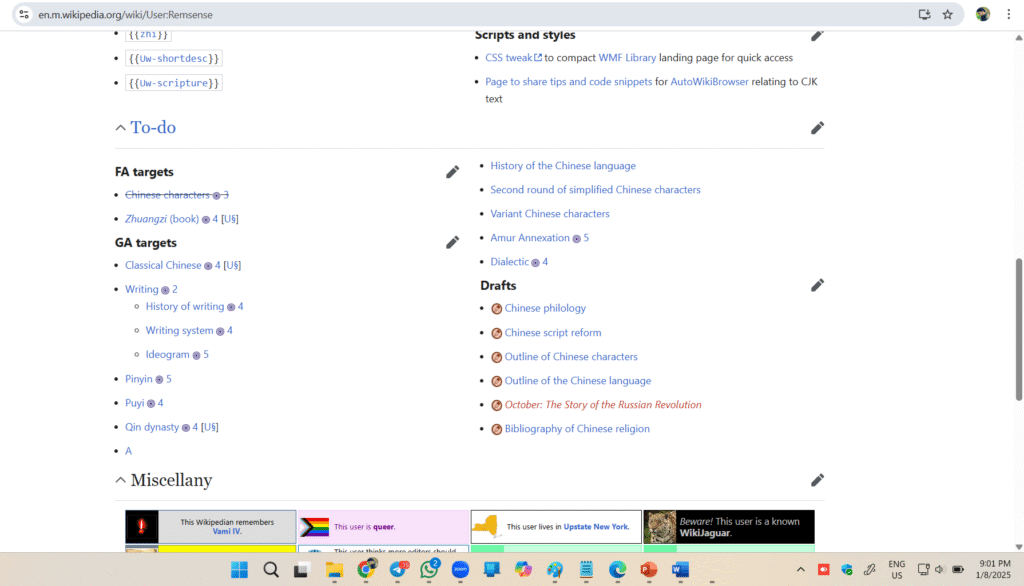
4) Fun fact (in case the user decides to change these later to “hide away”) and probably is jealous I may have these theological discoveries as an “Indian by race”. The user has no contribution in Wikipedia on “Christian Theology” but rather on “Chinese language stuff” with no indication having written say a book/journal publication on the topics I wrote but want to comment on Chiliasm? Also, he/she identifies as interested in “Christendom” but is also a “queer” (LGBTQ). Does the Holy Spirit live in a “queer” (LGBTQ) bias? I rest my case.
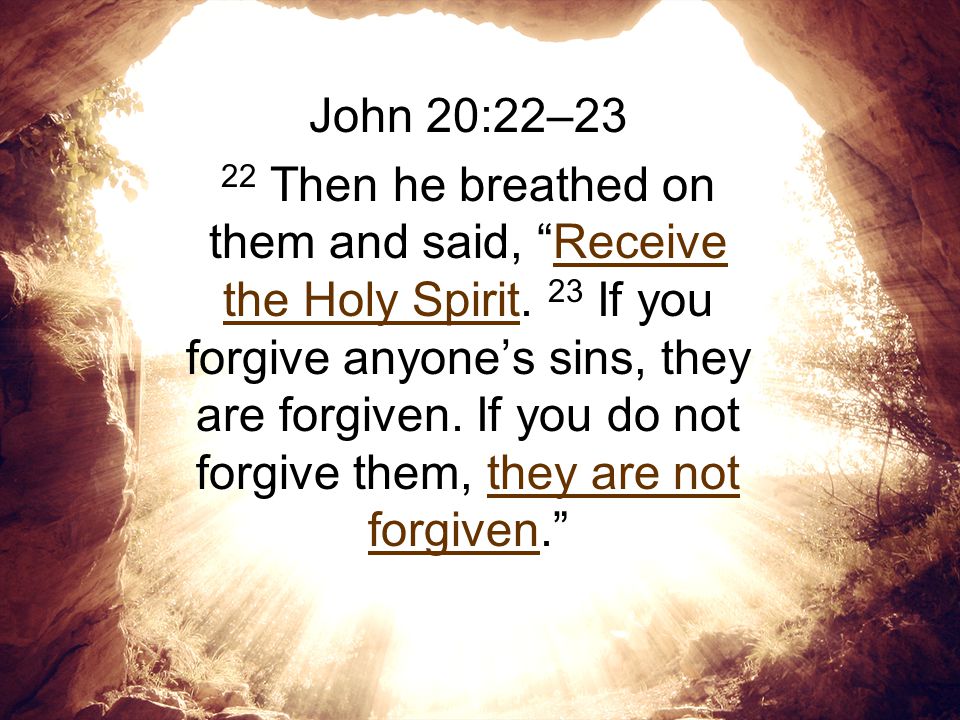
5) Last but not least, eternal rewards are guaranteed if I got theology more properly on any aspect of Chiliasm through God’s Grace, and so I did my part honestly. Christ Said a Christian can choose to “not forgive the sins of any” and I invoke that in this case (John 20:23) but they cannot do it on me even if they are a Christian since only the “same judgment is meted out” (Matthew 7: 1–2) where I never removed anybody’s freedom to express theology by book/journal even when I disagree. Shalom.
“11Blessed are you when they revile and persecute you, and say all kinds of evil against you falsely for My sake. 12Rejoice and be exceedingly glad, for great is your reward in heaven, for so they persecuted the prophets who were before you.” – Most Blessed Lord Jesus Christ (Matthew 5:11 – 12, NKJV)
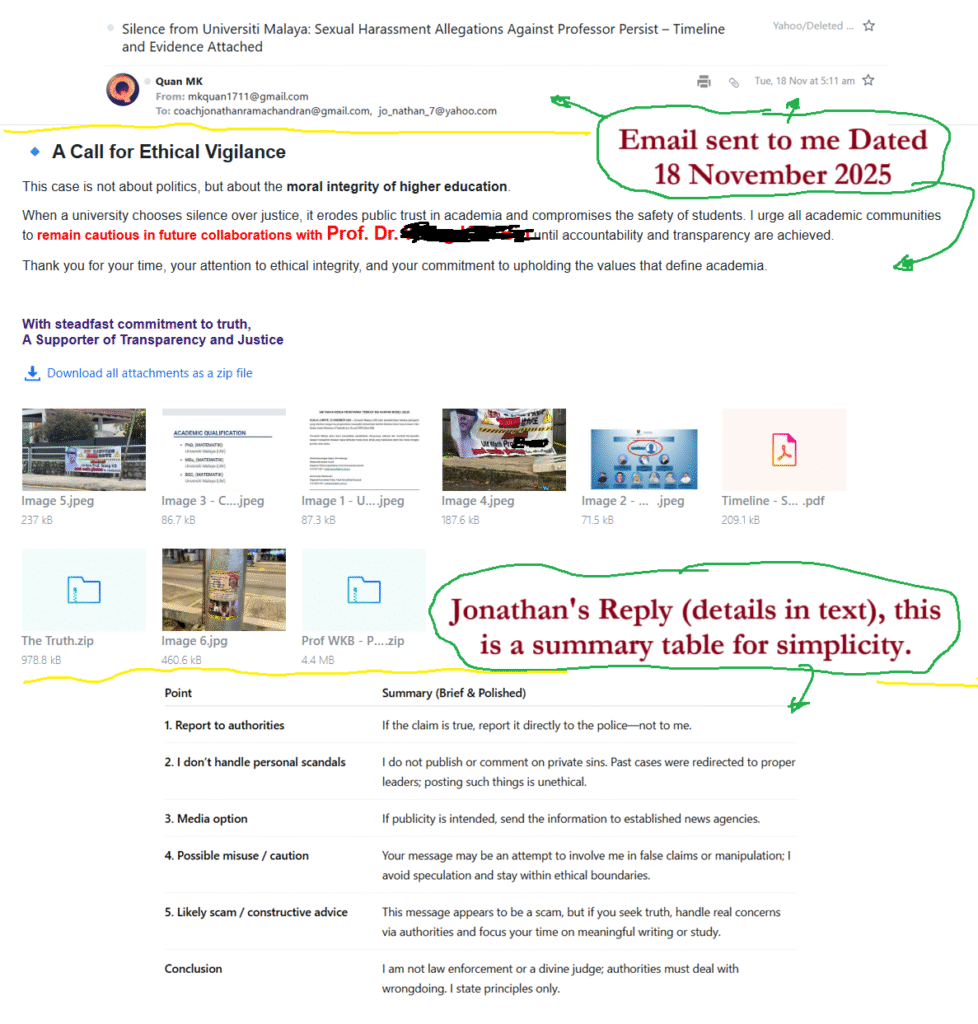
Proof Images:
Question 97
What would you do if someone sends you potential sensitive evidence which can be a downfall of someone else (if true)?
Reply 97
Hi Quan (if that’s your real name, from email: [email protected]),
1) If what you are saying is true, please report it directly to the police or the appropriate authorities. I am not the right person to receive this information.
2) Even if your claims are true, I do not publish or comment on anyone’s personal sins or private moral issues. For example, a few years ago I received inappropriate photos of several local pastors. I immediately instructed the sender to forward the material to the church leadership rather than to me. Although posting such things online might generate attention, that is not the ethical or Christian approach. Likewise, I expect anyone who contacts me to be truthful and to avoid fabricating or exaggerating claims.
3) If your intention is to make this information public, you may also contact recognised news agencies or newspapers. They have the proper channels for verifying and reporting sensitive matters.
4) I must also consider the possibility that your message is an attempt to involve me in false information, defamation, or other misconduct—intentionally or unintentionally. In past cases, people have tried to use religious or theological figures as tools in disputes or schemes. My role is not to comment on other faiths or to engage in speculation. As Scripture teaches (1 Corinthians 5:12), my responsibility is limited to matters within my own community, and even then, within proper boundaries.
5) Realistically, your message appears to be a scam or an attempt to provoke a reaction. However, in case you are genuinely seeking guidance, let me clarify: issues of crime or misconduct must be handled by the authorities, not by private individuals like me. If you wish to spend your time productively, consider developing a well-researched article or study within your own field or religious tradition. That would be a far better use of energy.
6) To conclude: I am neither law enforcement nor an agent of divine justice. My responsibility is simply to state principles clearly. Civil authorities exist to address wrongdoing, and it is their duty—not mine—to act. I wish you well, and I hope you will handle any real concerns through the proper channels. I repeat, If true, please send this to the police (not me).
Sincerely,
Jonathan
Shalom.
A Berean of Scripture vs. Reputation, Fear, and a Title-Oriented Society
Problem: Preachers are often afraid to admit mistakes in their sermons because they are human, especially after claiming, “God told me” for the message of the day. I mean, if God gives an inspired message, it should have zero error—whether in content or meaning. My point is that it’s okay to be human and make errors—and to admit them—rather than make divine claims of inspiration which, if wrong, risk breaking the 3rd of the Ten Commandments: ‘Thou shalt not take the name of the LORD thy God in vain’ (Exodus 20:7).
Issue: Recently, I spoke with a well-known theologian in Malaysia and asked why there are no interdenominational Bible discussion forums. He plainly answered that Bible schools, churches, pastors, and theologians here are generally not interested, as it’s not their culture—they might seem like they are getting “roasted” in a debate by someone else. This contrasts with the USA, where a scholar is respected in their field even if their points are not as strong as another’s on a specific topic, which sometimes can be subjective.
Disclaimer: I am not writing this to bad-mouth anyone. But if we become overly sensitive to anyone cross-examining our claims, we are not fulfilling this verse, as even the Apostle Paul’s sermons were examined. The Holy Spirit calls those who verify teachings “more noble” than those who just absorb whatever their pastor says:
“These were more noble than those in Thessalonica, in that they received the word with all readiness of mind, and searched the scriptures daily, whether those things were so.” (Acts 17:11, KJV)
Comment: That’s why in my journal papers, I present ideas as possibilities, building my case chiefly using Scripture and basing it on patristic writings, particularly Chiliasm authors (Justin, Irenaeus, Tertullian). I do not claim infallibility or inspiration, lest I be wrong and be condemned for breaking the 3rd Commandment of “taking God’s Name in vain.” If some parts or all of it turn out to be correct on Judgment Day, I would rather claim the reward from God, Who has shown unmerited mercy to me.
Sample: A Peculiar Thing Someone Said About Ephesians 4:26
Verse:
“Be ye angry, and sin not: let not the sun go down upon your wrath:” (Ephesians 4:26, KJV)
A leading pastor or scholar said verbally that the Greek here is different, implying that the phrase “sun go down” links to Joshua’s case, where God made the “sun stand still without setting for a long day” (Joshua 10:12–14). This suggests it is not necessarily about the literal one day. A question arises: can we link these two passages solely because of a similar phrase? Also, he was likely reiterating something another scholar or mentor had said, unless it was his original interpretation.
Reply: I was impressed by this example, as I had never heard it before. When I returned home, I searched online to trace the source but could not find anyone via ChatGPT. I could not ask the person directly, as he might feel offended if he realized I was checking his facts. Anonymity helps.
Solution: I am sharing how I personally fulfill Acts 17:11. I searched online and found that the key Church Fathers—who were proficient in Koine Greek and grounded in apostolic teaching—wrote that Ephesians 4:26 literally means not to let anger last beyond the day. This contradicts the modern scholar’s proposal. Compare:
- John Chrysostom, AD 407:
“Do you wish to have your fill of anger? One hour, or two or three is enough for you. But do not let the sun go down and leave you both as enemies. It was God’s goodness that did not leave us in anger. He did not let us part in enmity. He shed his light upon those of us who were sinners. So when evening is coming on, be reconciled. Quell the evil impulses while they are fresh. For if night overtakes you, the next day will not be enough time to extinguish the further evil which has been increasing overnight,”[1]
- Lactantius, AD 320:
“In time. God has enjoined us not to let the sun go down upon our wrath. For if His anger had been altogether immortal, there would be no place after a fault for satisfaction or kind feeling, though He Himself commands men to be reconciled before the setting of the sun,”[2]
- Tertullian of Carthage, AD 220:
“Expresses his meaning, (he says,) ‘Be ye angry, and sin not; Let not the sun go down upon your wrath.’ Be angry, our anger must not be maintained beyond sunset, as the apostle admonishes. If ‘the sun go down over our wrath’ we are in jeopardy. And (a right distinction it was); for John has here sanctioned it; in that there are some sins of daily committal, to which we all are liable: for who will be free from the accident of either being angry unjustly, and retaining his anger beyond sunset,”[3]
The person was a Calvinist and might therefore object that even these Church Fathers were not as proficient in Koine Greek as his lecturer, who likely taught that interpretation. I therefore checked John Calvin, and he too agrees with the Fathers on this point:
“26He enjoins accordingly, let not the sun go down upon your wrath. If at any time we happen to be angry, let us endeavor to be appeased before the sun has set,”[4]
In short, neither these Church Fathers nor John Calvin linked this verse to Joshua’s passage in their commentaries or usage.
Conclusion: If I don’t write about it, I am not sharing my process of fulfilling Acts 17:11 and Matthew 5:17–19, which command not only to ‘do’ (private study) but also to ‘teach’ (for others to consider), as applied in this case.
Yes, you may read my book and journal papers and write for or against it, even quoting me openly, as I am not sensitive. If I find time, I might respond where ambiguity exists. If I am wrong, I have no problem admitting it, since I have written against some church beliefs I once held, which changed after reading the Church Fathers.
Pastors who dislike people analyzing their sermons don’t understand this: imagine paying a preacher (salary, love offerings, etc.), but the preacher teaches inaccurate points that could cost your heavenly reward. Would you be happy? A key difference is that if a topic has more than one view, I mention it, present possibilities, and let readers make their own decisions and research. I take responsibility but do not take any money.
Those who are salaried in leadership should present accurate teachings and offer free sermons in writing and audio, since they have the resources to reach a broader audience. Leaders may fear people like me writing critiques, but if their points are correct or God-given, they will stand regardless.
Embracing this human approach is better than a man-made culture of refraining, which stands against Acts 17:11. As 1 Samuel 15:22 notes, “obedience is better than sacrifice” (relative principle, see Luke 21:1–3). Christ also said, “more is given, more is required” (Luke 12:48).
We cannot judge someone by pulpit size, number of baptisms, or full-time ministry hours—God rewards fairly according to circumstances (Philippians 4:11–13). Rewards are based on loving obedience (John 14:15; Matthew 5:19):
“19Whoever therefore breaks one of the least of these commandments, and teaches men so, shall be called least in the kingdom of heaven; but whoever does and teaches them, he shall be called great in the kingdom of heaven.” (Matthew 5:19, NKJV)
Closing Thought: If someone points out an error in a topic, it doesn’t mean your paper is wrong overall. Similarly, being right on one point does not mean you are right on all points. God decides; we can only be human and do our best to fulfill Acts 17:11 while doing His will, without taking offense.
[1] Catena Bible & Commentaries, commentary on Ephesians 4:26, CatenaBible.com, accessed January 17, 2026, https://catenabible.com/eph/4/26
[2] Ibid.
[3] Ibid.
[4] John Calvin, Calvin’s Commentary on the Bible, Ephesians 4:26, StudyLight.org, accessed January 17, 2026, https://www.studylight.org/commentary/ephesians/4-26.html
P/S 2: My one page Curriculum Vitae (CV): Removed because outdated. New CV link (as of 22 July 2025) which was not in original submission:
https://drive.google.com/file/d/1PIGhZIauswvIVlE_poOrt4tI4shYVcTi/view?usp=sharing
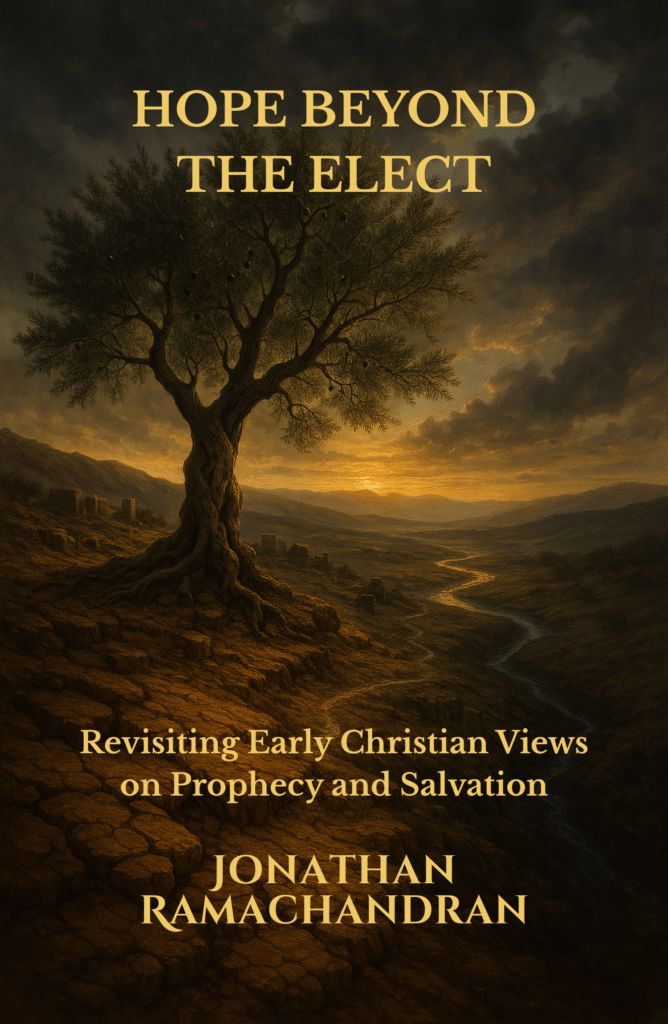
It is done! #Immortalize your work with an #academic #book. If right, praise God! and if any part of it is wrong, may God have mercy since it’s presented with actual early authoritative Christian writings.
1) Books
i) Ramachandran, Jonathan. ESSAYS IN EARLY CHRISTIANITY: Chiliasm Prophecy Model and Non-Elect Salvation Possibility. Cambridge, Ohio, USA: Christian Publishing House, 13 July 2025.
Links: https://www.amazon.com/dp/1949586421 (Amazon)
https://play.google.com/store/books/details?id=0rpwEQAAQBAJ (Google E-Book)
Note: In other bookstores, it may eventually appear (just search for it).

The other book:
ii) Ramachandran, Jonathan. HOPE BEYOND THE ELECT: Revisiting Early Christian Views on Prophecy and Salvation. Cambridge, Ohio, USA: Christian Publishing House, 6 June 2025.
Links: https://www.amazon.com/dp/1949586405 (Amazon)
https://books.google.cl/books/about?id=_d1jEQAAQBAJ&redir_esc=y (Google E-Book)
https://www.goodreads.com/book/show/235829454-hope-beyond-the-elect (GoodReads)
https://www.christianpublishers.org/product-page/hope-beyond-the-elect-revisiting-early-christian-views-on-prophecy-and-salvation (CPH Bookstore: Under apocalyptic/eschatology and theology genres)
2) Journals
i) 1st Publication
Ramachandran, Jonathan. “Non Elect Salvation Possibility.” The American Journal of Biblical Theology (AJBT) Vol 26, no. 6 (9 February 2025).
www.biblicaltheology.com/Research/RamachandranJ01.pdf
ii) 2nd Publication
Ramachandran, Jonathan. “Thousand Year Gap for Prophecy in 1 Thessalonians 4:17 and 1 Corinthians 15:52 with Chiliasm Church Fathers.” The American Journal of Biblical Theology (AJBT) Vol 26, no. 22 (1 June 2025). www.biblicaltheology.com/Research/RamachandranJ02.pdf
iii) 3rd Publication on a 3-level peer review as well
Ramachandran, Jonathan. “Thousand Year Gap for Prophecy in 1 Thessalonians 4:17 and 1 Corinthians 15:52 with Chiliasm Church Fathers.” Journal of Biblical Theology (JBT) Vol 8, no. 3 (1 June 2025): 185-208. https://www.biblicaltheology.com/research.html
About the Author
JONATHAN RAMACHANDRAN
Theologian, Missionary, Engineer, Freelance Math Olympiad Coach & Musician
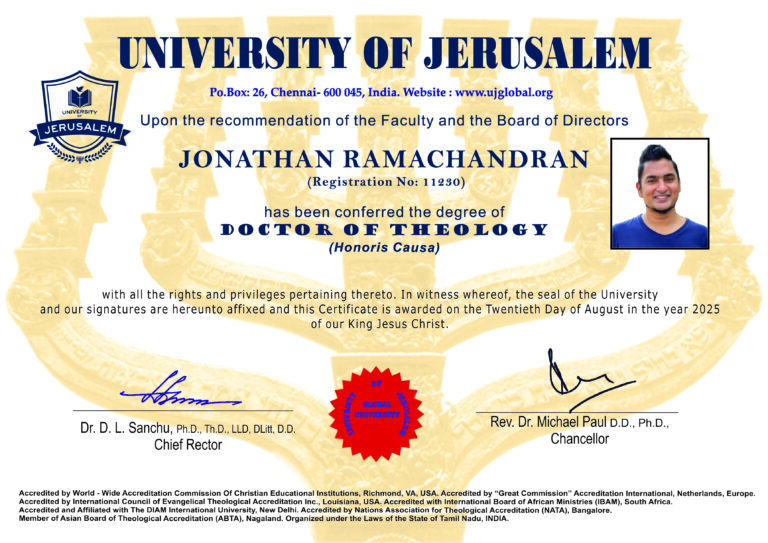
Jonathan Ramachandran is a self taught theological enthusiast who loves the Chiliasm Church Fathers and tries to understand Prophecy of the Bible with their writings. He has published with the Journal of Biblical Theology (JBT, 3 levels of peer reviews), the American Journal of Biblical Theology (AJBT, 2 levels of peer reviews) and also with Christian Publishing House (CPH, Cambridge, Ohio, USA). He runs his theology blog being a freelance missionary of tentmaker style at www.AnonymousChristian.org and lives in Malaysia where he is an operations manager for an engineering company.
Jon is a freelance preacher who is active both online and offline who has baptized some of his students into Christianity. His varied full time working experience includes working with Christian ministries dealing with charity, seismic engineering, educational centre management, teaching Math at schools (elementary and high school with a competition touch) and is one of Malaysia’s International Mathematical Olympiad (IMO) coaches.
Other Book details:
1) ESSAYS IN EARLY CHRISTIANITY: Chiliasm Prophecy Model and Non-Elect Salvation Possibility
i) Paperback
Print length : 432 pages
ISBN-10 : 1949586421
ISBN-13 : 978-1949586428
ii) Hardcover
Print length : 432 pages
ISBN-10 : 194958643X
ISBN-13 : 978-1949586435
2) HOPE BEYOND THE ELECT: Revisiting Early Christian Views on Prophecy and Salvation
i) Paperback
Print length : 182 pages
ISBN-10 : 1949586405
ISBN-13 : 978-1949586404
ii) Hardcover
Print length : 182 pages
ISBN-10 : 1949586413
ISBN-13 : 978-1949586411
#My ORCID Link: https://orcid.org/0009-0008-4669-1077
#GoogleScholar Link:
https://scholar.google.com/citations?hl=en&user=Bv7IFrAAAAAJ
#Academia Link:
https://independent.academia.edu/RamachandranJonathan
Note: Christian Publishing House (CPH) is publisher for the UASV Bible. About CPH: https://www.christianpublishers.org
www.AnonymousChristian.org
#CoachJonathanRamachandran #AnonymousChristian #ChiliasmProphecyModel #CPM #NonElectSalvationPossibility #NESP #Book released 9 June 2025 with #Irenaeus of #Lyons #Justin of #Rome #JustinMartyr and #Tertullian #Catholic #Protestant #Orthodox #Lutheran #Methodist #Anglican #Pentecostal #Denominations .
My CV (22 July 2025) Link:
https://drive.google.com/file/d/1PIGhZIauswvIVlE_poOrt4tI4shYVcTi/view?usp=sharing
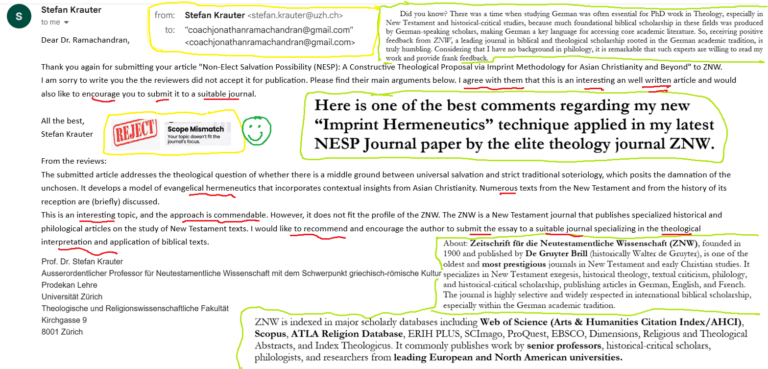
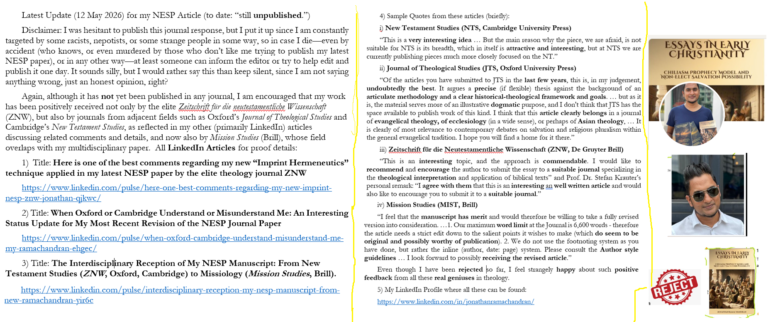
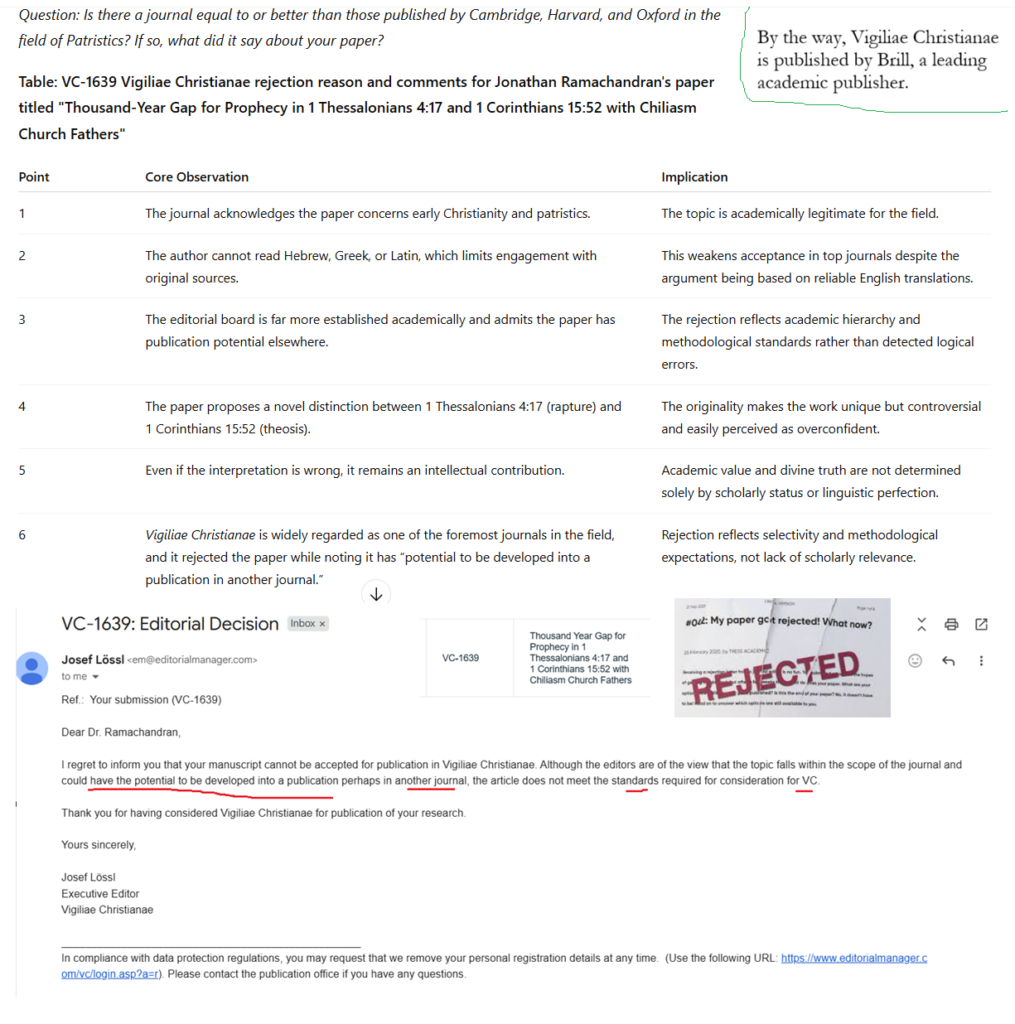
Is there a journal equal to or better than those published by Cambridge, Harvard, and Oxford in the field of Patristics? If so, what did it say about your paper?
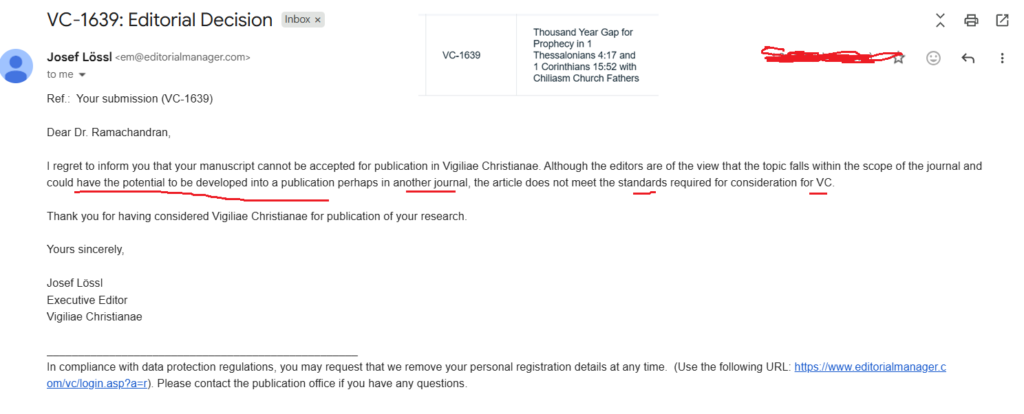
One of the most highly respected journals in the study of early Christianity and Patristics is Vigiliae Christianae. It is sometimes regarded not only as equal to journals published by Cambridge, Harvard, and Oxford, but in certain respects even more prestigious within this specific field. Although the journal rejected my paper, this is what it said about my submission:
Ref.: Your submission (VC-1639)
Dear Dr. Ramachandran,
I regret to inform you that your manuscript cannot be accepted for publication in Vigiliae Christianae. Although the editors are of the view that the topic falls within the scope of the journal and could have the potential to be developed into a publication perhaps in another journal, the article does not meet the standards required for consideration for VC.
Thank you for having considered Vigiliae Christianae for publication of your research.
Yours sincerely,
Josef Lössl
Executive Editor
Vigiliae Christianae
My honest reflections (I may be wrong, but I may also be right in my opinion):
1) The editors acknowledge that my topic clearly belongs to the field of early Christianity and Patristics (“Church Fathers”). This refers to Jonathan Ramachandran’s revised paper, “Thousand-Year Gap for Prophecy in 1 Thessalonians 4:17 and 1 Corinthians 15:52 with Chiliasm Church Fathers,” which is substantially improved and distinct from the version published in Journal of Biblical Theology 8, no. 3 (June 1, 2025).
2) They are aware that I cannot read Hebrew, Koine Greek, or Latin, which means I cannot directly consult the original biblical manuscripts or the original surviving texts of the Church Fathers. This is a serious limitation for a top-tier journal such as this, since they expect authors to engage directly with the original languages and to argue from the precise wording of the primary sources, at least in key passages.
I had already stated that if the English translations I used are accurate for the passages cited, then my interpretive claims based on those texts would remain valid regardless. This, however, leads to a further difficulty for them, which is explained in the next point.
3) The editor and review team are far more accomplished than I am in this field (I am not even in the same league of comparison, which is simply a fact). Yet the editorial decision states that my paper “has the potential to be developed into a publication, perhaps in another journal.”
This suggests either that they did not find a clear error in my line of reasoning as presented, or that, given their position at the highest level of the discipline, they cannot easily acknowledge that my interpretation might be correct because of the limitation noted in point (2), and because I am not an established scholar in the conventional sense (for example, from a top university, holding a PhD in theology, or affiliated with a well-known church or pastor). The only other possibility is that my paper is nonsense, in which case such journals would, I believe, have responded differently and rejected it much more quickly—right?
Whenever I state that I am the first to propose that 1 Thessalonians 4:17 refers to the rapture, while 1 Corinthians 15:52 refers to theosis, separated by 1,000 years, it can sound like bragging and may put readers off. That is not my intention, although I acknowledge that my human weakness is sometimes present in this. My purpose is only to highlight a key distinction that makes the paper both unique and controversial. Scholars in Patristics have long read the same primary sources or translations of the Church Fathers that I cite, yet they have interpreted them differently from what I propose. That difference of interpretation is precisely my contribution. In the end, only God knows which interpretation is correct.
For argument’s sake, even if my view were ultimately shown to be wrong, such a proposal could still represent a meaningful intellectual contribution, because it demonstrates that the same texts can reasonably be understood in another way. As I have said before, academic excellence and contribution are important, yet even the Book of Revelation—one of the most significant texts for prophecy and eschatology—contains grammatical errors while remaining divinely accurate and perfect in meaning. Divine truth, prophetic authority, and final heavenly reward are therefore independent of human linguistic perfection, and any Christian may excel beyond another if God so wills. By the way, Vigiliae Christianae is published by Brill, a leading academic publisher.
Common question: Can you give an example of a Cambridge-, Oxford-, or even Harvard-level Christian journal article that is wrong and could spiritually mislead people, even toward Hell?
Reply: Any paper promoting LGBTQ acceptance contributes to sin when such behavior is normalized, even within marriage. All three institutions—Cambridge, Oxford, and Harvard—have published such papers and books. Polygamy is another example: while it was tolerated in the Old Testament as a human weakness, it contradicts New Testament standards and is considered morally wrong. Likewise, Old Testament rules, such as dietary restrictions, were temporary; teaching them as binding in the New Testament becomes a “doctrine of demons” (Acts 10:9–16; 1 Timothy 4:3–5).
I mean, if God is that strict about what constitutes a doctrine of demons based on the addition of dietary restrictions, do you think He would be lenient with claims such as “Christ had a wife,” or that “polygamy or LGBTQ behavior is acceptable, even in a marriage context”? (Note: polygamy can still be tolerated if a person practiced it before knowing Christ—no one can deceive God.)
One of the most controversial Christian theology articles was published by Harvard[1]: Karen L. King’s “‘Jesus Said to Them, ‘My Wife…’”: A New Coptic Papyrus Fragment.” King, born in 1954, is an American historian of religion, a scholar of early Christianity and Gnosticism, and Hollis Research Professor of Divinity at Harvard Divinity School. She specializes in early Christian texts, gender, orthodoxy and heresy, and religion and violence.
When reading this paper, ponder what I said earlier: “What a remarkable piece of scholarship—offering no direct biblical support, no precedent in the Church Fathers, no historical Catholic, Orthodox, or Protestant tradition before the twentieth century, and relying heavily on cultural claims from pagan or secular sources alongside a few modern sympathetic commentators—yet it still passed the rigorous peer review of Cambridge, Harvard, Oxford, and similar institutions.”
In this article, she presents a Coptic fragment in which Jesus purportedly says, “my wife…,” framing it as part of her research on early Christian diversity. Presenting this idea misleads readers and undermines core Christian truth. I am examining something deeper, namely:
- Conservative Christian perspective: Any conservative Christian would reject this idea outright, since we rely on the New Testament—not on a papyrus fragment unearthed by a professor and her team (or anyone else), regardless of whether it is historically authentic. Why? Read on.
- Authenticity vs. authority: “Authentic” only means that someone wrote it at the time. Many heretical manuscripts have survived, fueling academic study. I treat writings not cited by Church Fathers cautiously, rejecting those that contradict the Bible. If a Church Father cites a work, I favor Chiliasm-aligned interpretations, though differing conservative opinions may also be considered. Academic journals, by contrast, aim for neutrality and often publish controversial ideas without a confessional filter.
- Academic rigor does not equal truth: This article is well-written in the usual academic sense: the original language and manuscript are consulted, styles and grammar are analyzed, and linguistic features are discussed. However, these elements do not imply theological truth. Any Christian would disagree with the article’s conclusions.
- Wisdom and insight come from accuracy: Ultimately, if something is wrong, there is no reward from God, and if taught as doctrine, judgment awaits. Unverified ideas should at least be supported by Church Fathers; otherwise, heretical notions accumulate and cause confusion. For example, a Harvard article claims Christ may have been married—blasphemous—and cites no Church Fathers.
- Popularity vs. truth: Interestingly, this article has been cited 17 times (to date)—a high number—despite analyzing an ancient, heretical fragment. By contrast, a theological work can have zero citations but still be accurate and rewarded by God in His Kingdom.
Conclusion:
I share this as a real example to help readers understand the difference between “academic” and “devotional/confessional” approaches in journals. Many Christian journals occupy a middle ground, which can help prevent outright heresies from finding a place in our literature. Controversial topics—such as LGBTQ issues—also require careful discernment, which I reject completely. When reading a journal article on Christian theology (not general religious studies or psychology, which God may not reward if it does not reflect a correct confessional stance), always check:
- Who is cited in support of the claims
- Whether Bible verses and Church Fathers are referenced
Otherwise, it may be purely academic, highly regarded in the world, but of no value for true theological interpretation—especially if it is wrong, as in this case.
As Luke 16:15 (NKJV) says:
“And He [Christ] said to them, ‘You are those who justify yourselves before men, but God knows your hearts; for what is highly esteemed among men is detestable in the sight of God.’”
Principle: God values the truth of our hearts and alignment with His Word above human praise or academic prestige. Claims like “Christ had a wife” or that polygamy or LGBTQ behavior is acceptable contradict New Testament standards, even if polygamy was tolerated in the Old Testament. Karen L. King’s Harvard article on a Coptic fragment shows that scholarly rigor does not guarantee theological truth.
A key distinction: All of these ideas may seem harmless to a Christian—until your daughter becomes LGBTQ, your sons become polygamists, or they join other heretical cults claiming Christ had a wife under the guise of feminist empowerment—all after reading writings from Cambridge, Harvard, or Oxford that in some way support these ideas, potentially leading them to Hell if fully embraced.
The difference is that my paper addresses non-elect salvation soteriology, meaning that the doctrine of elect salvation remains intact according to any confessional standard within existing denominations. In short, all those denominations teach that the unsaved either go to eternal Hell or are annihilated. My paper merely explores a potential hope for such non-elect individuals (if God wills), based on early Christian writings.
This means it cannot lead anyone to Hell, even if my interpretations are wrong, because the elect will believe in Him regardless, and the non-elect will disbelieve regardless—not due to the influence of my paper. Do you see the difference? For example, some Cambridge, Harvard, or Oxford papers promoting pro-LGBTQ action could potentially lead even the elect to commit such sins, meaning they may not truly be elect after all.
[1] Karen L. King, “‘Jesus Said to Them, “My Wife…”’: A New Coptic Papyrus Fragment,” Harvard Theological Review 107, no. 2 (2014): 131–159, accessed February 7, 2026, Cambridge Core: https://www.cambridge.org/core/journals/harvard-theological-review/article/jesus-said-to-them-my-wife-a-new-coptic-papyrus-fragment/CF713C1BF69091F7380ECE8505D5EEF4; Harvard DASH Repository (PDF): http://nrs.harvard.edu/urn-3:HUL.InstRepos:12423666; Harvard GOJW PDF: https://projects.iq.harvard.edu/files/gojw/files/jesus-said-to-them-final.pdf; freely available PDF: https://dash.harvard.edu/server/api/core/bitstreams/7312037d-26c9-6bd4-e053-0100007fdf3b/content