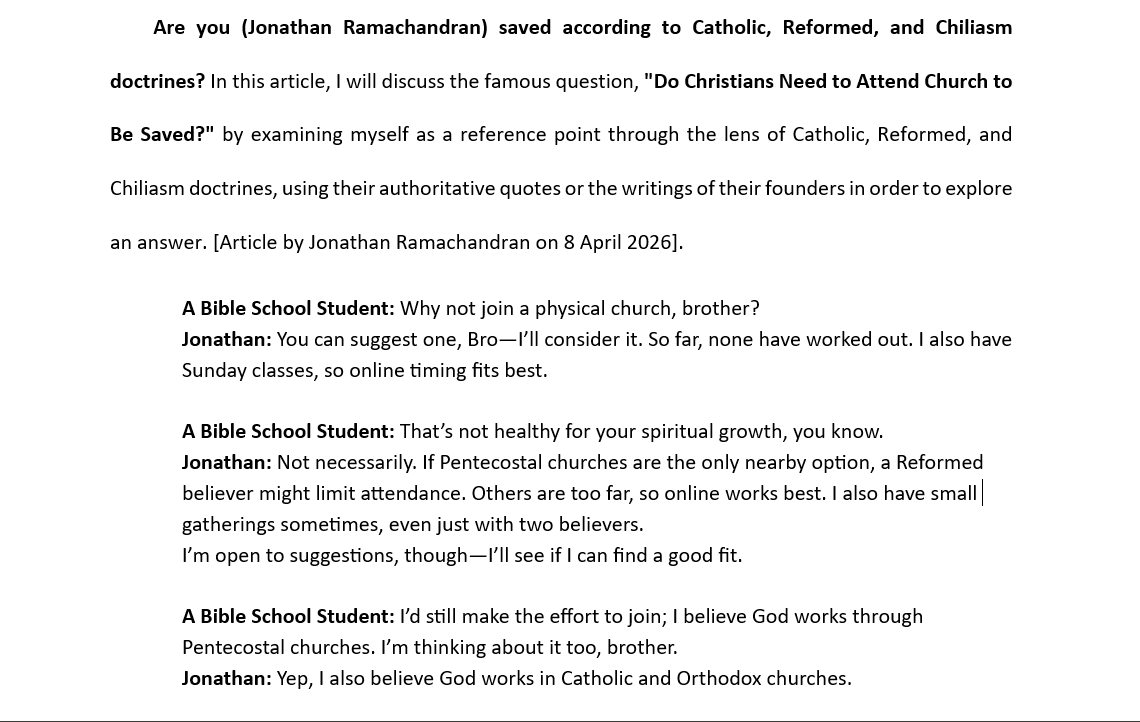
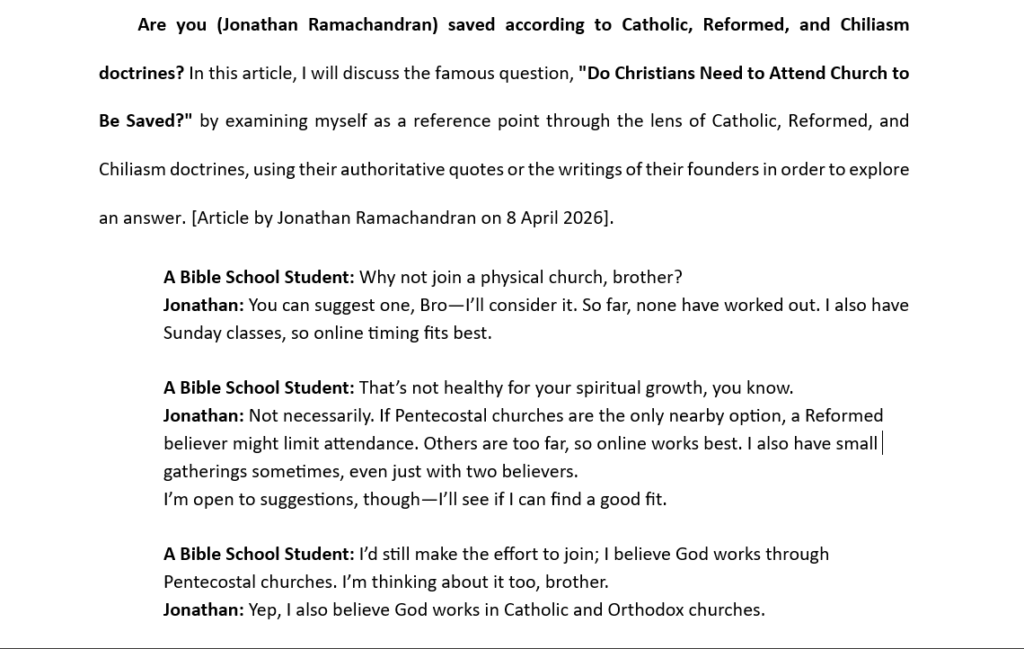
Are you (Jonathan Ramachandran) saved according to Catholic, Reformed, and Chiliasm doctrines?
In this article, I will discuss the famous question, “Do Christians Need to Attend Church to Be Saved?” by examining myself as a reference point through the lens of Catholic, Reformed, and Chiliasm doctrines, using their authoritative quotes or the writings of their founders in order to explore an answer.
What about other denominations? They generally recognize one another as saved. For example, Anglicans, Lutherans, Methodists, and Pentecostals often affirm John Calvin (the founder of the Reformed churches) and St. Augustine of Hippo (the principal Catholicism saint) as saved, since they also incorporate aspects of Calvinism and Augustinism in their doctrinal statements, whether collectively or individually, respectively. Therefore, quoting John Calvin and St. Augustine alone is sufficient for our brief discussion here.
Sample: A Familiar Dialogue
A Bible School Student: Nowadays, do you not attend church?
Jonathan: I mostly attend online church.
A Bible School Student: I see… haha, I hope it’s not Shincheonji.
Jonathan: Haha, no way—that sounds like a cult!
Jonathan: If you’re curious, I follow a mix of online services here and there. Here’s a sample list from Malaysia (January 2026).
“I’m an ecumenical Christian, exploring beliefs topic by topic based on the Bible and Church Fathers, especially on Chiliasm. I may agree with different denominations on different topics, so I can’t commit to just one church.”
A Bible School Student: Why not join a physical church, brother?
Jonathan: You can suggest one, Bro—I’ll consider it. So far, none have worked out. I also have Sunday classes, so online timing fits best.
A Bible School Student: That’s not healthy for your spiritual growth, you know.
Jonathan: Not necessarily. If Pentecostal churches are the only nearby option, a Reformed believer might limit attendance. Others are too far, so online works best. I also have small gatherings sometimes, even just with two believers.
I’m open to suggestions, though—I’ll see if I can find a good fit.
A Bible School Student: I’d still make the effort to join; I believe God works through Pentecostal churches. I’m thinking about it too, brother.
Jonathan: Yep, I also believe God works in Catholic and Orthodox churches.
“However, a person can possibly have a salvific link with Christ and his Church in various ways, some of which are known to God alone. This can be via the valid sacraments they may have, e.g., all seven with the Orthodox, or two with Protestants (baptism and matrimony).”[4]
The Catholic Church recognizes that many Protestants are baptized in the name of the Trinity and share elements of Christian faith, though they are not in full communion with the Church. As the Catechism of the Catholic Church states, “Those who have been incorporated into Christ through Baptism are members of Christ’s body.
The Church recognizes in the baptized who are not yet in full communion with her a certain, though imperfect, communion with the Catholic Church” (CCC 818). It continues, “Many elements of sanctification and truth are found outside the visible confines of the Catholic Church. These gifts are forces impelling toward Catholic unity” (CCC 819).
While Protestants are in imperfect communion, full, ordinary salvation is through the Catholic Church: “Christ is the one mediator and the way of salvation; he is present to us in his body, the Church. He himself explicitly asserted the necessity of faith and Baptism, and thereby affirmed at the same time the necessity of the Church which men enter through Baptism as through a door” (CCC 846).
At the same time, the Church acknowledges God’s extraordinary mercy: “All who have been justified by faith in Baptism are incorporated into Christ; and although separated from full communion with the Catholic Church, they retain a certain link with the Church” (Unitatis Redintegratio 4). Thus, Protestants are urged toward unity with the Catholic Church, but their salvation is not automatically denied (Unitatis Redintegratio 3).
“In this church there is a very large mixture of hypocrites, who have nothing of Christ but the name and outward appearance…”[7]
Calvin taught that salvation is found only in Christ and the true church, defined by its proper marks. He held that the visible church includes both the elect and others, but he did not explicitly state that “Catholics” are saved. In his predestinarian framework, a Catholic who happens to be among the elect and truly united to Christ could be saved, though Calvin never made this claim explicitly by name.
In John Owen’s The True Nature of a Gospel Church[8], he explains the distinction between the visible church (the organized body of professing believers) and the mystical church (the true believers united to Christ). Owen writes that although the visible church contains members by outward profession, many visible members are not true members of Christ Jesus.
St. Augustine of Hippo
“They observe most constantly the rule of faith which has been sought out with diligence; and if in anything they stray from it, they submit to speedy correction under Catholic authority, although, in Cyprian’s words, they be tossed about, by reason of their fleshly appetite, with the various conflicts of phantasies. There are some also who as yet live wickedly, or even lie in heresies or the superstitions of the Gentiles, and yet even then “the Lord knows them that are His.” For, in that unspeakable foreknowledge of God, many who seem to be without are in reality within, and many who seem to be within yet really are without.”[9]
St. Augustine’s quote here acknowledges that Christians could be mystically part of the Church even without visible membership, provided they accepted Catholic authority—a view primarily addressing his contemporaries. He, like earlier church fathers such as St. Irenaeus of Lyons and Tertullian (both Chiliasm believers), in their writings, did not include prayers to the Virgin Mary or saints, nor did he support women pastors.
Augustine’s non-Chiliasm stance, contrasted with their Chiliasm beliefs, illustrates a nuanced and flexible landscape: while doctrinal emphases varied, these authorities suggest that being a faithful or “accurate” Christian extends beyond mere salvation, incorporating both belief and alignment with the Church’s corrective guidance and that only “the Lord knows them that are His.”
Chiliasm Church Fathers
Two Chiliasm church fathers often cited for their emphasis on Church authority and unity are St. Irenaeus of Lyons (c. 130–202) and Tertullian (c. 155–240). However, both were Chiliasm believers, and Tertullian is not officially recognized as a saint due to some Montanist tendencies. This demonstrates that I can be saved, as I model most of their beliefs[10]—unless I misunderstand them in my books, journal, or research which is open to debate or discussion.
Since even the modern Catholic Church does not fully uphold all their beliefs, especially those linked to Chiliasm, it seems unreasonable to judge me as abandoning the first Church God instituted when I seek to follow them, even if no one today fully observes their Chiliasm elements. For other aspects of their doctrine that align with Catholic or Reformed confessions, I also agree. Hence, my position can be understood in light of this explanation.
Conclusion
Johann von Staupitz, Luther’s spiritual mentor and confessor, remained a Roman Catholic priest and Benedictine monk until his death and never joined the Lutheran Reformation[11].
Martin Luther said of him, “If it had not been for Dr. Staupitz, I should have sunk in hell.”[12]
This shows that, despite Luther’s general claim that Catholics are unsaved, he recognized that sincere, non-corrupt Catholics could indeed be saved.
Similarly, I view Catholics, Reformed Christians, and other mainstream believers—such as Anglicans, Lutherans, Methodists, Pentecostals, Charismatics, or Brethren—as potentially saved, though some may receive higher or lower rewards depending on doctrinal accuracy. I leave such judgments to God, avoiding any personal condemnation or justification. My focus is on defending my positions topic by topic, stating my views either as doctrine or as possibilities, with reasons provided in my writings.
My strongest point showing that my position aligns with Biblical interpretation comes not merely from my own opinion, but from St. Clement of Rome (Pope Clement I, for Roman Catholics, c. 88–99 AD), who was a direct disciple of the Apostle St. Peter—imagine being personally appointed by the Apostle of our Lord Jesus Himself! The writing I am quoting, Clement 1, is generally considered authentic even by leading scholars (though Clement 2 is sometimes disputed), and in some parts of early Christendom, it was even regarded as Scripture. I will quote the next part briefly from my book:
As a historical precedent, Clement of Rome affirmed that doctrinal accuracy may not always reside with the majority. He asserted that a person who separates from a church over error—if proven correct—would receive great honor and glory from the Lord. This tradition is affirmed by Irenaeus of Lyons as having apostolic origin.[[13]]
This is a clear demonstration of the free will God permits, even in matters of doctrinal accuracy within a church that outwardly agrees with Christ.[[14]] Clement of Rome writes:
“Who then among you is noble-minded? Who compassionate? Who full of love? Let him declare, If on my account sedition and disagreement and schisms have arisen, I will depart, I will go away wherever ye desire, and I will do whatever the majority commands; only let the flock of Christ live on terms of peace with the presbyters set over it. He that acts thus shall procure to himself great glory in the Lord; and every place will welcome him. For the earth is the Lord’s, and the fullness thereof. These things they who live a godly life that is never to be repented of, both have done and always will do.”[15]
Many could receive higher overall heavenly rewards than I do if their doctrines are more accurate, and vice versa; this is for God to decide, and that’s the ‘game theory’ element, which God allows as free will bounded by His will, as I believe. Hence, I am an ecumenical Christian.
Footnotes
[1] Catechism of the Catholic Church, 2nd ed. (Vatican City: Libreria Editrice Vaticana, 2000), 818–819, https://www.vatican.va/content/catechism/en/part_one/section_two/chapter_three/article_9/paragraph_3_the_church_is_one%2C_holy%2C_catholic%2C_and_apostolic.html.
[2] Ibid., 846.
[3] Second Vatican Council, Unitatis Redintegratio: Decree on Ecumenism, November 21, 1964, https://www.vatican.va/archive/hist_councils/ii_vatican_council/documents/vat-ii_decree_19641121_unitatis-redintegratio_en.html.
[4] Tim Staples, “Is There Really ‘No Salvation Outside the Catholic Church?’” Catholic Answers Magazine, February 6, 2015, https://www.catholic.com/magazine/online-edition/is-there-really-no-salvation-outside-the-catholic-church.
[5] “Visible and Invisible Church,” Monergism, accessed April 8, 2026, https://www.monergism.com/taxonomy/term/41672.
[6] John Calvin, Institutes of the Christian Religion, Book IV, Chapter 1, §7 (1536; repr., multiple editions), https://www.christianstudylibrary.org/article/calvin-church-our-mother.
[7] John Calvin, Institutes of the Christian Religion, Book IV, Chapter 1, Section 7, English translation, accessed April 8, 2026, https://www.biblestudytools.com/history/calvin-institutes-christianity/book4/chapter-1.html.
[8] John Owen, The True Nature of a Gospel Church, in Inquiry into the Original, Nature, Institution, Power, Order, and Communion of Evangelical Churches, ch. III, accessed April 8, 2026, https://www.ccel.org/ccel/owen/evangelicalchurches.iii.iii.html.
[9] Augustine, Chapter 27, On Baptism, Against the Donatists (Book V), in Nicene and Post‑Nicene Fathers, First Series, Vol. 4, trans. J.R. King, rev. Chester D. Hartranft, ed. Philip Schaff (Buffalo, NY: Christian Literature Publishing Co., 1887), accessed April 8, 2026, https://www.newadvent.org/fathers/14085.htm.
[10] Jonathan Ramachandran, ESSAYS IN EARLY CHRISTIANITY: Chiliasm Prophecy Model and Non-Elect Salvation Possibility (Cambridge, OH: Christian Publishing House, July 13, 2025), ISBN 978-1949586435, https://www.amazon.com/dp/1949586421.
[11] Toward the end of his life, Luther, in a letter to Elector John Frederick of March 27, 1545, summed up his indebtedness: “Doctor Staupitz is first of all my father in this doctrine and gave birth to me in Christ.” Franz Posset, “Johannes von Staupitz’s Influence on Martin Luther,” Oxford Research Encyclopedia of Religion, August 31, 2016, accessed January 6, 2026, https://oxfordre.com/religion/view/10.1093/acrefore/9780199340378.001.0001/acrefore-9780199340378-e-371.
[12] Roland Bainton, Here I Stand: A Life of Martin Luther (Nashville: Abingdon Press, 1950), 53, https://archive.org/details/hereistandalifeo017222mbp
[13] Irenaeus of Lyons writes concerning Clement of Rome, “For there were many still remaining who had received instructions from the apostles. In the time of this Clement, no small dissension having occurred among the brethren at Corinth, the Church in Rome dispatched a most powerful letter to the Corinthians, exhorting them to peace, renewing their faith, and declaring the tradition which it had lately received from the apostles.” Against Heresies, Book 3, Chapter 3, Point 3. www.newadvent.org/fathers/0103303.htm
[14] Luke 6:22–23 reads, “Blessed are you when men hate you, and when they exclude you, and revile you, and cast out your name as evil, for the Son of Man’s sake. Rejoice in that day and leap for joy! For indeed your reward is great in heaven, for in like manner their fathers did to the prophets” (NKJV).
[15] Jonathan, ESSAYS IN EARLY CHRISTIANITY, 12.
Bibliography
Augustine. On Baptism, Against the Donatists (Book V). Translated by J.R. King; revised by Chester D. Hartranft. Edited by Philip Schaff. Buffalo, NY: Christian Literature Publishing Co., 1887. Accessed April 8, 2026. https://www.newadvent.org/fathers/14085.htm.
Bainton, Roland. Here I Stand: A Life of Martin Luther. Nashville: Abingdon Press, 1950. https://archive.org/details/hereistandalifeo017222mbp.
Calvin, John. Institutes of the Christian Religion. Book IV, Chapter 1, §7 (1536; repr., multiple editions). https://www.christianstudylibrary.org/article/calvin-church-our-mother.
Calvin, John. Institutes of the Christian Religion. Book IV, Chapter 1, Section 7. English translation. Accessed April 8, 2026. https://www.biblestudytools.com/history/calvin-institutes-christianity/book4/chapter-1.html.
Catechism of the Catholic Church. 2nd ed. Vatican City: Libreria Editrice Vaticana, 2000. https://www.vatican.va/content/catechism/en/part_one/section_two/chapter_three/article_9/paragraph_3_the_church_is_one%2C_holy%2C_catholic%2C_and_apostolic.html.
Catholic Answers. “Is There Really No Salvation Outside the Catholic Church?” Last modified 2021. https://www.catholic.com/magazine/online-edition/is-there-really-no-salvation-outside-the-catholic-church.
Owen, John. The True Nature of a Gospel Church. In Inquiry into the Original, Nature, Institution, Power, Order, and Communion of Evangelical Churches. Accessed April 8, 2026. https://www.ccel.org/ccel/owen/evangelicalchurches.iii.iii.html.
Posset, Franz. “Johannes von Staupitz’s Influence on Martin Luther.” Oxford Research Encyclopedia of Religion, August 31, 2016. Accessed January 6, 2026. https://oxfordre.com/religion/view/10.1093/acrefore/9780199340378.001.0001/acrefore-9780199340378-e-371.
Ramachandran, Jonathan. Essays in Early Christianity: Chiliasm Prophecy Model and Non-Elect Salvation Possibility. Cambridge, OH: Christian Publishing House, 13 July 2025. ISBN 978-1949586435. https://www.amazon.com/dp/1949586421.
Second Vatican Council. Unitatis Redintegratio: Decree on Ecumenism. November 21, 1964. https://www.vatican.va/archive/hist_councils/ii_vatican_council/documents/vat-ii_decree_19641121_unitatis-redintegratio_en.html.
Staples, Tim. “Is There Really ‘No Salvation Outside the Catholic Church?’” Catholic Answers Magazine, February 6, 2015. https://www.catholic.com/magazine/online-edition/is-there-really-no-salvation-outside-the-catholic-church.
“Visible and Invisible Church.” Monergism. Accessed April 8, 2026. https://www.monergism.com/taxonomy/term/41672.
Last but not least, here are the LinkedIn articles I have written for further discussion and reference:
1) Faith and Charity or the Prosperity Gospel?—What Would Jesus Do (WWJD)?
https://www.linkedin.com/pulse/faith-charity-prosperity-gospelwhat-would-jesus-do-ramachandran-0boqc
2) Authority, Order, and Learning: Scripture, History, and the Transmission of the Bible
https://www.linkedin.com/pulse/authority-order-learning-scripture-history-bible-ramachandran-foi4c
3) Can one truly live by faith without practicing almsgiving, except in unavoidable circumstances, as with the thief on the cross?
https://www.linkedin.com/pulse/can-one-truly-live-faith-without-practicing-except-ramachandran-ynxvc
4) Why should this Christian theological journal paper be considered suitable for publication?
5) Can the Great Commission be fulfilled by those with imperfect English or even imperfect grammar in Hebrew or Greek?
6) Questions for the Spiritually or Psychologically Insightful
https://www.linkedin.com/pulse/questions-spiritually-psychologically-insightful-ramachandran-mjeoc
7) Is being a Christian in a non-Christian country associated with greater relative measure of faith and, consequently, greater eternal reward?
https://www.linkedin.com/pulse/being-christian-non-christian-country-associated-ramachandran-owrnc
8) Explore Free School Math Solutions by Jon — all learning resources and Facebook links are available on article here for easy access!
9) Explore Free Elementary School Math Olympiad Solutions by Jon — all learning resources and Facebook links are available on post here for easy access!
10) Free High School Math Olympiad by Jon: Problems 1–340, Solutions & Links
https://www.linkedin.com/pulse/free-high-school-math-olympiad-jon-problems-1340-ramachandran-tfiqc
11) Free High School Math Olympiad by Jon: Problems 341–545, Solutions & Links
https://www.linkedin.com/pulse/free-high-school-math-olympiad-jon-problems-341545-ramachandran-has7c
12) Common Fallacy: If You Are So Spiritually Wise, Why Are You Not a Millionaire or a Famous Pastor?
https://www.linkedin.com/pulse/common-fallacy-you-so-spiritually-wise-why-famous-ramachandran-ccgsc
13) What Cambridge, Harvard, and Oxford Haven’t Published: Prophetic or Mundane Interesting Coincidence in God’s Human Providential Will via Game Theory
14) Do you like any Pentecostal denomination or find common ground with them instead of opposing them only?
15) Azusa’s Paradox: Parham vs. Seymour, COGIC vs. AOG—Different Claims to the Holy Spirit or Contradicting Human Assumptions Using God’s Name?
16) Acknowledging Those Who Made My Biblical Scholarship Possible By Jonathan Ramachandran (26 February 2026)
17) Fruits of Non-Christianism, Secularism, and Pentecostalism: A Reflection on Faith, Truth, and Eternal Reward
https://www.linkedin.com/pulse/fruits-non-christianism-secularism-pentecostalism-ramachandran-i901c
18) Are you “High Class” or “Low Class”?
https://www.linkedin.com/pulse/you-high-class-low-jonathan-ramachandran-qf3cc
19) Who Dares to Nuke Israel? 3rd Temple Prophecy, Christian Chiliasm, and the Misunderstood Judgment of Zion
20) If I Die Tragically, Does That Prove My Theology Was Wrong? Would You Say the Same About Your Own Heroes?
21) Why Pentecostal Theology Grew Rapidly and Gained Support from Unbelieving Jews: Differences Between Christian Zionism and Jewish Zionism
22) A Simple Solution to the World’s Most Complex Religious Problem: The What, Who, Where, How, and Why of the Third Jewish Temple Construction
23) FAQ: What Is the Point of Your Book or Journal Publication If Scholars from Cambridge, Harvard, or Oxford—and Even Most Reformed or Pentecostals (from Opposite Theological Extremes)—Would Never Believe It?
https://www.linkedin.com/pulse/what-point-your-book-journal-publication-scholars-ramachandran-rbbnc
24) My NESP Paper, WTJ, and the Dynamics of Positive Rejection: A ‘Game Theory’ Perspective
https://www.linkedin.com/pulse/my-nesp-paper-wtj-dynamics-positive-rejection-game-ramachandran-ea4xc
25) The Personhood of the Holy Spirit and the Unity of the Trinity
26) Why are you angry with the Christian God when the man or woman making your work life miserable isn’t even Christian?
https://www.linkedin.com/pulse/why-you-angry-christian-god-when-man-woman-making-ramachandran-d4thc
27) Are you (Jonathan Ramachandran) saved according to Catholic, Reformed, and Chiliasm doctrines?
https://www.linkedin.com/pulse/you-jonathan-ramachandran-saved-according-catholic-ramachandran-qiuzc
28) Thought: Toward a Revised Abstract of Non-Elect Salvation Possibility (NESP) Paper with Methodological Defense
Thank you!
Regardless of Hillsong’s theology, which I disagree with a lot (prosperity gospel, feminism, etc.), I still like some of their songs, such as this one:
https://www.youtube.com/watch?v=nQWFzMvCfLE
Shalom.
#My ORCID Link: https://orcid.org/0009-0008-4669-1077
#GoogleScholar Link:
https://scholar.google.com/citations?hl=en&user=Bv7IFrAAAAAJ
#Academia Link:
https://independent.academia.edu/RamachandranJonathan
Note: Christian Publishing House (CPH) is publisher for the UASV Bible. About CPH: https://www.christianpublishers.org
Previous books, journal articles, and magazine articles published:
1) Jonathan Ramachandran, ESSAYS IN EARLY CHRISTIANITY: Chiliasm Prophecy Model and Non-Elect Salvation Possibility (Cambridge, OH: Christian Publishing House, July 13, 2025), ISBN 978-1949586435, https://www.amazon.com/dp/1949586421
2) Jonathan Ramachandran, HOPE BEYOND THE ELECT: Revisiting Early Christian Views on Prophecy and Salvation (Cambridge, OH: Christian Publishing House, June 6, 2025), ISBN 978-1949586411, https://www.amazon.com/dp/1949586405
3) Jonathan Ramachandran, “Non Elect Salvation Possibility,” American Journal of Biblical Theology (AJBT), vol. 26, no. 6 (February 9, 2025), https://www.biblicaltheology.com/Research/RamachandranJ01.pdf
4) Jonathan Ramachandran, “Thousand Year Gap for Prophecy in 1 Thessalonians 4:17 and 1 Corinthians 15:52 with Chiliasm Church Fathers,” Journal of Biblical Theology (JBT), vol. 8, no. 3 (June 1, 2025): 185–208, https://www.biblicaltheology.com/research.html. This article is identical to the version published in American Journal of Biblical Theology, vol. 26, no. 22 (June 1, 2025), https://www.biblicaltheology.com/Research/RamachandranJ02.pdf
5) Jonathan Ramachandran, “The Personhood of the Holy Spirit and the Unity of the Trinity,” JOY! Magazine, April 2026, theology section, 28–30, published by JOY! Magazine (Somerset West, Western Cape, South Africa), accessed April 3, 2026, https://joygifts.co.za/product/https-joygifts-co-za-joy-april-2026/.
A brief bio and photo.
Jonathan Ramachandran, B.Sc., Th.D. (Hon.), D.Div. (Hon.), D.Min. (Hon.) is an ecumenical Christian, Malaysian theologian, missionary blogger (https://www.anonymouschristian.org/), IMO coach, published author, and operations manager, integrating theology, mathematics, and ministry. He can be contacted at email ([email protected]) or phone (+6010-8803763)

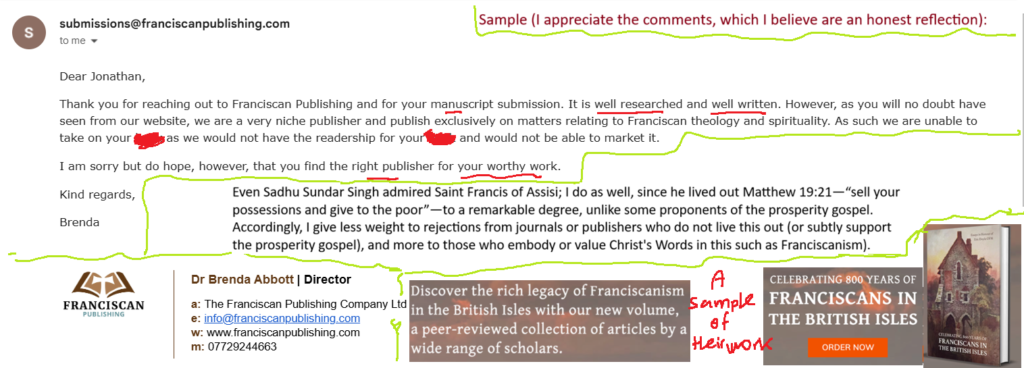
Sample (I appreciate the comments, which I believe are an honest reflection):
[email protected] wrote:
Dear Jonathan,
Thank you for reaching out to Franciscan Publishing and for your manuscript submission. It is well researched and well written. However, as you will no doubt have seen from our website, we are a very niche publisher and publish exclusively on matters relating to Franciscan theology and spirituality. As such we are unable to take on your XX as we would not have the readership for your XX and would not be able to market it.
I am sorry but do hope, however, that you find the right publisher for your worthy work.
Kind regards,
Brenda
Dr Brenda Abbott | Director
a: The Franciscan Publishing Company Ltd
w: www.franciscanpublishing.com
w: www.franciscanpublishing.com
Here’s a sample of one of their major work which has an attractive description which reads “Discover the rich legacy of Franciscanism in the British Isles with our new volume, a peer-reviewed collection of articles by a wide range of scholars.”
Note: Franciscanism is a spiritual and religious tradition within Christianity that follows the teachings and lifestyle of Saint Francis of Assisi (1181/82–1226).
Neither Martin Luther nor John Calvin were admirers of Saint Francis of Assisi in a devotional sense, but both respected him as a sincere Christian while rejecting the theological framework of Franciscanism. Several Protestants—such as John Wesley, Evelyn Underhill, and Dietrich Bonhoeffer—openly admired Saint Francis of Assisi for his simplicity, humility, and Christ-like life. Even Sadhu Sundar Singh admired him. I admire Saint Francis of Assisi because he lived out Matthew 19:21—“sell your possessions and give to the poor”—to a remarkable degree, especially in contrast to some proponents of the prosperity gospel.
Similarly, I do not take seriously rejections by various journals or publishers who have not lived out Matthew 19:21 to any significant degree—or worse, who covertly support the prosperity gospel (leaving judgment to God, I simply mean to show that I value different strengths, such as Franciscanism; accordingly, a positive comment from those who practice such levels of renunciation, or who support such people, carries more weight for me).
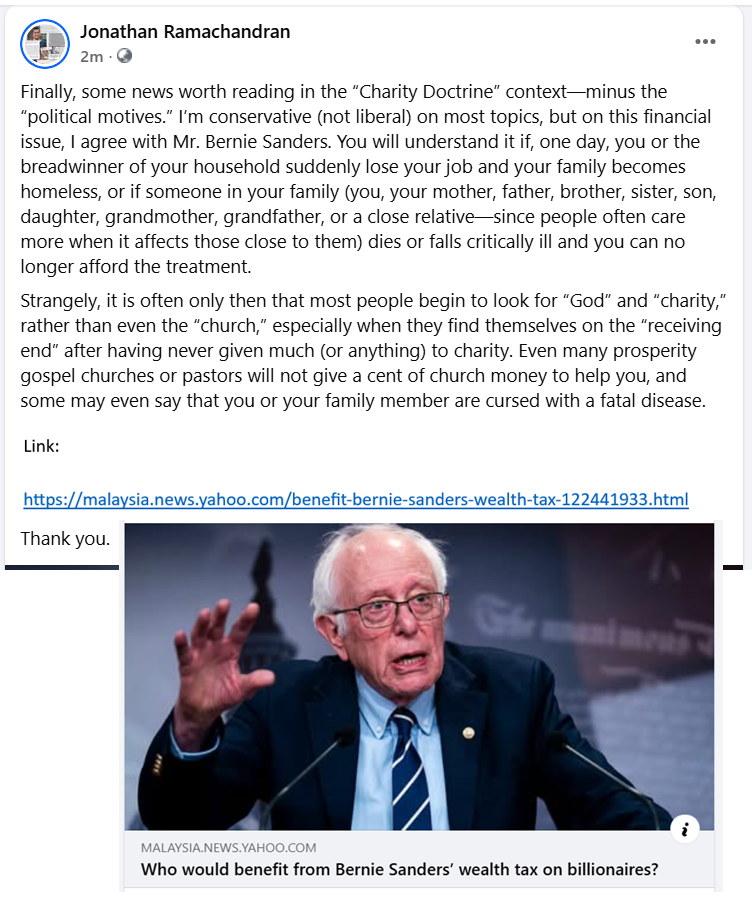
Finally, some news worth reading in the “Charity Doctrine” context—minus the “political motives.” I’m conservative (not liberal) on most topics, but on this financial issue, I agree with Mr. Bernie Sanders. You will understand it if, one day, you or the breadwinner of your household suddenly lose your job and your family becomes homeless, or if someone in your family (you, your mother, father, brother, sister, son, daughter, grandmother, grandfather, or a close relative—since people often care more when it affects those close to them) dies or falls critically ill and you can no longer afford the treatment.
Strangely, it is often only then that most people begin to look for “God” and “charity,” rather than even the “church,” especially when they find themselves on the “receiving end” after having never given much (or anything) to charity. Even many prosperity gospel churches or pastors will not give a cent of church money to help you, and some may even say that you or your family member are cursed with a fatal disease.
Link:
https://malaysia.news.yahoo.com/benefit-bernie-sanders-wealth-tax-122441933.html
When reviewers of my NESP paper cite a methodological error based on their view that it should include the original context—such as the topic at the time the quote was made, the historical setting, other secondary scholars, and alternative interpretations of that same quote (if they exist)—I respond as follows:
By reading this, readers may become more aware of the complex landscape surrounding what constitutes Biblical exegesis versus eisegesis. Even when examining a single verse (1 Corinthians 3:15), John Calvin does not interpret it as supporting any form of posthumous salvation, whereas Augustine of Hippo, citing the same passage, clearly understands it as referring to purgatory (i.e., a form of salvation occurring after death and beyond judgment, not limited to this life).
For argument’s sake, if Calvin turned out to be right, then even Blessed Augustine would be wrong on this. In that case, my view of non-elect salvation possibility would not be entirely unreasonable, even if it were ultimately incorrect in a similar way. Can you see what I mean?
Source (Article titled “Thought: Toward a Revised Abstract of Non-Elect Salvation Possibility (NESP) Paper with Methodological Defense”), more details:
Thank you for reading!