
My APMO and IMO 2002 Experience: Facts and Perspectives You May Not Realize
I am writing this article to promote my Math Olympiad classes, beginning from the elementary-school level onward.
Some say that I humiliated my country, religion, and race at IMO 2002 by scoring only 1 mark. Usually, such people do not realize that they themselves never achieved full marks in, say, OMK 2002 as I did (or, equivalently, never attained any “national olympics”-level achievement in their own field or sport, nor represented their country at an Olympics-level competition in their respective discipline). In many fields, there are literally hundreds, thousands, or even tens of thousands of people within a country who possess similar qualifications. In contrast, in what I am discussing, only six students each year satisfy all the stringent requirements to represent Malaysia at the IMO.
Were you ever among the top six in your field in your country, by merit, at any point in your life — especially at a level involving not only national but also international competition? Mathematics is not as popular as sports or music, and therefore it does not attract as many views, likes, or viral attention, unlike even comparatively lower achievements in those fields.
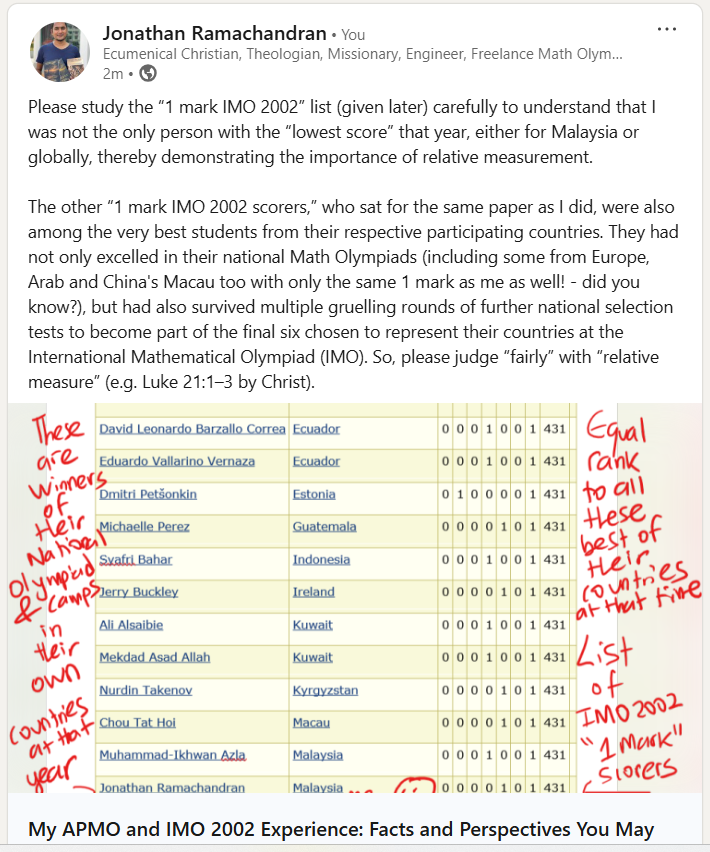
Please study the “1 mark IMO 2002” list (given later) carefully to understand that I was not the only person with the “lowest score” that year, either for Malaysia or globally, thereby demonstrating the importance of relative measurement.
The other “1 mark IMO 2002 scorers,” who sat for the same paper as I did, were also among the very best students from their respective participating countries. They had not only excelled in their national Math Olympiads (including some from Europe, Arab and China’s Macau too with only the same 1 mark as me as well or lower 0 marks! – did you know?), but had also survived multiple gruelling rounds of further national selection tests to become part of the final six chosen to represent their countries at the International Mathematical Olympiad (IMO). So, please judge “fairly” with “relative measure” (e.g. Luke 21:1–3 by Christ).
A strange APMO Story
APMO stands for Asia Pacific Mathematical Olympiad.
Firstly, I was reluctant to write this story because sometimes some people misunderstand thinking I am bragging but how else am I supposed to market for my living? (I mean if someone from their own family/ race / religion had this story or any of such achievements, they seem to not look at it as bragging if it was told, right? So that’s how I can be clear likewise of such false accusations).
It happened and so it’s the truth and it can be corroborated by some who are still living if you are keen. Since it’s related to my personal life, I have every right to voice it out because I am not talking about something which involves other people only but I mention only things which are related to me directly or by nature of work in comparison.
Here are two strange facts:
1) My IMO Story
At the International Mathematical Olympiad IMO 2002, I only got 1 Mark out of 42 Marks (failed miserably) but I got this interesting comment:
“… That’s the most beautiful mistake I have seen at the IMO (commenting on my failed solution for IMO Problem 5 in 2002, where due to some unsound Math Argument but the Mathematical Induction Method I used seemed to Work) …” – IMO Jury 2002
(told to me via Professor of Mathematics & Malaysian Head Coach at that time Prof. Dr. Abu Osman Md Tap, A renown local Mathematician & yes sadly, I failed him at the IMO)
Comments:
I just couldn’t do it. No excuses I failed regardless and I accept it. You must understand that the first time I saw a Math Olympiad problem was in 1999 (Age 16) and I couldn’t do it and missed Math Olympiads (OMK) for years 2000 and 2001 because school did not participate and by God’s Grace I only managed to participate in 2002 (pretty late exposure and only self training those days with little math camps and I did not do much either where if you look at medalists they usually train from very young, primary (elementary) school itself and surely the chances of losing to them is certain.
However, sometimes I do believe that we get lucky as some problems could be something we have seen or trained for earlier which I present with proof in my next real life story (not fiction) below in the APMO story part. But before that, please allow me to share some related facts regarding the IMO too.
i) Did contestants from other countries get equal score at IMO 2002 or lower? Yes:
[Note: Some among these 1 Mark contestants at IMO 2002 which I participated today have Professor of Mathematics qualification (PHD) from Cambridge (the Real One) too where I will let you discover such person(s) as they are very humble as I know at least 1 personally]
Format: Name ; Country; P1: P2; P3: P4: P5: P6: Rank.
Note: A score of “1” in “P1” means obtaining 1 mark in Problem 1 at IMO 2002. Generally, P1 is the easiest problem, while P5 and P6 are the hardest at the IMO each year, meaning that scoring 1 mark in P5 is more impressive than scoring 1 mark in P1–P4. Some even scored “0 marks” in total at IMO 2002, as shown in this list as well.
If anyone wants to mock my race or religion for this, ask yourself how many people on this same list are also from your race or religion (or even denomination). How about the fact that some of your race or religion (more accurately, your denomination) may not even appear anywhere on the entire IMO list, if at all?
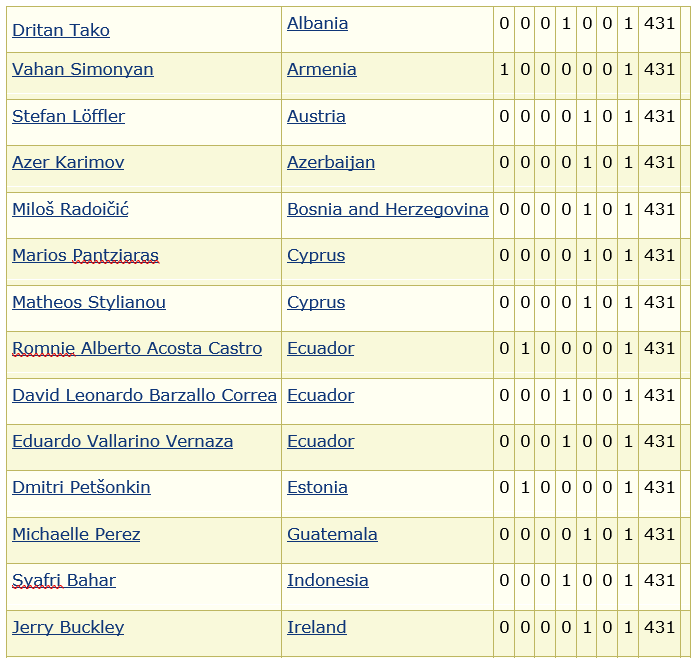


[Text version]
Source:
https://www.imo-official.org/year_individual_r.aspx?year=2002&column=total&order=desc
*Relative Measure is important because “how many 1 mark at IMO 2002?” and “how many 0 Marks at IMO 2002?” contestants are also the BEST in their NATIONAL COUNTRY OLYMPIADS + Rigorous IMO Math Camp Selections (which are equivalent to the Olympics Country Training in Academic but sport is more popular and even in sports I do not think that we have qualified much even to compete in it let alone win medals in that – can you see it?) where such IMO Math Camp Trainings are some of the toughest Math Academic exams within the country and globally (e.g. surely harder than the school IB exams even).
ii) Which problem was the hardest problem (to date) at the IMO?
To quote:
I vote for Problem 6, IMO 1988.
Let aa and bb be positive integers such that (1+ab)|(a2+b2)(1+ab)|(a2+b2). Show that (a2+b2)/(1+ab)(a2+b2)/(1+ab) must be a perfect square.
Niven, Zuckerman and Montgomery, in their infinite wisdom, have added this problem a double-starred exercise in Section 1.2 (Divisibility) of their textbook An Introduction to the Theory of Numbers. The problem has a chequered history, narrated among other places in Arthur Engel’s Problem-Solving Strategies.
This problem was submitted in 1988 by West Germany. None of the six members of the Australian problem committee could solve it. Two of the members were George and Esther Szekeres, both famous problem solvers and problem creators. Since it was a number-theoretic problem, it was sent to the four most renowned Australian number theorists. They were asked to work on it for six hours. None of them could solve it in this time. The problem committee submitted it to the jury of the XXIX IMO marked with a double asterisk, which meant a superhard problem, possibly too hard to pose. After a long discussion, the jury finally had the courage to choose it as the last problem of the competition. Eleven students gave perfect solutions.
Among the eleven contestants who answered the problem correctly were Fields Medallist Ngo Bao Chau and Putnam Fellow Ravi Vakil. Among the many who scored 1 point out of 7 were Fields Medallist Terence Tao (who was, after all, only 13 years old) and Putnam Fellow Jordan Ellenberg, who had perfect scores in 1987 and 1989.
Source: https://www.quora.com/What-is-the-toughest-problem-ever-asked-in-an-IMO
To keep things in context, please remember that quite a number of Math PHD holders and lecturers in Malaysia or even globally have competed even in National Math Olympiads (e.g. OMK in Malaysia) or even at IMO and failed likewise with sometimes no national ranking nor even passing the IMO Selection Camps to represent Malaysia. This is not to downgrade anyone as they achieve better later in the usual academia meaning the OMK and IMO is that tough! (and thus those who do well in it are very few indeed).
2) My APMO Story
The reason I presented the “hardest IMO problem” part above is to show a crucial fact regarding “relative measure” which is the APMO (Asia Pacific Math Olympiad, the real one) is used for IMO Selection across various countries including Malaysia and it’s at 5 problems 4 hours level of difficulty and I did not fare well in APMO 2002 (where I think I got 4 marks only or so if memory serves me well). However, just like at the IMO, solving even one problem completely merits an honourable mention:
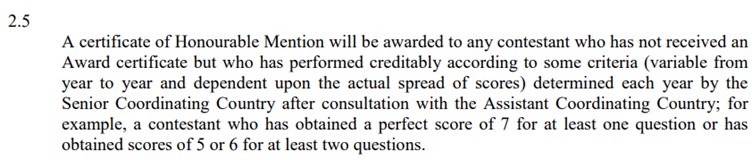
Source: https://www.apmo-official.org/static/regulations/apmo-reg-2021.pdf
Why am I mentioning this? I solved APMO 2003 Problem 1 which if asked on my APMO year 2002 could have merited me the Honourable Mention proving that sometimes the questions which we can do were not asked in our year (but the year after my IMO and am not qualified to participate anymore in APMO either due to my age) but there’s an interesting story behind it. Please allow me to share the details next.
There was this one website which contained plenty of Olympiad & other math competition problems with their solutions, done by John Scholes (an ex-Olympian from UK many years ago). However, copyright problems caused his website to “close down”. But a lot of people do not know that you can still obtain major contents of his website from a “webcopy” (which I show on the link below):
I think it’s this Mr. John Scholes (ex-IMO Silver Medalist in 1968 for England):
https://www.imo-official.org/participant_r.aspx?id=10081
https://en.wikipedia.org/wiki/John_M._Scholes
Here’s the deal:
Mr. John Scholes is a brilliant mathematician who usually solves all these problems by himself. But at times, there’s this one or two which he cannot solve or wish to get a better solution of which he will then “open to the public” for solution suggestions.
One such problem I helped to solve was the 15th APMO 2003 (Asia Pacific Math Olympiad), Question 1 in the year 2003 (this does NOT mean that I’m better than Mr. Scholes but rather that it’s an example of “sharing knowledge”). Here is that problem with its “solution – key”:
https://prase.cz/kalva/ or http://mks.mff.cuni.cz/kalva/
Note: you have to click at “APMO” and “15th APMO 2003” to view it as the link is setup in such a way.
About Mr. Suhaimi Ramly (credible and respected witness) whom I am going to quote next (where his highest achievement is Bronze Medal at IMO 2000 solving almost 1 Problem fully with 6 marks plus 2 Mark + 3 Marks across 3 Problems for a total of 11 marks out of 42), Source: https://www.imo-official.org/participant_r.aspx?id=5851
Here’s my Story regarding APMO 2003 Problem 1 why is it unusual:
I got an email from my good friend (ex-IMO Bronze Medalist for Malaysia in 2000, and Double OMK 2000 & 2001 Perfect Score Winner, the legendary Mr. Suhaimi Ramly himself) somewhere in 2003 stating that many of the enrolled Massachusetts Institute of Technology (the real MIT)students (new and old) could not find a solution to a particular problem namely APMO 2003 Problem 1 which he asked me to try. Strangely (almost immediately) I could see the answer and eventually emailed him a solution and he was happy about it! (you can ask him to see if this story ‘really happened’).
Further proof that this particular APMO 2003 Problem 1 received such global alarm for both Math Olympians at that time including ex-IMO contestants too was very clear via Mr. John Scholes website because he never asks anyone to send in solutions until he has tried to solve it by himself first and also this takes days (meaning even other ex-IMO and current IMO contestants whether at MIT or globally in touch with this famous website for IMO-Academia at that time, which is plenty) also got to try it since he put up a request for solution after Mr. John Scholes couldn’t solve it.
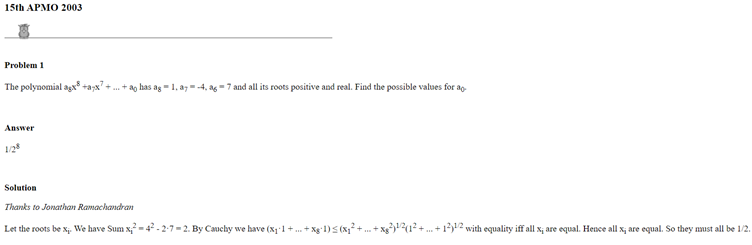
I emailed him my solution (somehow I did not keep a copy of both my emails to Mr. Suhaimi at MIT nor Mr. John Scholes) but the proof of it is in image below where Mr. John Scholes published my solution for APMO 2003 Problem 1 (which by Relative Measure seems hard because even many MIT Math Students an ex-IMO and current IMO contestants at that time could not or did not send in solutions to him) and if Mr. John Scholes solved it, he would have stated that he did but this solution is better (as he does with other problems) proving my point that as per the IMO hardest problem earlier it’s measured relatively by how many students in that year could do itand this APMO 2003 Problem 1 had that effect in some way where I could not solve any of the problems they could but by God’s Grace I was allowed to see this solution (where even at IMO solving a rare question with few solutions or uniquely sometimes even gets a special prize, just mentioning) and can you see the other fact which is proven here namely that sometimes we get lucky in regards to the question asked for a particular year?
Source: https://prase.cz/kalva/apmo/asoln/asol031.html
The length of the solution looks short because Mr. John Scholes re-phrased my solution only highlighting the crux move skipping the details (which I did give him). In comparison please take note that the “Hardest ever IMO Problem” in point 1 earlier also doesn’t seem to have a “long solution” either but is incredible tough, right? Here is that IMO hardest problem example solution (where it is not so long either),
to quote:
Example
This method can be applied to problem #6 at IMO 1988: Let a and b be positive integers such that ab + 1 divides a2 + b2. Prove that a2 + b2/ab + 1 is a perfect square.
- Let a2 + b2/ab + 1 = q and fix the value of q. If q = 1, q is a perfect square as desired. If q = 2, then (a–b)2 = 2 and there is no integral solution a, b. When q > 2, the equation x2 + y2 − qxy − q = 0 defines a hyperbola H and (a,b) represents an integral lattice point on H.
- If (x,y) is an integral lattice point on H with x = y > 0, then one can see that q = 1 (with x = y = 1). This proposition’s statement is true for this point.
- Let P = (x, y) be a lattice point on a branch H with x, y > 0. By the previous remark, we can assume x ≠ y . By symmetry, we can assume that x < y and that P is on the higher branch of H. By applying Vieta’s Formulas, (x, qx − y) is a lattice point on the lower branch of H. Let y′ = qx − y. From the equation for H, one sees that 1 + x y′ > 0. Since x > 0, it follows that y′ ≥ 0. Hence the point (x, y′) is in the first quadrant. By reflection, the point (y′, x) is also a point in the first quadrant on H. Moreover from Vieta’s formulas, yy′ = x2 – q, and y′ = x2 – q/y. Combining this equation with x < y, one can show that y′ < x. The constructed point Q = (y′, x) is in the first quadrant, on the higher branch of H with a smaller y-coordinate than the point P we started with.
- This process can be repeated whenever the point Q has a positive x-coordinate. However, since the y-coordinates of these points will form a decreasing sequence of positive integers, it can only be repeated finitely many times. Thus, this process must arrive at a point Q = (0, x) on the upper branch of H; by substitution, q = x2 is a square as required.
Source: https://en.wikipedia.org/wiki/Vieta_jumping
Please allow me to repeat my solution re-phrased and posted with less details by Mr. John Scholes (And regarding MIT, I never even knew I could apply as back then I always thought I was a failure for 1 Mark at the IMO 2002 and wanted to leave math in shame):
Original Problem Wording (APMO 2003 Problem 1):
My Solution by GOD’s GRACE ONLY (question & solution rephrased by Mr. John Scholes):
15th APMO 2003
Problem 1
The polynomial a8x8 +a7x7 + … + a0 has a8 = 1, a7 = -4, a6 = 7 and all its roots positive and real. Find the possible values for a0.
Answer
1/28
Solution
Thanks to Jonathan Ramachandran
Let the roots be xi. We have Sum xi2 = 42 – 2·7 = 2. By Cauchy we have (x1·1 + … + x8·1) ≤ (x12 + … + x82)1/2(12 + … + 12)1/2 with equality iff all xi are equal. Hence all xi are equal. So they must all be 1/2.
15th APMO 2003 © John Scholes [email protected]
6 Jul 2003 Last corrected/updated 6 Jul 03
Source: https://prase.cz/kalva/apmo/asoln/asol031.html
P/S 1: My Year’s OMK 2002 Questions


I repeat: I mentioned before that although I also scored full marks in the highest individual level, called the “Sulong” category at OMK 2002, I was awarded “2nd Place” (individual) because there cannot be two first places, and the other person’s solution was considered better written.
Three of us got “1 mark” at IMO 2002 (including me, an Indian, another Chinese student, and a Malay student). I beat them in OMK 2002, as they did not achieve a top 3 ranking, while I received the result described earlier.
Did you know that both of them went to Cambridge, while I did not even know I could apply? I only found this out a few years ago—one of them dropped out, while the other eventually completed a PhD in Mathematics there.
I would probably have dropped out as well, I think, but dropping out of Cambridge sounds cool, doesn’t it? I missed that opportunity.
Note: Each question was allotted 30 minutes. I solved all of them nevertheless, since, if I remember correctly, we only had to answer 4 out of the 5 questions (where all questions are subjective). Different from the format today.
P/S 2: More of My Math Olympiad and Related Knowledge Sharing
1) Explore Free School Math Solutions by Jon — all learning resources and Facebook links are available on article here for easy access!
2) Explore Free Elementary School Math Olympiad Solutions by Jon — all learning resources and Facebook links are available on post here for easy access!
3) Free High School Math Olympiad by Jon: Problems 1–340, Solutions & Links
https://www.linkedin.com/pulse/free-high-school-math-olympiad-jon-problems-1340-ramachandran-tfiqc
4) Free High School Math Olympiad by Jon: Problems 341–545, Solutions & Links
https://www.linkedin.com/pulse/free-high-school-math-olympiad-jon-problems-341545-ramachandran-has7c
P/S 3: Recent photo of me and my dad in May 2026, who actually taught me all the mathematics even before school did and far beyond it as well, with the rest coming from self-study by God’s grace.

Thank you!

Source:
I think this would be a nice background song for the occasion:
Hehe.