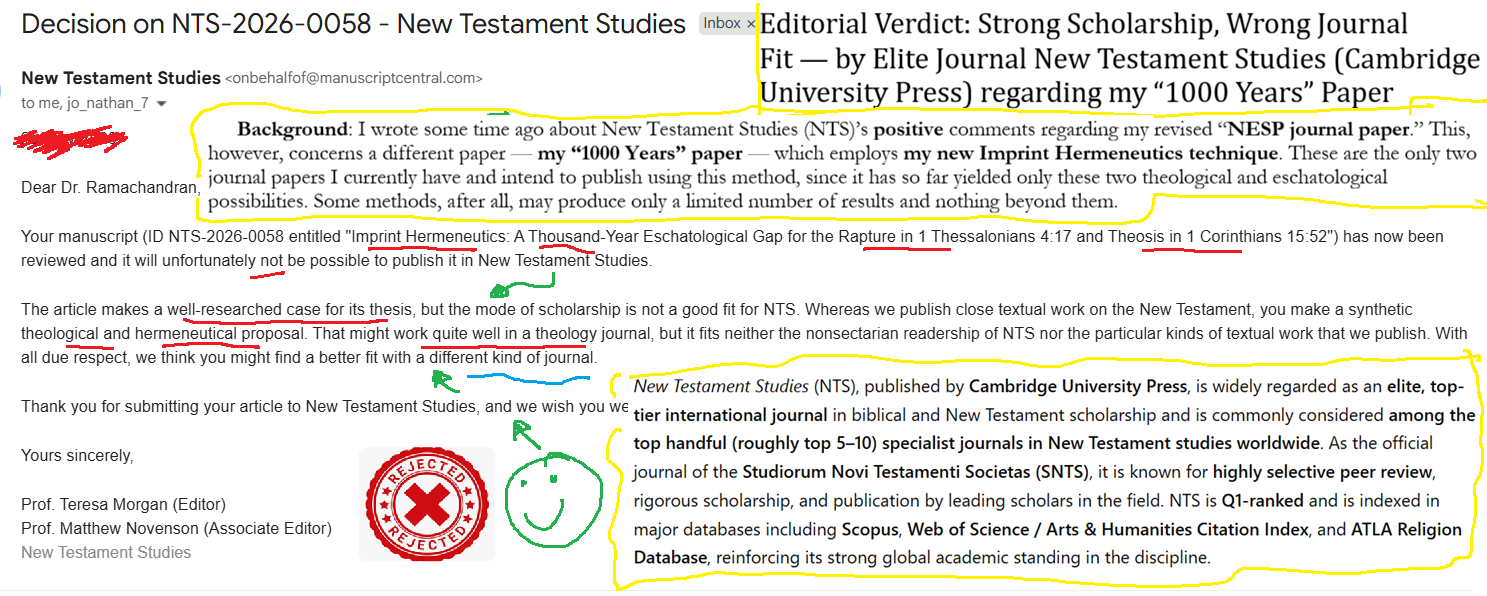
Editorial Verdict: Strong Scholarship, Wrong Journal Fit — by Elite Journal New Testament Studies (Cambridge University Press) regarding my “1000 Years” Paper
Background: I wrote some time ago about New Testament Studies (NTS)’s positive comments regarding my revised “NESP journal paper.” This, however, concerns a different paper — my “1000 Years” paper — which employs my new Imprint Hermeneutics technique. These are the only two journal papers I currently have and intend to publish using this method, since it has so far yielded only these two theological and eschatological possibilities. Some methods, after all, may produce only a limited number of results and nothing beyond them.
As always, if these conclusions are true, all glory goes to God; if false, they remain an intellectual exercise — albeit one that has at least elicited positive engagement from Cambridge-level (the real Cambridge) scholars and renowned professors. I do not think they would offer strong recommendations for something they considered nonsensical, methodologically incoherent, or incapable of generating any genuinely new meaning, even at a purely intellectual level — would they?
Details:
from: New Testament Studies <[email protected]>
reply-to: [email protected]
to: [email protected], [email protected]
subject: Decision on NTS-2026-0058 – New Testament Studies
Dear Dr. Ramachandran,
Your manuscript (ID NTS-2026-0058 entitled “Imprint Hermeneutics: A Thousand-Year Eschatological Gap for the Rapture in 1 Thessalonians 4:17 and Theosis in 1 Corinthians 15:52″) has now been reviewed and it will unfortunately not be possible to publish it in New Testament Studies.
The article makes a well-researched case for its thesis, but the mode of scholarship is not a good fit for NTS. Whereas we publish close textual work on the New Testament, you make a synthetic theological and hermeneutical proposal. That might work quite well in a theology journal, but it fits neither the nonsectarian readership of NTS nor the particular kinds of textual work that we publish. With all due respect, we think you might find a better fit with a different kind of journal.
Thank you for submitting your article to New Testament Studies, and we wish you well in your future scholarly work.
Yours sincerely,
Prof. Teresa Morgan (Editor)
Prof. Matthew Novenson (Associate Editor)
New Testament Studies
About: New Testament Studies (NTS), published by Cambridge University Press, is widely regarded as an elite, top-tier international journal in biblical and New Testament scholarship and is commonly considered among the top handful (roughly top 5–10) specialist journals in New Testament studies worldwide. As the official journal of the Studiorum Novi Testamenti Societas (SNTS), it is known for highly selective peer review, rigorous scholarship, and publication by leading scholars in the field. NTS is Q1-ranked and is indexed in major databases including Scopus, Web of Science / Arts & Humanities Citation Index, and ATLA Religion Database, reinforcing its strong global academic standing in the discipline.
What does it mean?
New Testament Studies declined the manuscript not for lack of scholarship, but for poor fit with the journal’s scope. While recognizing the article as well-researched and strongly argued, the editors judged it to be a synthetic theological and hermeneutical proposal rather than the close New Testament textual analysis that NTS publishes. They felt its approach better suits a theology journal, as it does not align with NTS’s nonsectarian readership or its established mode of textual scholarship. The editors closed respectfully, thanking the author and wishing success in future publication efforts.
ChatGPT analyzed the response and concluded: In essence, the editors are saying that your article is substantial and scholarly, but that it belongs to a different academic conversation from the one New Testament Studies typically hosts.
Source:
Thank you.