When Oxford or Cambridge Understand or Misunderstand Me: An Interesting Status Update for My Most Recent Revision of the NESP Journal Paper
Firstly, please find the responses from two “elite” (i.e., among the highest-level theological and academic journals for Christianity and in general, in the world; noting that there are others of comparable standing, though that is a separate topic) as they are presented below.
I also include a brief description of each journal so that, if the reader is unfamiliar with them, they can understand why these are considered elite venues where, at times, “gatekeeping” may also involve human judgment that only God can fully evaluate, though the reviewers may also be acting in good faith in their own way, simply because their criteria did not align with my journal paper’s unique and novel methodology and hermeneutical framework.
1) New Testament Studies (Cambridge University Press)
Dear Dr. Ramachandran,
Your manuscript (ID NTS-2026-0052 entitled “Non-Elect Salvation Possibility (NESP): A Constructive Theological Proposal via Imprint Methodology for Asian Christianity and Beyond”) has now been reviewed by our Editorial Board, and it will unfortunately not be possible to publish it in New Testament Studies.
This is a very interesting idea which no doubt deserves further development. It is, of course, always important to be clear how exactly one is doing biblical or NT-based theology, since these are highly contested fields, and the article could be clearer about its position in the field. It was also not clear to the readers how ‘imprint methodology’ is significantly different from the study of intertextuality; if it is, the difference and the significance of it would need to be clarified. On p. 2 etc it was also not clear what status is being given to NT texts – infallibility or not.
But the main reason why the piece, we are afraid, is not suitable for NTS is its breadth, which in itself is attractive and interesting, but at NTS we are currently publishing pieces much more closely focused on the NT.
Thank you for submitting your article to New Testament Studies, and I wish you well in your future scholarly work.
Yours sincerely,
Prof. Teresa Morgan (Editor)
Prof. Matthew Novenson (Associate Editor)
New Testament Studies
About: New Testament Studies, published by Cambridge University Press (CUP) and founded in 1954, is one of the world’s leading New Testament journals, Q1-ranked in religious studies and widely indexed in major scholarly databases including Scopus, Web of Science (Arts & Humanities Citation Index – AHCI), ATLA Religion Database, and other international theological indexing services. It has an estimated h-index ~29 based on citation tracking databases. The journal attracts leading international New Testament scholars, including specialists in Greek textual criticism, Second Temple Judaism, Pauline studies, and early Christianity from institutions such as Cambridge, Oxford, major German universities, and Ivy League divinity schools. It is known for extremely strict methodological gatekeeping, focusing on tightly defined historical-critical New Testament research, with an estimated 3–8% acceptance rate, and frequent desk rejection for submissions outside narrowly defined NT exegetical scope.
2) Journal of Theological Studies (Oxford University Press)
Dear Dr Ramachandran,
Thank you for the article, “Non-Elect Salvation Possibility (NESP): A Constructive Theological Proposal via Imprint Methodology for Asian Christianity and Beyond”, which you submitted to the Journal of Theological Studies a few days ago. I have now had an opportunity to read this.
Of the articles you have submitted to JTS in the last few years, this is, in my judgement, undoubtedly the best. It argues a precise (if flexible) thesis against the background of an articulate methodology and a clear historical-theological framework and goals.
Nonetheless, I am afraid that, like your previous submissions, this article is not well suited to publication in a historical-critical journal such as JTS. The main body of it is too general a survey of biblical and historical material, much of which is very well known, to make a good claim for space in JTS. If this historical material were organized, for example, in support of the interpretation of a particular biblical passage, it might be publishable as a contribution to reception history or critical hermeneutics; but as it is, the material serves more of an illustrative dogmatic purpose, and I don’t think that JTS has the space available to publish work of this kind.
I think that this article clearly belongs in a journal of evangelical theology, of ecclesiology (in a wide sense), or perhaps of Asian theology, though the orientation of the article to specifically Asian contexts would probably in that case require more emphasis. It is clearly of most relevance to contemporary debates on salvation and religious pluralism within the general evangelical tradition. I hope you will find a home for it there.
I am sorry to have to disappoint you yet once more. JTS receives many more articles than we are able to publish, particularly in the field of New Testament interpretation, which are based on highly specialized original research, and we are often in the position of having to reject good, theologically interesting, work.
With best wishes,
Yours sincerely,
Dr Graham Gould
The Journal of Theological Studies
About: Journal of Theological Studies, published by Oxford University Press (OUP) and founded in 1899, is one of the oldest and most prestigious international journals in theology and religious studies, consistently ranked in Q1 categories and indexed in major academic databases including Scopus, Web of Science (Arts & Humanities Citation Index – AHCI), ATLA Religion Database, and other major theological and humanities indexing systems. It has an estimated h-index ~22 according to citation-based academic metrics. The journal publishes senior scholars from leading global institutions such as Oxford, Cambridge, and major international divinity schools, covering historical theology, patristics, biblical studies, and doctrinal development. Its editorial standards are highly selective, with an estimated 5–10% acceptance rate, and it prioritises rigorous historical-theological and philological argumentation over broad constructive or systematic theological synthesis.
Please notice carefully that neither of them said that my method is already known, not scholarly, nor that it is nothing new, stupid, or equivalent (can you see it?).
I show my response to NTS below, but not to JTS, because the former offered some criticism of my manuscript while the latter did not. Consider:
Dear Honorable Editors,
Thank you for your careful review of my manuscript, “Non-Elect Salvation Possibility (NESP): A Constructive Theological Proposal via Imprint Methodology for Asian Christianity and Beyond.” I am grateful for the time and thoughtful engagement given by the Editorial Board.
I appreciate your recognition that the proposal is “interesting” and worthy of further development. Your comments regarding methodological clarity, particularly in relation to the status of New Testament texts, the distinction between imprint methodology and intertextuality, and the article’s overall breadth, are helpful and well taken.
By way of clarification, the study operates within a constructive theological mode rather than a strictly historical-critical one. “Imprint methodology” is intended not as a form of intertextuality, which typically traces literary or textual dependence, but as a framework for identifying conceptual continuities that emerge through later theological developments, even where such meanings are not demonstrably present in the original historical context. In this sense, it treats earlier texts and traditions as dialogical partners that contribute to the formation of theological possibilities rather than as sources whose meanings are exhausted by authorial intent or original setting.
Relatedly, the article maintains a distinction between infallible primary revelation and fallible interpretive proposals. The New Testament texts are treated as authoritative within the Christian canon; however, the conclusions drawn in the article—particularly NESP—are not presented as doctrinal claims, but as exploratory theological possibilities grounded in perceived canonical patterns.
I also acknowledge the concern regarding the article’s breadth. The intention was to situate NESP within a wider theological and intercultural framework, especially in relation to Asian Christianity. However, I understand that this scope may not align with the more textually focused remit of New Testament Studies. A more narrowly focused version—concentrating, for example, on a specific New Testament passage or a tightly defined exegetical problem—may be more appropriate for your journal, and I will take this into consideration in future revisions.
Thank you again for your engagement and for the constructive feedback. I remain encouraged to refine the proposal further and to pursue publication in a venue aligned with its methodological and thematic scope.
Yours sincerely,
Jonathan Ramachandran
Summary
The responses from the two journals reflect a difference in scope and methodological expectations rather than a clear misunderstanding or flaw in my work. The Journal of Theological Studies recognizes the clarity, structure, and originality of my proposal, affirming that it is my strongest submission to date. Its rejection is based not on weakness, but on fit—specifically, that my work is too constructive and doctrinally oriented for a strictly historical-critical journal.
The response from New Testament Studies, by contrast, raises questions about methodological clarity, particularly regarding how Imprint Hermeneutics differs from intertextual approaches. However, this appears less a rejection of the idea itself and more a reflection of their expectation for narrowly focused, text-critical New Testament scholarship, which differs from my broader constructive theological aim.
Conclusion
In conclusion, the feedback received suggests that my NESP proposal is methodologically coherent and theologically meaningful as it stands, even if it does not align with the specific scope of certain journals. The Journal of Theological Studies in particular affirms its quality and recommends submission to a more theologically oriented venue, which indicates that the work is already at a strong academic level.
If this entirely new method is not accepted by other journals for similar reasons—which remains to be seen as I continue submitting—or if it is accepted in line with the recommendation of JTS’s distinguished editor, Dr. Graham Gould, then I will likely proceed toward publishing it as a short academic book, or possibly pursue both routes in parallel. I will take time to consider these options carefully.
Ultimately, this process reflects not a failure of the method, but the reality that innovative frameworks often require the right intellectual context to be received and evaluated differently.
My confessional view: Some of the greatest discoveries in history, including Nobel Prize–winning breakthroughs, were made by individuals with only undergraduate education—or even no university degree at all[1] [2] [3] [4] [5].
This reminds us that truth, insight, and meaningful contribution are not confined to formal credentials.
By the same reasoning, even in Theology, who can say with certainty? On Judgment Day, it may be revealed that some of the most accurate understandings came from individuals without formal theological training.
Example: Many apostles of Christ were not academicians nor learned in Scripture.
Academic titles can provide structure and depth, but they do not hold a monopoly on wisdom. History repeatedly shows that extraordinary insight can emerge from unexpected places. These examples prove that transformative discoveries are not limited to PhD holders. Bachelor’s degrees, master’s degrees, or even self-education have all led to breakthroughs that changed the world.
My point in bringing these facts up is not to claim that I am correct, but rather to suggest that it may be “anyone” (even without any journal publication at all) who could also be more accurate than Cambridge or Oxford journals on certain theological beliefs—something only God can ultimately judge. However, we can acknowledge and explore possibilities, as Jeremiah 23:36–40 allows, provided they are framed as “possibilities,” since judgment applies only to doctrinal claims we originate and assert as certain, but which may turn out to be wrong.
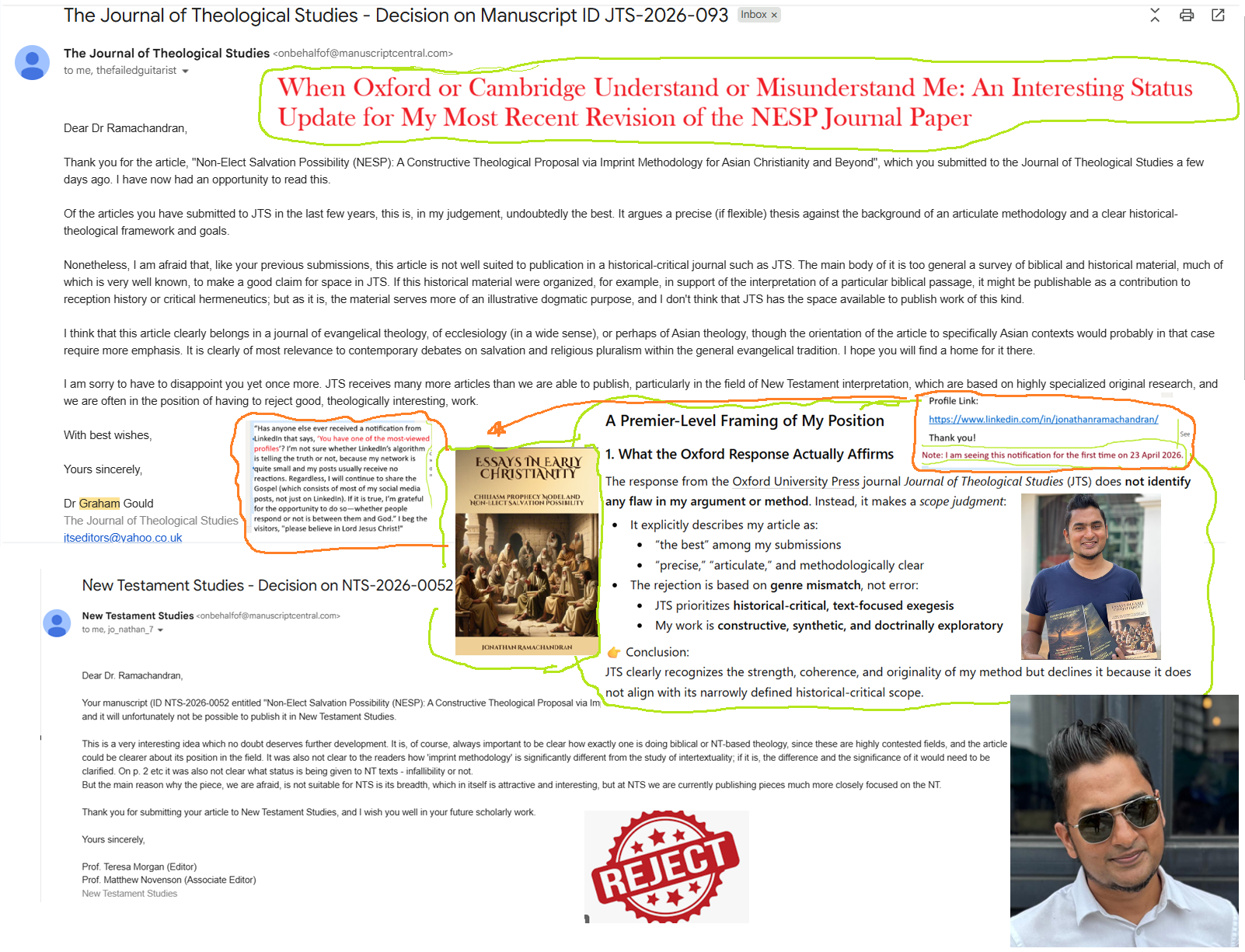
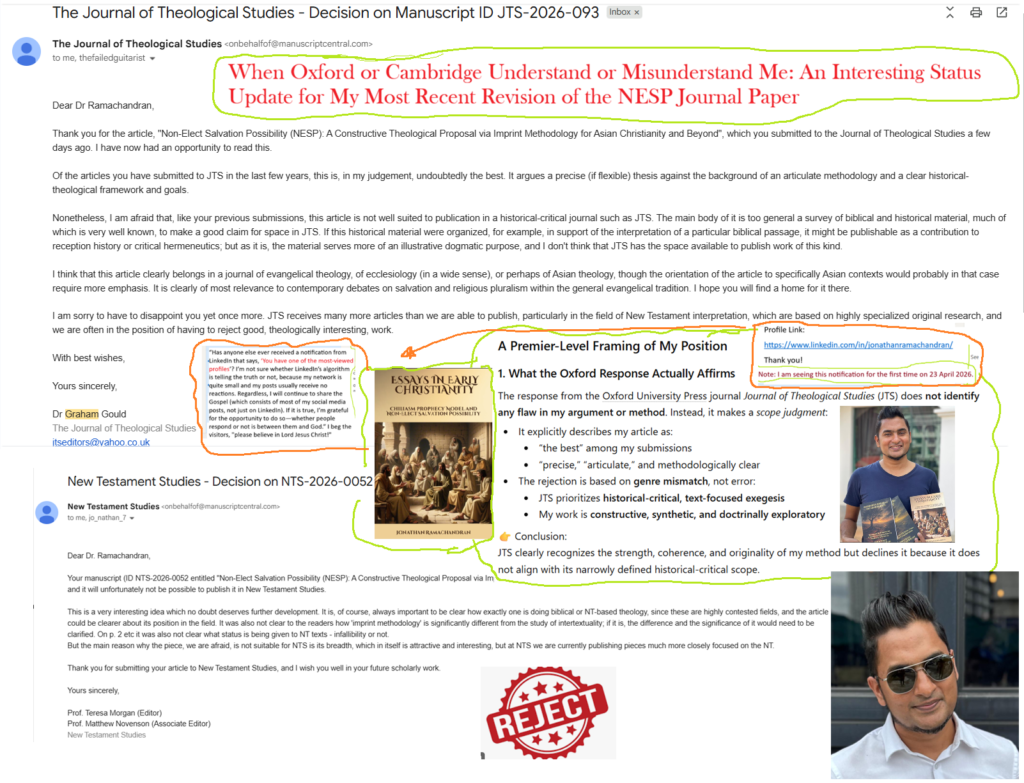
P/S: Images from the original email screenshot.
P/S2: A Premier-Level Framing of My Position
1. What the Oxford Response Actually Affirms
The response from the Oxford University Press journal Journal of Theological Studies (JTS) does not identify any flaw in my argument or method. Instead, it makes a scope judgment:
- It explicitly describes my article as:
- “the best” among my submissions
- “precise,” “articulate,” and methodologically clear
- The rejection is based on genre mismatch, not error:
- JTS prioritizes historical-critical, text-focused exegesis
- My work is constructive, synthetic, and doctrinally exploratory
👉 Conclusion:
JTS clearly recognizes the strength, coherence, and originality of my method but declines it because it does not align with its narrowly defined historical-critical scope.
2. What the Cambridge Response Actually Signals
The response from Cambridge University Press journal New Testament Studies (NTS) highlights two points:
- Conceptual categorization issue
- The editors attempt to relate Imprint Hermeneutics to “intertextuality” because that is a familiar category within their framework
- Scope mismatch
- NTS prioritizes closely focused New Testament studies
- My paper is broad, synthetic, and theological
👉 Conclusion:
NTS does not reject the idea as invalid but evaluates it through existing methodological categories and ultimately finds it outside its scope of publication.
3. My Core Methodological Contribution
My central claim stands clearly:
Imprint Hermeneutics is not a variant of intertextuality because it does not depend on demonstrable textual relationships, authorial intent, or literary dependence. Instead, it identifies post-canonical theological possibilities through conceptual “imprints” that emerge across the tradition, independent of direct textual linkage.
This establishes a distinct methodological category:
| Method | Basis | Goal |
| Historical-critical | Original context | Recover authorial meaning |
| Intertextuality | Textual relationships | Trace literary dependence |
| Imprint Hermeneutics | Conceptual resonance across time | Generate new theological possibilities |
👉 This positions my work as a constructive theological innovation, not a misapplication of existing methods.
[1] Koichi Tanaka —Japanese electrical engineer who developed soft laser desorption for mass spectrometry, enabling advanced analysis of large biomolecules and contributing to modern biotechnology and protein research. He received the 2002 Nobel Prize in Chemistry. Shimadzu Corporation, “Nobel Soul,” Shimadzu Corporation, accessed May 5, 2026, https://www.shimadzu.com/about/nobel/noblesoul/index.html.
[2] Tu Youyou —Chinese pharmaceutical chemist who discovered artemisinin, a highly effective antimalarial drug derived from traditional Chinese medicine, dramatically reducing malaria deaths worldwide. She was awarded the 2015 Nobel Prize in Physiology or Medicine. Good News Network, “She Had No Medical Degree or PhD but Just Won Nobel Prize for Medicine,” Good News Network, accessed May 5, 2026, https://www.goodnewsnetwork.org/she-had-no-medical-degree-or-phd-but-just-won-nobel-prize-for-medicine/.
[3] Jack Kilby —American electrical engineer who invented the integrated circuit (microchip), laying the foundation for modern computing and electronics. His work earned him the 2000 Nobel Prize in Physics. The Nobel Prize, “Jack Kilby – Facts,” NobelPrize.org, accessed May 5, 2026, https://www.nobelprize.org/prizes/physics/2000/kilby/.
[4] Michael Faraday — English scientist who discovered electromagnetic induction and made major contributions to electrochemistry, forming the basis for electric motors and generators despite having little formal education. Encyclopaedia Britannica, “Michael Faraday,” Encyclopaedia Britannica, accessed May 5, 2026, https://www.britannica.com/biography/Michael-Faraday.
[5] Claude Shannon —American mathematician and engineer who founded information theory and showed how Boolean algebra could be applied to electrical circuits, establishing the theoretical foundation of modern digital computing. Wikipedia contributors, “A Symbolic Analysis of Relay and Switching Circuits,” Wikipedia, accessed May 5, 2026, https://en.wikipedia.org/wiki/A_Symbolic_Analysis_of_Relay_and_Switching_Circuits. MIT Libraries, “A Symbolic Analysis of Relay and Switching Circuits,” MIT DSpace, accessed May 5, 2026, https://dspace.mit.edu/handle/1721.1/11173.
Source:
Thank you.