Beyond the Torah: Charity, Justice, and the Pursuit of Spiritual Perfection by Lord Jesus Christ
To learn how I integrated Christian ministry with educational initiatives in a small, individual way by relative measure, please read this article for full details.
Also, if you can refute all my theological points here, I will convert to your denomination. But if not, then you can understand why I remain an ecumenical Christian: because only certain aspects are sometimes practiced by some churches or pastors, while most ignore these matters as long as their family and salary are secure. There is little willingness to embrace the risky faith required for the “perfection” of Christ’s Charity Doctrine—unless circumstances force it.
I know what is running through your mind—namely, the question: What have I done to fulfill this? Reluctant as I am to reveal the details, I know that if I do not, you may criticize without understanding them and assume you are right. Therefore, I must disclose these matters.
1) “My church or pastor has converted so many people—how about you?”
Indeed, churches without women pastors—not only modern ones, but also those prior to 1900, when none ordained women to the priesthood, though women could still share the Gospel without holding ordained office—converted far more people than many of your modern churches or pastors. They also carried out the real work of evangelism by reaching tribes in the jungles for the very first time, across mainstream Christianity.
More importantly, however, you have missed a deeper question. Christ spoke of thirtyfold, sixtyfold, and hundredfold believers (Matthew 13:8). This does not refer to the “number of converts,” as some pastors teach. In the same Parable of the Sower, Christ already identifies the “good ground” separately; the thirtyfold, sixtyfold, and hundredfold refer instead to varying levels of fruitfulness, not to the quantity of converts. Can you see the distinction?
Furthermore, in Matthew 19:29, the only other place where Christ mentions “hundredfold,” He refers to a level of reward. As many Church Fathers also noted, this points to acts of sacrificial faithfulness—doing one or more of the things listed in that passage, all of which involve leaving behind something significant in God’s name, rather than gaining worldly prosperity.
This includes marriage or remaining unmarried (“left wife”), houses and lands (linked in Acts 2:44 and 4:32 to the Charity Doctrine lifestyle of the first church), and even family (“brothers, sisters, mothers, fathers”) for the sake of Gospel work. It can also include spending one’s resources on Gospel commands after first giving others what is due, maintaining proper balance. Can you see it?
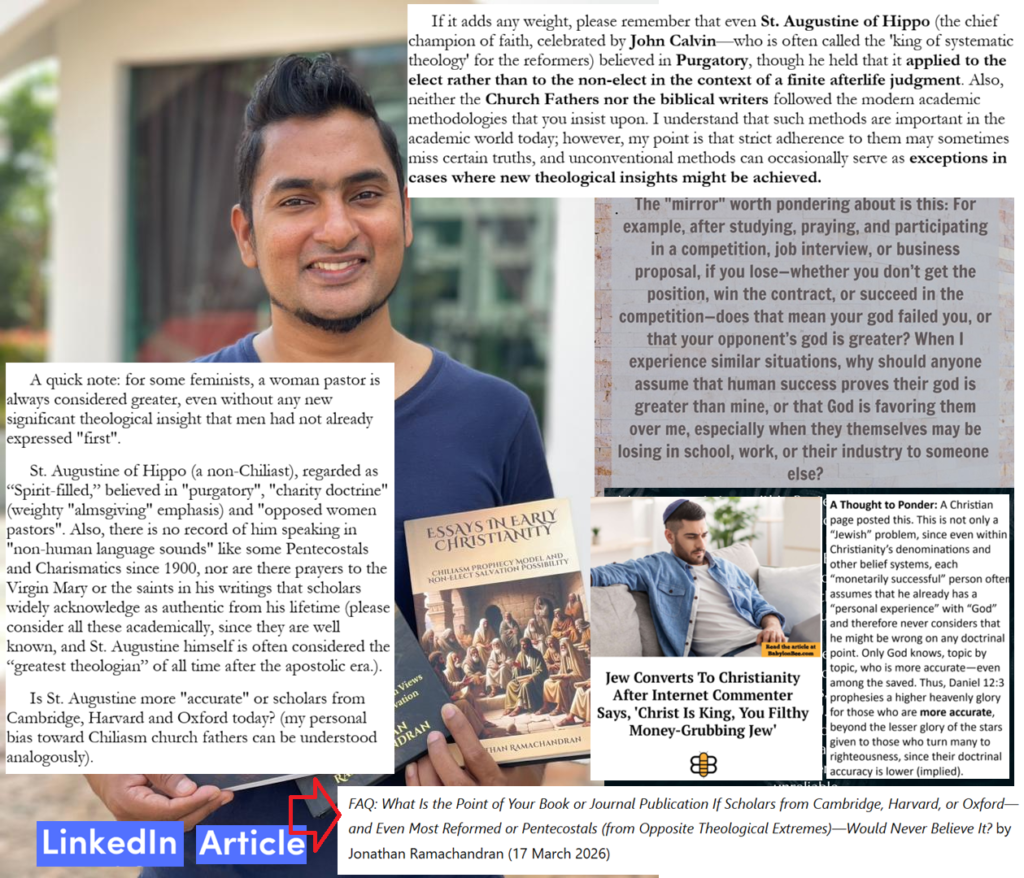
I quote from page 386 of my book to highlight further proof that this is not about the number of converts, but about individual faithfulness in fulfilling Christ’s commands at such high levels of sacrificial living. It is this that determines one’s closeness to God and the highest rewards.
“As many church fathers have pointed out, the 144,000 are unmarried, and how many people in history who have converted many to Christianity were virgins and Jewish by descent? Is there a single example of such a person inside our own church or denomination? This, combined with the terms “no deceit” and “without fault,” which are used in these verses to characterize them, shows that the quantity of converts in our church does not determine one’s proximity to God, but rather accurate prophetic and doctrinal truth. This is because we can hardly think of anyone who converted many people to Christianity that fits this scriptural description. This is consistent with both the prophecy of St. Clement of Rome (page 11) and Daniel 12:3.”
Source: Jonathan Ramachandran, Essays in Early Christianity: Chiliasm Prophecy Model and Non-Elect Salvation Possibility (Cambridge, OH: Christian Publishing House, July 13, 2025), 386.
2) What have you done for the Gospel commandments beyond the foundational ones?
Just as the rich man said he had kept all the Torah, yet the Lord Jesus Christ was not impressed at all; rather, He revealed a truth not fully understood earlier—namely, the doctrine of charity as the path to spiritual perfection, since it encompasses both love and justice in action.
“Jesus said to him, ‘If you want to be perfect, go, sell what you have and give to the poor, and you will have treasure in heaven; and come, follow Me.’ But when the young man heard that saying, he went away sorrowful, for he had great possessions. Then Jesus said to His disciples, ‘Assuredly, I say to you that it is hard for a rich man to enter the kingdom of heaven. And again I say to you, it is easier for a camel to go through the eye of a needle than for a rich man to enter the kingdom of God.’” (Matthew 19:21–24, NKJV)
Quoting “with God all things are possible” does not remove the level of Charity Doctrine required to be free from the love of money, which Christ highlights in this passage. Such freedom can only occur if God changes a person’s heart.
The rich man went away “sorrowful” because he could not bring himself to share to that extent. This seems to indicate that he was unsaved, because a person who is truly saved would both share and do so with joy—as illustrated in the case of Zacchaeus. Though both men were rich, Zacchaeus promised Christ that he would repay fourfold to anyone he had defrauded and also give half of his wealth to the poor (Luke 19:1–10). Do you see the significance?
If other rich people were not required to willingly do at least some measure of this, then why does Christ commend Zacchaeus as saved in this passage, while the rich man earlier receives no such affirmation?
“Then Zacchaeus stood and said to the Lord, ‘Look, Lord, I give half of my goods to the poor; and if I have taken anything from anyone by false accusation, I restore fourfold.’ And Jesus said to him, ‘Today salvation has come to this house, because he also is a son of Abraham; for the Son of Man has come to seek and to save that which was lost.’”
— Luke 19:8–10 (NKJV)
Therefore, speaking openly about what one intends to do for the Charity Doctrine—or what one has done or is willing to do, even publicly for the sake of the Gospel, as Zacchaeus did here—is permissible when circumstances require it, especially when others criticize without understanding. Christ Himself approved such testimony in this context.
So again, there is nothing wrong with my writing this article under similar circumstances. Please read on.
3) Living as a Christian in Malaysia in Daily Life Through Work and Ministry: Are We Truly Practicing God’s Justice, or Merely Performing Nepotist Drama Instead of Living the Truth? An Empirical Illustration Through Math Olympiad Initiatives by Jonathan
3.1) Some say, “I have done so much for my family. I suffered, worked, even tapped rubber in the estate, and ate rice with salt to provide for my children.”
This is a familiar sentiment. But how does such a life align with being a man or woman of God in light of these verses: “Houses and riches are an inheritance from fathers” (Proverbs 19:14, NKJV), and “A good man leaves an inheritance to his children’s children” (Proverbs 13:22, NKJV)? If your level of provision—or that of your parents—was substandard, leaving everyone in hardship, then how does that measure against these ideals?
Would it not be better for a person—like me—to choose to remain unmarried, even for financial reasons, since I am poor and my forefathers did not leave me wealth in any meaningful measure, as these verses describe? They were unbelievers, and neither their beliefs nor their way of life made them prosperous across generations. At least, by remaining unmarried, I do not willingly bring a child into this world to eat rice with salt, receive substandard educational provision, and endure hardship—only so that in my old age, I may depend on that child for care. Which intention sounds more Christ-like?
For those who argue that these are Old Testament verses and therefore do not apply under the New Testament—while that may be true for many passages, this particular principle remains relevant. The Apostle St. Paul, under the inspiration of the Most Blessed Holy Spirit of God, writes: “For the children ought not to lay up for the parents, but the parents for the children” (2 Corinthians 12:14, NKJV).
This means that God’s will is for parents to provide for their children—just as those earlier verses indicate. Consider Abraham, often cited as a model of prosperity in Christian teaching. Yet many overlook that he first passed wealth to his son Isaac, who then used it to care for him in his old age. Do you see the difference? Rather than children receiving insufficient provision and later being forced into hardship to support their parents, the biblical ideal is generational blessing flowing forward.
In 2 Corinthians 12:14, Paul extends this principle even into spiritual parenting, working and providing for other members of the church as part of the Charity Doctrine. So how many churches actively support such charity? How many care for sick members—not only pastors, but ordinary believers? How many provide for the elderly among them, or establish homes for their care?
If none—or only very few—are fulfilling these biblical principles in financial matters, then how does the Great Commission’s call to “teach them to observe all that I commanded you” apply here? And if these commands are neglected, how will believers attain the hundredfold reward level?
3.2) Educational Ministry in a Church Context
If churches can run entire homeschooling programs using IGCSE or other examination syllabi and call it “ministry” aimed at “reaching the lost” (though in practice, it often reaches only the rich, since poor families cannot afford monthly school fees for even one child—costs that can be comparable to a car installment in Malaysia), then by the same logic they could also run Math Olympiad or mathematics tuition programs, as I have proposed, either directly under the church or through a registered company affiliated with church branding.
Why is church branding important? In the Math Olympiad program, the aim is not for me to profit personally, but to return most of the income to the church as a donation. For example, see the PowerPoint presentation here:
I have emailed this proposal to nearly all major churches and ministry organizations in Malaysia, but so far none have responded.
Why might this be the case? Possible reasons include:
i) This initiative could reduce advantages for wealthier communities by giving high-quality educational materials freely to poorer groups.
ii) The poor are seen as belonging to different ethnic or church communities, and therefore expected to be supported by their own respective institutions.
iii) Homeschooling programs generate higher revenue through fees, and if wealthy parents convert to Christianity, they may contribute larger donations that also support pastoral salaries.
iv) Some say that Jonathan is trying to make himself rich and earn an income from all this. Why should we support him? They suggest instead supporting people from our own community to provide more math classes, even if they have not won any Math Olympiad awards, and charging higher fees, while boycotting him. This reflects how so called merit is perceived in people.
I have no problem with Math Olympiad participants being supported first for math tuition classes over those who have not, especially those who have demonstrated the “charity doctrine” in this area, as I explain in section 4) and 5) later.
3.3) What Would (Lord) Jesus Do? [WWJD]
Teaching charity as a doctrine is considered wrong by some. However, the Most Blessed Lord Jesus Christ Himself taught that a rich man went to Hell for failing to show charity toward the beggar Lazarus in His vivid description. In that passage, He even reveals:
“But Abraham said, ‘Son, remember that in your lifetime you received your good things, and likewise Lazarus evil things; but now he is comforted and you are tormented.’” (Luke 16:25, NKJV)
Many Bible scholars attempt to reinterpret or explain away this passage in various ways. However, if one ends up in Hell for not believing it, what answer will be given to Christ? The meaning here is understood by many as literal, “as it is written,” because it echoes the earlier sin of Sodom, where God judges not only specific immoral acts but also a lack of charity toward the poor.
According to this understanding, God requires—rather than merely recommends—care for the needy, especially for those who are prosperous and have excess resources (e.g. “food”). This is reflected in Scripture:
“Now this was the guilt of your sister Sodom: she and her daughters had pride, excess of food, and prosperous ease, but did not aid the poor and needy. They were haughty and committed abominations before me; therefore I removed them when I saw it.” (Ezekiel 16:49–50, NRSV)
Note: If you end up in Hell upon death, you can blame it on your pastors whom you pay monthly, and do not blame it on me (whom you may, at most, pay the price of one book I am currently selling), but yet, I am still presenting all such warnings and truths. See the difference?
Please be careful of those who misrepresent the truth in matters of financial doctrine, because it is in this context that Christ gives one of His most vivid descriptions of judgment in Hell earlier (Luke 16). This suggests it may be one of the most serious reasons people are warned about Hell:
“…and all liars shall have their part in the lake which burns with fire and brimstone, which is the second death.” (Revelation 21:8, NKJV)
There is little point in holding a PhD from Ivy League universities, even in Biblical Studies, if one cannot clearly preach all of this; rather, blessed are those who use their high credentials from institutions such as Cambridge, Harvard, or Oxford, especially if they preach this financial doctrinal truth, both to proclaim and to live it out in Christ.
4) What’s the solution if all from church, charity-ministry to educational foundations or even secular businesses boycott you in this? You failed, haha!
One liner: Lazarus the beggar was saved in the afterlife but the rich man may burn for eternity in Hell-fire (Luke 16).
The fact that Christ compares a “beggar” to be “saved” while a “rich man” burns in
Hell” itself refutes any “prosperity” mindset understanding that “if you are rich, God is with you” and “if you are poor, God is against you”. Can you see it?
For similar reasons—such as the possibility that I might earn more money from Math Olympiad classes—even some of the educational foundations I have worked with have refused to allow vernacular schools under their network to run Math Olympiad classes through me. This is despite the fact that I remain the only International Math Olympiad finalist of Indian descent from this marginalized community, and I even achieved full marks at the National Math Olympiad (OMK 2002), though I was awarded second place in the highest “Sulong” category on the basis that “two first places cannot be given, and the other candidate had a better written solution.”
No other Indian student from this community has come close to reaching not only the highest category, but also the subsequent levels of selection required to become part of the final six candidates for IMO representation for the country each year. Yet, despite this, I have never received funding for any math class initiative, even after requesting it (which was ignored).
Why is this the case? I believe it may be because I am a Christian. In contrast, others within the same foundation have conducted Kangaroo Math Classes (KMC) in schools through other employees of the foundation (you may verify this), even though those individuals are not mathematics graduates, not Olympiad-level participants, and do not hold mathematics-related qualifications. Yet such opportunities were not extended to me, even within my own Indian community.
I also wonder whether, had I been Hindu, I might have been given these opportunities instead, or whether they are simply waiting for a Hindu student to win competitions and later run such programs. As it stands, I feel I am boycotted even by my own ethnic community. Perhaps I am mistaken, and these institutions are equally fair and loving toward Christians, including within the Indian community.
Alternatively, perhaps if I were a woman instead of a man, there would be more willingness to support me, since previous KMC programs within the same foundation network were conducted by a woman. Is this what is meant by “merit” in a fair system?
Am I expected to respect such educational foundations unless they change their approach? Even though I am the only Math Olympiad finalist in their entire history, they refuse to fund mathematics competition classes (KMC or Olympiad), which could easily be conducted online via Zoom, as I have proposed. Their concern seems to be that I might earn income, while school teachers across the country who teach basic mathematics and run after-school tuition programs through similar foundations are considered acceptable. But if I am involved, the response becomes one of rejection or boycott. Is that the standard being applied?
5) How did I overcome all these and find biblical “contentment”?
Lord Jesus already showed that a widow being “poor” on earth does not necessarily mean I am “cursed by God” or under judgment. Giving is measured by proportion (which reveals the heart), and so even if that “two coins” offering did not feed one person or convert one person, it is still rewarded as the highest in heaven.
This is despite Christ mentioning the “rich giving more” in the same passage, which implies that more converts or more charitable acts, such as providing meals, may not necessarily count as greater, since they come out of “abundance.” This reflects the understanding that God judges fairly in the afterlife, which is part of His perfect justice.
“And He looked up and saw the rich putting their gifts into the treasury, and He saw also a certain poor widow putting in two mites. So He said, ‘Truly I say to you that this poor widow has put in more than all; for all these out of their abundance have put in offerings for God, but she out of her poverty put in all the livelihood that she had.’” (Luke 21:1–4, NKJV)
I didn’t let the Math Olympiad charity part end there, as I solved many problems (not reading from solutions and then presenting them, but rather I only put up solutions to questions which I solved by myself, which are sometimes asked by people through those years—putting only important ones up). These can be seen in pages below as part of fulfilling the charity doctrine command of Christ instead of me just “preaching with words alone” earlier:
i) School Math Free Solutions
Jonathan Ramachandran, School Math Facebook Links, updated October 26, 2025, Problems 1–154, https://www.facebook.com/jonathan.ramachandran/posts/pfbid025mCA6wGPKLJ4ERhfLBzUwooHBJez59wdhJuHnbKZ9F9ZdaDpEmvX4vinwmoNjdsUl; Website listing, https://www.anonymouschristian.org/blog/school-math-facebook-links/
Or videos:
Jonathan Ramachandran, Jonathan’s Math Video Solutions, YouTube channel,
https://youtube.com/@jonathanramachandran1537?si=oKVTC4hLTK7iRKSf
ii) Elementary School Math Olympiad Free Solutions
Jonathan Ramachandran, Elementary School Math Olympiad Facebook Links, updated October 26, 2025, Problems 1–264, https://www.facebook.com/jonathan.ramachandran/posts/pfbid0wkPqT9UULb6G4x1qRVRceBzqARRuWajpKdeVT7d2YfGkD28z7hcqB7yvMFRE3Wpal; Website listing, https://www.anonymouschristian.org/blog/elementary-school-math-olympiad-facebook-links/
iii) High School Math Olympiad Free Solutions
Jonathan Ramachandran, High School Math Olympiad Facebook Links, updated October 26, 2025, Problems 1–340, https://www.facebook.com/jonathan.ramachandran/posts/pfbid0AwdYEToSrX8B2W1KJyzuKoCyVXAHPAtt5bSfwd3tF2oMEbnmgwCoacyPxczppl; Problems 341–545, https://www.facebook.com/jonathan.ramachandran/posts/pfbid0hJeHxUuJp5kRwWJQ5QFhoNPS4Ym2mmh3ciei2nctqsThbNhWuTAJYvRzk3AU5APil; Website listing of Problems 1–545, https://www.anonymouschristian.org/blog/high-school-math-olympiad-facebook-links/
iv) If you prefer them in LinkedIn article format, here they are:
a) Jonathan Ramachandran, “Explore Free School Math Solutions by Jon — all learning resources and Facebook links are available on article here for easy access!,” LinkedIn, accessed May 3, 2026, https://www.linkedin.com/pulse/explore-free-school-math-solutions-jon-all-learning-ramachandran-vx3rc/.
b) Jonathan Ramachandran, “Explore Free Elementary School Math Olympiad Solutions by Jon — all learning resources and Facebook links are available on post here for easy access!,” LinkedIn, accessed May 3, 2026, https://www.linkedin.com/pulse/explore-free-elementary-school-math-olympiad-jon-all-ramachandran-ssopc/.
c) Jonathan Ramachandran, “Free High School Math Olympiad by Jon: Problems 1–340, Solutions & Links,” LinkedIn, accessed May 3, 2026, https://www.linkedin.com/pulse/free-high-school-math-olympiad-jon-problems-1340-ramachandran-tfiqc/.
d) Jonathan Ramachandran, “Free High School Math Olympiad by Jon: Problems 341–545, Solutions & Links,” LinkedIn, accessed May 3, 2026, https://www.linkedin.com/pulse/free-high-school-math-olympiad-jon-problems-341545-ramachandran-has7c/.
Remember: It does not matter how many people benefited or not from this, since I remind you that, as per the poor widow’s case, it is all about the “relative measure” of what you are given (percentage giving reflected from the condition of the heart, as Christ taught).
These are questions to ponder regarding why I do this, and you must similarly ask with your own skill which God has given you (not the part where you are “paid for work”), but rather what “free” thing are you giving, or if some money from income is given to charity (the other way), to reflect on Christ or New Testament direct questions below:
i. Charity (“alms”) is a doctrine which Apostle St. Paul also demonstrated at the highest level in the context of “sanctification” (i.e. ‘holiness’ in a financial context), as the word “purified” in this passage represents. Similarly, in a small way, that is why my Math Olympiad solutions shared for free can likewise mimic this “alms and offerings to my nation (Malaysia),” as God led Paul to do here:
“Now after many years I came to bring alms and offerings to my nation, in the midst of which some Jews from Asia found me purified in the temple,” (Acts 24:17–18, NKJV)
ii. Christ clearly asked, “What do you do more than others?” (notice this phrase carefully in the passage below, which many miss), meaning He will compare us against others (can you see it?). Therefore, it is good to do things which not many are doing. The context of this verse involves not only loving family (or one’s own race, church, or equivalent group), but also what we have given freely to benefit even “enemies” with our “money” or “high-level skill,” instead of giving only “cheap” or low-level educational content for free in comparison:
“You have heard that it was said, ‘You shall love your neighbor and hate your enemy.’ But I say to you, love your enemies, bless those who curse you… For if you love those who love you, what reward have you? … And if you greet your brethren only, what do you do more than others? … Therefore you shall be perfect, just as your Father in heaven is perfect.” (Matthew 5:43–48, NKJV)
iii. That is why, in following Christ, I publish my “high-quality difficult” Math Olympiad solution pages for free so that even those from different religions, different races, or anyone can access them without worrying about benefiting my “enemies.”
Why? Only then can this verse be fulfilled, and hopefully my critics have done likewise with their own “high-quality” skills for free, which should also be available for me to benefit from—if they truly have done so—rather than only giving them privately to their own “family, race, or religion.” Strangely, Christ remarks in contrast that this may not even count as reward, as He says:
“But if you love those who love you, what credit is that to you?” (Luke 6:32, NKJV)
In this reward-context, giving (or lending “money” without receiving anything back on earth) even to “enemies” is encouraged:
“But love your enemies, do good, and lend, hoping for nothing in return; and your reward will be great… Therefore be merciful, just as your Father also is merciful.” (Luke 6:32–36, NKJV)
Conclusion
In short, when we do all this, we “follow Christ,” even in matters of “money commands.” Forget men and their lies.
For Christians: should I be boycotted for fulfilling all these principles in my Math Olympiad work by merit, while you support math classes run by those who have not fulfilled such commands? Is that Christlikeness, or is it your internal anger arising from nepotism, because you are unable to fulfill these Bible verses “as it is written”?
No one can deceive or merely perform these type of genuine good works for show, as politicians are often accused of doing. In my case, the solutions I share are distributed equally to people of any race, religion, or background. By contrast, the kind of insincere or selective “good works” being described often refers to help that is limited only to one’s own family, race, or religion—for example, when I am unable to access their solutions. Can you see the difference, and the wisdom of God in Christ, Lord Jesus, in giving these commands in such a way that they cannot be easily faked?
Personally, I have little or no respect for any leader, whether in the church or in secular life, if they themselves do not do any of the things I have mentioned here, do not consider them important as per the Bible verses quoted, and do not mingle much (my style) and vice versa.
[Text]:
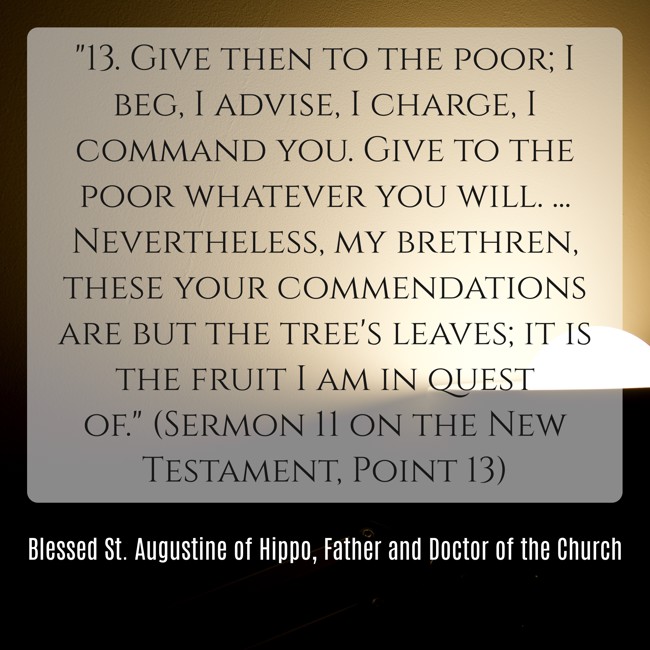
“13. Give then to the poor; I beg, I advise, I charge, I command you. Give to the poor whatever you will. … Nevertheless, my brethren, these your commendations are but the tree’s leaves; it is the fruit I am in quest of.” (Sermon 11 on the New Testament, Point 13) – Blessed St. Augustine of Hippo, Father and Doctor of the Church
Source: Augustine of Hippo, “Sermon 11 on the New Testament,” point 13, in Nicene and Post-Nicene Fathers, First Series, vol. 6, trans. R. G. MacMullen, ed. Philip Schaff (Buffalo, NY: Christian Literature Publishing Co., 1888), rev. and ed. for New Advent by Kevin Knight, accessed May 3, 2026, https://www.newadvent.org/fathers/160311.htm.
I used to feel a great deal of pity in the past and once hoped for Christian universalism, which I have since repented of. I now believe in eternal Hell for my enemies, open either to everlasting torment or eventual annihilation, since the precise wording is difficult to determine.
For those who have been kind to me or supported my classes, even on the basis of merit as mentioned here, but were not Christians, I still try to hold hope and wish that the idea of non-elect salvation possibility (NESP) may be true for them. This applies not only to non-Christians who have treated me fairly, but also to unbelievers who may have been kind and fair by merit toward other Christians as well, though this is not certain.
Therefore, I encourage all who read this to repent and believe in Christ in order to receive the elect salvation, which alone is affirmed as certain doctrine.
Source:
Here’s a recent photo of me with my dad on 2 May 2026.