
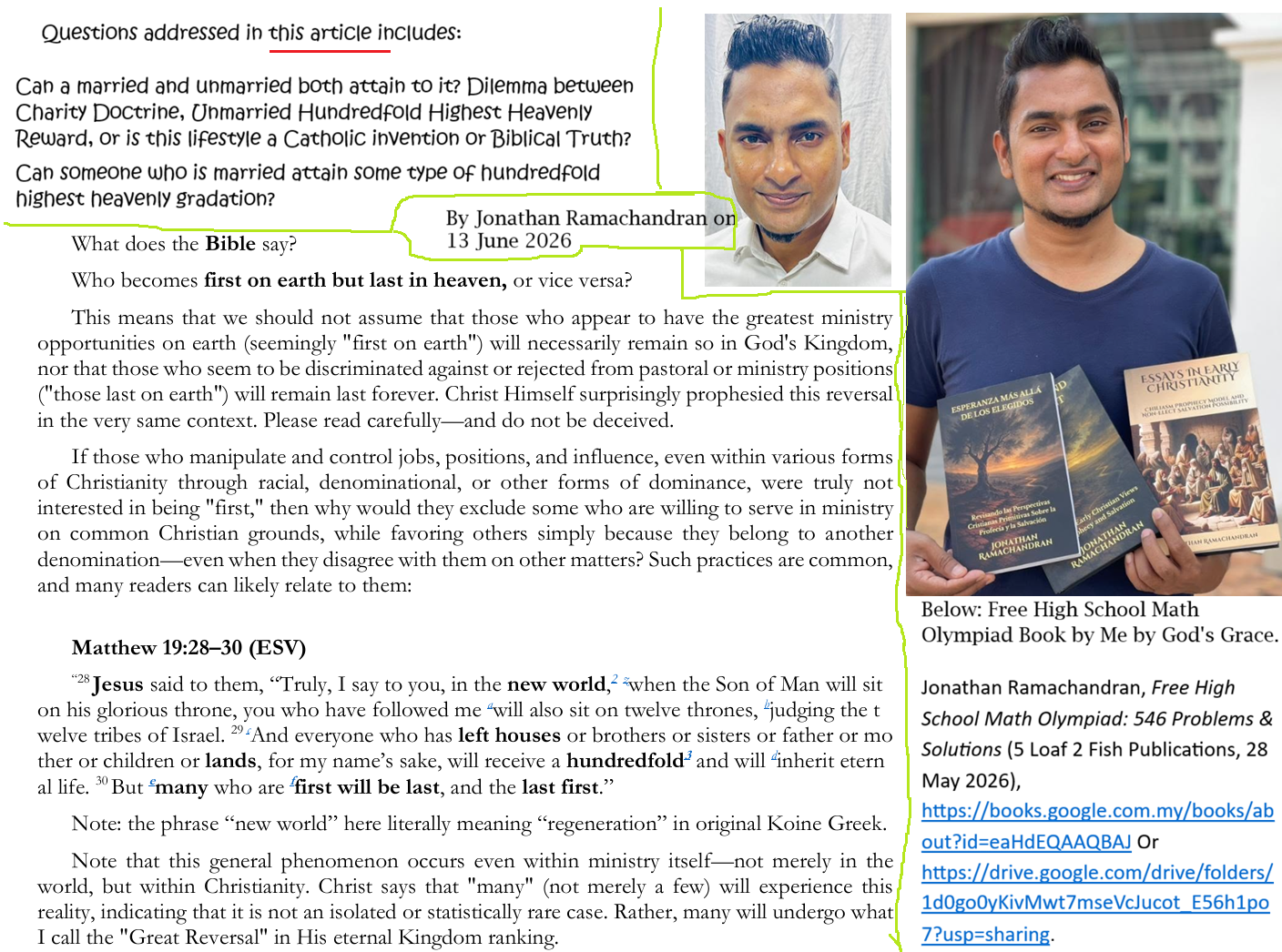
Can a married and unmarried both attain to it? Dilemma between Charity Doctrine, Unmarried Hundredfold Highest Heavenly Reward, or is this lifestyle a Catholic invention or Biblical Truth?
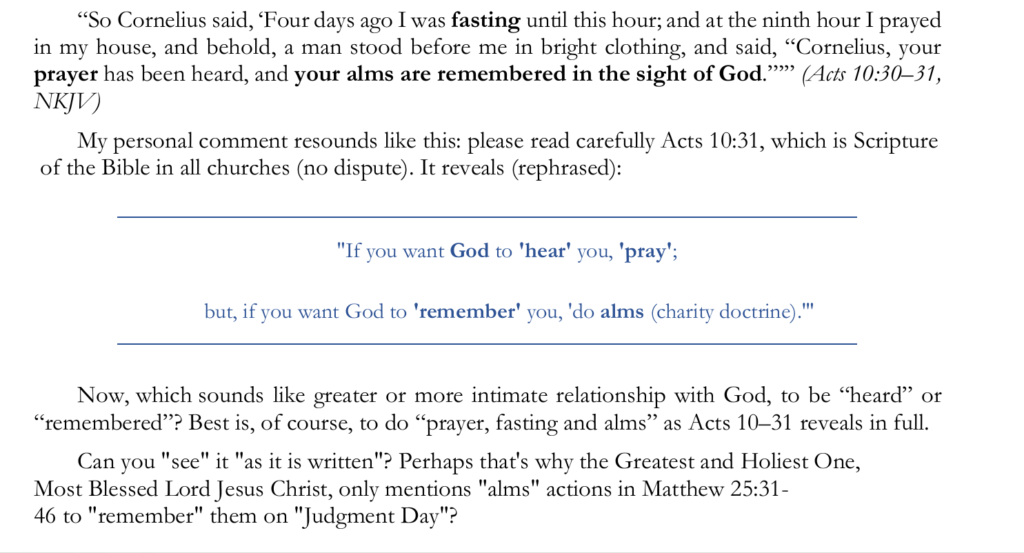
[Text] “So Cornelius said, ‘Four days ago I was fasting until this hour; and at the ninth hour I prayed in my house, and behold, a man stood before me in bright clothing, and said, “Cornelius, your prayer has been heard, and your alms are remembered in the sight of God.”’” (Acts 10:30–31, NKJV)
My personal comment resounds like this: please read carefully Acts 10:31, which is Scripture of the Bible in all churches (no dispute). It reveals (rephrased):
“If you want God to ‘hear’ you, ‘pray’;
but, if you want God to ‘remember’ you, ‘do alms (charity doctrine).'”
Now, which sounds like greater or more intimate relationship with God, to be “heard” or “remembered”? Best is, of course, to do “prayer, fasting and alms” as Acts 10–31 reveals in full.
Can you “see” it “as it is written”? Perhaps that’s why the Greatest and Holiest One, Most Blessed Lord Jesus Christ, only mentions “alms” actions in Matthew 25:31-46 to “remember” them on “Judgment Day”?
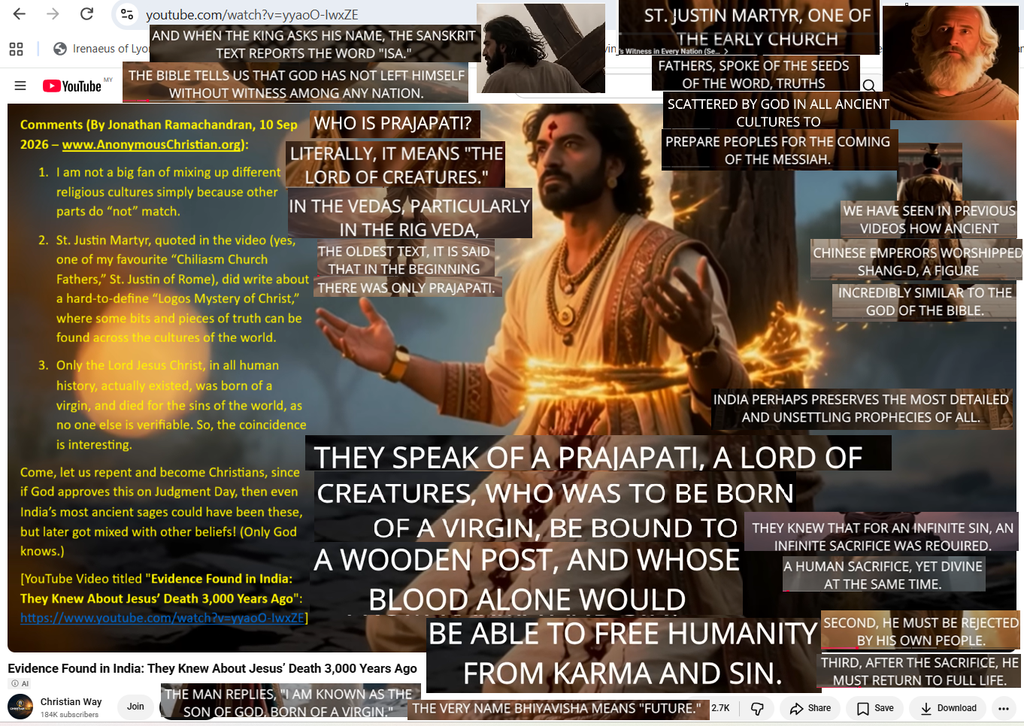
[Text] Mystery 3— There are strange, almost unexplainable mysteries in “Christian Tradition.” Here’s one titled ” Evidence Found in India: They Knew About Jesus’ Death 3,000 Years Ago“. Link:
https://www.youtube.com/watch?v=yyaoO-IwxZE
Whether it is true or not, it makes you wonder. (Only God knows.)
https://www.youtube.com/watch?v=yyaoO-IwxZE
…
Comments (By Jonathan Ramachandran, 10 Sep 2026 – www.AnonymousChristian.org):
- I am not a big fan of mixing up different religious cultures simply because other parts do “not” match.
- St. Justin Martyr, quoted in the video (yes, one of my favourite “Chiliasm Church Fathers,” St. Justin of Rome), did write about a hard-to-define “Logos Mystery of Christ,” where some bits and pieces of truth can be found across the cultures of the world.
- Only the Lord Jesus Christ, in all human history, actually existed, was born of a virgin, and died for the sins of the world, as no one else is verifiable. So, the coincidence is interesting.
Come, let us repent and become Christians, since if God approves this on Judgment Day, then even India’s most ancient sages could have been these, but later got mixed with other beliefs! (Only God knows.)
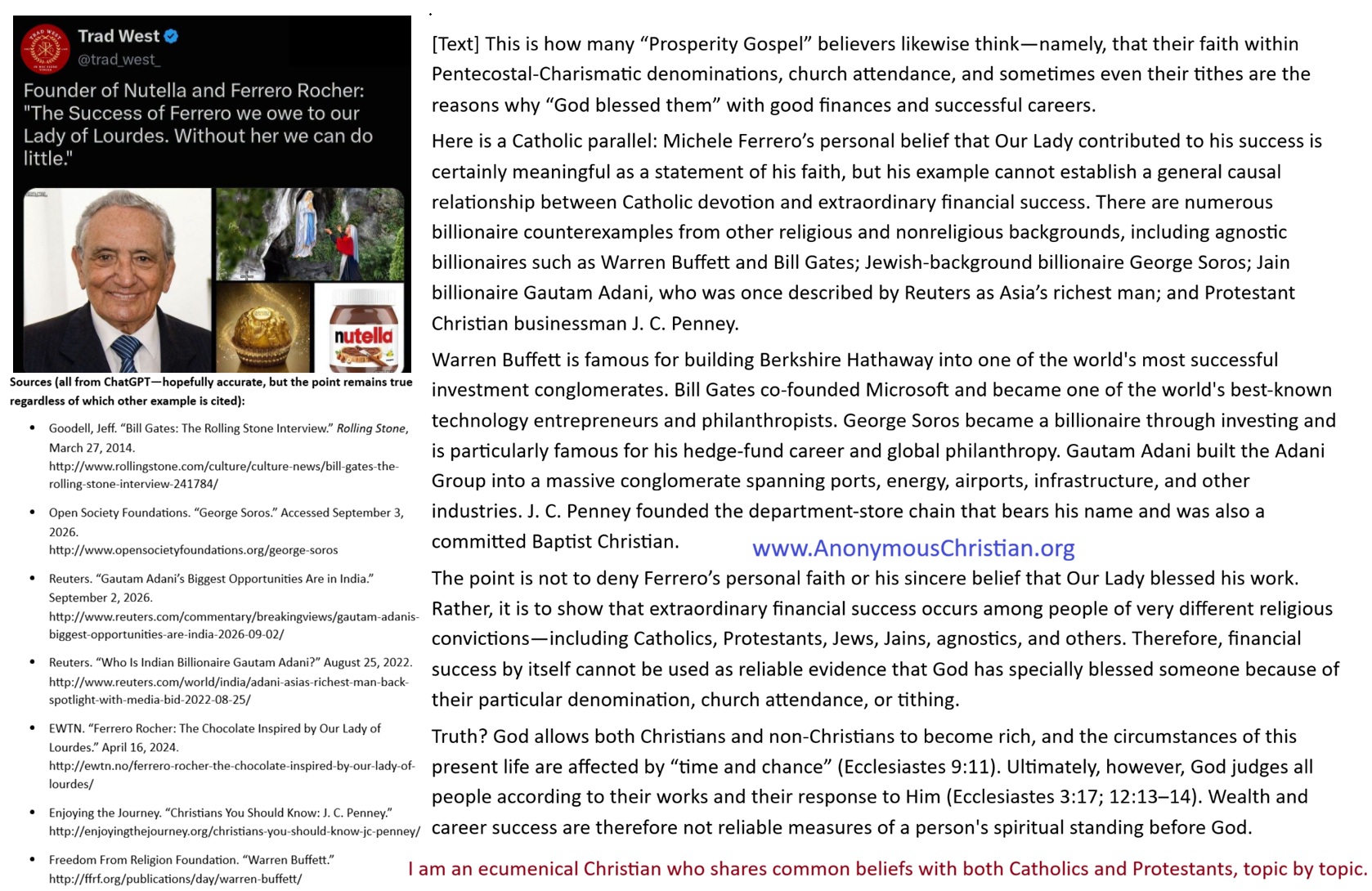
[Text] This is how many “Prosperity Gospel” believers likewise think—namely, that their faith within Pentecostal-Charismatic denominations, church attendance, and sometimes even their tithes are the reasons why “God blessed them” with good finances and successful careers.
Here is a Catholic parallel: Michele Ferrero’s personal belief that Our Lady contributed to his success is certainly meaningful as a statement of his faith, but his example cannot establish a general causal relationship between Catholic devotion and extraordinary financial success. There are numerous billionaire counterexamples from other religious and nonreligious backgrounds, including agnostic billionaires such as Warren Buffett and Bill Gates; Jewish-background billionaire George Soros; Jain billionaire Gautam Adani, who was once described by Reuters as Asia’s richest man; and Protestant Christian businessman J. C. Penney.
Warren Buffett is famous for building Berkshire Hathaway into one of the world’s most successful investment conglomerates. Bill Gates co-founded Microsoft and became one of the world’s best-known technology entrepreneurs and philanthropists. George Soros became a billionaire through investing and is particularly famous for his hedge-fund career and global philanthropy. Gautam Adani built the Adani Group into a massive conglomerate spanning ports, energy, airports, infrastructure, and other industries. J. C. Penney founded the department-store chain that bears his name and was also a committed Baptist Christian.
The point is not to deny Ferrero’s personal faith or his sincere belief that Our Lady blessed his work. Rather, it is to show that extraordinary financial success occurs among people of very different religious convictions—including Catholics, Protestants, Jews, Jains, agnostics, and others. Therefore, financial success by itself cannot be used as reliable evidence that God has specially blessed someone because of their particular denomination, church attendance, or tithing.
Truth? God allows both Christians and non-Christians to become rich, and the circumstances of this present life are affected by “time and chance” (Ecclesiastes 9:11). Ultimately, however, God judges all people according to their works and their response to Him (Ecclesiastes 3:17; 12:13–14). Wealth and career success are therefore not reliable measures of a person’s spiritual standing before God.
Sources (all from ChatGPT—hopefully accurate, but the point remains true regardless of which other example is cited):
- Goodell, Jeff. “Bill Gates: The Rolling Stone Interview.” Rolling Stone, March 27, 2014.
http://www.rollingstone.com/culture/culture-news/bill-gates-the-rolling-stone-interview-241784/ - Open Society Foundations. “George Soros.” Accessed September 3, 2026.
http://www.opensocietyfoundations.org/george-soros - Reuters. “Gautam Adani’s Biggest Opportunities Are in India.” September 2, 2026.
http://www.reuters.com/commentary/breakingviews/gautam-adanis-biggest-opportunities-are-india-2026-09-02/ - Reuters. “Who Is Indian Billionaire Gautam Adani?” August 25, 2022.
http://www.reuters.com/world/india/adani-asias-richest-man-back-spotlight-with-media-bid-2022-08-25/ - EWTN. “Ferrero Rocher: The Chocolate Inspired by Our Lady of Lourdes.” April 16, 2024.
http://ewtn.no/ferrero-rocher-the-chocolate-inspired-by-our-lady-of-lourdes/ - Enjoying the Journey. “Christians You Should Know: J. C. Penney.”
http://enjoyingthejourney.org/christians-you-should-know-jc-penney/ - Freedom From Religion Foundation. “Warren Buffett.”
http://ffrf.org/publications/day/warren-buffett/
I am an ecumenical Christian who shares common beliefs with both Catholics and Protestants, topic by topic.
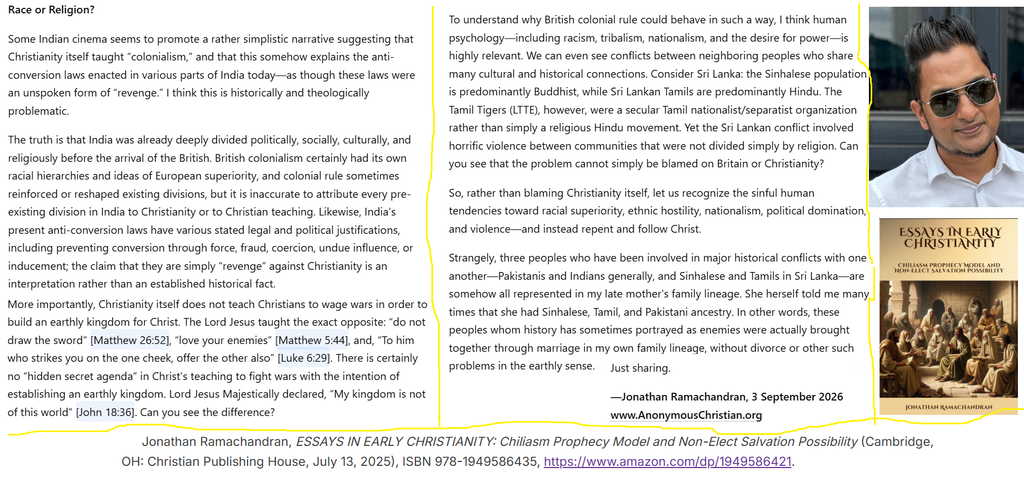
[Text] Race or Religion?
Some Indian cinema seems to promote a rather simplistic narrative suggesting that Christianity itself taught “colonialism,” and that this somehow explains the anti-conversion laws enacted in various parts of India today—as though these laws were an unspoken form of “revenge.” I think this is historically and theologically problematic.
The truth is that India was already deeply divided politically, socially, culturally, and religiously before the arrival of the British. British colonialism certainly had its own racial hierarchies and ideas of European superiority, and colonial rule sometimes reinforced or reshaped existing divisions, but it is inaccurate to attribute every pre-existing division in India to Christianity or to Christian teaching. Likewise, India’s present anti-conversion laws have various stated legal and political justifications, including preventing conversion through force, fraud, coercion, undue influence, or inducement; the claim that they are simply “revenge” against Christianity is an interpretation rather than an established historical fact.
More importantly, Christianity itself does not teach Christians to wage wars in order to build an earthly kingdom for Christ. The Lord Jesus taught the exact opposite: “do not draw the sword” [Matthew 26:52], “love your enemies” [Matthew 5:44], and, “To him who strikes you on the one cheek, offer the other also” [Luke 6:29]. There is certainly no “hidden secret agenda” in Christ’s teaching to fight wars with the intention of establishing an earthly kingdom. Lord Jesus Majestically declared, “My kingdom is not of this world” [John 18:36]. Can you see the difference?
To understand why British colonial rule could behave in such a way, I think human psychology—including racism, tribalism, nationalism, and the desire for power—is highly relevant. We can even see conflicts between neighboring peoples who share many cultural and historical connections. Consider Sri Lanka: the Sinhalese population is predominantly Buddhist, while Sri Lankan Tamils are predominantly Hindu. The Tamil Tigers (LTTE), however, were a secular Tamil nationalist/separatist organization rather than simply a religious Hindu movement. Yet the Sri Lankan conflict involved horrific violence between communities that were not divided simply by religion. Can you see that the problem cannot simply be blamed on Britain or Christianity?
So, rather than blaming Christianity itself, let us recognize the sinful human tendencies toward racial superiority, ethnic hostility, nationalism, political domination, and violence—and instead repent and follow Christ.
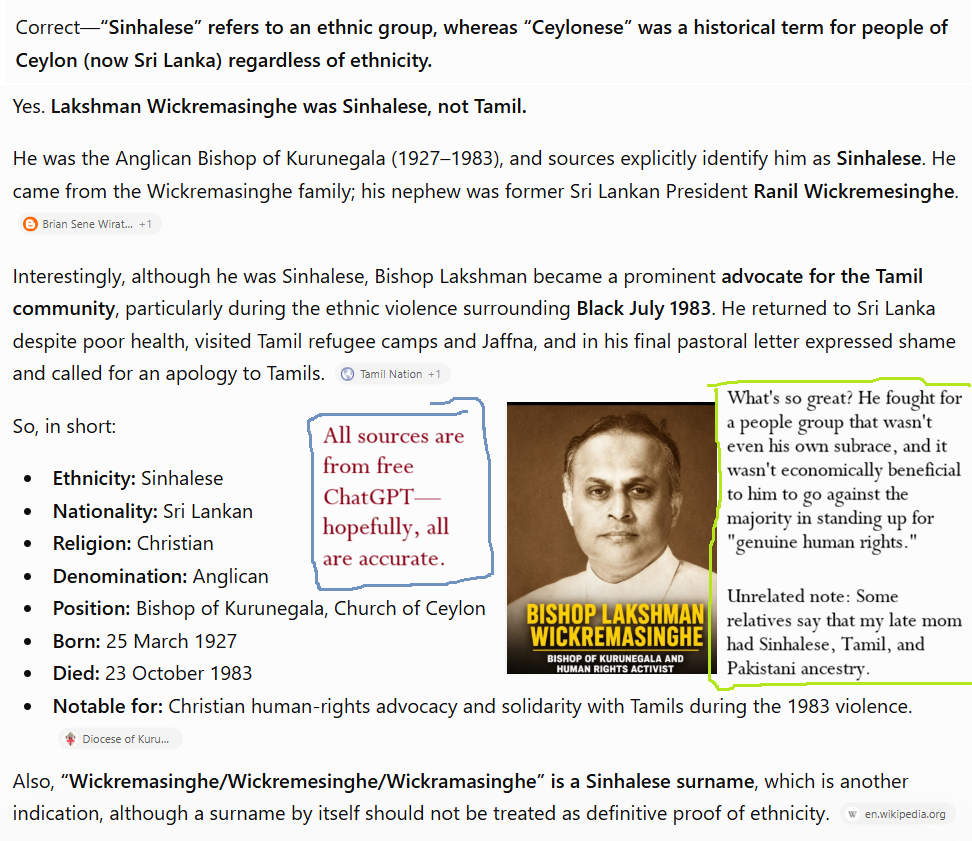
Strangely, three peoples who have been involved in major historical conflicts with one another—Pakistanis and Indians generally, and Sinhalese and Tamils in Sri Lanka—are somehow all represented in my late mother’s family lineage. She herself told me many times that she had Sinhalese, Tamil, and Pakistani ancestry. In other words, these peoples whom history has sometimes portrayed as enemies were actually brought together through marriage in my own family lineage, without divorce or other such problems in the earthly sense.
Just sharing.
—Jonathan Ramachandran, 3 September 2026
www.AnonymousChristian.org
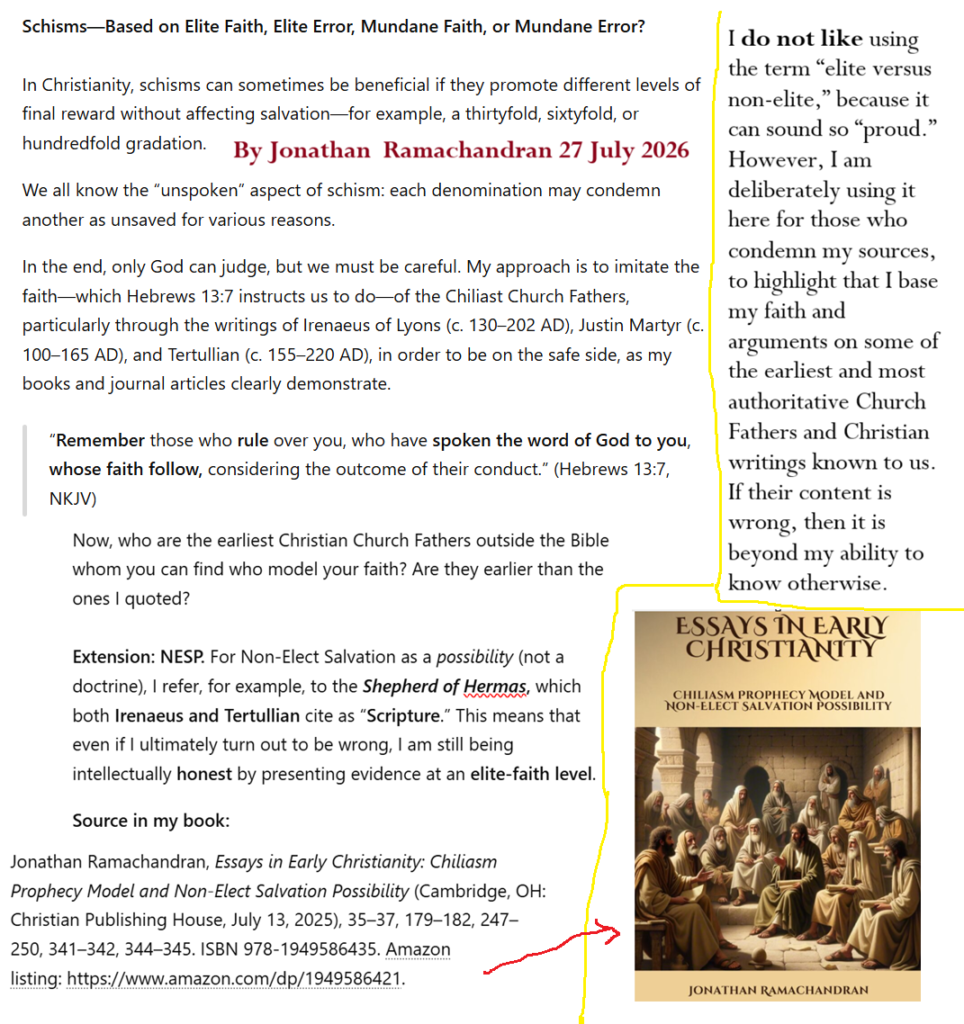
[Text] Schisms—Based on Elite Faith, Elite Error, Mundane Faith, or Mundane Error?
Note: I do not like using the term “elite versus non-elite,” because it can sound so “proud.” However, I am deliberately using it here for those who condemn my sources, to highlight that I base my faith and arguments on some of the earliest and most authoritative Church Fathers and Christian writings known to us. If their content is wrong, then it is beyond my ability to know otherwise.
In Christianity, schisms can sometimes be beneficial if they promote different levels of final reward without affecting salvation—for example, a thirtyfold, sixtyfold, or hundredfold gradation.
We all know the “unspoken” aspect of schism: each denomination may condemn another as unsaved for various reasons.
In the end, only God can judge, but we must be careful. My approach is to imitate the faith—which Hebrews 13:7 instructs us to do—of the Chiliast Church Fathers, particularly through the writings of Irenaeus of Lyons (c. 130–202 AD), Justin Martyr (c. 100–165 AD), and Tertullian (c. 155–220 AD), in order to be on the safe side, as my books and journal articles clearly demonstrate.
“Remember those who rule over you, who have spoken the word of God to you, whose faith follow, considering the outcome of their conduct.” (Hebrews 13:7, NKJV)
Now, who are the earliest Christian Church Fathers outside the Bible whom you can find who model your faith? Are they earlier than the ones I quoted?
Extension: NESP. For Non-Elect Salvation as a possibility (not a doctrine), I refer, for example, to the Shepherd of Hermas, which both Irenaeus and Tertullian cite as “Scripture.” This means that even if I ultimately turn out to be wrong, I am still being intellectually honest by presenting evidence at an elite-faith level.
Source in my book:
Jonathan Ramachandran, Essays in Early Christianity: Chiliasm Prophecy Model and Non-Elect Salvation Possibility (Cambridge, OH: Christian Publishing House, July 13, 2025), 35–37, 179–182, 247–250, 341–342, 344–345. ISBN 978-1949586435. Amazon listing: https://www.amazon.com/dp/1949586421.
Source:
Thank you.
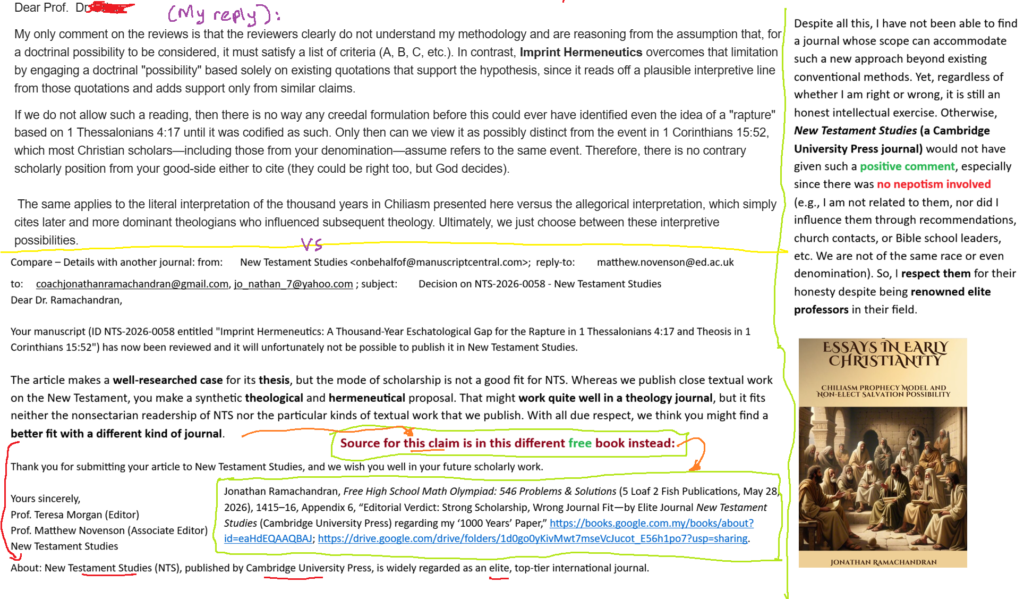
[Text]: Dear Prof. Dr. [Name Withheld for Privacy],
My only comment on the reviews is that the reviewers clearly do not understand my methodology and are reasoning from the assumption that, for a doctrinal possibility to be considered, it must satisfy a list of criteria (A, B, C, etc.). In contrast, Imprint Hermeneutics overcomes that limitation by engaging a doctrinal “possibility” based solely on existing quotations that support the hypothesis, since it reads off a plausible interpretive line from those quotations and adds support only from similar claims.
If we do not allow such a reading, then there is no way any creedal formulation before this could ever have identified even the idea of a “rapture” based on 1 Thessalonians 4:17 until it was codified as such. Only then can we view it as possibly distinct from the event in 1 Corinthians 15:52, which most Christian scholars—including those from your denomination—assume refers to the same event. Therefore, there is no contrary scholarly position from your good-side either to cite (they could be right too, but God decides).
The same applies to the literal interpretation of the thousand years in Chiliasm presented here versus the allegorical interpretation, which simply cites later and more dominant theologians who influenced subsequent theology. Ultimately, we just choose between these interpretive possibilities.
Thank you & sincerely
Jonathan
Compare – Details with another journal:
from: New Testament Studies <[email protected]>
reply-to: [email protected]
to: [email protected], [email protected]
subject: Decision on NTS-2026-0058 – New Testament Studies
Dear Dr. Ramachandran,
Your manuscript (ID NTS-2026-0058 entitled “Imprint Hermeneutics: A Thousand-Year Eschatological Gap for the Rapture in 1 Thessalonians 4:17 and Theosis in 1 Corinthians 15:52″) has now been reviewed and it will unfortunately not be possible to publish it in New Testament Studies.
The article makes a well-researched case for its thesis, but the mode of scholarship is not a good fit for NTS. Whereas we publish close textual work on the New Testament, you make a synthetic theological and hermeneutical proposal. That might work quite well in a theology journal, but it fits neither the nonsectarian readership of NTS nor the particular kinds of textual work that we publish. With all due respect, we think you might find a better fit with a different kind of journal.
Thank you for submitting your article to New Testament Studies, and we wish you well in your future scholarly work.
Yours sincerely,
Prof. Teresa Morgan (Editor)
Prof. Matthew Novenson (Associate Editor)
New Testament Studies
About: New Testament Studies (NTS), published by Cambridge University Press, is widely regarded as an elite, top-tier international journal.
Source:
Jonathan Ramachandran, Free High School Math Olympiad: 546 Problems & Solutions (5 Loaf 2 Fish Publications, May 28, 2026), 1415–16, Appendix 6, “Editorial Verdict: Strong Scholarship, Wrong Journal Fit—by Elite Journal New Testament Studies (Cambridge University Press) regarding my ‘1000 Years’ Paper,” https://books.google.com.my/books/about?id=eaHdEQAAQBAJ; https://drive.google.com/drive/folders/1d0go0yKivMwt7mseVcJucot_E56h1po7?usp=sharing.
Despite all this, I have not been able to find a journal whose scope can accommodate such a new approach beyond existing conventional methods. Yet, regardless of whether I am right or wrong, it is still an honest intellectual exercise. Otherwise, New Testament Studies (a Cambridge University Press journal) would not have given such a positive comment, especially since there was no nepotism involved (e.g., I am not related to them, nor did I influence them through recommendations, church contacts, or Bible school leaders, etc. We are not of the same race or even denomination). So, I respect them for their honesty despite being renowned elite professors in their field.
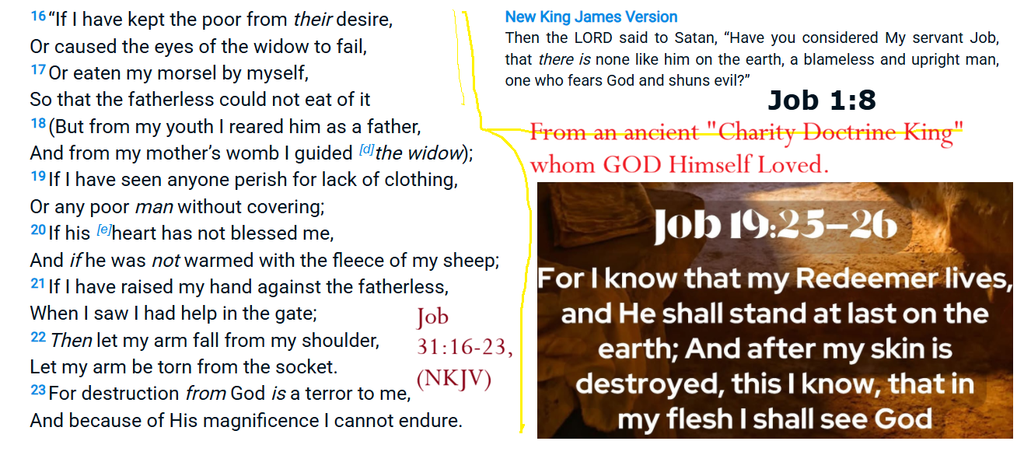
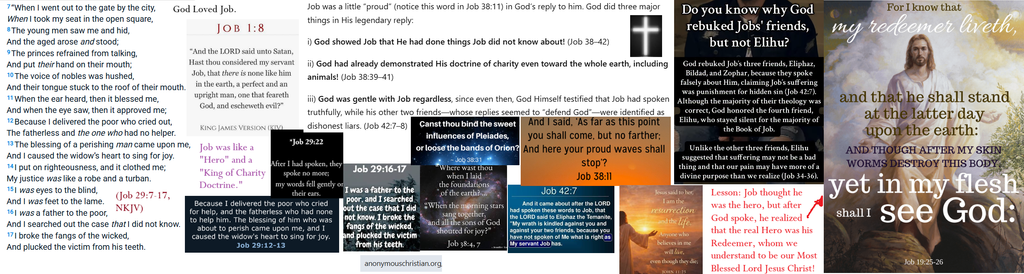
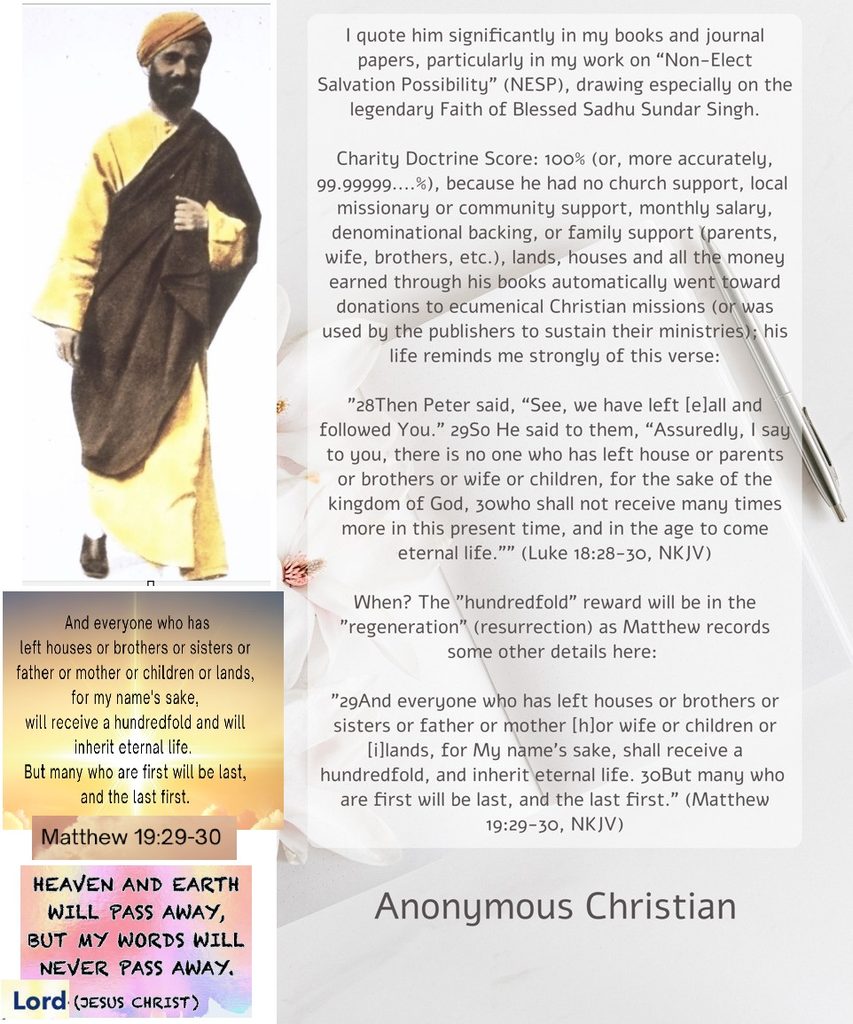
I quote him significantly in my books and journal papers, particularly in my work on “Non-Elect Salvation Possibility” (NESP), drawing especially on the legendary Faith of Blessed Sadhu Sundar Singh.
Charity Doctrine Score: 100% (or, more accurately, 99.99999….%), because he had no church support, local missionary or community support, monthly salary, denominational backing, or family support (parents, wife, brothers, etc.), lands, houses and all the money earned through his books automatically went toward donations to ecumenical Christian missions (or was used by the publishers to sustain their ministries); his life reminds me strongly of this verse:
“28Then Peter said, “See, we have left [e]all and followed You.”
29So He said to them, “Assuredly, I say to you, there is no one who has left house or parents or brothers or wife or children, for the sake of the kingdom of God, 30who shall not receive many times more in this present time, and in the age to come eternal life.”” (Luke 18:28-30, NKJV)
When? The “hundredfold” reward will be in the “regeneration” (resurrection) as Matthew records some other details here:
“27Then Peter answered and said to Him, “See, we have left all and followed You. Therefore what shall we have?” 28So Jesus said to them, “Assuredly I say to you, that in the regeneration, when the Son of Man sits on the throne of His glory, you who have followed Me will also sit on twelve thrones, judging the twelve tribes of Israel. 29And everyone who has left houses or brothers or sisters or father or mother [h]or wife or children or [i]lands, for My name’s sake, shall receive a hundredfold, and inherit eternal life. 30But many who are first will be last, and the last first.” (Matthew 19:27-30, NKJV)
The original article below is not by me. Source link:
https://www.facebook.com/photo/?fbid=27833425226329014&set=a.189462334485342
THE PREACHER WHO SURVIVED BEING SKINNED ALIVE. THE MOUNTAINS FINALLY TOOK HIM.
They sewed him into a wet animal skin and left him in the sun to die slowly as it tightened around his body. He survived. They packed cloth full of scorpions and leeches against his skin. He survived that too. They tied him to a tree overnight as bait for wild animals in the mountains. He survived. Then one spring morning in 1929, he walked into the Himalayas alone, and nobody ever saw him again.
Sundar Singh was born in 1889 into a wealthy, landowning Sikh family in Punjab, India. His mother took him weekly to sit at the feet of a Hindu holy man in the forest, hoping to raise a devoted son. When she died, Sundar was only fourteen, and grief turned to rage. He hated the missionaries in his town, mocked their faith, and one day bought a Bible and burned it page by page in front of his friends to prove his contempt.
The peace he expected never came. Weeks later, hollowed out by despair, he decided he would end his life unless the “true God,” whoever that was, showed up before dawn. That night, he said, a light filled his room and he saw Jesus Christ standing before him, asking why he had persecuted Him. By morning, sixteen-year-old Sundar Singh was a Christian.
His family’s response was immediate and brutal. His father disowned him. His own brother tried to poison him. The community that had once respected his family now treated him as a traitor. Rather than retreat, Sundar made a decision that stunned everyone who knew him: he put on the plain yellow robe of a Hindu holy man and chose to live as a barefoot, homeless preacher of Christ, walking from village to village with no possessions, no salary, and no home to return to.
He became known across northern India as “the apostle with the bleeding feet.” His robe offered no protection against the snow. He was stoned. He was arrested. He once slept in a roadside hut and woke to find a cobra had shared the space with him through the night.
But it was Tibet that called to him most. Closed to missionaries, fiercely Buddhist, and hostile to any foreign faith, Tibet had defeated nearly every attempt to bring the gospel across its border. Sundar Singh crossed it anyway, for the first time at just nineteen years old, and then returned almost every year that followed.
The persecution there went far beyond stones. In the Tibetan town of Rasar, he was arrested, tried, and sentenced to death for preaching. His executioners sewed him into a freshly skinned, still-wet yak hide and left him in the open sun, knowing the hide would shrink as it dried, crushing the person inside. Villagers later said he was found alive, the yak skin split open, with no explanation anyone could give. On another occasion, he was thrown into a dry well filled with the remains of previous prisoners and left to die in the dark. Two nights later, he said, a rope was lowered down to him and he was pulled out, though he never saw who had done it. Other accounts describe him bound to a tree overnight in wolf territory, packed in cloth filled with stinging insects, and other things few missionaries anywhere in history have endured and lived to describe.
He kept going back.
By his thirties, Sundar Singh had preached across India, Tibet, Nepal, and eventually Europe, America, Australia, and beyond, drawing enormous crowds wherever he spoke. Yet the very hardship of his Tibet journeys had worn his body down long before old age had any right to. Friends who saw him in his last years described him as prematurely aged, frail, and exhausted in a way that alarmed them.
In April 1929, against the advice of nearly everyone close to him, Sundar Singh set out on what he intended to be one more journey into Tibet. He reached a small town called Kalka at the foot of the Himalayas, a worn, aging figure in a yellow robe among the pilgrims beginning their own climbs into the mountains.
He was never seen again.
No body was ever found. No grave exists. No witness ever came forward with a final account. Whether he collapsed from exhaustion on a mountain path, was killed by those still hostile to his preaching, or simply reached the high mountains he loved and was lost to the snow, no one has ever been able to say. Nearly a century later, it remains one of the enduring unsolved mysteries in modern mission history.
A man who survived being sewn alive into an animal skin, left for dead in a well of corpses, and bound out as bait for wolves, was finally taken, quietly and without a trace, by the very mountains that had always called him home.
LESSONS FROM HIS LIFE:
• Surviving hardship isn’t the same as being spared from cost, both were true in his life at once
• Radical obedience often costs relationships with the people we love most
• Faithfulness doesn’t require safety, only surrender
• Some of the most significant lives leave the world with more questions than answers, and that’s alright
• A body poured out again and again in service still needed rest it rarely received
“For to me, to live is Christ, and to die is gain.” — Philippians 1:21
If your final chapter was never written for anyone to read, would your life still have spoken loudly enough?
Follow this page for a new story like his every week.
Researched and written by Christian Ekeneme.
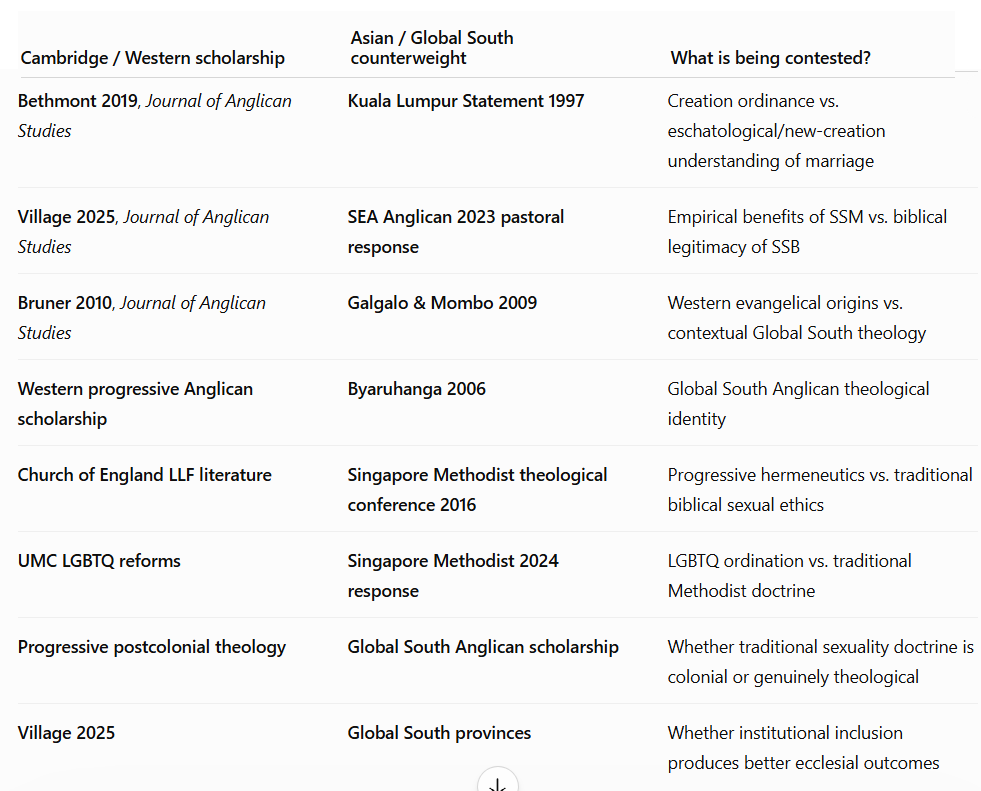
Have Asian Christian leaders opposed “Cambridge- or Ivy-League-level” new biblical interpretations advanced by leading Anglican, Methodist, or other Western scholars?
Yes. The LGBTQ issue is a clear example. Asian Christian leaders have challenged theological developments from influential Western churches and academic circles. For example, Malaysia’s Methodist Church severed its relationship with the UMC amid doctrinal differences, while Malaysian Anglicans maintain their wider Anglican connection but reject Western Anglican developments concerning LGBTQ inclusion.
This shows that academic prestige is not theological authority. A position being associated with Cambridge, Oxford, Harvard, an Ivy League institution, or a prestigious journal does not make it automatically correct—or require Christians to accept it. Likewise, rejecting such a position does not make the opposing conservative Christian position “academically low-level.”
The same applies to other doctrines. We should not be carried away by prestigious names or credentials. My approach is Bible + Chiliasm Church Fathers + early Christian writings first, assessing modern reinterpretations in light of these sources rather than allowing modern reinterpretations to determine the meaning of the earlier sources.
I personally believe the conservative Asian position is more faithful to Scripture, while the liberal position risks grave spiritual consequences, potentially even hellfire. That is my personal theological and polemical stance. Ultimately, God is the final Judge. Choose well.
Jonathan Ramachandran (29 August 2026).
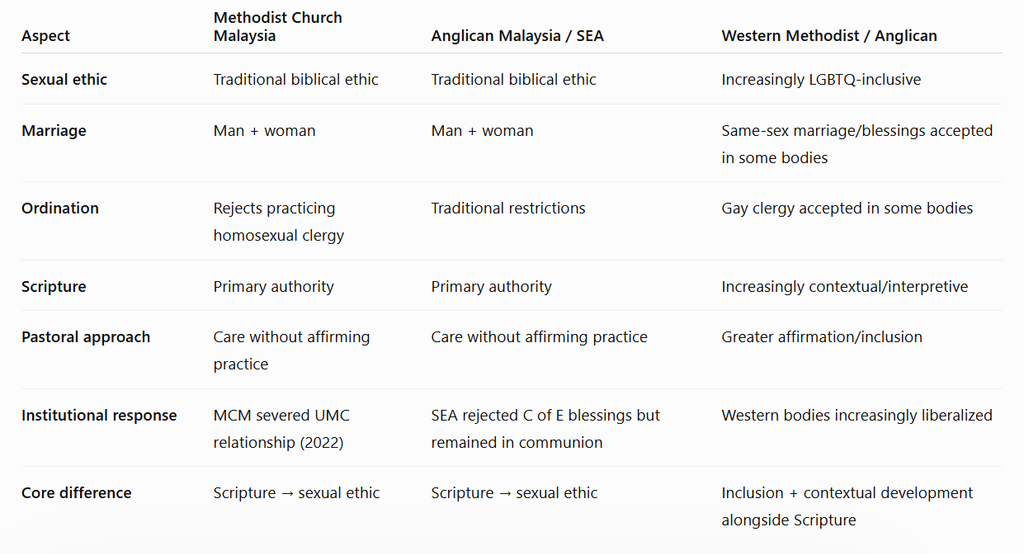
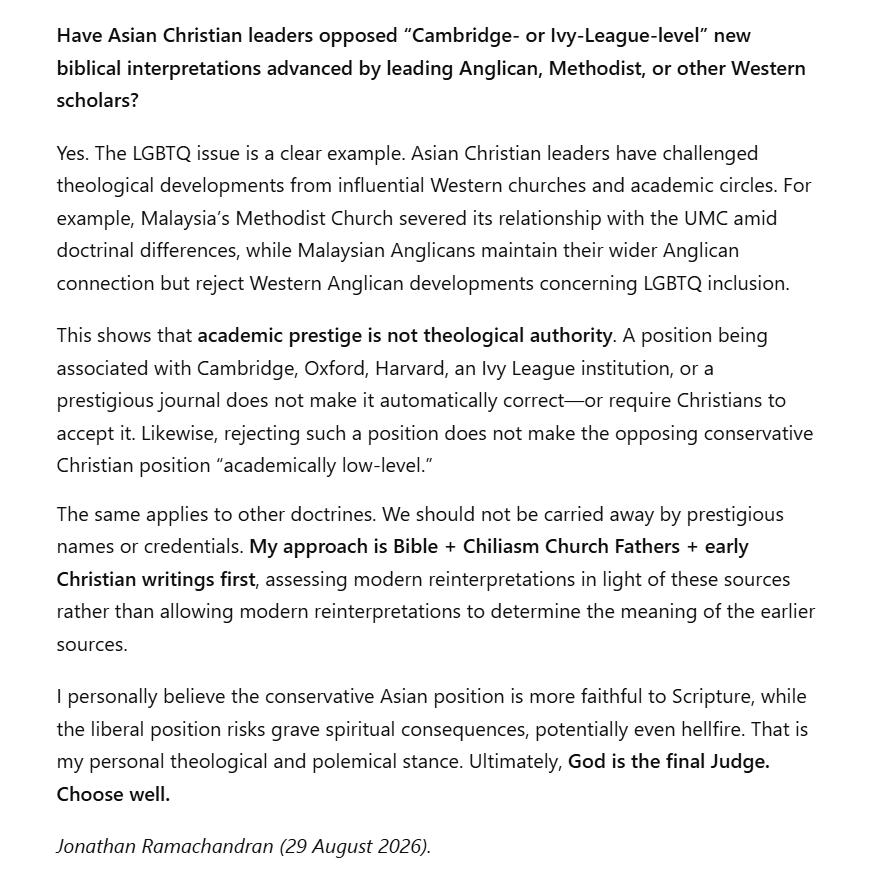
Reading list or references for these “recent claims”:
1 – John Philip Anderson, “Conservative Christianity, the Global South and the Battle over Sexual Orientation,” Third World Quarterly 32, no. 9 (2011): 1589–1605. https://doi.org/10.1080/01436597.2011.618648
2 – William L. Sachs, “Sexuality and Anglicanism,” in The Oxford History of Anglicanism, Volume IV: Global Western Anglicanism, c. 1910–Present, ed. Jeremy Morris (Oxford: Oxford University Press, 2017), 93–116. https://doi.org/10.1093/acprof:oso/9780199641406.003.0005
3 – Hwa Yung, “The Shift of the Center of Gravity of the Church from the West to the Majority World,” Transformation 39, no. 2 (2022): 77–85. https://doi.org/10.1177/02653788221082019
4 – Justin Joon Lee, “The Mission and People of God: Rethinking Theology and Theological Methodology in Asia,” International Bulletin of Mission Research 52, no. 2 (2024). https://doi.org/10.1177/00918296241230976
5 – Peter C. Phan, ed., The Oxford Handbook of Asian Christian Theologies (Oxford: Oxford University Press, 2026). https://doi.org/10.1093/9780197633793.001.0001
6 – Susannah Cornwall, “Incompleteness, Imperial Legacies, and Anglican Fudge: How Concerns about Gender and Sexuality Affect How Anglicans Do Theology,” Anglican Theological Review 105, no. 4 (2023): 454–480. https://doi.org/10.1177/00033286231209714
7 – Richard Gauvain, “Truth and Tradition: Bishop Mouneer Hanna Anis and the Ongoing Construction of Egyptian Anglican Orthodoxy,” International Journal for the Study of the Christian Church 24, no. 2 (2024): 233–252. https://doi.org/10.1080/1474225X.2024.2335124
8 – Jae Sung Ha, “The Authority of the Bible, Queer Theology and Christian Counseling,” Journal of Counseling and Gospel 27, no. 2 (2019): 297–326. https://doi.org/10.17841/jocag.2019.27.2.297
9 – Angus Paddison, “The Authority of Scripture and the Triune God,” International Journal of Systematic Theology 13, no. 4 (2011): 448–462. https://doi.org/10.1111/j.1468-2400.2011.00594.x
10 – Nigel Voak, “Richard Hooker and the Principle of Sola Scriptura,” Journal of Theological Studies 59, no. 1 (2008): 96–139. https://doi.org/10.1093/jts/flm160
11 – Stephen T. Davis, “Scripture, Tradition, and Theological Authority,” in Christian Philosophical Theology (Oxford: Oxford University Press, 2006), 265–283. https://doi.org/10.1093/0199284598.003.0016
12 – Peter Carnley, “A Problematic Doctrine of Scripture,” Journal of Anglican Studies (2026). https://www.cambridge.org/core/journals/journal-of-anglican-studies/article/abs/problematic-doctrine-of-scripture/E5481636CCAC6B0975A95D111380E696
13 – Methodist Church in Malaysia, “The Position of the Methodist Church in Malaysia on Homosexuality and Same Sex Marriage,” August 24, 2011. https://www.methodistchurch.org.my/newsmaster.cfm?action=view&menuid=6&retrieveid=618
14 – Council of Bishops of The United Methodist Church, “Affiliated Churches: Reimagining Global Methodist Partnerships beyond Institutional Ties,” July 2026. https://www.unitedmethodistbishops.org/newsdetail/affiliated-churches-reimagining-global-methodist-partnerships-beyond-institutional-ties-19904258
15 – Anglican Communion Office, Good Differentiation? Addressing Disputes in the Anglican Communion (London: Anglican Communion Office, 2023). https://www.anglicancommunion.org/resource/good-differentiation-5/
16 – Second Anglican Encounter in the South, “The Kuala Lumpur Statement on Human Sexuality,” Kuala Lumpur, February 10–15, 1997. https://acl.asn.au/reference-documents/the-kuala-lumpur-statement/
17 – George Conger, “Province of South East Asia Will Not Ordain Women, New Bishop Says,” Anglican Ink, May 28, 2015. https://anglican.ink/2015/05/28/province-of-south-east-asia-will-not-ordain-women-new-bishop-says/
18 – Jan Nunley, “Some Anglican Provinces Declare Impaired or Broken Relationship with ECUSA,” Episcopal News Service, December 8, 2003. https://digitalarchives.episcopalarchives.org/cgi-bin/ENS/ENSpress_release.pl?pr_number=031208-1
19 – Anglican News, “Text of Lambeth Conference Resolution on Sexuality,” August 5, 1998. https://www.anglicannews.org/news/1998/08/text-of-lambeth-conference-resolution-on-sexuality.aspx
20 – Anglican Church of Australia, “Kuala Lumpur Statement,” General Synod Resolution 70/98, 1998. https://anglican.org.au/resolutions/kuala-lumpur-statement/
“Choose Well.”
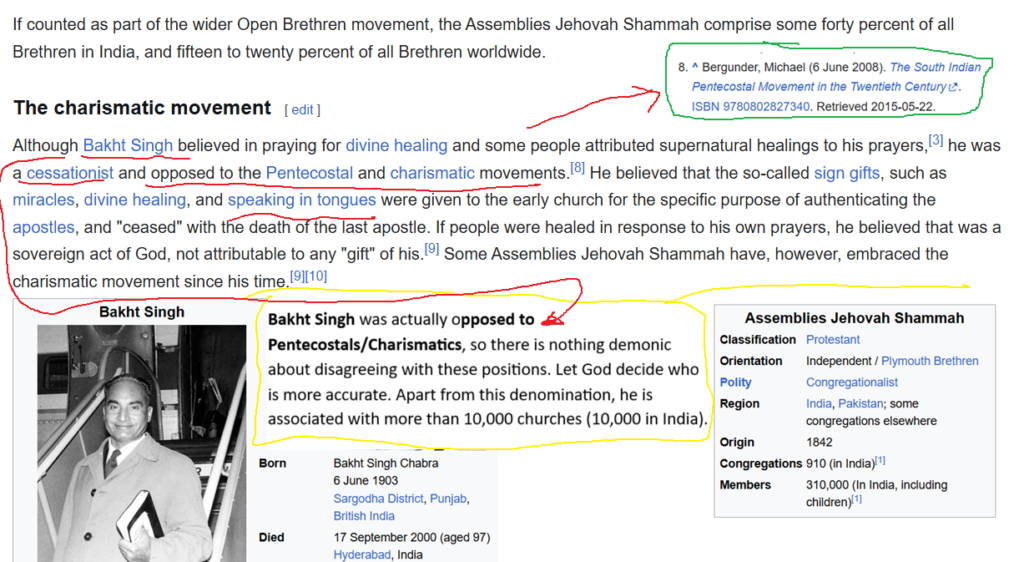
[Text] Bakht Singh was actually opposed to Pentecostals/Charismatics, so there is nothing demonic about disagreeing with these positions. Let God decide who is more accurate. Apart from this denomination, he is associated with more than 10,000 churches (10,000 in India).
To quote:
The charismatic movement
Although Bakht Singh believed in praying for divine healing and some people attributed supernatural healings to his prayers,[3] he was a cessationist and opposed to the Pentecostal and charismatic movements.[8] He believed that the so-called sign gifts, such as miracles, divine healing, and speaking in tongues were given to the early church for the specific purpose of authenticating the apostles, and “ceased” with the death of the last apostle. If people were healed in response to his own prayers, he believed that was a sovereign act of God, not attributable to any “gift” of his.[9] Some Assemblies Jehovah Shammah have, however, embraced the charismatic movement since his time.[9][10]
Sources:
[8] Bergunder, Michael (6 June 2008). The South Indian Pentecostal Movement in the Twentieth Century. ISBN 9780802827340. Retrieved 2015-05-22.
https://en.wikipedia.org/wiki/Assemblies_Jehovah_Shammah
https://en.wikipedia.org/wiki/Bakht_Singh
Thank you
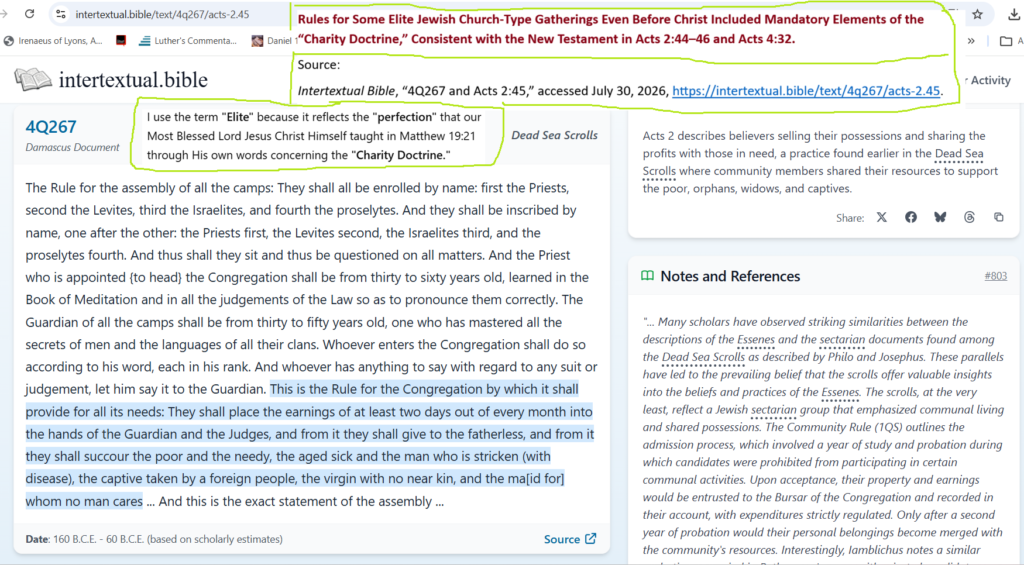
[Text] Rules for Some Elite Jewish Church-Type Gatherings Even Before Christ Included Mandatory Elements of the “Charity Doctrine,” Consistent with the New Testament in Acts 2:44–46 and Acts 4:32.
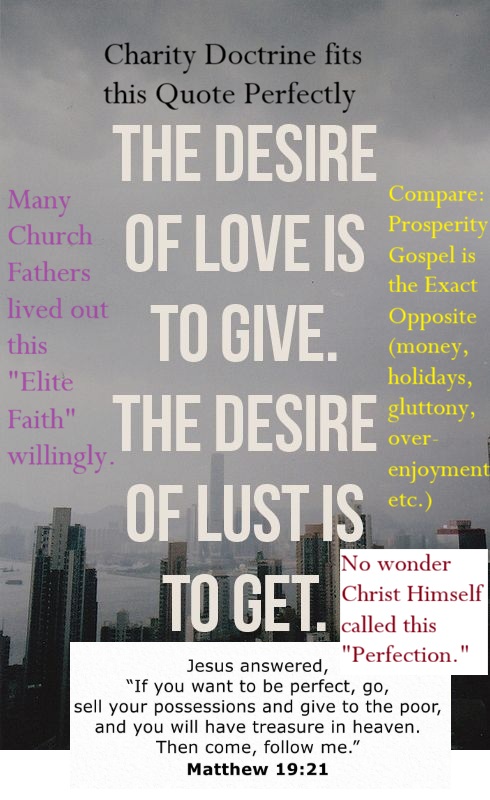
I use the term “Elite” because it reflects the “perfection” that our Most Blessed Lord Jesus Christ Himself taught in Matthew 19:21 through His own words concerning the “Charity Doctrine.”
Source:
Intertextual Bible, “4Q267 and Acts 2:45,” accessed July 30, 2026, https://intertextual.bible/text/4q267/acts-2.45.
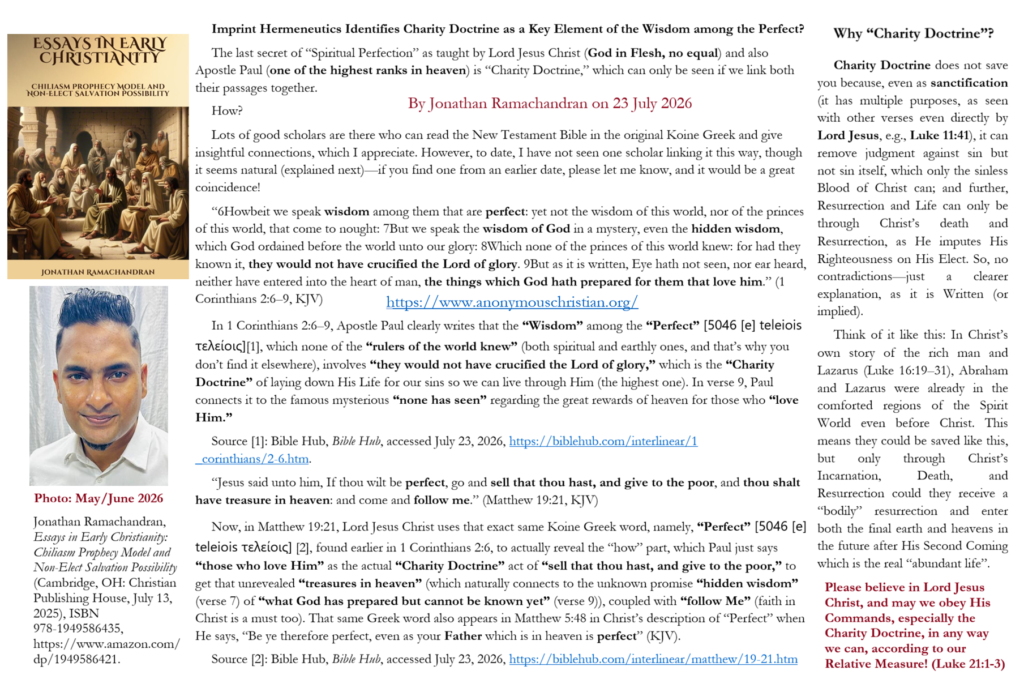
Imprint Hermeneutics Identifies Charity Doctrine as a Key Element of the Wisdom among the Perfect?
The last secret of “Spiritual Perfection” as taught by Lord Jesus Christ (God in Flesh, no equal) and also Apostle Paul (one of the highest ranks in heaven) is “Charity Doctrine,” which can only be seen if we link both their passages together.
How?
Lots of good scholars are there who can read the New Testament Bible in the original Koine Greek and give insightful connections, which I appreciate. However, to date, I have not seen one scholar linking it this way, though it seems natural (explained next)—if you find one from an earlier date, please let me know, and it would be a great coincidence!
“6Howbeit we speak wisdom among them that are perfect: yet not the wisdom of this world, nor of the princes of this world, that come to nought: 7But we speak the wisdom of God in a mystery, even the hidden wisdom, which God ordained before the world unto our glory: 8Which none of the princes of this world knew: for had they known it, they would not have crucified the Lord of glory. 9But as it is written, Eye hath not seen, nor ear heard, neither have entered into the heart of man, the things which God hath prepared for them that love him.” (1 Corinthians 2:6–9, KJV)
In 1 Corinthians 2:6–9, Apostle Paul clearly writes that the “Wisdom” among the “Perfect” [5046 [e] teleiois τελείοις][1], which none of the “rulers of the world knew” (both spiritual and earthly ones, and that’s why you don’t find it elsewhere), involves “they would not have crucified the Lord of glory,” which is the “Charity Doctrine” of laying down His Life for our sins so we can live through Him (the highest one). In verse 9, Paul connects it to the famous mysterious “none has seen” regarding the great rewards of heaven for those who “love Him.”
Source [1]: Bible Hub, Bible Hub, accessed July 23, 2026, https://biblehub.com/interlinear/1_corinthians/2-6.htm.
“Jesus said unto him, If thou wilt be perfect, go and sell that thou hast, and give to the poor, and thou shalt have treasure in heaven: and come and follow me.” (Matthew 19:21, KJV)
Now, in Matthew 19:21, Lord Jesus Christ uses that exact same Koine Greek word, namely, “Perfect” [5046 [e] teleiois τελείοις] [2], found earlier in 1 Corinthians 2:6, to actually reveal the “how” part, which Paul just says “those who love Him” as the actual “Charity Doctrine” act of “sell that thou hast, and give to the poor,” to get that unrevealed “treasures in heaven” (which naturally connects to the unknown promise “hidden wisdom” (verse 7) of “what God has prepared but cannot be known yet” (verse 9)), coupled with “follow Me” (faith in Christ is a must too). That same Greek word also appears in Matthew 5:48 in Christ’s description of “Perfect” when He says, “Be ye therefore perfect, even as your Father which is in heaven is perfect” (KJV).
Source [2]: Bible Hub, Bible Hub, accessed July 23, 2026, https://biblehub.com/interlinear/matthew/19-21.htm
Charity Doctrine does not save you because, even as sanctification (it has multiple purposes, as seen with other verses even directly by Lord Jesus, e.g., Luke 11:41), it can remove judgment against sin but not sin itself, which only the sinless Blood of Christ can; and further, Resurrection and Life can only be through Christ’s death and Resurrection, as He imputes His Righteousness on His Elect. So, no contradictions—just a clearer explanation, as it is Written (or implied).
Think of it like this: In Christ’s own story of the rich man and Lazarus (Luke 16:19–31), Abraham and Lazarus were already in the comforted regions of the Spirit World even before Christ. This means they could be saved like this, but only through Christ’s Incarnation, Death, and Resurrection could they receive a “bodily” resurrection and enter both the final earth and heavens in the future after His Second Coming which is the real “abundant life”.
Source:
Thank you!
The Spiritual Pinnacle of Imprint Hermeneutics: Even Gospel Preaching Attains Its Highest Reward Only Through the Charity Doctrine Lifestyle
I give an example of the excellence of virtue and why boycotts do not work.
Acts 20:33–35 (KJV)
“I have coveted no man’s silver, or gold, or apparel. Yea, ye yourselves know, that these hands have ministered unto my necessities, and to them that were with me. I have shewed you all things, how that so labouring ye ought to support the weak, and to remember the words of the Lord Jesus, how he said, It is more blessed to give than to receive.“
1 Corinthians 9:16–18 (KJV)
“For though I preach the gospel, I have nothing to glory of: for necessity is laid upon me; yea, woe is unto me, if I preach not the gospel! For if I do this thing willingly, I have a reward: but if against my will, a dispensation of the gospel is committed unto me. What is my reward then? Verily that, when I preach the gospel, I may make the gospel of Christ without charge, that I abuse not my power in the gospel.”
In 1 Corinthians 9, the Holy Spirit already revealed that preaching the Gospel is not a big deal in itself, but is a duty (a curse or woe is pronounced on those who do not preach). However, if it is done in the path of virtue (God explains His rule for the Gospel), namely the Charity Doctrine way of not taking a salary or love offerings into one’s personal bank account for it, then it carries a reward. Again, we see the Charity Doctrine as the pinnacle of virtue even in Gospel preaching according to Holy Scripture itself. The Holy Spirit allowed the Apostle St. Paul to even “boast” about this fact only next:
1 Corinthians 9:12, 14–15 (KJV)
“If others be partakers of this power over you, are not we rather? Nevertheless we have not used this power; but suffer all things, lest we should hinder the gospel of Christ. Even so hath the Lord ordained that they which preach the gospel should live of the gospel. But I have used none of these things: neither have I written these things, that it should be so done unto me: for it were better for me to die, than that any man should make my glorying void.“
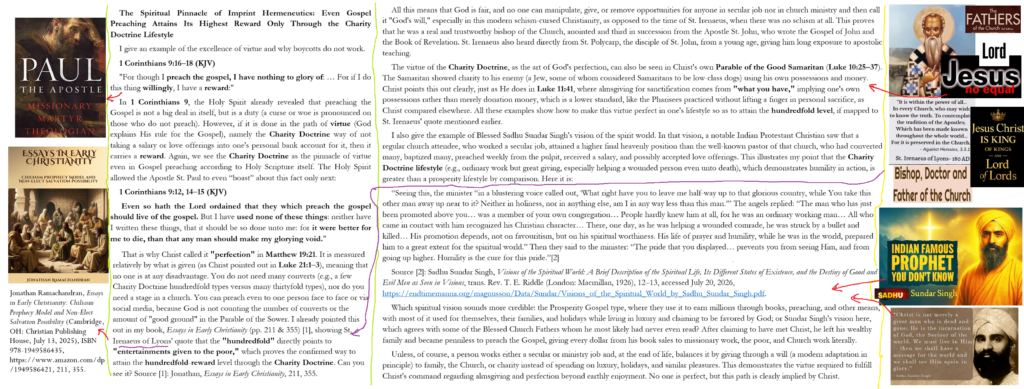
That is why Christ called it “perfection” in Matthew 19:21. It is measured relatively by what is given (as Christ pointed out in Luke 21:1–3), meaning that no one is at any disadvantage. You do not need many converts (e.g., a few Charity Doctrine hundredfold types versus many thirtyfold types), nor do you need a stage in a church. You can preach even to one person face to face or via social media, because God is not counting the number of converts or the amount of “good ground” in the Parable of the Sower. I already pointed this out in my book, Essays in Early Christianity (pp. 211 & 355) [1], showing St. Irenaeus of Lyons’ quote that the “hundredfold” directly points to “entertainments given to the poor,” which proves the confirmed way to attain the hundredfold–reward level through the Charity Doctrine. Can you see it?
Source [1]: Jonathan, Essays in Early Christianity, 211, 355.
All this means that God is fair, and no one can manipulate, give, or remove opportunities for anyone in secular job nor in church ministry and then call it “God’s will,” especially in this modern schism-cursed Christianity, as opposed to the time of St. Irenaeus, when there was no schism at all. This proves that he was a real and trustworthy bishop of the Church, anointed and third in succession from the Apostle St. John, who wrote the Gospel of John and the Book of Revelation. St. Irenaeus also heard directly from St. Polycarp, the disciple of St. John, from a young age, giving him long exposure to apostolic teaching.
The virtue of the Charity Doctrine, as the art of God’s perfection, can also be seen in Christ’s own Parable of the Good Samaritan (Luke 10:25–37). The Samaritan showed charity to his enemy (a Jew, some of whom considered Samaritans to be low-class dogs) using his own possessions and money. Christ points this out clearly, just as He does in Luke 11:41, where almsgiving for sanctification comes from “what you have,” implying one’s own possessions rather than merely donation money, which is a lower standard, like the Pharisees practiced without lifting a finger in personal sacrifice, as Christ compared elsewhere. All these examples show how to make this virtue perfect in one’s lifestyle so as to attain the hundredfold level, if mapped to St. Irenaeus’ quote mentioned earlier.
The Church Fathers stressed such virtue in many ways, which later became more extreme in both Catholicism and Orthodoxy, where Christian monks and nuns also embraced this path. How far their devotion is considered outside or within Scripture, let God judge. However, what I admire is that they practiced this extreme Charity Doctrine lifestyle while also doing Gospel preaching and works of almsgiving, in contrast to Prosperity Gospel missionaries who receive comfortable salaries, accumulate wealth for retirement or family, and spend on holidays and other personal benefits, whereas the former sacrificed all these things.
I also give the example of Blessed Sadhu Sundar Singh’s vision of the spirit world. In that vision, a notable Indian Protestant Christian saw that a regular church attendee, who worked a secular job, attained a higher final heavenly position than the well-known pastor of that church, who had converted many, baptized many, preached weekly from the pulpit, received a salary, and possibly accepted love offerings. This illustrates my point that the Charity Doctrine lifestyle (e.g., ordinary work but great giving, especially helping a wounded person even unto death), which demonstrates humility in action, is greater than a prosperity lifestyle by comparison. Here it is:
“Seeing this, the minister “in a blustering voice called out, ‘What right have you to leave me half-way up to that glorious country, while You take this other man away up near to it? Neither in holiness, nor in anything else, am I in any way less than this man.’” The angels replied: “The man who has just been promoted above you… was a member of your own congregation… People hardly knew him at all, for he was an ordinary working man… All who came in contact with him recognized his Christian character… There, one day, as he was helping a wounded comrade, he was struck by a bullet and killed… His promotion depends, not on favouritism, but on his spiritual worthiness. His life of prayer and humility, while he was in the world, prepared him to a great extent for the spiritual world.” Then they said to the minister: “The pride that you displayed… prevents you from seeing Him, and from going up higher. Humility is the cure for this pride.”[2]
Source [2]: Sadhu Sundar Singh, Visions of the Spiritual World: A Brief Description of the Spiritual Life, Its Different States of Existence, and the Destiny of Good and Evil Men as Seen in Visions, trans. Rev. T. E. Riddle (London: Macmillan, 1926), 12–13, accessed July 20, 2026, https://endtimemanna.org/magnusson/Data/Sundar/Visions_of_the_Spiritual_World_by_Sadhu_Sundar_Singh.pdf.
Which spiritual vision sounds more credible: the Prosperity Gospel type, where they use it to earn millions through books, preaching, and other means, with most of it used for themselves, their families, and holidays while living in luxury and claiming to be favored by God; or Sundar Singh’s vision here, which agrees with some of the Blessed Church Fathers whom he most likely had never even read? After claiming to have met Christ, he left his wealthy family and became penniless to preach the Gospel, giving every dollar from his book sales to missionary work, the poor, and Church work literally.
Unless, of course, a person works either a secular or ministry job and, at the end of life, balances it by giving through a will (a modern adaptation in principle) to family, the Church, or charity instead of spending on luxury, holidays, and similar pleasures. This demonstrates the virtue required to fulfill Christ’s command regarding almsgiving and perfection beyond earthly enjoyment. No one is perfect, but this path is clearly implied by Christ.
There is no shortcut for me or for you in virtue. This is unlike the Prosperity Gospel model, where becoming a pastor enables one to collect tithes and love offerings and gain extra financial advantages, falsely placing oneself above others without any New Testament Bible verse teaching such a thing. In contrast, every claim I have made here is based on New Testament Scripture, not the Old Testament with the bonus of St. Irenaeus and Sadhu’s testimony.
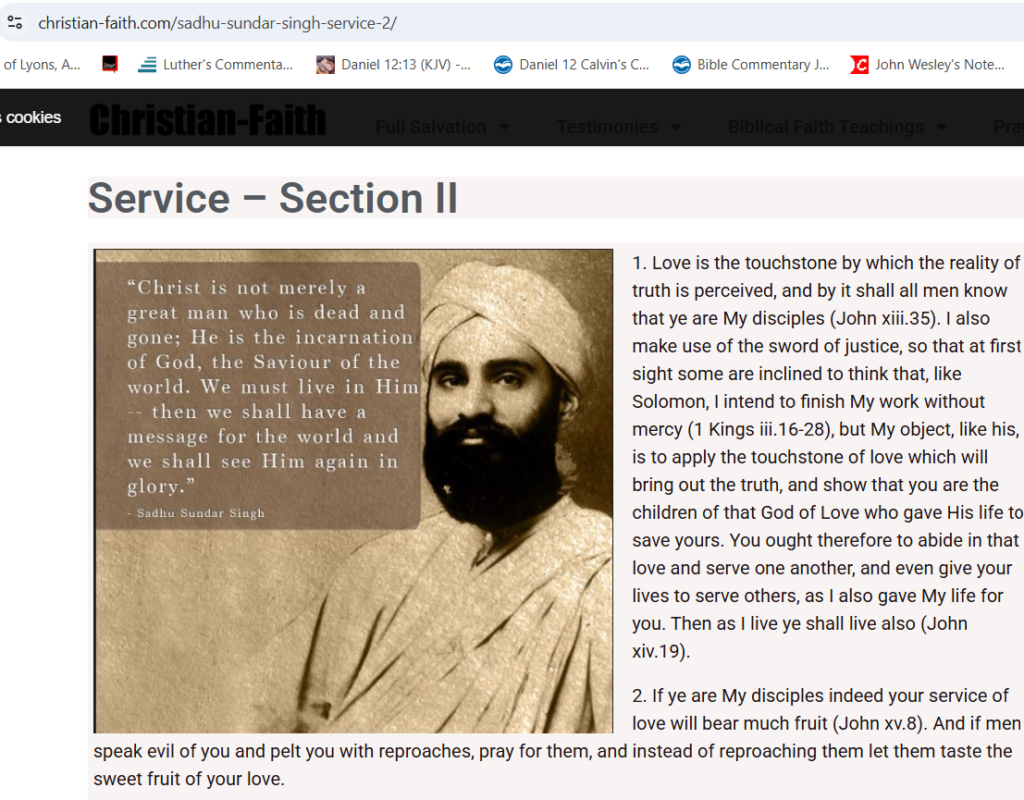
Image Source: https://christian-faith.com/sadhu-sundar-singh-service-2/
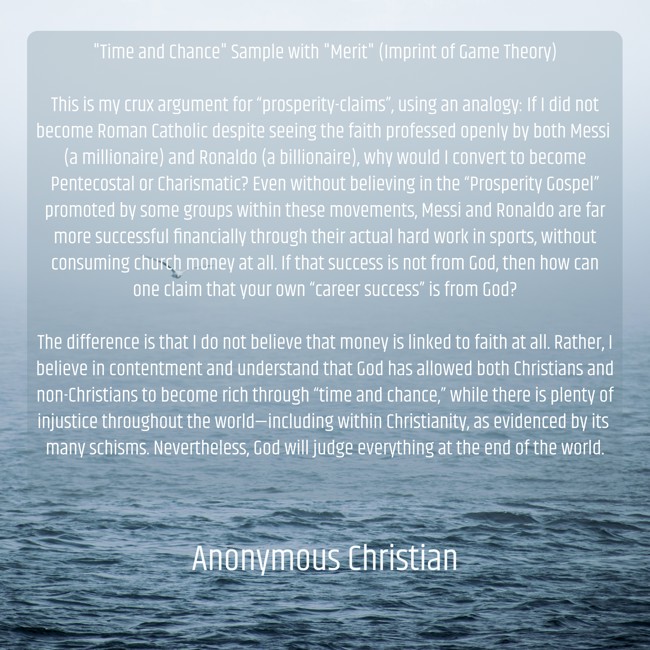
“Time and Chance” Sample with “Merit” (Imprint of Game Theory)
“I returned and saw under the sun that— The race is not to the swift, Nor the battle to the strong, Nor bread to the wise, Nor riches to men of understanding, Nor favor to men of skill; But time and chance happen to them all.” (Ecclesiastes 9:11, NKJV)
Most things in the world are influenced by “manipulation” rather than merit (see the other Bible verses, c.f. Ecclesiastes 5:8 ), whether within religion (e.g. the Pharisees) or outside it (e.g. secular jobs, etc.).
“If you see the oppression of the poor, and the violent perversion of justice and righteousness in a province, do not marvel at the matter; for high official watches over high official, and higher officials are over them.” (Ecclesiastes 5:8, NKJV)
Always observe carefully which “god’s people” do not perform on merit, and note such “non-virtue.”
For the sports section (soccer here), some local churches in Malaysia organise evangelism, which is good. However, the theological irony is that both Spain and Argentina are majority Catholic countries (even the two most popularly regarded as the best players today, Messi and Ronaldo, are Catholic), meaning they are neither Pentecostal nor Protestant.
Imagine the analogy globally: someone is not even selected for school-, state-, or national-level soccer in a country that cannot even qualify for the World Cup, yet claims as a testimony that their god helped them win some insignificant local soccer match somewhere, compared to these Catholic giants. Can you see it?
If that does not prove who God is (I am ecumenical and take the middle position), why should all those little victories, human manipulation, job success, and other achievements—all based on human will, which God permits but will judge according to “virtue” on Judgment Day—matter?
For this context, only contentment matters, regardless of whatever happens, as that is true faith in Christ.
IMO (International Mathematical Olympiad)[1] and soccer[2] are more merit-based, since you cannot really cheat your way through them as you can in many other daily jobs, etc., through racism, religious bias, language bias, and so on. I repeat: always notice which cultures (religions, races, or language groups) are absent from performance.
Source [1]: International Mathematical Olympiad, “Team Results – 67th International Mathematical Olympiad (IMO2026),” IMO 2026 Official Website, accessed July 21, 2026, https://www.imo2026.com/Results/Team_Results.htm.
Source [2]: FIFA, “FIFA World Cup 2026 Final Standings,” final standings: 1. Spain, 2. Argentina, 3. England (England defeated France 6–4 in the third-place playoff; Spain defeated Argentina 1–0 in the final), accessed July 21, 2026, https://www.fifa.com/en/tournaments/mens/worldcup/canadamexicousa2026.
Last but not least, merit needs to be checked against population ratio and opportunities as well to be fair (God’s “relative measure, c.f. Luke 21:1–3).
This is my crux argument for “prosperity-claims”, using an analogy: If I did not become Roman Catholic despite seeing the faith professed openly by both Messi (a millionaire) and Ronaldo (a billionaire), why would I convert to become Pentecostal or Charismatic? Even without believing in the “Prosperity Gospel” promoted by some groups within these movements, Messi and Ronaldo are far more successful financially through their actual hard work in sports, without consuming church money at all. If that success is not from God, then how can one claim that your own “career success” is from God?
The difference is that I do not believe that money is linked to faith at all. Rather, I believe in contentment and understand that God has allowed both Christians and non-Christians to become rich through “time and chance,” while there is plenty of injustice throughout the world—including within Christianity, as evidenced by its many schisms. Nevertheless, God will judge everything at the end of the world.
One more thing I believe: To make it fair, I quote a Roman Catholic example where they are billionaires who have literally given everything away, such as Mr. Chuck Feeney (from a working-class background)[3] or Mr. Scott-Vincent Borba (from an ordinary middle-class background)[4] who became a priest to attain Christ’s command of perfection in Matthew 19:21 after achieving all his wealth from scratch. Neither is rich because of inheritance or nobility, but came from relatively humble backgrounds—a high relative measure, as per Luke 21:1–3. Can you see it?
Source [3]: Joe Wilensky, “Chuck Feeney Reaches Lifetime Goal: Giving Away a Fortune,” Cornell Chronicle, October 8, 2020, https://news.cornell.edu/stories/2020/10/chuck-feeney-reaches-lifetime-goal-giving-away-fortune.
Source [4]: David Begnaud and Grace Baek, “Why the Millionaire Co-Founder of e.l.f. Cosmetics Left His Beauty Empire to Become a Catholic Priest,” CBS News, June 15, 2026, https://www.cbsnews.com/news/co-founder-of-e-l-f-cosmetics-leaves-beauty-empire-catholic-priest/.
I believe that great Christians will ultimately be saved into His Kingdom from among Protestants, Catholics, and the Orthodox, particularly those who follow the Charity Doctrine. Therefore, I write all these things with neutrality, while also mentioning which doctrines I agree with and which I do not, as well as what I consider possible, in order to show honesty as I understand it.
Let God judge, but I admire this as the hardest thing in life: the “Charity Doctrine” of Matthew 19:21 taught by Christ, which goes beyond the basic “believing in Christ.”
Source:
Thank you!
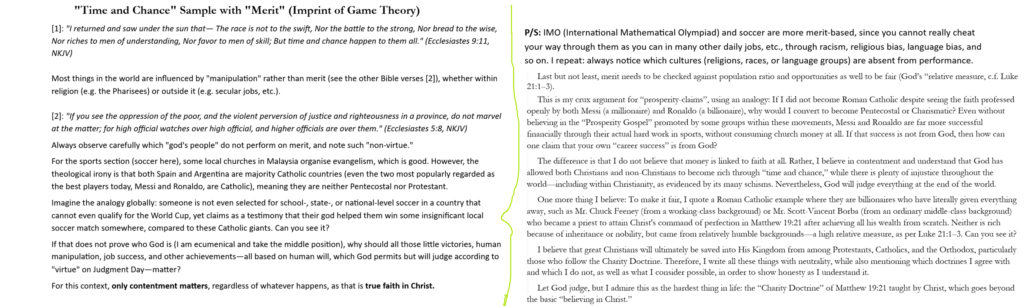
About the author:
Jonathan Ramachandran is an ecumenical Christian.
Education: B.Sc., Th.D. (Hon.), D.Div. (Hon.), D.Min. (Hon.)
Bsc. Actuarial Science (National University of Malaysia, 2006) with Honors.
Dr. Jonathan Ramachandran obtained his Honorary Doctor of Theology (Th.D.) from University of Jerusalem (UJ, Chennai, India, 20 August 2025; Reg. No.: 11230), Honorary Doctor of Divinity (D.Div.) from Triumphant Christian University of America (TCUA, Illinois, USA, 20 August 2025, Cert. ID.: 7704247) and Honorary Doctor of Ministry (D.Min.) from Open Christian University (OCU, California, USA, 31 August 2025, Cert. ID.: OCU250124/831208-14-6517MY).
Works & Links:
Ramachandran, Jonathan. Anonymous Christian. Accessed October 30, 2025. https://www.anonymouschristian.org/
Ramachandran, Jonathan. Coach Jonathan Ramachandran (Facebook Pages). https://www.facebook.com/CoachJonathanRamachandran/, or https://www.facebook.com/profile.php?id=100057109853813, or https://www.facebook.com/profile.php?id=100070978834712
Ramachandran, Jonathan. Defense of Honorary Doctorates. Accessed October 30, 2025. https://drive.google.com/file/d/1dLffkOnLe8BPz9vd3RMPbhZmn6puY7op/view?usp=sharing
Ramachandran, Jonathan. Elementary School Math Olympiad Facebook Links. Updated October 26, 2025. Problems 1–264, https://www.facebook.com/jonathan.ramachandran/posts/pfbid0wkPqT9UULb6G4x1qRVRceBzqARRuWajpKdeVT7d2YfGkD28z7hcqB7yvMFRE3Wpal; Website listing, https://www.anonymouschristian.org/blog/elementary-school-math-olympiad-facebook-links/
Ramachandran, Jonathan. Essays in Early Christianity: Chiliasm Prophecy Model and Non-Elect Salvation Possibility. Cambridge, OH: Christian Publishing House, 13 July 2025. ISBN 978-1949586435. https://www.amazon.com/dp/1949586421.
Ramachandran, Jonathan. Free High School Math Olympiad: 546 Problems & Solutions. 5 Loaf 2 Fish Publications, May 28, 2026. https://books.google.com.my/books/about?id=eaHdEQAAQBAJ or https://drive.google.com/drive/folders/1d0go0yKivMwt7mseVcJucot_E56h1po7?usp=sharing.
Ramachandran, Jonathan. High School Math Olympiad Facebook Links. Updated October 26, 2025. Problems 1–340, https://www.facebook.com/jonathan.ramachandran/posts/pfbid0AwdYEToSrX8B2W1KJyzuKoCyWv3VXAHPAtt5bSfwd3tF2oMEbnmgwCoacyPxczppl; Problems 341–545, https://www.facebook.com/jonathan.ramachandran/posts/pfbid0hJeHxUuJp5kRwWJQ5QFhoNPS4Ym2mmh3ciei2nctqsThbNhWuTAJYvRzk3AU5APil; Website listing of Problems 1–545, https://www.anonymouschristian.org/blog/high-school-math-olympiad-facebook-links/
Ramachandran, Jonathan. Hope Beyond the Elect: Revisiting Early Christian Views on Prophecy and Salvation. Cambridge, OH: Christian Publishing House, 2025. www.amazon.com/dp/1949586405.
Ramachandran, Jonathan. Jonathan’s Math Video Solutions. YouTube channel. https://youtube.com/@jonathanramachandran1537?si=oKVTC4hLTK7iRKSf
Ramachandran, Jonathan. Jonathan Ramachandran – Independent Researcher (Academia.edu profile). Accessed October 30, 2025. https://independent.academia.edu/RamachandranJonathan
Ramachandran, Jonathan. Sample CV. 14 September 2025. https://drive.google.com/file/d/19YuhL31EpC4l3JnHcbbQNio-ueogAEXQ/view?usp=sharing
Ramachandran, Jonathan. School Math Facebook Links. Updated October 26, 2025. Problems 1–154, https://www.facebook.com/jonathan.ramachandran/posts/pfbid025mCA6wGPKLJ4ERhfLBzUwooHBJez59wdhJuHnbKZ9F9ZdaDpEmvX4vinwmoNjdsUl; Website listing, https://www.anonymouschristian.org/blog/school-math-facebook-links/
Ramachandran, Jonathan. Thank God Regardless: Math, Merit, and Being Unapologetically Christian. 5 Loaf 2 Fish Publications, 2026. https://drive.google.com/drive/folders/1d0go0yKivMwt7mseVcJucot_E56h1po7?usp=sharing or https://books.google.com.my/books/about?id=3KPfEQAAQBAJ.
Ramachandran, Jonathan. “Jonathan Ramachandran – Google Scholar Profile.” Accessed October 30, 2025. https://scholar.google.com/citations?hl=en&user=Bv7IFrAAAAAJ
Ramachandran, Jonathan. “Non Elect Salvation Possibility.” American Journal of Biblical Theology (AJBT) 26, no. 6 (February 2025). www.biblicaltheology.com/Research/RamachandranJ01.pdf.
Ramachandran, Jonathan. “ORCID 0009‑0008‑4669‑1077.” Accessed October 30, 2025. https://orcid.org/0009-0008-4669-1077
Ramachandran, Jonathan. “The Personhood of the Holy Spirit and the Unity of the Trinity.” JOY! Magazine, theology section, April 2026. Accessed April 3, 2026. https://joygifts.co.za/product/https-joygifts-co-za-joy-april-2026/.
Ramachandran, Jonathan. “Thousand Year Gap for Prophecy in 1 Thessalonians 4:17 and 1 Corinthians 15:52 with Chiliasm Church Fathers.” Journal of Biblical Theology (JBT) 8, no. 3 (June 2025).
Ramachandran, Jonathan. “Thousand Year Gap for Prophecy in 1 Thessalonians 4:17 and 1 Corinthians 15:52 with Chiliasm Church Fathers.” American Journal of Biblical Theology (AJBT) 26, no. 22 (June 2025). www.biblicaltheology.com/Research/RamachandranJ02.pdf.
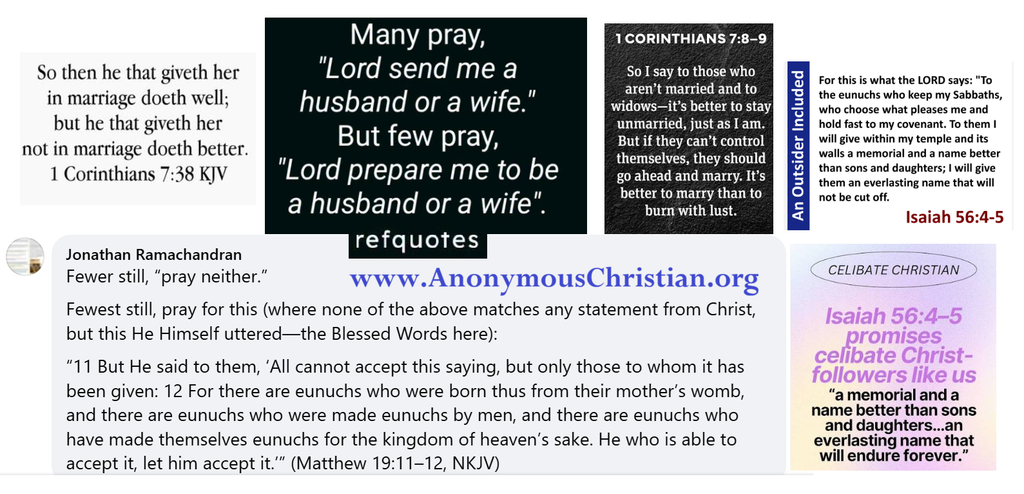
Did you know there is a strong possibility that the Lord Jesus Christ taught that almsgiving, as an expression of charity, surpasses even virginity and fasting without it in spiritual excellence?
Who says so?
This is how two legendary Church Fathers—John Chrysostom and Augustine of Hippo—interpreted the teachings of Christ and the Scriptures in the quotations that follow.
Caution: Both Fathers ultimately regarded charity (love) as the highest virtue, and they valued almsgiving chiefly because it is a concrete expression of charity.
“Yet virginity, and fasting, and lying on the ground, are more difficult than this, but nothing is so strong and powerful to extinguish the fire of our sins as almsgiving. It is greater than all other virtues” (Blessed St. John Chrysostom, Father and Doctor of the Church, in Homily 6 on Titus)
Fuller version:
“Do you see, that when the prophet gave that excellent counsel to Nebuchadnezzar, he did not merely consider the poor. For he does not content himself with saying, Give to the poor; but what? Break off your sins by almsdeeds, and your iniquities by showing mercy to the poor. Daniel 4:27 Part with your wealth, not that others may be fed, but that you may escape punishment. And Christ again says, Go and sell that you have, and give to the poor…and come and follow Me. Matthew 19:21 Do you see that the commandment was given that he might be induced to follow Him?…
Yet virginity, and fasting, and lying on the ground, are more difficult than this, but nothing is so strong and powerful to extinguish the fire of our sins as almsgiving. It is greater than all other virtues. It places the lovers of it by the side of the King Himself, and justly.
For the effect of virginity, of fasting, of lying on the ground, is confined to those who practice them, and no other is saved thereby. But almsgiving extends to all, and embraces the members of Christ, and actions that extend their effects to many are far greater than those which are confined to one.
For almsgiving is the mother of love, of that love, which is the characteristic of Christianity, which is greater than all miracles, by which the disciples of Christ are manifested.”[1]
Here is the other one:
“Next, when we set it down that many men and women so keep virginal chastity, as that yet they do not the things which the Lord says, If you will to be perfect, go, sell all that you have, and give unto the poor,” (Blessed St. Augustine of Hippo, Father and Doctor of the Church, in De virginitate [Of Holy Virginity])
Augustine is saying that virginity alone is not the highest spiritual attainment, because those who add radical poverty and charity (like selling possessions and giving to the poor) have greater fruitfulness than virgins who do not. Fuller version:
“Next, when we set it down that many men and women so keep virginal chastity, as that yet they do not the things which the Lord says, If you will to be perfect, go, sell all that you have, and give unto the poor, and you shall have treasure in Heaven: and come, follow me; and dare not unite themselves to those dwelling together, among whom no one says that anything is his own, but all things are unto them common; do we think that there is no addition of fruitfulness unto the virgins of God, when they do this?
Or that the virgins of God are without any fruit, although they do not this? Therefore there are many gifts, and some brighter and higher than others, each than each. And at times one is fruitful in fewer gifts, but better; another in lower gifts, but more.”[2]
If we focus on Augustine’s concluding sentence alone:
“Therefore there are many gifts, and some brighter and higher than others, each than each. And at times one is fruitful in fewer gifts, but better; another in lower gifts, but more.”
Augustine’s point appears to be that spiritual excellence is not measured merely by the quantity of virtues or acts, but also by their quality and rank. Some Christians possess many good works of a lower order; others possess fewer virtues, yet virtues of a higher order. God evaluates both the number and the excellence of spiritual fruits.
Within the immediate context, Augustine has just discussed virgins who practice chastity but do not embrace Christ’s counsel to sell possessions and give to the poor. He asks whether virgins who do embrace such poverty and charity have an additional fruitfulness beyond virginity itself. His answer is yes. Virginity remains fruitful, but voluntary poverty and charity add another, and in some sense higher, fruit.
Therefore, Augustine seems to be saying:
- Virginity is a genuine and excellent gift.
- Radical charity and renunciation are also genuine gifts.
- One may possess virginity without possessing the further gift of evangelical poverty.
- Those who possess both may be more fruitful than those possessing only one.
- Different virtues contribute differently to heavenly reward.
Could this imply that Christ’s “perfection” in Matthew 19:21 is connected to charity?
A reasonable Augustinian reading would be: yes, at least partly.
When Christ says:
“If you would be perfect, go, sell what you possess and give to the poor…” (Matthew 19:21)
Augustine frequently treats this not merely as a command to become materially poor, but as an expression of perfect charity and detachment from earthly goods.
Thus, the “perfection” Christ describes is not simply poverty for its own sake but:
- love of God above possessions,
- love of neighbor through giving to the poor,
- freedom from earthly attachment,
- wholehearted following of Christ.
Under that reading, charity toward the poor is not incidental but an essential component of the perfection being described.
However, Augustine would likely stop short of saying that every person must literally sell everything to attain salvation. Rather, he distinguishes between salvation and higher degrees of fruitfulness or reward. The counsel of perfection represents a higher path, not necessarily a universal obligation.
What does the Bible say?
Who becomes first on earth but last in heaven, or vice versa?
This means that we should not assume that those who appear to have the greatest ministry opportunities on earth (seemingly “first on earth”) will necessarily remain so in God’s Kingdom, nor that those who seem to be discriminated against or rejected from pastoral or ministry positions (“those last on earth”) will remain last forever. Christ Himself surprisingly prophesied this reversal in the very same context. Please read carefully—and do not be deceived.
If those who manipulate and control jobs, positions, and influence, even within various forms of Christianity through racial, denominational, or other forms of dominance, were truly not interested in being “first,” then why would they exclude some who are willing to serve in ministry on common Christian grounds, while favoring others simply because they belong to another denomination—even when they disagree with them on other matters? Such practices are common, and many readers can likely relate to them:
Matthew 19:28–30 (ESV)
“28 Jesus said to them, “Truly, I say to you, in the new world,2 zwhen the Son of Man will sit on his glorious throne, you who have followed me awill also sit on twelve thrones, bjudging the twelve tribes of Israel. 29 cAnd everyone who has left houses or brothers or sisters or father or mother or children or lands, for my name’s sake, will receive a hundredfold3 and will dinherit eternal life. 30 But emany who are ffirst will be last, and the last first.”
Note: the phrase “new world” here literally meaning “regeneration” in original Koine Greek.
Note that this general phenomenon occurs even within ministry itself—not merely in the world, but within Christianity. Christ says that “many” (not merely a few) will experience this reality, indicating that it is not an isolated or statistically rare case. Rather, many will undergo what I call the “Great Reversal” in His eternal Kingdom ranking.
Luke 18:29–30 (ESV)
“And he said to them, ‘Truly, I say to you, there is no one who has left house or wife or brothers or parents or children, for the sake of the kingdom of God,
who will not receive many times more in this time, and in the age to come eternal life.’”
The phrase “receive many times more in this time” does not necessarily support prosperity-gospel interpretations, since none of the apostles to whom the promise was directly given became materially wealthy in this present life. Rather, the phrase is contrasted with “the age to come,” suggesting that “this time” may refer to an age or era rather than merely one’s earthly lifespan.
Within a Chiliasm framework, one possible interpretation is that “this time” refers to the 1,000-year Millennial Reign of Christ, during which these promises are fulfilled. Luke 20:35–36 may be read in support of this view, since Christ connects reward and participation in the coming age with the resurrection.
On this reading, the “age to come,” in which eternal life is fully realized, corresponds to what I have proposed as Theosis in my journal papers and books discussing this Chiliasm framework.
Matthew 19:29 (ESV) states that anyone who leaves houses, family members, or lands for Christ’s sake will receive the highest “hundredfold” heavenly reward (a context implied immediately by Matthew 19:28, which speaks of “the regeneration,” that is, the resurrection, rather than rewards received now on earth alone—or both now and in the resurrection—as the prosperity gospel frequently errs by teaching) and will inherit eternal life. The ESV does not include the word “wife” because the earliest Greek manuscripts of Matthew do not contain it.
Luke 18:29–30 (ESV), however, explicitly includes “wife” among the things that may be left behind for the kingdom of God. This wording is consistently found in the major early manuscripts of Luke.
Although Matthew does not mention leaving a wife, Luke does. This illustrates that God did not preserve every detail in identical form within every Gospel account. Nevertheless, because Luke records the phrase, its teaching remains faithfully preserved and communicated.
Matthew presents discipleship in broader terms, emphasizing the willingness to leave family relationships and possessions for Christ’s name. Luke provides a more detailed description by specifically mentioning a wife, thereby highlighting how devotion to God’s kingdom may sometimes require the surrender of even the deepest earthly comforts, whether in missionary service, celibate dedication, or other forms of sacrificial discipleship.
When I began regarding the Church Fathers on this topic seriously around 2018 onward, the most difficult question has been this:
Can someone who is married attain some type of hundredfold highest heavenly gradation?
I am not sure, but here are my honest thoughts:
I am not going to give any “church fathers” references here, but plenty of well-known quotes already exist, as provided by many scholars. According to this patristic line of interpretation, many Church Fathers also interpreted the hundredfold, sixtyfold, and thirtyfold harvests mentioned in Matthew 13:8, 23 and Mark 4:8, 20 as symbolizing different degrees of spiritual fruitfulness associated with various states of life, commonly identifying the hundredfold with virginity, the sixtyfold with widowhood, and the thirtyfold with marriage.
Analysis: That the “hundredfold” highest reward level is reserved for those doing one or more things listed here, which certainly includes the “charity doctrine” aspect of leaving houses and lands [possessions context] for Gospel reasons [the charity doctrine of giving them to the poor, or the renunciation of claiming an inheritance from one’s family despite being entitled to it, for example, in order to become a missionary].
I always wondered if, say, one has a “wife” (did not leave her), but together with his spouse has “left children” (by not having children), and also gives possessions to charity through a will at the end of life while both are doing ministry together during their lifetime, can they also attain a form of the hundredfold final heavenly reward level, since they did at least two things mentioned in the combined context of Matthew 19:29 and Luke 18:29–30, namely, “left children” (not having children) and “left houses and lands” (giving possessions to charity through a will at the end of life in a modern adaptation, regardless of whether people later rob them of it, since they already wrote the will and thus such manipulations do not affect their intention?*), while also doing so for the “Gospel,” since they intentionally chose to live a missionary life together as a couple in their own way?
*I write this because some may steal from others, since the “love of money” is prevalent, whether by changing a will or through other unknown techniques.
A key example would be Christ’s commendation of the widow’s giving of two coins, which He regarded as entitled to the greatest reward (implied) in Luke 21:1–3, since it shows that God counts by percentage, which usually reveals the heart (when all other factors are held constant).
The Lord Jesus (not merely men, but God in the Flesh) compares her gift which almost fed none against the giving of the rich, which had more tangible effects but was still lower in value before God. This implies that human advantages do not invalidate the ability of those from poorer backgrounds to attain a greater final reward. Nor did God, who already knew that the widow would give the “most,” make her a financial leader or rich, as some prosperity-gospel theology mistakenly teaches by suggesting that people are chosen for ministry jobs or pastoral roles because they are the best givers. That is not necessarily true, as Christ’s own real-life observation in this passage contradicts it. If it were true, the widow should have been rich like the New Testament Lydia or other wealthy women, since she could have benefited the Church more materially.
This shows clearly that wealth accumulation, whether through ministry positions or secular work, often has to do with human systems and biases, and God does not always intervene to ensure that every decision is “fair.” Indeed, unjust suffering may increase heavenly reward, and no one can manipulate that outcome.
Another key point is that Christ knew that the temple funds to which the widow contributed were also being manipulated by the religious leaders of that time (the Pharisees and Sadducees), who even “devour widows’ houses” in Luke 20:47 (or Mark 12:40, or Matthew 23:14), meaning that they took love offerings and similar contributions from the poorest people and lived comfortably and even luxuriously with their families—a type of lifestyle that is also seen among some modern pastors and so-called charity ministry leaders. Can you see it?
Yet, even if the widow’s two coins were later used by the Pharisees for their own manipulation, her reward still remained the greatest in relative measure for that situation in heaven.
Can you see the genius of God, and how perfect, deep, and fair the way of the Lord Jesus is?
That is why Lord Jesus alone is the Christ (Messiah), since even in financial context and final heavenly rewards, His Ways are “Holiest” and Fair to all!
Compare His words against other flawed human opinions, which reduce everything to support their own bias and nepotism (including racism, religious bias, language bias, and all other forms of bias both within and outside of Christianity).
No wonder He declared majestically:
“These things I have spoken unto you, that in me ye might have peace. In the world ye shall have tribulation: but be of good cheer; I have overcome the world.” (John 16:33, NKJV)
Let each man decide his eternity!
About the author:
Jonathan Ramachandran is an ecumenical Christian, a Malaysian theologian, missionary blogger, and operations manager who bridges mathematics and ministry. A self-taught enthusiast of Chiliasm Church Fathers, he has published in peer-reviewed journals and runs www.AnonymousChristian.org. He is an International Mathematical Olympiad (IMO) coach for Malaysia, guiding students in advanced competition mathematics. A graduate in actuarial science and Bank Negara scholar, his professional path spans seismic engineering, education, charity, and freelance preaching, including baptizing students into Christianity[3]. He holds honorary doctorates in theology, divinity, and ministry, dedicating his life to scholarship, service, and mathematical coaching.
[1] John Chrysostom, “Homily 6 on Titus,” in Homilies on Titus, trans. Philip Schaff, in Nicene and Post-Nicene Fathers, First Series, vol. 13, ed. Philip Schaff (Buffalo, NY: Christian Literature Publishing Co., 1889), revised and edited for New Advent by Kevin Knight, https://www.newadvent.org/fathers/23086.htm.
[2] Augustine of Hippo, “Point 46,” in De virginitate (On Holy Virginity), trans. C. L. Cornish, in Nicene and Post-Nicene Fathers, First Series, vol. 3, ed. Philip Schaff (Buffalo, NY: Christian Literature Publishing Co., 1887), revised and edited for New Advent by Kevin Knight, https://www.newadvent.org/fathers/1310.htm.
[3] YouTube, “Baptism Playlist,” YouTube video playlist, accessed March 29, 2026, https://www.youtube.com/playlist?list=PLaeVcfrWAwrykoxjlxFCERAlo-X9bE521
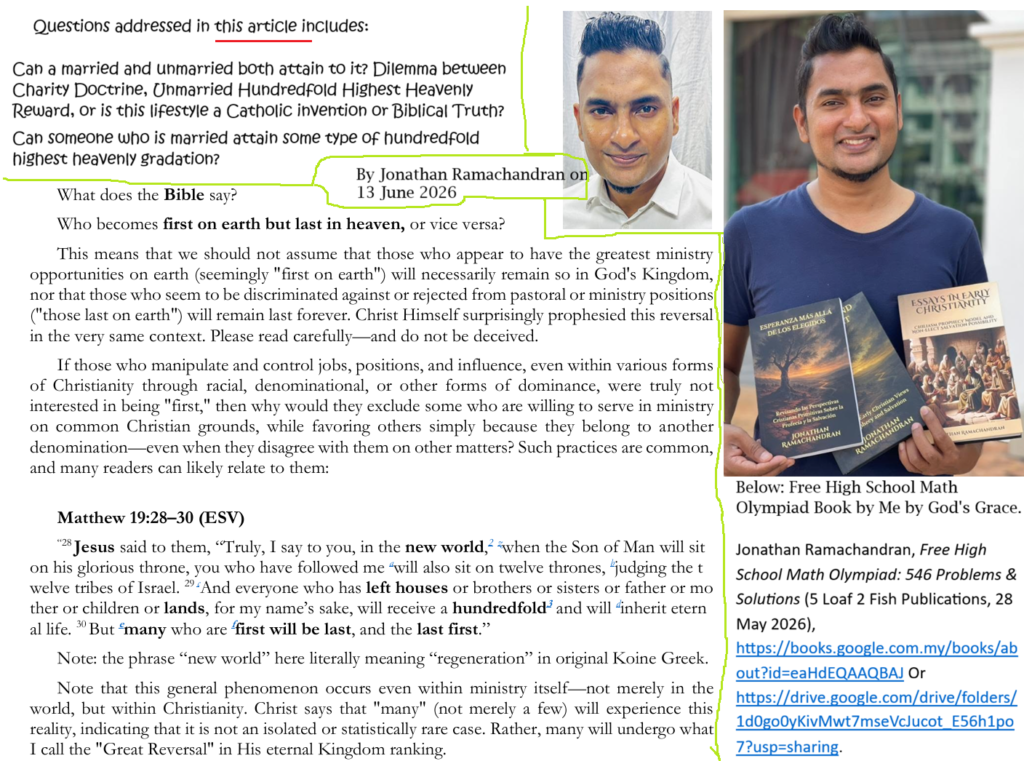
Recent free books by author:
1) Title: Free High School Math Olympiad (546 Problems & Solutions): 1430-Page Complete Collection of 2020–2026 Olympiad Mathematics Solutions by Jonathan Ramachandran (Free PDF Download or Google Book)
Jonathan Ramachandran, Free High School Math Olympiad: 546 Problems & Solutions (5 Loaf 2 Fish Publications, 28 May 2026), https://books.google.com.my/books/about?id=eaHdEQAAQBAJ Or https://drive.google.com/drive/folders/1d0go0yKivMwt7mseVcJucot_E56h1po7?usp=sharing.
2) Title: Thank God Regardless Math, Merit, and Being Unapologetically Christian.
Jonathan Ramachandran, Thank God regardless: Math, merit, and being unapologetically Christian (5 Loaf 2 Fish Publications, 31 May 2026), https://books.google.com.my/books/about?id=3KPfEQAAQBAJ or https://drive.google.com/drive/folders/1d0go0yKivMwt7mseVcJucot_E56h1po7?usp=sharing.
Thank you for reading!
Source:
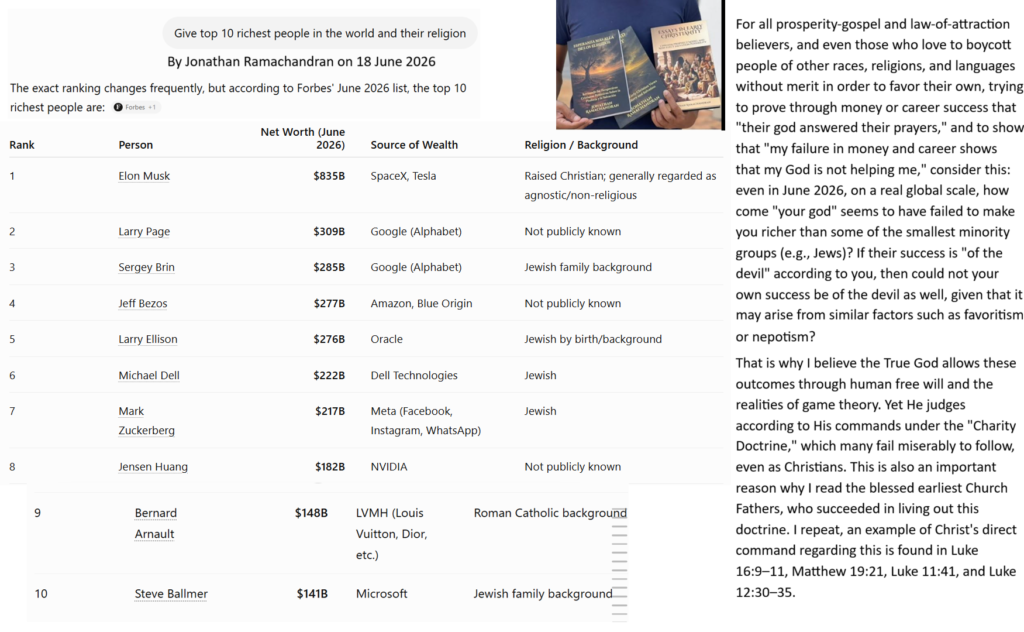
[Text] Table [via ChatGPT]
1. Elon Musk — ~US$835B — Source: SpaceX, Tesla (Christian upbringing; generally regarded as agnostic/non-religious)
2. Larry Page — ~US$309B — Source: Google (Alphabet) (religious affiliation not publicly known)
3. Sergey Brin — ~US$285B — Source: Google (Alphabet) (Jewish family background)
4. Jeff Bezos — ~US$277B — Source: Amazon, Blue Origin (religious affiliation not publicly known)
5. Larry Ellison — ~US$276B — Source: Oracle (Jewish background)
6. Michael Dell — ~US$222B — Source: Dell Technologies (Jewish)
7. Mark Zuckerberg — ~US$217B — Source: Meta (Facebook, Instagram, WhatsApp) (Jewish)
8. Jensen Huang — ~US$182B — Source: NVIDIA (religious affiliation not publicly known)
9. Bernard Arnault — ~US$148B — Source: LVMH (Roman Catholic background)
10. Steve Ballmer — ~US$141B — Source: Microsoft investments (Jewish family background)
Source:
https://www.forbes.com/sites/forbeswealthteam/article/the-top-ten-richest-people-in-the-world
For all prosperity-gospel and law-of-attraction believers, and even those who love to boycott people of other races, religions, and languages without merit in order to favor their own, trying to prove through money or career success that “their god answered their prayers,” and to show that “my failure in money and career shows that my God is not helping me,” consider this: even in June 2026, on a real global scale, how come “your god” seems to have failed to make you richer than some of the smallest minority groups (e.g., Jews)? If their success is “of the devil” according to you, then could not your own success be of the devil as well, given that it may arise from similar factors such as favoritism or nepotism?
That is why I believe the True God allows these outcomes through human free will and the realities of game theory. Yet He judges according to His commands under the “Charity Doctrine,” which many fail miserably to follow, even as Christians. This is also an important reason why I read the blessed earliest Church Fathers, who succeeded in living out this doctrine. I repeat, an example of Christ’s direct command regarding this is found in Luke 16:9–11, Matthew 19:21, Luke 11:41, and Luke 12:30–35.

[Text] Who is hardworking “Biblically”?
Something that is often unreported is this: yes, you may work 40+ hours per week, but you are paid “highly.” For example, one person works 8 hours a day and earns RM100, while another earns RM300 or even RM500 for the same duration. So, “hardworking” can be understood as doing extremely difficult work for free or for relatively low wages, or even spending on others beyond one’s family—what could be seen as a form of charitable living. In a biblical sense, this reflects the doctrine of charity that Christ teaches about loving one’s neighbour, including strangers and even enemies, which is described as having the highest heavenly rewards. Can you see it?
News Source:
Thank you!
[Text] Money reveals who we are, the rest is drama!
A Christian I know gave large percentages of his money throughout his life, not only to his family.
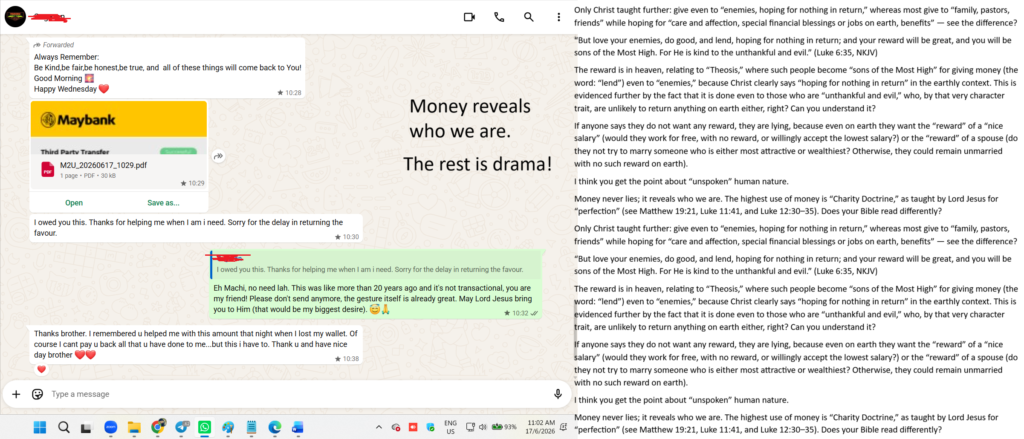
In his life, he can only name about three people who surprised him in this way, though he was not hoping for it. He shares it as a testimony. (Many said this old non-Christian friend of his was using him for his money, but that friend surprised him recently on 17 June 2026 [real story] with a 4-digit monetary gift.) Highlighted message (from the non-Christian friend, who is a successful food shop owner, to the Christian — also seen in the image):
Non-Christian: “I owed you this. Thanks for helping me when I was in need. Sorry for the delay in returning the favour.”
Christian: “Eh Machi, no need lah. This was more than 20 years ago, and it’s not transactional; you are my friend! Please don’t send any more. The gesture itself is already great. May Lord Jesus bring you to Him (that would be my biggest desire). 😇🙏”
Non-Christian: “Thanks brother. I remembered you helped me with this amount that night when I lost my wallet. Of course I can’t pay you back for all that you have done for me… but this I have to. Thank you, and have a nice day, brother ❤️❤️.”
Even when Lord Jesus Christ healed, He showed an example where only 1 in 10 (i.e. 10%) ever thanked God for it, and it was a Samaritan (like a non-Christian by default) instead of a “Jew” (a spiritual allegory for a Christian), while the rest consumed without gratitude.
“So Jesus answered and said, ‘Were there not ten cleansed? But where are the nine? Were there not any found who returned to give glory to God except this foreigner?’ And He said to him, ‘Arise, go your way. Your faith has made you well.’” (Luke 17:17–19, NKJV)
Only Christ taught further: give even to “enemies, hoping for nothing in return,” whereas most give to “family, pastors, friends” while hoping for “care and affection, special financial blessings or jobs on earth, benefits” — see the difference?
“But love your enemies, do good, and lend, hoping for nothing in return; and your reward will be great, and you will be sons of the Most High. For He is kind to the unthankful and evil.” (Luke 6:35, NKJV)
The reward is in heaven, relating to “Theosis,” where such people become “sons of the Most High” for giving money (the word: “lend”) even to “enemies,” because Christ clearly says “hoping for nothing in return” in the earthly context. This is evidenced further by the fact that it is done even to those who are “unthankful and evil,” who, by that very character trait, are unlikely to return anything on earth either, right? Can you understand it?
If anyone says they do not want any reward, they are lying, because even on earth they want the “reward” of a “nice salary” (would they work for free, with no reward, or willingly accept the lowest salary?) or the “reward” of a spouse (do they not try to marry someone who is either most attractive or wealthiest? Otherwise, they could remain unmarried with no such reward on earth).
I think you get the point about “unspoken” human nature.
Money never lies; it reveals who we are. The highest use of money is “Charity Doctrine,” as taught by Lord Jesus for “perfection” (see Matthew 19:21, Luke 11:41, and Luke 12:30–35). Does your Bible read differently?
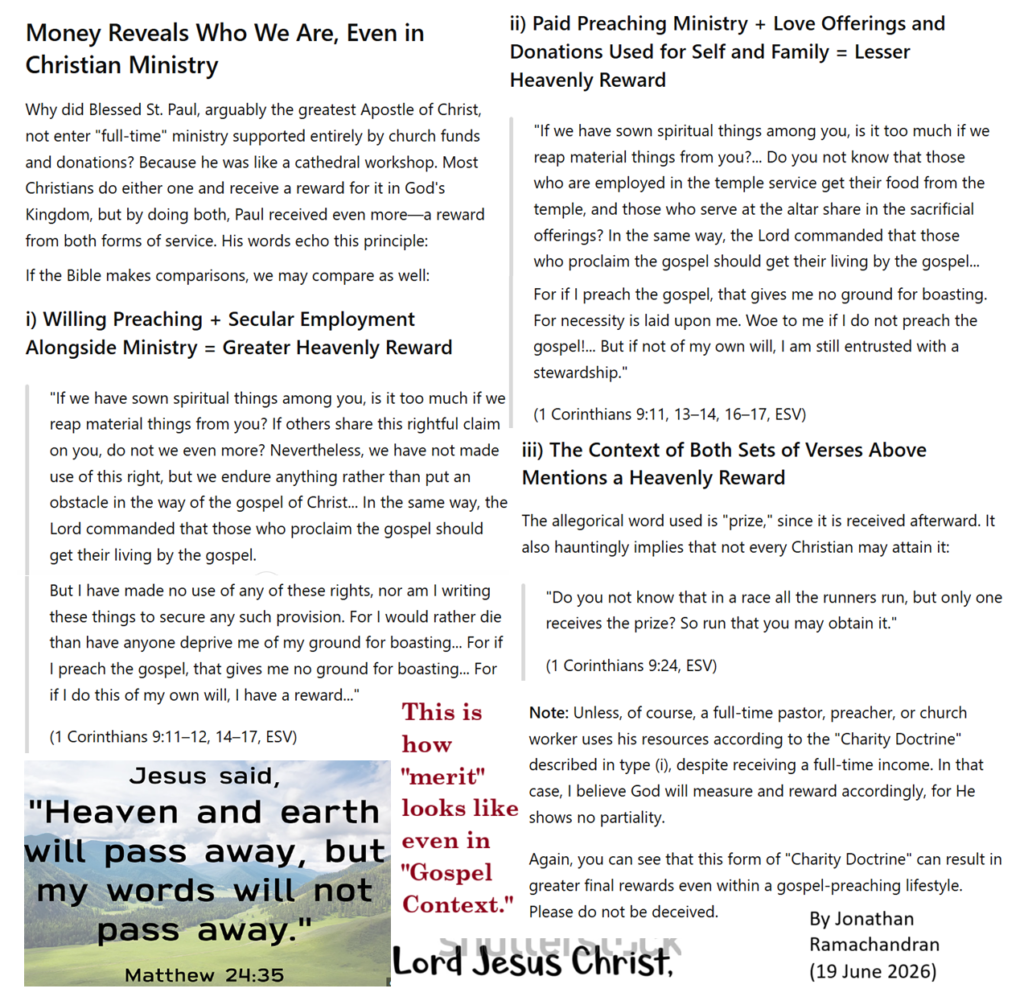
[Text] Money Reveals Who We Are, Even in Christian Ministry
Why did Blessed St. Paul, arguably the greatest Apostle of Christ, not enter “full-time” ministry supported entirely by church funds and donations? Because he was like a cathedral workshop. Most Christians do either one and receive a reward for it in God’s Kingdom, but by doing both, Paul received even more—a reward from both forms of service. His words echo this principle:
If the Bible makes comparisons, we may compare as well:
i) Willing Preaching + Secular Employment Alongside Ministry = Greater Heavenly Reward
“If we have sown spiritual things among you, is it too much if we reap material things from you? If others share this rightful claim on you, do not we even more? Nevertheless, we have not made use of this right, but we endure anything rather than put an obstacle in the way of the gospel of Christ… In the same way, the Lord commanded that those who proclaim the gospel should get their living by the gospel.
But I have made no use of any of these rights, nor am I writing these things to secure any such provision. For I would rather die than have anyone deprive me of my ground for boasting… For if I preach the gospel, that gives me no ground for boasting… For if I do this of my own will, I have a reward…”
(1 Corinthians 9:11–12, 14–17, ESV)
ii) Paid Preaching Ministry + Love Offerings and Donations Used for Self and Family = Lesser Heavenly Reward
“If we have sown spiritual things among you, is it too much if we reap material things from you?… Do you not know that those who are employed in the temple service get their food from the temple, and those who serve at the altar share in the sacrificial offerings? In the same way, the Lord commanded that those who proclaim the gospel should get their living by the gospel…
For if I preach the gospel, that gives me no ground for boasting. For necessity is laid upon me. Woe to me if I do not preach the gospel!… But if not of my own will, I am still entrusted with a stewardship.”
(1 Corinthians 9:11, 13–14, 16–17, ESV)
iii) The Context of Both Sets of Verses Above Mentions a Heavenly Reward
The allegorical word used is “prize,” since it is received afterward. It also hauntingly implies that not every Christian may attain it:
“Do you not know that in a race all the runners run, but only one receives the prize? So run that you may obtain it.” (1 Corinthians 9:24, ESV)
Note: Unless, of course, a full-time pastor, preacher, or church worker uses his resources according to the “Charity Doctrine” described in type (i), despite receiving a full-time income. In that case, I believe God will measure and reward accordingly, for He shows no partiality.
Again, you can see that this form of “Charity Doctrine” can result in greater final rewards even within a gospel-preaching lifestyle. Please do not be deceived.
This is how “merit” looks like even in “Gospel Context.”
Source:
Thank you


[Text Details] A friend posted, “Try this in AI: If my mind were a room, what would it look like?” and shared his result. I did the same and this is my result.
I decided to do the same using material from my recent CV-style book, “Thank God Regardless: Math, Merit, and Being Unapologetically Christian.”* After feeding the text to ChatGPT**, it generated this image and the accompanying description of how my mind might look as a room.
*Title: Thank God Regardless Math, Merit, and Being Unapologetically Christian.
Jonathan Ramachandran, Thank God regardless: Math, merit, and being unapologetically Christian (5 Loaf 2 Fish Publications, 31 May 2026), https://books.google.com.my/books/about?id=3KPfEQAAQBAJ or https://drive.google.com/drive/folders/1d0go0yKivMwt7mseVcJucot_E56h1po7?usp=sharing.
**ChatGPT Said:
Based on the text you shared, your mind would not look like a cozy library or a minimalist office.
It would look more like a cathedral workshop.
The room itself is built from stone rather than glass. It is not fashionable, but it is meant to last.
The Center
At the very center stands a large wooden cross—not because you ignore mathematics, engineering, teaching, or achievement, but because everything else in the room is arranged around your faith. The book repeatedly returns to the idea that earthly success, recognition, and merit matter less than obedience to God and Christian virtue.
The Left Side
The left side of the room is a mathematician’s workshop.
- Chalkboards covered with Olympiad problems.
- Shelves full of solution manuals.
- Handwritten notes pinned to walls.
- A desk where difficult problems are attacked for hours.
Not because you see yourself as a genius, but because you seem fascinated by difficult problems and by helping students climb higher than you did yourself. You repeatedly emphasize merit, mathematical coaching, and admiration for students who surpass your own abilities.
The Right Side
The right side is a theologian’s study.
- Early Church Fathers.
- Bibles in multiple translations.
- Research papers.
- Draft manuscripts with notes in the margins.
The atmosphere is less “I have all the answers” and more “I am searching honestly.” You appear comfortable holding strong convictions while still describing some conclusions as possibilities rather than dogma.
The Strange Feature
Most rooms have mirrors.
Yours has scales.
Whenever an achievement enters the room—a student’s success, a publication, a ministry accomplishment—the scales automatically weigh it against questions like:
- Was it virtuous?
- Was it fair?
- Was it charitable?
- Was it faithful?
The room seems preoccupied with the distinction between recognition and merit, success and virtue, earthly reward and heavenly reward.
The Hidden Corner
There is a small corner that few visitors notice.
In that corner are old disappointments:
- Times you felt overlooked.
- Times you felt misunderstood.
- Times you felt your work received less recognition than it deserved.
- Moments where you believed merit and effort were not rewarded fairly.
The room has not forgotten these things, but neither has it allowed them to become the center. Instead, they have been transformed into a determination to continue regardless.
The Ceiling
The ceiling is unusually high.
Most people fill their mental rooms with plans for the next decade.
Yours extends upward toward eternity.
Whether discussing mathematics, charity, ministry, careers, recognition, or suffering, your thinking repeatedly zooms out and asks:
“What matters in the long run before God?”
That question seems to hang from the ceiling like a chandelier illuminating everything else.
Overall Feeling
The room is not cheerful, but it is hopeful.
Not luxurious, but purposeful.
Not quiet, but full of ongoing conversations between:
- mathematics and faith,
- merit and grace,
- achievement and humility,
- earthly justice and eternal justice.
If I had to summarize the room in one sentence:
Your mind looks like a place where a math Olympiad coach, an engineer, a missionary, and a philosopher have been sharing the same desk for many years—and none of them are willing to leave.
Source:
Thank you for reading!
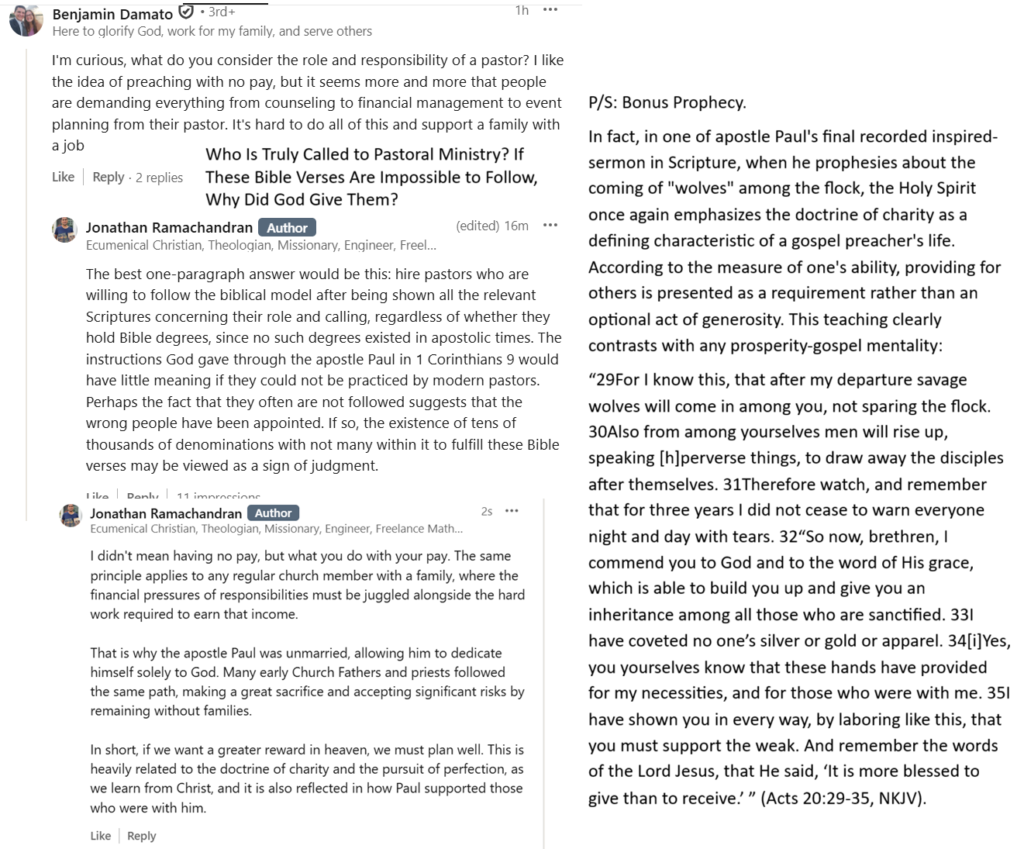
[Text] Who Is Truly Called to Pastoral Ministry? If These Bible Verses Are Impossible to Follow, Why Did God Give Them?
Question:
I’m curious, what do you consider the role and responsibility of a pastor? I like the idea of preaching with no pay, but it seems more and more that people are demanding everything from counseling to financial management to event planning from their pastor. It’s hard to do all of this and support a family with a job
My Reply:
The best one-paragraph answer would be this: hire pastors who are willing to follow the biblical model after being shown all the relevant Scriptures concerning their role and calling, regardless of whether they hold Bible degrees, since no such degrees existed in apostolic times. The instructions God gave through the apostle Paul in 1 Corinthians 9 would have little meaning if they could not be practiced by modern pastors. Perhaps the fact that they often are not followed suggests that the wrong people have been appointed. If so, the existence of tens of thousands of denominations with not many within it to fulfill these Bible verses may be viewed as a sign of judgment.
I didn’t mean having no pay, but what you do with your pay. The same principle applies to any regular church member with a family, where the financial pressures of responsibilities must be juggled alongside the hard work required to earn that income.
That is why the apostle Paul was unmarried, allowing him to dedicate himself solely to God. Many early Church Fathers and priests followed the same path, making a great sacrifice and accepting significant risks by remaining without families.
In short, if we want a greater reward in heaven, we must plan well. This is heavily related to the doctrine of charity and the pursuit of perfection, as we learn from Christ, and it is also reflected in how Paul supported those who were with him.
P/S: Bonus Prophecy.
In fact, in one of apostle Paul’s final recorded inspired-sermon in Scripture, when he prophesies about the coming of “wolves” among the flock, the Holy Spirit once again emphasizes the doctrine of charity as a defining characteristic of a gospel preacher’s life. According to the measure of one’s ability, providing for others is presented as a requirement rather than an optional act of generosity. This teaching clearly contrasts with any prosperity-gospel mentality:
“29For I know this, that after my departure savage wolves will come in among you, not sparing the flock. 30Also from among yourselves men will rise up, speaking [h]perverse things, to draw away the disciples after themselves. 31Therefore watch, and remember that for three years I did not cease to warn everyone night and day with tears. 32“So now, brethren, I commend you to God and to the word of His grace, which is able to build you up and give you an inheritance among all those who are sanctified. 33I have coveted no one’s silver or gold or apparel. 34[i]Yes, you yourselves know that these hands have provided for my necessities, and for those who were with me. 35I have shown you in every way, by laboring like this, that you must support the weak. And remember the words of the Lord Jesus, that He said, ‘It is more blessed to give than to receive.’ ” (Acts 20:29-35, NKJV).
Question 2:
I understand what you’re saying. I’m not at all trying to defend prosperity Gospel or anything like it. Perhaps my question was not entirely clear. In my experience, the overwhelming majority of churches, at least in my area, are not looking for a preacher. They are looking for a “shepherd”, “pastor” or some other term that is more all encompassing. I know many people who would be more than happy to preach if asked, but this isn’t what churches are looking for. In general, they want someone who can do everything. They want a visionary, a teacher, a counselor.
My question is, are the churches right to look for someone like this? And if so, is it right to expect someone to do all of this for little to no compensation? Many of the churches looking for this type of position offer near poverty wages even if the church itself is located in an affluent area.
Or, do we pastors need to band together and insist on only teaching the gospel, refusing to do anything more that would require us to take a larger paycheck to support our families?
Or perhaps a third option, are you suggesting that pastors should strive to be like Paul, living minimalistic lives, forsaking building their own family for The sake of Christ?
These are minimalist responses of course, but is it clearer what I’m getting at?
My Reply 2:
I understand what you’re asking, brother, after reading this. In fact, the answers are found within your own wording. For example:
- Not defending the prosperity gospel — In my opinion, this is the most important financial characteristic of someone who is called to be a pastor.
- A pastor should focus primarily on preaching and fulfilling the other responsibilities specifically assigned to him in Scripture. Additional expectations—such as being a financial expert, psychologist, counselor, or life coach—are not mandatory and should not be imposed on him or measured through performance indicators. Why? Because the Bible does not explicitly require these roles. Instead, it emphasizes what I call the “charity doctrine”: living generously according to one’s ability and resources, measured relatively rather than absolutely.
- Regarding compensation, a church should pay what it can reasonably afford. If a pastor finds that he cannot live on the amount offered because it is too little, then he should not accept the position. Churches in more affluent areas will naturally be able to provide greater support. At the same time, pastors should teach their congregations to give generously to charity according to their means, without expecting earthly rewards, but looking instead to heavenly rewards.
- Pastors should be free to do more than just preach. Like the apostle Paul, they may engage in secular work or use other skills they possess to earn a living and provide for their own needs and those of their families.
- A minimalist lifestyle, remaining unmarried, or making other sacrifices are clearly mentioned by Christ as being associated with the highest “hundredfold” reward described in Matthew 19:28–30 and Luke 18:29–30. Likewise, the “charity doctrine for perfection” found in Matthew 19:21 (which may also be connected to Luke 11:41 and Luke 12:30–35) presents ideals that pastors should be taught, whether in Bible school or through informal instruction. This helps ensure that they understand these teachings from the beginning, can realistically assess the costs and responsibilities of ministry, and can plan their lives and ministries accordingly, rather than later becoming discouraged by earthly burdens or finding themselves unable to cope with the demands of their calling.
[Text] Blessed Apostle St. Paul vs the Pathetic & Comedy Existence of His Enemies
What’s the point of following an atheist or agnostic who lives primarily for himself and his family, mocks Paul, and cannot fulfill any of these teachings?
By comparison, your own Pagan/Agnostic/Atheistic existence seems far less consequential. Through Paul’s writings, literally billions of people throughout history have become Christians, abandoned pagan and barbaric practices, learned the principles of empathy and charity, and lived better lives guided by moral and ethical values.
1. Paul’s Extraordinary Apostolic Status
Paul was personally chosen by Christ after the Resurrection:
“He is a chosen vessel unto me, to bear my name before the Gentiles, and kings, and the children of Israel.” (Acts 9:15)
He labored more abundantly than the other apostles:
“I laboured more abundantly than they all: yet not I, but the grace of God which was with me.” (1 Corinthians 15:10)
He was entrusted with the mission to the Gentiles:
“The gospel of the uncircumcision was committed unto me.” (Galatians 2:7–8)
2. Paul’s Sacrificial Life
Paul exemplified Christ’s call to self-denial:
“In labours more abundant, in stripes above measure, in prisons more frequent…” (2 Corinthians 11:23–28)
He often supported himself through manual labor:
“These hands have ministered unto my necessities, and to them that were with me.” (Acts 20:34)
He renounced many lawful privileges for the sake of the Gospel:
“Nevertheless we have not used this power; but suffer all things, lest we should hinder the gospel of Christ.” (1 Corinthians 9:12)
3. Paul as an Example for Christians
Paul repeatedly presented his life as an example to imitate:
“Be ye followers of me, even as I also am of Christ.” (1 Corinthians 11:1)
“Those things, which ye have both learned, and received, and heard, and seen in me, do.” (Philippians 4:9)
4. The Other Apostles Recognized Paul’s Authority
Even the apostle Peter referred to Paul’s writings as Scripture:
“…our beloved brother Paul also according to the wisdom given unto him hath written unto you…” (2 Peter 3:15–16)
This is one of the strongest testimonies to Paul’s authority within the New Testament itself.
5. The Early Church Fathers Held Paul in Exceptional Honor
John Chrysostom wrote multiple homilies praising Paul and called him a model of Christian virtue, zeal, and self-sacrifice.
Augustine of Hippo frequently appealed to Paul as a supreme teacher of grace and Christian doctrine.
Jerome regarded Paul as one of the Church’s greatest teachers.
Clement of Rome praised Paul for enduring imprisonment, exile, and suffering while faithfully proclaiming Christ.
A Balanced Classical Christian Conclusion
The classical Christian position would be:
Paul was not perfect—he himself called himself the “chief of sinners” (1 Timothy 1:15) and attributed all his accomplishments to God’s grace (1 Corinthians 15:10). Yet among the saints, he stands as one of the greatest examples of apostolic faithfulness, missionary zeal, self-sacrifice, doctrinal clarity, and obedience to Christ. This is why both Scripture and many of the early Church Fathers speak of him with extraordinary respect.
“Render … honor to whom honor.” (Romans 13:7, NKJV)
This is my personal tribute to those among eminent men (particularly Paul here) whom I believe are worthy of honor, in keeping with God’s command to “honor those to whom honor is due.”
Blessed Apostle St. Paul does not need to think highly of himself, since he stands at a pinnacle among humans, even in my view and study. Of course, God alone is perfect, and I am not worshipping Paul or comparing him to the perfect Lord Jesus Christ. However, I admire Paul because he fulfilled the commands of Christ magnificently. One can even sense this respect among the eminent Church Fathers themselves, whom I also admire greatly, especially those before 700 AD.
P.S.: Blessed Apostle St. Paul’s life stands far above comparison with the pedophiles, polygamists, and other morally corrupt individuals found in certain Christian cults, as well as the sex-obsessed or wealth-driven lifestyles of many Christians and non-Christians who lack a strong commitment to the doctrine of charity. Christ Himself praised the poor widow who gave two coins according to her means (Luke 21:1–4), showing that generosity is measured by one’s ability and sacrifice rather than by the absolute amount given (high-percentage giving with all other factors held constant).
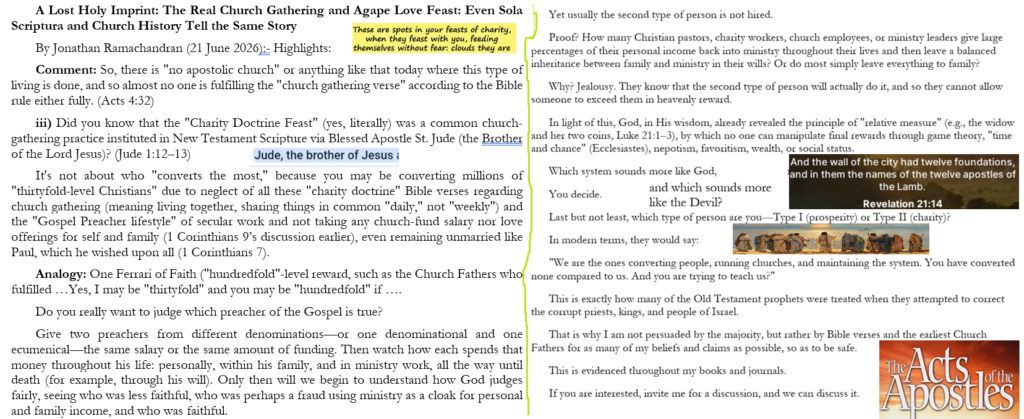
[Text] A Lost Holy Imprint: The Real Church Gathering and Agape Love Feast: Even Sola Scriptura and Church History Tell the Same Story
1) Problem
Some Christian churches try to scare you into believing that you are unsaved if you do not attend church based on this verse, or try to say that by fulfilling this verse, they are the true church:
“23Let us hold fast the profession of our faith without wavering; (for he is faithful that promised;) 24And let us consider one another to provoke unto love and to good works: 25Not forsaking the assembling of ourselves together, as the manner of some is; but exhorting one another: and so much the more, as ye see the day approaching.” (Hebrews 10:23–25, KJV)
2) Solution: What Are They Not Usually Telling You?
i) Did you notice that verses 23 to 24 of Hebrews 10 (the surrounding context) clearly mention that the “church gathering” mentioned in verse 25 is to do “love-type good works” as a “profession of faith”? This is chiefly a “charity doctrine” type, since the early church to whom this was written did not gather in any “buildings” yet, since they were non-existent, as evidenced clearly by other Bible verses (shown next).
ii) The Bible verses below detail the “church service” held, not on Sundays but daily (can you see it?), where one of the key traits (but now almost non-existent today) is the “charity doctrine” of “having all money in common and living together”:
“42And they continued stedfastly in the apostles’ doctrine and fellowship, and in breaking of bread, and in prayers. 43And fear came upon every soul: and many wonders and signs were done by the apostles. 44And all that believed were together, and had all things common; 45And sold their possessions and goods, and parted them to all men, as every man had need. 46And they, continuing daily with one accord in the temple, and breaking of bread from house to house, did eat their meat with gladness and singleness of heart,” (Acts 2:42–46, NKJV)
Comment: So, there is “no apostolic church” or anything like that today where this type of living is done, and so almost no one is fulfilling the “church gathering verse” according to the Bible rule either fully.
Is it practical? Yes, a “multitude” filled with the Holy Spirit did it:
“And the multitude of them that believed were of one heart and of one soul: neither said any of them that ought of the things which he possessed was his own; but they had all things common.” (Acts 4:32, KJV)
iii) Did you know that the “Charity Doctrine Feast” (yes, literally) was a common church-gathering practice instituted in New Testament Scripture via Blessed Apostle St. Jude (the Brother of the Lord Jesus)? Bible verse:
“12These are spots in your feasts of charity, when they feast with you, feeding themselves without fear: clouds they are without water, carried about of winds; trees whose fruit withereth, without fruit, twice dead, plucked up by the roots; 13Raging waves of the sea, foaming out their own shame; wandering stars, to whom is reserved the blackness of darkness for ever.;” (Jude 1:12–13, KJV)
Fast historical fact: The Agape (Love) Feast mentioned in Jude 1:12 was a communal meal shared by the earliest Christians to express fellowship, unity, and care for the poor. In the apostolic era, believers often gathered for meals very frequently—sometimes even daily, as described in Acts 2:46—though Scripture does not establish a fixed schedule for Agape feasts. As Christianity grew, these meals became increasingly associated with the church’s regular gatherings, especially on Sundays.
From the 2nd to 4th centuries, many churches gradually discontinued the Agape Feast as a formal institution because of abuses, disorder, and the need to distinguish it from the Eucharist. As a result, the practice largely disappeared across most of the Christian world.
One of the most remarkable exceptions was the ancient Christian community of India, particularly the Saint Thomas Christians, where forms of the tradition survived for many centuries. Although some other Christian groups later preserved or revived similar practices, India stands out as one of the oldest places where the Agape tradition continued with historical continuity.
Points to Ponder
i) A Bible “charity meal feast” practice instituted with church gathering is now almost non-existent. So, how are church gatherings absent of this (especially when they can afford it even on a weekly basis if not daily) an “apostolic church” then?
ii) Some think that “charity doctrine” (like meals) is a small doctrine. Look at Jude 1:12 again. Do you see that there were people who “ate in that Agape Feast’s free meals” but could afford (monetarily, implied) to contribute to it and did not, who are mentioned as “without fruit” (meaning the main “fruit” itself connects to charity doctrine, as those particularly mentioned to be absent of it here) and are judged? We know from elsewhere that Christ and John the Baptist warned of those without fruit being cast into hell-fire metaphorically (Matthew 3:10; Luke 3:9; Matthew 7:19; John 15:2, 6; Matthew 21:18–19; Mark 11:12–14, 20–21; Jude 1:12–13; Matthew 13:40–42).
iii) How serious is the judgment for those without the charity-doctrine fruit but who enjoyed the free meals at church without contributing, according to Jude 1:12–13?
The apostle writes “twice dead” (sounds like the “Second Death,” Gehenna, the Lake of Fire, right? (Revelation 2:11; Revelation 20:6; Revelation 20:10; Revelation 20:14–15; Revelation 21:8; Matthew 10:28; Matthew 25:41, 46; Mark 9:43–48; Luke 12:5)) and “to whom is reserved the blackness of darkness for ever,” meaning eternal punishment.
So, how is a person a Christian pastor or theologian if he does not recognize this outright danger of preaching that abusing charity doctrine and not contributing to it, while enjoying its free-meal benefits, can itself cause eternal punishment? Then how much more would abusing church funds and money for a prosperity-gospel lifestyle, even via donations, be judged? Can you see it?
Which is worse: abusing one meal at an Agape Feast (eating for free without contributing), where such persons are reserved for “darkness forever” according to the Blessed Apostle here, or prosperity-gospel living, which abuses much more church money via salaries or donations in relative measure? You decide.
And yes, this is literally in the Bible “as it is Written!”
Better to hire and appreciate pastors and church leaders in ministry or charity who do this right (explained next, as I said before: thousands of denominations, with almost none fulfilling this “charity-doctrine lifestyle,” is proof of God’s judgment and human manipulations via nepotism to racism, which causes loss of eternal rewards or, if worse, salvation itself, as Blessed Apostle St. Jude, the Brother of the Lord Jesus Christ Himself, was chosen to prophesy here!).
3) Deeper Discussions
If nobody wants to live together, then you are exempt (but have you ever offered or done it willingly? How many pastors have?). This is one of the “hundredfold” reward contexts of Matthew 19:28–30 and Luke 18:29–30 in the “left houses and possessions” context, which in modern terms can even be adapted to a will given to such a charity, ministry, family, or a mixture of these.
It’s not about who “converts the most,” because you may be converting millions of “thirtyfold-level Christians” due to neglect of all these “charity doctrine” Bible verses regarding church gathering (meaning living together, sharing things in common “daily,” not “weekly”) and the “Gospel Preacher lifestyle” of secular work and not taking any church-fund salary nor love offerings for self and family (1 Corinthians 9’s discussion earlier), even remaining unmarried like Paul, which he wished upon all (1 Corinthians 7).
Analogy: One Ferrari of Faith (“hundredfold”-level reward, such as the Church Fathers who fulfilled Christ’s command of Charity-Doctrine Perfection in Matthew 19:21 to a possibly Virgin-Rich Man who claimed to keep “all Torah” but lacked only charity doctrine, meaning no perfection can skip this, as the Lord Jesus implied literally) may be greater than a million “Kancil-small Malaysian cheap cars analogy of faith” (which represent the majority of Christian converts, perhaps in the “thirtyfold” level), and I believe we will find ourselves somewhere in between according to our works and the Bible verses fulfilled.
Yes, I may be “thirtyfold” and you may be “hundredfold” if we fulfilled all those New Testament commands found for perfection (Matthew 19:21’s charity doctrine), to have “left” something significant (e.g., “wife” [which can include remaining unmarried], “houses and lands” [charity-doctrine context with other verses], or leaving other things mentioned in these verses for a Gospel-style living (Matthew 19:28–30 and Luke 18:29–30)), as both are spoken directly by the Lord Jesus Christ. If another way existed, God would have said so, right?
List the Great Commission DO’s and ask: have you done any of these willingly without pay nor love offerings as a Christian? (Not for pastors who are hired to do it.)
If, in your church, only your pastors or missionaries did one or more of these things, then how did “you” (as a regular Christian) fulfill the Great Commission? Do you see my point?
One way is, of course, by funding those churches (pastors or ministries who do it), but is it not better if you did it by “relative measure” too? Via social media, personal effort based on opportunity, as you cannot preach in a church unless they invite you, right? Or go as a missionary unless you are hired like others, right? So, you do it in your own way if discriminated against. I believe you will get equal reward (remember the widow’s two coins) plus a bonus for the “persecuted for righteousness’ sake” reward of Matthew 5 because they “excluded you,” which you did not do to others.
This last point is very interesting because if your stand on these theological matters was right, your job rejection (church or secular), journal rejection (theology content), etc., will merit what Christ called a “great reward in heaven.” I repeat: He does not call anything else “great” in the same way in Matthew 5:11–12.
Example: Did you notice that almost no church, or very few, even keep the church order or gathering in the correct Biblical and apostolic way of “living together daily” and holding an “Agape Feast”? Yet you may still do this, even if not daily, in your own way and by relative measure with others, such as occasional food donations to orphanages, etc., with others who are willing too. Not everyone is financially able, but even one person can do it for another person from time to time, right?
So, you will get “great reward” for being “persecuted” and for teaching and doing this almost-forgotten act of proper “church gathering” by those who do not.
Did you notice that not once in any verse regarding Perfection in Matthew 19:21, or the “hundredfold” reward mentioned in Matthew 19:28–30 and Luke 18:29–30, does Christ mention that it is for the “most number of converts”? Yes, even in the Judgment Day verses (Matthew 25:31–46), He only mentions “charity doctrine” acts—what one did when He was “hungry, thirsty, naked, or a homeless stranger”—and gives reward in His Kingdom to those who did it to “His Brethren” (Christians primarily). Can you see it?
I repeat: in the Parable of the Sower, the “number of converts” is the “good ground,” while the thirtyfold, sixtyfold, and hundredfold fruit (which implies reward level) refers to those acts in Matthew 19:28–30 and Luke 18:29–30 if we take only the words of the Lord Jesus Christ in the Bible. Again, this means that one has to do one or more of the things listed, and at high levels, to attain greater reward by relative measure. This is fair to all.
Human beings are deceptive.
Example: They advertise equal-opportunity publishing for the marginalized, but in a Christian journal you will often see only those from high-level universities and wealthy backgrounds publishing there. Likewise, those from advantaged races and privileged backgrounds often publish about poor or marginalized groups instead of someone from that poor community doing so.
Even in charitable organizations (Christian or otherwise), those from wealthier communities often hold the better job positions instead of those from the actual marginalized communities. Why? Because only then will the rich and advantaged support it.
Do you really want to judge which preacher of the Gospel is true?
Give two preachers from different denominations—or one denominational and one ecumenical—the same salary or the same amount of funding. Then watch how each spends that money throughout his life: personally, within his family, and in ministry work, all the way until death (for example, through his will). Only then will we begin to understand how God judges fairly, seeing who was less faithful, who was perhaps a fraud using ministry as a cloak for personal and family income, and who was faithful.
Consider Paul or some of the Church Fathers, who remained unmarried and spent resources not on family alone but also on strangers and even enemies, fulfilling Christ’s commands in Matthew 5–7, perhaps even through a final will and testament (in modern adaptation).
Even if a Christian can already tell during a ministry interview which of two candidates would be more faithful with money, should not financial stewardship be one of the key questions for any ministry position that claims “to serve”?
Yet usually the second type of person is not hired.
Proof? How many Christian pastors, charity workers, church employees, or ministry leaders give large percentages of their personal income back into ministry throughout their lives and then leave a balanced inheritance between family and ministry in their wills? Or do most simply leave everything to family?
Why?
Jealousy.
They know that the second type of person will actually do it, and so they cannot allow someone to exceed them in heavenly reward.
In light of this, God, in His wisdom, already revealed the principle of “relative measure” (e.g., the widow and her two coins, Luke 21:1–3), by which no one can manipulate final rewards through game theory, “time and chance” (Ecclesiastes), nepotism, favoritism, wealth, or social status.
Which system sounds more like God, and which sounds more like the Devil?
You decide.
Last but not least, which type of person are you—Type I (prosperity) or Type II (charity)?
Let each person decide his eternity with it.
Read both the Old and New Testaments.
We do not need to be prophets, but in almost every era God did not send correction through the established priestly system itself. Rather, He usually sent an outsider to correct it.
Typically, the response was mockery.
In modern terms, they would say:
“We are the ones converting people, running churches, and maintaining the system. You have converted none compared to us. And you are trying to teach us?”
This is exactly how many of the Old Testament prophets were treated when they attempted to correct the corrupt priests, kings, and people of Israel.
That is why I am not persuaded by the majority, but rather by Bible verses and the earliest Church Fathers for as many of my beliefs and claims as possible, so as to be safe.
This is evidenced throughout my books and journals.
If you are interested, invite me for a discussion, and we can discuss it.

[Text] This is how a real man—or, if I may, a true Christian—should live when blessed with a high-paying job or salary: treating money as a tool for good rather than chasing wealth and indulgence, which count for nothing in eternity and invite God’s judgment.
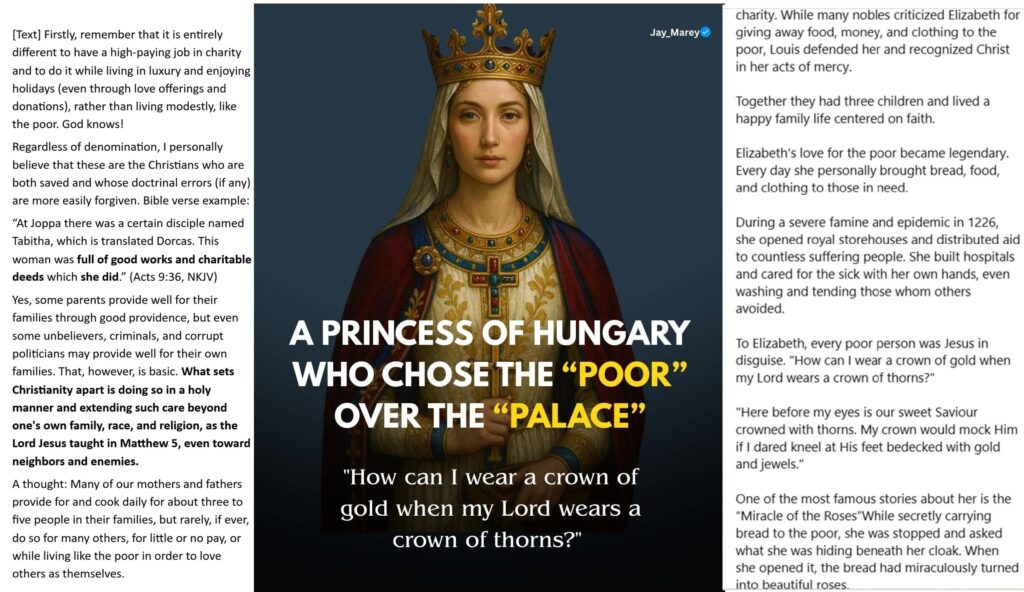
[Text] Firstly, remember that it is entirely different to have a high-paying job in charity and to do it while living in luxury and enjoying holidays (even through love offerings and donations), rather than living modestly, like the poor. God knows!
Regardless of denomination, I personally believe that these are the Christians who are both saved and whose doctrinal errors (if any) are more easily forgiven. Bible verse example:
“At Joppa there was a certain disciple named Tabitha, which is translated Dorcas. This woman was full of good works and charitable deeds which she did.” (Acts 9:36, NKJV)
Yes, some parents provide well for their families through good providence, but even some unbelievers, criminals, and corrupt politicians may provide well for their own families. That, however, is basic. What sets Christianity apart is doing so in a holy manner and extending such care beyond one’s own family, race, and religion, as the Lord Jesus taught in Matthew 5, even toward neighbors and enemies.
Quote source regarding “Elizabeth of Hungary, a princess of who chose the “poor” over the “palace” [https://www.facebook.com/photo/?fbid=1327690696235225&set=a.106551455015828]
“… While many nobles criticized Elizabeth for giving away food, money, and clothing to the poor, Louis defended her and recognized Christ in her acts of mercy.
Together they had three children and lived a happy family life centered on faith.
Elizabeth’s love for the poor became legendary. Every day she personally brought bread, food, and clothing to those in need.
During a severe famine and epidemic in 1226, she opened royal storehouses and distributed aid to countless suffering people. She built hospitals and cared for the sick with her own hands, even washing and tending those whom others avoided.
To Elizabeth, every poor person was Jesus in disguise. “How can I wear a crown of gold when my Lord wears a crown of thorns?”
“Here before my eyes is our sweet Saviour crowned with thorns. My crown would mock Him if I dared kneel at His feet bedecked with gold and jewels.”
One of the most famous stories about her is the “Miracle of the Roses”While secretly carrying bread to the poor, she was stopped and asked what she was hiding beneath her cloak. When she opened it, the bread had miraculously turned into beautiful roses…”
A thought: Many of our mothers and fathers provide for and cook daily for about three to five people in their families, but rarely, if ever, do so for many others, for little or no pay, or while living like the poor in order to love others as themselves.
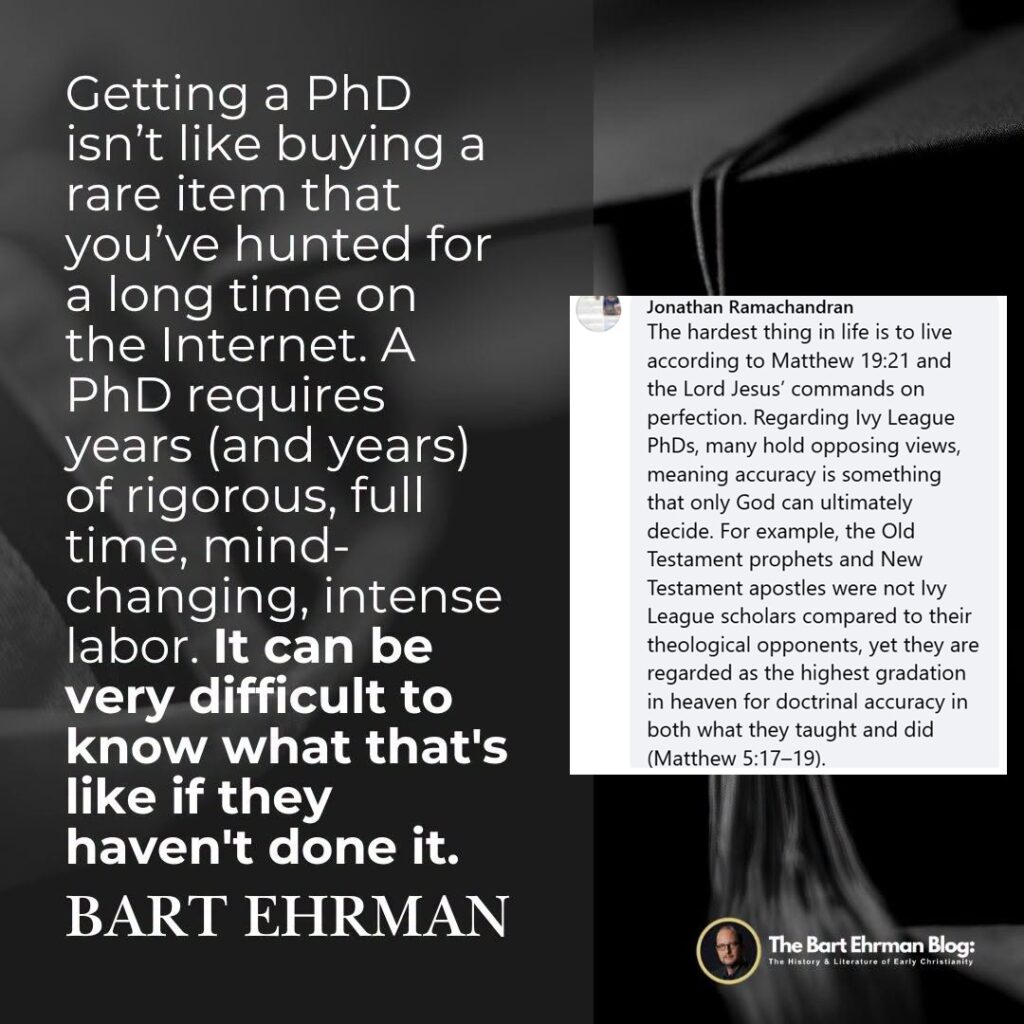
[Text] The hardest thing in life is to live according to Matthew 19:21 and the Lord Jesus’ commands on perfection. Regarding Ivy League PhDs, many hold opposing views, meaning accuracy is something that only God can ultimately decide. For example, the Old Testament prophets and New Testament apostles were not Ivy League scholars compared to their theological opponents, yet they are regarded as the highest gradation in heaven for doctrinal accuracy in both what they taught and did (Matthew 5:17–19).
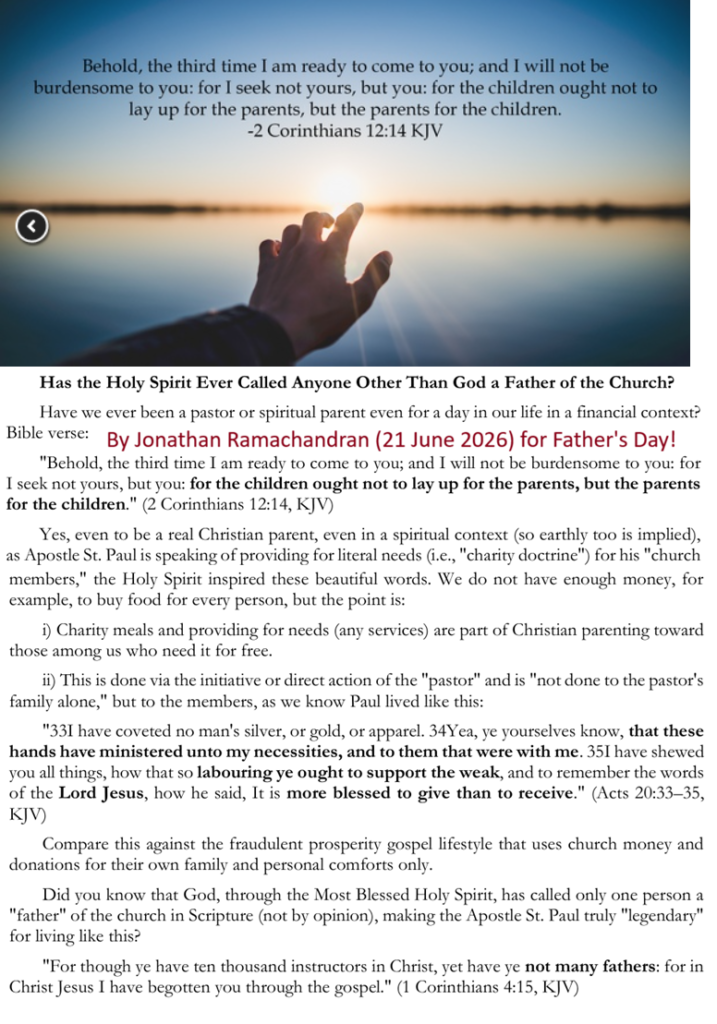
[Text] Has the Holy Spirit Ever Called Anyone Other Than God a Father of the Church?
Have we ever been a pastor or spiritual parent even for a day in our life in a financial context? Bible verse:
“Behold, the third time I am ready to come to you; and I will not be burdensome to you: for I seek not yours, but you: for the children ought not to lay up for the parents, but the parents for the children.” (2 Corinthians 12:14, KJV)
Yes, even to be a real Christian parent, even in a spiritual context (so earthly too is implied), as Apostle St. Paul is speaking of providing for literal needs (i.e., “charity doctrine”) for his “church members,” the Holy Spirit inspired these beautiful words. We do not have enough money, for example, to buy food for every person, but the point is:
i) Charity meals and providing for needs (any services) are part of Christian parenting toward those among us who need it for free.
ii) This is done via the initiative or direct action of the “pastor” and is “not done to the pastor’s family alone,” but to the members, as we know Paul lived like this:
“33I have coveted no man’s silver, or gold, or apparel. 34Yea, ye yourselves know, that these hands have ministered unto my necessities, and to them that were with me. 35I have shewed you all things, how that so labouring ye ought to support the weak, and to remember the words of the Lord Jesus, how he said, It is more blessed to give than to receive.” (Acts 20:33–35, KJV)
Compare this against the fraudulent prosperity gospel lifestyle that uses church money and donations for their own family and personal comforts only.
Did you know that God, through the Most Blessed Holy Spirit, has called only one person a “father” of the church in Scripture (not by opinion), making the Apostle St. Paul truly “legendary” for living like this?
“For though ye have ten thousand instructors in Christ, yet have ye not many fathers: for in Christ Jesus I have begotten you through the gospel.” (1 Corinthians 4:15, KJV)
Full Details in Source:
https://www.linkedin.com/pulse/can-marrie
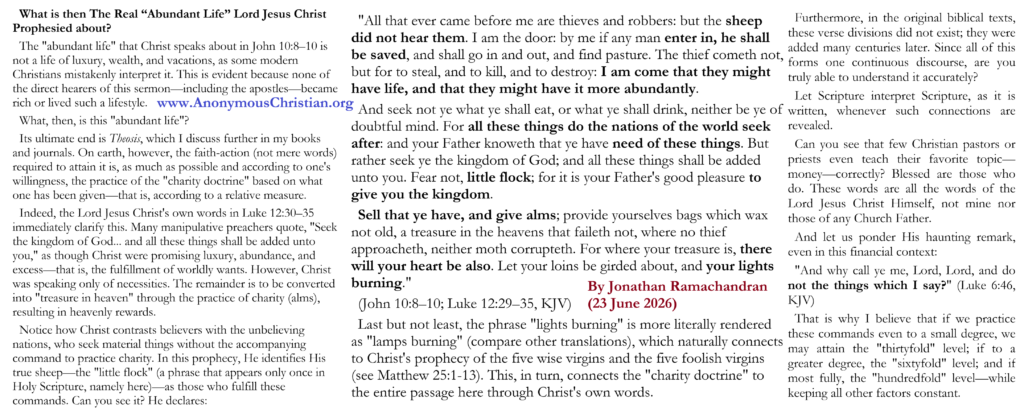
What is then The Real “Abundant Life” Lord Jesus Christ Prophesied about?
The “abundant life” that Christ speaks about in John 10:8–10 is not a life of luxury, wealth, and vacations, as some modern Christians mistakenly interpret it. This is evident because none of the direct hearers of this sermon—including the apostles—became rich or lived such a lifestyle.
What, then, is this “abundant life”?
Its ultimate end is Theosis, which I discuss further in my books and journals. On earth, however, the faith-action (not mere words) required to attain it is, as much as possible and according to one’s willingness, the practice of the “charity doctrine” based on what one has been given—that is, according to a relative measure.
Indeed, the Lord Jesus Christ’s own words in Luke 12:30–35 immediately clarify this. Many manipulative preachers quote, “Seek the kingdom of God… and all these things shall be added unto you,” as though Christ were promising luxury, abundance, and excess—that is, the fulfillment of worldly wants. However, Christ was speaking only of necessities. The remainder is to be converted into “treasure in heaven” through the practice of charity (alms), resulting in heavenly rewards.
Notice how Christ contrasts believers with the unbelieving nations, who seek material things without the accompanying command to practice charity. In this prophecy, He identifies His true sheep—the “little flock” (a phrase that appears only once in Holy Scripture, namely here)—as those who fulfill these commands. Can you see it? He declares:
“All that ever came before me are thieves and robbers: but the sheep did not hear them. I am the door: by me if any man enter in, he shall be saved, and shall go in and out, and find pasture. The thief cometh not, but for to steal, and to kill, and to destroy: I am come that they might have life, and that they might have it more abundantly.
And seek not ye what ye shall eat, or what ye shall drink, neither be ye of doubtful mind. For all these things do the nations of the world seek after: and your Father knoweth that ye have need of these things. But rather seek ye the kingdom of God; and all these things shall be added unto you. Fear not, little flock; for it is your Father’s good pleasure to give you the kingdom.
Sell that ye have, and give alms; provide yourselves bags which wax not old, a treasure in the heavens that faileth not, where no thief approacheth, neither moth corrupteth. For where your treasure is, there will your heart be also. Let your loins be girded about, and your lights burning.”
(John 10:8–10; Luke 12:29–35, KJV)
Last but not least, the phrase “lights burning” is more literally rendered as “lamps burning” (compare other translations), which naturally connects to Christ’s prophecy of the five wise virgins and the five foolish virgins (see Matthew 25:1-13). This, in turn, connects the “charity doctrine” to the entire passage here through Christ’s own words.
Furthermore, in the original biblical texts, these verse divisions did not exist; they were added many centuries later. Since all of this forms one continuous discourse, are you truly able to understand it accurately?
Let Scripture interpret Scripture, as it is written, whenever such connections are revealed.
Can you see that few Christian pastors or priests even teach their favorite topic—money—correctly? Blessed are those who do. These words are all the words of the Lord Jesus Christ Himself, not mine nor those of any Church Father.
And let us ponder His haunting remark, even in this financial context:
“And why call ye me, Lord, Lord, and do not the things which I say?” (Luke 6:46, KJV)
That is why I believe that if we practice these commands even to a small degree, we may attain the “thirtyfold” level; if to a greater degree, the “sixtyfold” level; and if most fully, the “hundredfold” level—while keeping all other factors constant.
[Text] Why “Charity Doctrine”?
Scripture unveils one great secret: God in Christ fulfills perfect love by the “Charity Doctrine” of self-giving sacrifice, paying with His own blood to freely save the world.
A Great Secret (longer version): All these New Testament Bible verses (e.g., Luke 11:41 and Luke 12:30–35) tell the same story—from Judgment Day in Matthew 25:31–46 to the rich man who thought he had kept “all the Torah” (Matthew 19:21–23): that the “Charity Doctrine” is the greatest action representing “faith working through love,” which God did not reveal earlier through Moses or the Prophets in its fullness, but only through His Son, the Most Blessed Lord Jesus Christ. For He alone is worthy, because to save us, God chose the method of the Charity Doctrine itself by paying for our sins with His own life and giving us salvation freely, thereby becoming the Saviour of the world.
Thus, only those who practice the “charity doctrine” (using their money, which gains higher value when earned through difficulty and disciplined effort, according to the holiness of their work and method) and then use it to give freely to others may begin to understand—in a small but real way—how much it cost the Lord Jesus Christ to “pay for the sins of the world.” He is the Lamb slain from the foundation of the world (Revelation 13:8), and not only during His earthly life.
In short, Christian salvation is God in the Flesh (the Lord Jesus Christ) fulfilling the Charity Doctrine by paying for our sins with His Blood—the Highest Price imaginable—to save us for FREE!
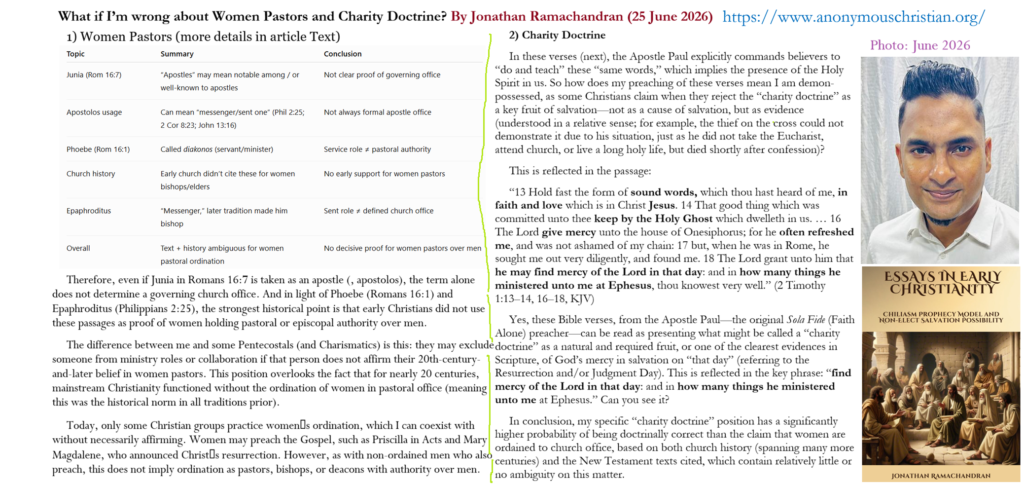
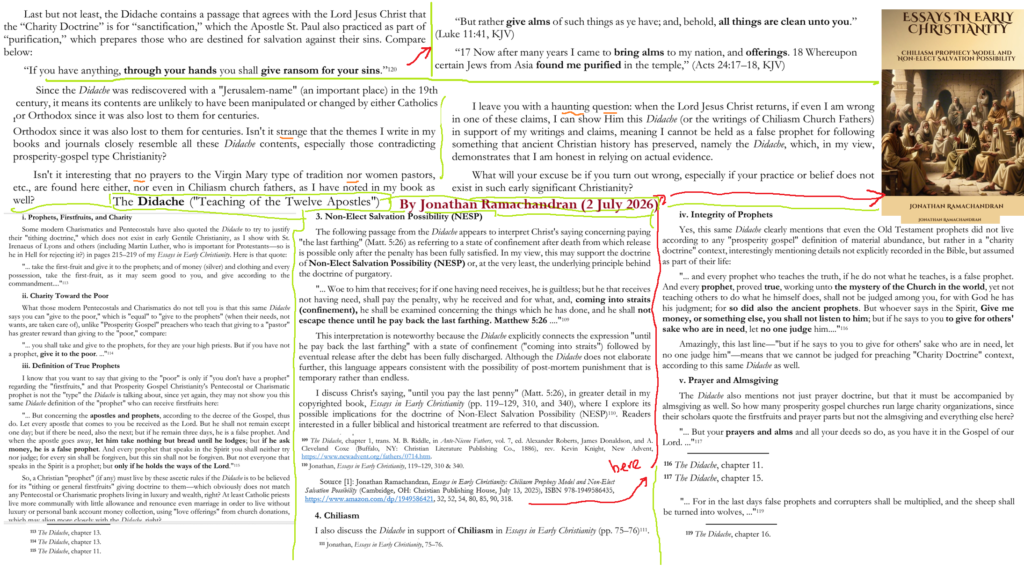
Summary of the Didache in the Context of Charity Doctrine, Spirit World Salvation, and the Identification of False Prophets
1. Brief History
The Didache (“Teaching of the Twelve Apostles”) is an early Christian manual, generally dated to AD 70–120, that instructs believers on Christian ethics, baptism, the Eucharist, church leadership, and Christ’s return. It disappeared for centuries before being rediscovered in 1873 by Philotheos Bryennios in the Codex Hierosolymitanus and published in 1883.
Among the Church Fathers, Eusebius of Caesarea and Athanasius of Alexandria explicitly mentioned the Didache as a respected but non-canonical work suitable for Christian instruction. Rufinus of Aquileia and John of Damascus also listed it among ecclesiastical writings. Earlier figures such as Clement of Alexandria, Origen, and the author of the Epistle of Barnabas appear to have known or reflected its teachings. Today, the Didache is regarded as one of the most important non-canonical witnesses to the beliefs and practices of the early post-apostolic Church.
Perhaps some books, such as the Didache, though non-canonical, can still provide sound hermeneutical guidance for understanding Holy Scripture. It is possible that God allowed such a work to disappear for centuries as a judgment upon Christianity for deviating in certain respects, and then allowed it to be rediscovered so that it could benefit later Christians by helping them attain greater doctrinal accuracy. In turn, this may contribute to a greater heavenly glory, in contrast to merely converting many people while maintaining lesser doctrinal accuracy—an idea that may be implied by the context of the prophecy in Daniel 12:3 [1].
Source [1]: Jonathan Ramachandran, Essays in Early Christianity: Chiliasm Prophecy Model and Non-Elect Salvation Possibility (Cambridge, OH: Christian Publishing House, July 13, 2025), ISBN 978-1949586435, https://www.amazon.com/dp/1949586421, 32, 52, 54, 80, 85, 90, 318.
2. Charity Doctrine
i. Charity Beyond One’s Own Circle
The Didache teaches a doctrine of charity that extends beyond loving one’s own family, race, or religion to include even one’s enemies. This reflects the heavenly “reward” context of Matthew 5 and is presented as part of “the way of life.” Notice especially its emphasis on giving freely—whether money, skills, knowledge, or any other blessing—without expecting repayment. Even when one’s generosity is abused or manipulated, the giver remains “guiltless,” since the recipient’s misuse lies beyond the giver’s control.
“… The way of life, then, is this: Bless those who curse you, and pray for your enemies, and fast for those who persecute you. For what reward is there, if you love those who love you? Do not also the Gentiles do the same? … If someone gives you a blow upon your right cheek, turn to him the other also, and you shall be perfect. If someone impresses you for one mile, go with him two. If someone takes away your cloak, give him also your coat. If someone takes from you what is yours, ask it not back, for indeed you are not able. Give to every one that asks you, and ask it not back; for the Father wills that to all should be given of our own blessings (free gifts). Happy is he that gives according to the commandment; for he is guiltless. …” [2]
Source [2]:
The Didache, chapter 1, trans. M. B. Riddle, in Ante-Nicene Fathers, vol. 7, ed. Alexander Roberts, James Donaldson, and A. Cleveland Coxe (Buffalo, NY: Christian Literature Publishing Co., 1886), rev. Kevin Knight, New Advent, https://www.newadvent.org/fathers/0714.htm.
This passage presents charity not merely as an act of kindness but as a defining characteristic of the Christian life. It echoes Christ’s teaching that heavenly reward is associated with loving one’s enemies rather than merely loving those who love us in return (Matt. 5:44–48).
ii. Discernment in Giving
At the same time, the Didache does not advocate indiscriminate giving. While Christians are encouraged to be generous, they are also instructed to exercise discernment so that charity is not exploited by those who falsely present themselves as being in need.
“… But also now concerning this, it has been said, Let your alms sweat in your hands, until you know to whom you should give….” [3]
Source [3]: The Didache, chapter 1.
This instruction demonstrates that Christian charity is to be exercised with both compassion and wisdom. Believers should neither become cynical toward those in genuine need nor allow habitual deception or manipulation to undermine responsible stewardship. The balance between generosity and discernment is an important feature of the Didache‘s doctrine of charity.
3. Non-Elect Salvation Possibility (NESP)
The following passage from the Didache appears to interpret Christ’s saying concerning paying “the last farthing” (Matt. 5:26) as referring to a state of confinement after death from which release is possible only after the penalty has been fully satisfied. In my view, this may support the doctrine of Non-Elect Salvation Possibility (NESP) or, at the very least, the underlying principle behind the doctrine of purgatory.
“… Woe to him that receives; for if one having need receives, he is guiltless; but he that receives not having need, shall pay the penalty, why he received and for what, and, coming into straits (confinement), he shall be examined concerning the things which he has done, and he shall not escape thence until he pay back the last farthing. Matthew 5:26 ….” [4]
Source [4]: The Didache, chapter 1.
This interpretation is noteworthy because the Didache explicitly connects the expression “until he pay back the last farthing” with a state of confinement (“coming into straits”) followed by eventual release after the debt has been fully discharged. Although the Didache does not elaborate further, this language appears consistent with the possibility of post-mortem punishment that is temporary rather than endless.
I discuss Christ’s saying, “until you pay the last penny” (Matt. 5:26), in greater detail in my copyrighted book, Essays in Early Christianity (pp. 119–129, 310, and 340), where I explore its possible implications for the doctrine of Non-Elect Salvation Possibility (NESP)[5]. Readers interested in a fuller biblical and historical treatment are referred to that discussion.
Source [5]: Jonathan, Essays in Early Christianity, 119–129, 310 & 340.
4. Chiliasm
I also discuss the Didache in support of Chiliasm in Essays in Early Christianity (pp. 75–76)[6].
Source [6]: Jonathan, Essays in Early Christianity, 75–76.
Although the Didache does not explicitly mention a literal thousand-year reign of Christ, its eschatological teaching in Chapter 16 reflects themes commonly associated with early premillennial expectation [7]. In my view, this places it within the broader stream of early Christian eschatology that is compatible with Chiliasm and should therefore be considered alongside the writings of other early Church Fathers who held similar millennial expectations.
Source [7]: Jonathan, The Didache, chapter 16.
5. False Prophets
i. Prophets, Firstfruits, and Charity
Some modern Charismatics and Pentecostals have also quoted the Didache to try to justify their “tithing doctrine,” which does not exist in early Gentile Christianity, as I show with St. Irenaeus of Lyons and others (including Martin Luther, who is important for Protestants—so is he in Hell for rejecting it?) in pages 215–219 of my Essays in Early Christianity. Here is that quote:
“… take the first-fruit and give it to the prophets; and of money (silver) and clothing and every possession, take the first-fruit, as it may seem good to you, and give according to the commandment….”[8]
Source [8]: Jonathan, The Didache, chapter 13.
ii. Charity Toward the Poor
What those modern Pentecostals and Charismatics do not tell you is that this same Didache says you can “give to the poor,” which is “equal” to “give to the prophets” (when their needs, not wants, are taken care of), unlike “Prosperity Gospel” preachers who teach that giving to a “pastor” has greater reward than giving to the “poor,” compare:
“… you shall take and give to the prophets, for they are your high priests. But if you have not a prophet, give it to the poor. …”[9]
Source [9]: Jonathan, The Didache, chapter 13.
iii. Definition of True Prophets
I know that you want to say that giving to the “poor” is only if “you don’t have a prophet” regarding the “firstfruits,” and that Prosperity Gospel Christianity’s Pentecostal or Charismatic prophet is not the “type” the Didache is talking about, since yet again, they may not show you this same Didache definition of the “prophet” who can receive firstfruits here:
“… But concerning the apostles and prophets, according to the decree of the Gospel, thus do. Let every apostle that comes to you be received as the Lord. But he shall not remain except one day; but if there be need, also the next; but if he remain three days, he is a false prophet. And when the apostle goes away, let him take nothing but bread until he lodges; but if he ask money, he is a false prophet. And every prophet that speaks in the Spirit you shall neither try nor judge; for every sin shall be forgiven, but this sin shall not be forgiven. But not everyone that speaks in the Spirit is a prophet; but only if he holds the ways of the Lord.”[10]
Source [10]: Jonathan, The Didache, chapter 11.
So, a Christian “prophet” (if any) must live by these ascetic rules if the Didache is to be believed for its “tithing or general firstfruits” giving doctrine to them—which obviously does not match any Pentecostal or Charismatic prophets living in luxury and wealth, right? At least Catholic priests live more communally with little allowance and renounce even marriage in order to live without luxury or personal bank account money collection, using “love offerings” from church donations, which may align more closely with the Didache, right?
Extension: Have we done this before when preaching or writing about a prophecy, whether via social media (Facebook, LinkedIn, videos), or in person (pulpit or non-pulpit), or in books, as the Didache says here: “let him take nothing but bread until he lodges; but if he ask money, he is a false prophet,” meaning “no money donations into bank account as love offering nor salary even,” but only bread as food?
If yes, how many times, during which you “received a prophecy from God”? (Any true Christian knows these are not a matter for play, and I don’t risk myself listening to prophecies from prophets who live in luxury and/or receive salary or love offering for the prophecy part of the job, either to be safe—my personal stance in light of all this).
iv. Integrity of Prophets
Yes, this same Didache clearly mentions that even the Old Testament prophets did not live according to any “prosperity gospel” definition of material abundance, but rather in a “charity doctrine” context, interestingly mentioning details not explicitly recorded in the Bible, but assumed as part of their life:
“… and every prophet who teaches the truth, if he do not what he teaches, is a false prophet. And every prophet, proved true, working unto the mystery of the Church in the world, yet not teaching others to do what he himself does, shall not be judged among you, for with God he has his judgment; for so did also the ancient prophets. But whoever says in the Spirit, Give me money, or something else, you shall not listen to him; but if he says to you to give for others’ sake who are in need, let no one judge him….”[11]
Source [11]: Jonathan, The Didache, chapter 11.
Amazingly, this last line—”but if he says to you to give for others’ sake who are in need, let no one judge him”—means that we cannot be judged for preaching “Charity Doctrine” context, according to this same Didache as well.
v. Prayer and Almsgiving
The Didache also mentions not just prayer doctrine, but that it must be accompanied by almsgiving as well. So how many prosperity gospel churches run large charity organizations, since their scholars quote the firstfruits and prayer parts but not the almsgiving and everything else here?
“… But your prayers and alms and all your deeds so do, as you have it in the Gospel of our Lord. …”[12]
Source [12]: Jonathan, The Didache, chapter 15.
vi. The Way of Death
Can you see how many “charity doctrine” aspects are repeated throughout the Didache? In fact, in its contrast with the “way of death,” it clearly implies that lack of charity is one of the traits that can lead to hell itself:
“… And the way of death is this: … loving vanities, pursuing requital, not pitying a poor man, not labouring for the afflicted, … turning away from him that is in want, afflicting him that is distressed, advocates of the rich, lawless judges of the poor, utter sinners. Be delivered, children, from all these.”[13]
Source [13]: Jonathan, The Didache, chapter 5.
“Love not the world, neither the things that are in the world. If any man love the world, the love of the Father is not in him.” (1 John 2:15, KJV)
In short, it seems unlikely that the Holy Spirit is speaking through Prosperity Gospel prophets and telling them that it’s okay to live in luxury, have excess beyond need, and all that, since that is “loving the things of this world,” right? You only pray and ask for the “things you love”—can you see it? Unless of course, you live modestly despite having a high income or savings and donate it back via a will to the poor through church ministries that support it as part of holistic biblical evangelism or charity too.
6. Conclusion
So, if the Didache is to be believed, then it warns against those teaching contrary to its ethical and spiritual framework, particularly in relation to charity, discernment, and integrity. These themes are not isolated but are repeated throughout the text in different forms, especially in its contrast between the “way of life” and the “way of death.”
“… For in the last days false prophets and corrupters shall be multiplied, and the sheep shall be turned into wolves, …”[14]
Source [14]: Jonathan, The Didache, chapter 16.
Since the Didache was rediscovered in “Jerusalem” (an important place) in the 19th century, it means its contents are unlikely to have been manipulated or changed by either Catholics or Orthodox since it was also lost to them for centuries. Isn’t it strange that the themes I write in my books and journals closely resemble all these Didache contents, especially those contradicting prosperity-gospel type Christianity?
Isn’t it interesting that no prayers to the Virgin Mary type of tradition nor women pastors, etc., are found here either, nor even in Chiliasm church fathers, as I have noted in my book as well?
I leave you with a haunting question: when the Lord Jesus Christ returns, if even I am wrong in one of these claims, I can show Him this Didache (or the writings of Chiliasm Church Fathers) in support of my writings and claims, meaning I cannot be held as a false prophet for following something that ancient Christian history has preserved, namely the Didache, which, in my view, demonstrates that I am honest in relying on actual evidence.
What will your excuse be if you turn out wrong, especially if your practice or belief does not exist in such early significant Christianity?
Last but not least, the Didache contains a passage that agrees with the Lord Jesus Christ that the “Charity Doctrine” is for “sanctification,” which the Apostle St. Paul also practiced as part of “purification,” which prepares those who are destined for salvation against their sins. Compare below:
“If you have anything, through your hands you shall give ransom for your sins.”
Source: The Didache, chapter 4.“But rather give alms of such things as ye have; and, behold, all things are clean unto you.” (Luke 11:41, KJV)
“17 Now after many years I came to bring alms to my nation, and offerings. 18 Whereupon certain Jews from Asia found me purified in the temple,” (Acts 24:17–18, KJV)
[Text] What if I’m wrong about Women Pastors and Charity Doctrine?
1) Women Pastors
Romans 16:7 is often discussed because Paul writes, “Salute Andronicus and Junia, my kinsmen, and my fellowprisoners, who are of note among the apostles (ἀπόστολος, apostolos), who also were in Christ before me” (Romans 16:7, KJV). Grammatically, this may mean either they were “notable among the apostles” or “well known to the apostles.” Early writers such as Chrysostom appear to have understood Junia as a woman and associated her with the apostles (ἀπόστολος, apostolos), yet they did not appeal to this passage as proof that women held governing offices such as bishop, elder, or pastor.
A useful parallel appears within this same chapter in Romans 16:1 with Phoebe, described as a “servant” (διάκονος, diakonos). While later church history sometimes recognizes deaconesses, their role is generally described as distinct and often focused on service among women rather than governing authority over mixed congregations. This shows that ministry titles in Romans 16 do not automatically define pastoral or ruling office.
The term ἀπόστολος (apostolos) itself is also flexible in Scripture. In Philippians 2:25, Epaphroditus is called “your messenger” (ἀπόστολος, apostolos) (KJV), and in 2 Corinthians 8:23 others are likewise called “messengers of the churches” (ἀπόστολοι, apostoloi) (KJV). Even Jesus uses the concept broadly: “he that is sent” (ἀπόστολος, apostolos) (John 13:16, KJV). This shows the word can mean a commissioned representative, not necessarily a fixed governing office.
Epaphroditus is also significant in church history: while the New Testament does not assign him a formal episcopal office, later traditions sometimes identify him as one of the Seventy and even as a bishop. This illustrates how early “sent” messengers were later remembered with elevated roles, even though the biblical text itself does not define such offices.
Therefore, even if Junia in Romans 16:7 is taken as an apostle (ἀπόστολος, apostolos), the term alone does not determine a governing church office. And in light of Phoebe (Romans 16:1) and Epaphroditus (Philippians 2:25), the strongest historical point is that early Christians did not use these passages as proof of women holding pastoral or episcopal authority over men.
The difference between me and some Pentecostals (and Charismatics) is this: they may exclude someone from ministry roles or collaboration if that person does not affirm their 20th-century-and-later belief in women pastors. This position overlooks the fact that for nearly 20 centuries, mainstream Christianity functioned without the ordination of women in pastoral office (meaning this was the historical norm in all traditions prior).
Today, only some Christian groups practice women’s ordination, which I can coexist with without necessarily affirming. Women may preach the Gospel, such as Priscilla in Acts and Mary Magdalene, who announced Christ’s resurrection. However, as with non-ordained men who also preach, this does not imply ordination as pastors, bishops, or deacons with authority over men.
Sample Sources:
i) Clement of Alexandria, Stromata 3.6, in Ante-Nicene Fathers, vol. 2, ed. Alexander Roberts and James Donaldson (Peabody, MA: Hendrickson, 1994).
ii) Didascalia Apostolorum 16, trans. R. Hugh Connolly (Oxford: Clarendon Press, 1929).
iii) “Didascalia Apostolorum,” Women Deacons, accessed June 25, 2026, https://www.womendeacons.org/didascalia-apostolorum/.
iv) John Chrysostom, Homilies on Romans, Homily 30, in Nicene and Post-Nicene Fathers, First Series, vol. 11, ed. Philip Schaff (Peabody, MA: Hendrickson, 1994).
2) Charity Doctrine
In these verses (next), the Apostle Paul explicitly commands believers to “do and teach” these “same words,” which implies the presence of the Holy Spirit in us. So how does my preaching of these verses mean I am demon-possessed, as some Christians claim when they reject the “charity doctrine” as a key fruit of salvation—not as a cause of salvation, but as evidence (understood in a relative sense; for example, the thief on the cross could not demonstrate it due to his situation, just as he did not take the Eucharist, attend church, or live a long holy life, but died shortly after confession)?
This is reflected in the passage:
“13 Hold fast the form of sound words, which thou hast heard of me, in faith and love which is in Christ Jesus. 14 That good thing which was committed unto thee keep by the Holy Ghost which dwelleth in us. … 16 The Lord give mercy unto the house of Onesiphorus; for he often refreshed me, and was not ashamed of my chain: 17 but, when he was in Rome, he sought me out very diligently, and found me. 18 The Lord grant unto him that he may find mercy of the Lord in that day: and in how many things he ministered unto me at Ephesus, thou knowest very well.” (2 Timothy 1:13–14, 16–18, KJV)
Yes, these Bible verses, from the Apostle Paul—the original Sola Fide (Faith Alone) preacher—can be read as presenting what might be called a “charity doctrine” as a natural and required fruit, or one of the clearest evidences in Scripture, of God’s mercy in salvation on “that day” (referring to the Resurrection and/or Judgment Day). This is reflected in the key phrase: “find mercy of the Lord in that day: and in how many things he ministered unto me at Ephesus.” Can you see it?
In conclusion, my specific “charity doctrine” position has a significantly higher probability of being doctrinally correct than the claim that women are ordained to church office, based on both church history (spanning many more centuries) and the New Testament texts cited, which contain relatively little or no ambiguity on this matter.
P/S: “in that Day”
Holy Bible, King James Version (KJV): “Henceforth there is laid up for me a crown of righteousness, which the Lord, the righteous judge, shall give me at that day: and not to me only, but unto all them also that love his appearing” (2 Timothy 4:8); “When he shall come to be glorified in his saints, and to be admired in all them that believe (because our testimony among you was believed) in that day” (2 Thessalonians 1:10); “Many will say to me in that day, Lord, Lord, have we not prophesied in thy name? and in thy name have cast out devils? and in thy name done many wonderful works?” (Matthew 7:22); “But I say unto you, that it shall be more tolerable for Sodom at that day, than for that city” (Luke 10:12).
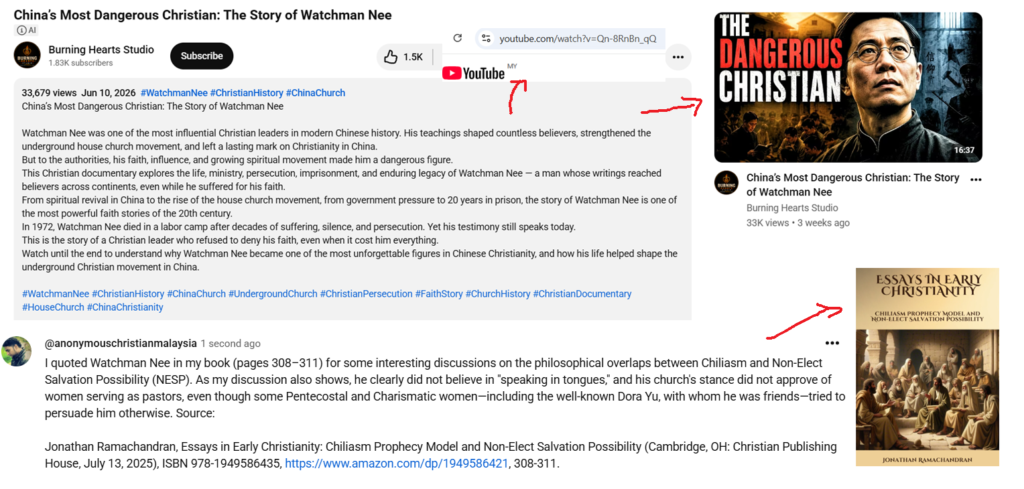
[Text] I quoted Watchman Nee in my book (pages 308–311) for some interesting discussions on the philosophical overlaps between Chiliasm and Non-Elect Salvation Possibility (NESP). As my discussion also shows, he clearly did not believe in “speaking in tongues,” and his church’s stance did not approve of women serving as pastors, even though some Pentecostal and Charismatic women—including the well-known Dora Yu, with whom he was friends—tried to persuade him otherwise.
Source: Jonathan Ramachandran, Essays in Early Christianity: Chiliasm Prophecy Model and Non-Elect Salvation Possibility (Cambridge, OH: Christian Publishing House, July 13, 2025), ISBN 978-1949586435, https://www.amazon.com/dp/1949586421, 308-311.
YouTube link: https://www.youtube.com/watch?v=Qn-8RnBn_qQ
Thank you!
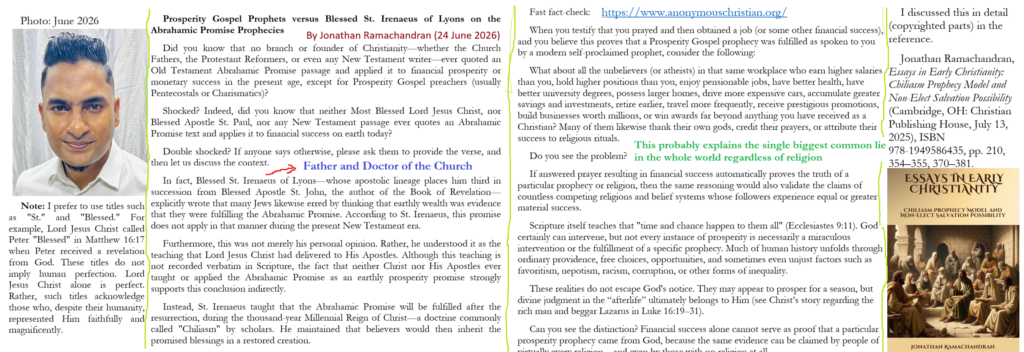
[Text] Prosperity Gospel Prophets versus Blessed St. Irenaeus of Lyons on the Abrahamic Promise Prophecies
Did you know that no branch or founder of Christianity—whether the Church Fathers, the Protestant Reformers, or even any New Testament writer—ever quoted an Old Testament Abrahamic Promise passage and applied it to financial prosperity or monetary success in the present age, except for Prosperity Gospel preachers (usually Pentecostals or Charismatics)?
Shocked? Indeed, did you know that neither Most Blessed Lord Jesus Christ, nor Blessed Apostle St. Paul, nor any New Testament passage ever quotes an Abrahamic Promise text and applies it to financial success on earth today?
Double shocked? If anyone says otherwise, please ask them to provide the verse, and then let us discuss the context.
In fact, Blessed St. Irenaeus of Lyons—whose apostolic lineage places him third in succession from Blessed Apostle St. John, the author of the Book of Revelation—explicitly wrote that many Jews likewise erred by thinking that earthly wealth was evidence that they were fulfilling the Abrahamic Promise. According to St. Irenaeus, this promise does not apply in that manner during the present New Testament era.
Furthermore, this was not merely his personal opinion. Rather, he understood it as the teaching that Lord Jesus Christ had delivered to His Apostles. Although this teaching is not recorded verbatim in Scripture, the fact that neither Christ nor His Apostles ever taught or applied the Abrahamic Promise as an earthly prosperity promise strongly supports this conclusion indirectly.
Instead, St. Irenaeus taught that the Abrahamic Promise will be fulfilled after the resurrection, during the thousand-year Millennial Reign of Christ—a doctrine commonly called “Chiliasm” by scholars. He maintained that believers would then inherit the promised blessings in a restored creation.
I discuss the details supporting this conclusion in my book. Since I cannot reproduce lengthy copyrighted quotations here, I will simply note one distinctive feature of the work.
For reference:
Jonathan Ramachandran, Essays in Early Christianity: Chiliasm Prophecy Model and Non-Elect Salvation Possibility (Cambridge, OH: Christian Publishing House, July 13, 2025), ISBN 978-1949586435, pp. 210, 354–355, 370–381.
If the Pentecostals or Charismatics are correct about the Prosperity Gospel prophecies they frequently utter and claim, then they will be rewarded in heaven for being falsely accused. On the other hand, if I (or Christians with a similar position) am correct in rejecting those claims—and if my position is further substantiated by the quotations of St. Irenaeus—then their boycotts of me from ministry opportunities, journals, jobs (whether secular or Christian), and similar contexts will only secure for me the unique “great” reward Christ promises in Matthew 5:10–12 to those who are falsely accused for His sake (in this case, regarding the accuracy of prophecy) and persecuted for “righteousness’ sake.”
If I ultimately turn out to be correct—and I am entirely willing to stake that claim, given what I believe to be the weight of the evidence—then such treatment would fall under those promises. I am also prepared to discuss the evidence with anyone who wishes to engage on the subject.
Fast fact-check:
When you testify that you prayed and then obtained a job (or some other financial success), and you believe this proves that a Prosperity Gospel prophecy was fulfilled as spoken to you by a modern self-proclaimed prophet, consider the following:
What about all the unbelievers (or atheists) in that same workplace who earn higher salaries than you, hold higher positions than you, enjoy pensionable jobs, have better health, have better university degrees, possess larger homes, drive more expensive cars, accumulate greater savings and investments, retire earlier, travel more frequently, receive prestigious promotions, build businesses worth millions, or win awards far beyond anything you have received as a Christian? Many of them likewise thank their own gods, credit their prayers, or attribute their success to religious rituals.
Do you see the problem?
If answered prayer resulting in financial success automatically proves the truth of a particular prophecy or religion, then the same reasoning would also validate the claims of countless competing religions and belief systems whose followers experience equal or greater material success.
Scripture itself teaches that “time and chance happen to them all” (Ecclesiastes 9:11). God certainly can intervene, but not every instance of prosperity is necessarily a miraculous intervention or the fulfillment of a specific prophecy. Much of human history unfolds through ordinary providence, free choices, opportunities, and sometimes even unjust factors such as favoritism, nepotism, racism, corruption, or other forms of inequality.
These realities do not escape God’s notice. They may appear to prosper for a season, but divine judgment in the “afterlife” ultimately belongs to Him (see Christ’s story regarding the rich man and beggar Lazarus in Luke 16:19–31).
Can you see the distinction? Financial success alone cannot serve as proof that a particular prosperity prophecy came from God, because the same evidence can be claimed by people of virtually every religion—and even by those with no religion at all.
Note: I prefer to use titles such as “St.” and “Blessed.” For example, Lord Jesus Christ called Peter “Blessed” in Matthew 16:17 when Peter received a revelation from God. These titles do not imply human perfection. Lord Jesus Christ alone is perfect. Rather, such titles acknowledge those who, despite their humanity, represented Him faithfully and magnificently.
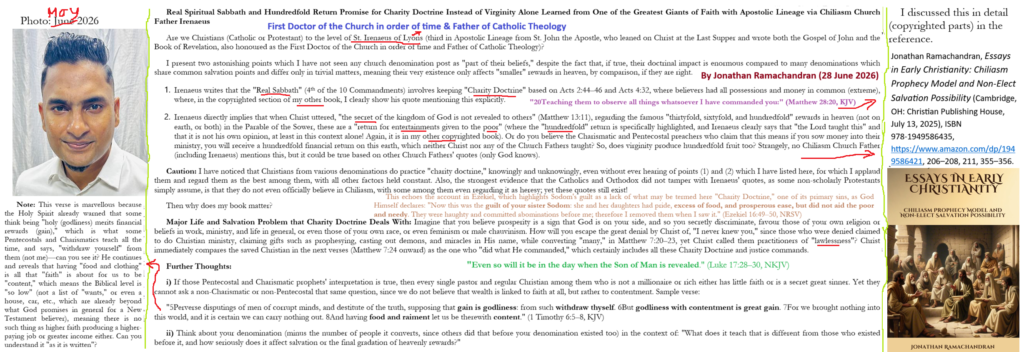
Real Spiritual Sabbath and Hundredfold Return Promise for Charity Doctrine Instead of Virginity Alone Learned from One of the Greatest Giants of Faith with Apostolic Lineage via Chiliasm Church Father Irenaeus
Are we Christians (Catholic or Protestant) to the level of St. Irenaeus of Lyons (third in Apostolic Lineage from St. John the Apostle, who leaned on Christ at the Last Supper and wrote both the Gospel of John and the Book of Revelation, also honoured as the First Doctor of the Church in order of time and Father of Catholic Theology)?
I present two astonishing points which I have not seen any church denomination post as “part of their beliefs,” despite the fact that, if true, their doctrinal impact is enormous compared to many denominations which share common salvation points and differ only in trivial matters, meaning their very existence only affects “smaller” rewards in heaven, by comparison, if they are right.
- Irenaeus writes that the “Real Sabbath” (4th of the 10 Commandments) involves keeping “Charity Doctrine” based on Acts 2:44–46 and Acts 4:32, where believers had all possessions and money in common (extreme), where, in the copyrighted section of my other book [1], I clearly show his quote mentioning this explicitly.
Source [1]: Jonathan Ramachandran, Essays in Early Christianity: Chiliasm Prophecy Model and Non-Elect Salvation Possibility (Cambridge, OH: Christian Publishing House, July 13, 2025), ISBN 978-1949586435, https://www.amazon.com/dp/1949586421, 206–208.
- Irenaeus directly implies that when Christ uttered, “the secret of the kingdom of God is not revealed to others” (Matthew 13:11), regarding the famous “thirtyfold, sixtyfold, and hundredfold” rewards in heaven (not on earth, or both) in the Parable of the Sower, these are a “return for entertainments given to the poor” (where the “hundredfold” return is specifically highlighted, and Irenaeus clearly says that “the Lord taught this” and that it is not his own opinion, at least in this context alone! Again, it is in my other copyrighted book [2]). Or do you believe the Charismatic and Pentecostal preachers who claim that this means if you sow money into their ministry, you will receive a hundredfold financial return on this earth, which neither Christ nor any of the Church Fathers taught? So, does virginity produce hundredfold fruit too? Strangely, no Chiliasm Church Father (including Irenaeus) mentions this, but it could be true based on other Church Fathers’ quotes (only God knows).
Source [2]: Jonathan Ramachandran, Essays in Early Christianity: Chiliasm Prophecy Model and Non-Elect Salvation Possibility (Cambridge, OH: Christian Publishing House, July 13, 2025), ISBN 978-1949586435, https://www.amazon.com/dp/1949586421, 211, 355–356.
Caution: I have noticed that Christians from various denominations do practice “charity doctrine,” knowingly and unknowingly, even without ever hearing of points (1) and (2) which I have listed here, for which I applaud them and regard them as the best among them, with all other factors held constant. Also, the strongest evidence that the Catholics and Orthodox did not tamper with Irenaeus’ quotes, as some non-scholarly Protestants simply assume, is that they do not even officially believe in Chiliasm, with some among them even regarding it as heresy; yet these quotes still exist!
Then why does my book matter?
Major Life and Salvation Problem that Charity Doctrine Deals With: Imagine that you believe prosperity is a sign that God is on your side, and so you secretly discriminate, favour those of your own religion or beliefs in work, ministry, and life in general, or even those of your own race, or even feminism or male chauvinism. How will you escape the great denial by Christ of, “I never knew you,” since those who were denied claimed to do Christian ministry, claiming gifts such as prophesying, casting out demons, and miracles in His name, while converting “many,” in Matthew 7:20–23, yet Christ called them practitioners of “lawlessness”? Christ immediately compares the saved Christian in the next verses (Matthew 7:24 onward) as the one who “did what He commanded,” which certainly includes all these Charity Doctrine and justice commands.
Further Thoughts:
i) If those Pentecostal and Charismatic prophets’ interpretation is true, then every single pastor and regular Christian among them who is not a millionaire or rich either has little faith or is a secret great sinner. Yet they cannot ask a non-Charismatic or non-Pentecostal that same question, since we do not believe that wealth is linked to faith at all, but rather to contentment. Sample verse:
“5Perverse disputings of men of corrupt minds, and destitute of the truth, supposing that gain is godliness: from such withdraw thyself. 6But godliness with contentment is great gain. 7For we brought nothing into this world, and it is certain we can carry nothing out. 8And having food and raiment let us be therewith content.” (1 Timothy 6:5–8, KJV)
Note: This verse is marvellous because the Holy Spirit already warned that some think being “holy (godliness) merits financial rewards (gain),” which is what some Pentecostals and Charismatics teach all the time, and says, “withdraw yourself” from them (not me)—can you see it? He continues and reveals that having “food and clothing” is all that “faith” is about for us to be “content,” which means the Biblical level is “so low” (not a list of “wants,” or even a house, car, etc., which are already beyond what God promises in general for a New Testament believer), meaning there is no such thing as higher faith producing a higher-paying job or greater income either. Can you understand it “as it is written”?
ii) Think about your denomination (minus the number of people it converts, since others did that before your denomination existed too) in the context of: “What does it teach that is different from those who existed before it, and how seriously does it affect salvation or the final gradation of heavenly rewards?”
iii) Compare: Which is true? That being sons and daughters of the King means God chose you to live in luxury with little to no Charity Doctrine, or that it means you live modestly and practise maximal Charity Doctrine by relative measure? There are even silly pagan beliefs which teach something like: never help the poor since it is their punishment, and if you help them, you become infected by their curse. See how the Devil has already planted anti-Charity Doctrine in some non-Christian religions, meaning this is how the “doctrine of demons” has polluted them? Can you see why those who believe such deserve eternal Hell? (Compare Christ’s story of the rich man and the beggar Lazarus in Luke 16:19–31 for an example.)
iv) Let us also remember the warning of our Lord Jesus Christ, who declared that the end times would reflect the sins of Sodom, a message closely related to the topic of financial holiness. As He said:
“Likewise as it was also in the days of Lot: They ate, they drank, they bought, they sold, they planted, they built; but on the day that Lot went out of Sodom it rained fire and brimstone from heaven and destroyed them all. Even so will it be in the day when the Son of Man is revealed.” (Luke 17:28–30, NKJV)
This echoes the account in Ezekiel, which highlights Sodom’s guilt as a lack of what may be termed here “Charity Doctrine,” one of its primary sins, as God Himself declares:
“Now this was the guilt of your sister Sodom: she and her daughters had pride, excess of food, and prosperous ease, but did not aid the poor and needy. They were haughty and committed abominations before me; therefore I removed them when I saw it.” (Ezekiel 16:49–50, NRSV)
Conclusion
Christians across various mainstream denominations do practise Charity Doctrine without realizing facts like these, which I believe are among the strongest evidences of the fruit of elect salvation.
However, only if you both “do and teach” them (not “do only and don’t teach,” or “teach but do not do”) do you become “great” in the “kingdom of heaven,” implying a context of gradation and reward, or vice versa, as the Lord Jesus Christ Himself taught in Matthew 5:17–20. That is one reason why I wrote my book and blogs (on my social media: website, Facebook, and LinkedIn), by “relative measure” (Luke 21:1–4—that even if there are “no tangible effects compared to the rich,” one can still merit higher rewards if the percentage of giving is higher, with all other factors held constant—and the principle that “to whom much is given, much more is required” in Luke 12:48 at the Judgment, both of which Christ taught).
This means that those who do not (whether they neither teach nor do, or only do one without the other) end up being “small” in the kingdom, even if saved, as warned by Christ in this same passage. What an eternal loss!
That is why accuracy of doctrine is more important than travelling land and sea to make a convert, especially regarding topics involving “Charity Doctrine,” which Christ spoke about more than many others, even presenting it as Perfection (Matthew 19:21), Sanctification (Luke 11:41), both from “what you have” (not merely using donation money only, like how the Pharisees—the pastors of the past—did), as well as Heavenly Rewards and keeping our lamps lit as the Wise Virgins did (Luke 12:30–35), as I discussed earlier.
If I had a financial sermon regarding the most important doctrine Christ taught on this subject, this would be it. Remember, the Gospel’s Great Commission is not just about “preaching about Christ,” but also about “preaching what Christ commanded,” as Christ Himself clearly stated in the famous Matthew 28:19–20 passage, beyond the verse about believing in Him and being baptized:
“19Go ye therefore, and teach all nations, baptizing them in the name of the Father, and of the Son, and of the Holy Ghost: 20Teaching them to observe all things whatsoever I have commanded you: and, lo, I am with you alway, even unto the end of the world. Amen.” (Matthew 28:19–20, KJV)
Maranatha! Even so come Lord Jesus, Amen.
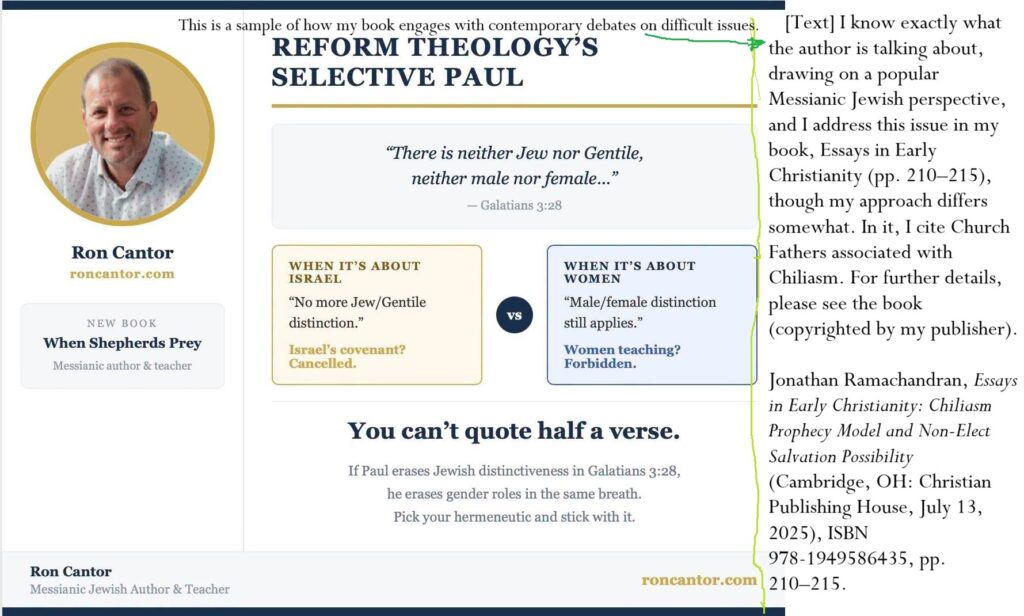
[Text] This is a sample of how my book engages with contemporary debates on difficult issues. No more Jew or Gentile? Nor Male or Female? How?
I know exactly what the author is talking about, drawing on a popular Messianic Jewish perspective, and I address this issue in my book, Essays in Early Christianity (pp. 210–215), though my approach differs somewhat. In it, I cite Church Fathers associated with Chiliasm. For further details, please see the book (copyrighted by my publisher).
Jonathan Ramachandran, Essays in Early Christianity: Chiliasm Prophecy Model and Non-Elect Salvation Possibility (Cambridge, OH: Christian Publishing House, July 13, 2025), ISBN 978-1949586435, pp. 210–215.
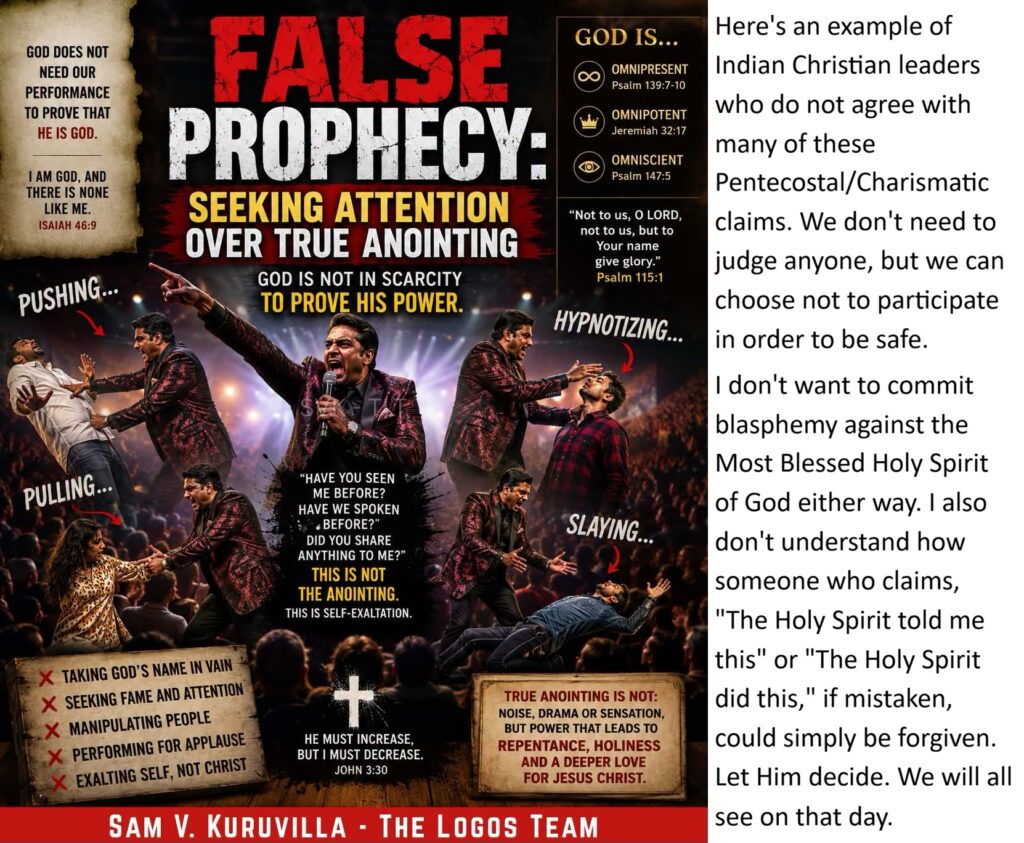
[Text] Here’s an example of Indian Christian leaders who do not agree with many of these Pentecostal/Charismatic claims. We don’t need to judge anyone, but we can choose not to participate in order to be safe.
I don’t want to commit blasphemy against the Most Blessed Holy Spirit of God either way. I also don’t understand how someone who claims, “The Holy Spirit told me this” or “The Holy Spirit did this,” if mistaken, could simply be forgiven. Let Him decide. We will all see on that day.
Source Post Link:
Thank you.
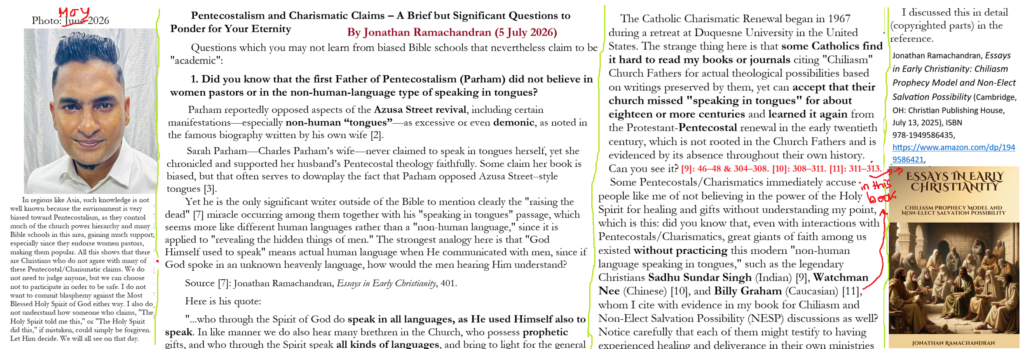
Pentecostalism and Charismatic Claims – A Brief but Significant Questions to Ponder for Your Eternity
Questions which you may not learn from biased Bible schools that nevertheless claim to be “academic”:
1. Did you know that the first Father of Pentecostalism (Parham) did not believe in women pastors or in the non-human-language type of speaking in tongues?
Why would the Holy Spirit use Charles Parham, a white man who first spoke in tongues but did not allow women pastors, and then use his student, William J. Seymour, a Black man, to allow women pastors? Couldn’t the Holy Spirit have used just one of them so that this question in the Pentecostal context would have been resolved on day one? How does this align with 1 Corinthians 14:33—”God is not the author of confusion”—given that both Pentecostal streams have subsequently converted millions into their denominations, even after splitting?
Regarding Pentecostalism and speaking in tongues, I refer you to the largest Pentecostal denomination in the USA, namely COGIC—in a most advanced country—with proof, data, and sources showing that they do not ordain women pastors at all, unlike your AOG-type denomination. Although women hold significant ministry and leadership roles in the Church of God in Christ (COGIC)—as evangelists, missionaries, and leaders in women’s departments—they are not ordained as elders, pastors, or bishops [1].
Source [1]: Church of God in Christ, “Church of God in Christ,” Wikipedia, last modified 2026, https://en.wikipedia.org/wiki/Church_of_God_in_Christ; Church of God in Christ, Official Manual (COGIC Publishing House), page explaining that no scriptural mandate exists to ordain women as elders, pastors, or bishops, https://cogicjustice.net/wp-content/uploads/2012/04/COGIC-OFFICIAL-MANUAL.pdf; Lisa P. Stephenson, “Prophesying Women and Ruling Men: Women’s Religious Authority in North American Pentecostalism,” Religions 2, no. 3 (2011): 410–426, https://www.mdpi.com/2077-1444/2/3/410
Parham reportedly opposed aspects of the Azusa Street revival, including certain manifestations—especially non-human “tongues”—as excessive or even demonic, as noted in the famous biography written by his own wife [2].
Source [2]: Sarah Parham (Parham’s own wife!), The Life of Charles F. Parham (Birmingham, AL: Commercial Printing Co., 1930), quoted in WhatSpirt8, Unity Publishing, n.d., accessed February 24, 2026, https://www.unitypublishing.com/NewReligiousMovements/WhatSpirt8.html, “I hurried to Los Angeles, and … I found conditions even worse than I had anticipated … spiritualistic controls, saw people practicing hypnotism at the altar over candidates seeking baptism, though many were receiving the real baptism of the Holy Ghost … Let me speak plainly with regard to the work as I have found it here. I found hypnotic influences, familiar spirit influences, spiritualistic influences, mesomeric influences, and all kinds of spells, spasms, falling in trances … The Holy Ghost does nothing that is unnatural or unseemly, and any strained exertion of body, mind or voice is not the work of the Holy Spirit, but of some familiar spirit, or other influence …”
Sarah Parham—Charles Parham’s wife—never claimed to speak in tongues herself, yet she chronicled and supported her husband’s Pentecostal theology faithfully. Some claim her book is biased, but that often serves to downplay the fact that Parham opposed Azusa Street–style tongues [3].
Source [3]: Sarah Parham, The Life of Charles F. Parham, quoted in The Charismatic Movement – La Vista Church of Christ, n.d., accessed February 24, 2026, https://www.lavistachurchofchrist.org/cms/the-charismatic-movement/, “Parham described many who ‘came through chattering, jabbering, speaking no language at all’ and noted that one of the elders at the mission was a hypnotist.”
Look at the first “Chinese” writing: does it truly resemble Chinese? [4] Could the Holy Spirit have produced it? Let Him answer on that day. Even scholars who defend Parham must reckon with it, though few openly do.
Source [4]: Agnes Ozman’s Handwriting, Topeka Daily Capital, January 6, 1901, archived at the Flower Pentecostal Heritage Center, accessed February 24, 2026, https://archives.ifphc.org/index.cfm?ArchiveGUID=786C5AB4-2705-4920-91A6-A5D300ABF4D8&FullTextIndex_SearchType=all&MaxRows=25&ResourceTypes=Books%2CPhotographs%2CAudio%2FVisual%2CRecord+Group%2CArtifacts%2CDocuments%2CPeriodicals&SearchCriteria=&Search_Creator=&SortedBy=Title&StartRow=1&fuseaction=research.showArchiveDetails&referrer=search.moreArchivesBySubject&search_ArchiveID=&search_Contributor=&search_Coverage=&search_CreatedBy=&search_Donor=&search_Identifier=&search_Language=&search_ModifiedBy=&search_Publisher=&search_Subject=Ozman%2C+Agnes+N.&search_Title=&search_Type=&search_referrer=search.moreArchivesBySubject
2. St. Augustine of Hippo is commonly cited as a cessationist, along with other Church Fathers, meaning that all these gifts did not operate in their times.
3. St. Irenaeus of Lyons (third in apostolic lineage from Apostle St. John, who wrote the Book of Revelation and the Gospel of John), whose writings even contain “Chiliasm,” which is not official Roman Catholic doctrine (meaning his writings are unaltered—strong evidence), is one to contain no women pastors doctrine [5], as he mentions that only heretics have that, who can even prophesy accurately while having a demon (Acts 16:16) [6].
Source [5]: Jonathan Ramachandran, Essays in Early Christianity: Chiliasm Prophecy Model and Non-Elect Salvation Possibility (Cambridge, OH: Christian Publishing House, July 13, 2025), ISBN 978-1949586435, https://www.amazon.com/dp/1949586421, 400.
Source [6]: Ibid.
Yet he is the only significant writer outside of the Bible to mention clearly the “raising the dead” [7] miracle occurring among them together with his “speaking in tongues” passage, which seems more like different human languages rather than a “non-human language,” since it is applied to “revealing the hidden things of men.”
The strongest analogy here is that “God Himself used to speak” means actual human language when He communicated with men, since if God spoke in an unknown heavenly language, how would the men hearing Him understand?
Source [7]: Jonathan Ramachandran, Essays in Early Christianity, 401.
Here is his quote:
“…who through the Spirit of God do speak in all languages, as He used Himself also to speak. In like manner we do also hear many brethren in the Church, who possess prophetic gifts, and who through the Spirit speak all kinds of languages, and bring to light for the general benefit the hidden things of men, and declare the mysteries of God…”[8]
Source [8]: Irenaeus of Lyons, Against Heresies, bk. 5, chap. 6, trans. Alexander Roberts and William Rambaut, in Ante-Nicene Fathers, vol. 1, ed. Alexander Roberts, James Donaldson, and A. Cleveland Coxe (Buffalo, NY: Christian Literature Publishing Co., 1885), rev. and ed. for New Advent by Kevin Knight, accessed July 5, 2026, https://www.newadvent.org/fathers/0103506.htm.
4. The Catholic Charismatic Renewal began in 1967 during a retreat at Duquesne University in the United States. These same Catholics do not believe in women pastors and also pray to the Virgin Mary, etc. Do Pentecostal or Charismatic Christians who do not practice these things nevertheless acknowledge them?
I mean, if I showed you a video without mentioning whether it was Catholic or Protestant, with people speaking in tongues in the modern non-human-language way, you would not be able to tell which denomination they are from because they sound the same (or at least very similar), right?
The strange thing here is that some Catholics find it hard to read my books or journals citing “Chiliasm” Church Fathers for actual theological possibilities based on writings preserved by them, yet can accept that their church missed “speaking in tongues” for about eighteen or more centuries and learned it again from the Protestant-Pentecostal renewal in the early twentieth century, which is not rooted in the Church Fathers and is evidenced by its absence throughout their own history.
Can you see it?
5. Some Pentecostals/Charismatics immediately accuse people like me of not believing in the power of the Holy Spirit for healing and gifts without understanding my point, which is this: did you know that, even with interactions with Pentecostals/Charismatics, great giants of faith among us existed without practicing this modern “non-human language speaking in tongues,” such as the legendary Christians Sadhu Sundar Singh (Indian) [9], Watchman Nee (Chinese) [10], and Billy Graham (Caucasian) [11], whom I cite with evidence in my book for Chiliasm and Non-Elect Salvation Possibility (NESP) discussions as well?
Source [9]: Jonathan Ramachandran, Essays in Early Christianity, 46–48 & 304–308.
Source [10]: Jonathan Ramachandran, Essays in Early Christianity, 308–311.
Source [11]: Jonathan Ramachandran, Essays in Early Christianity, 311–313.
Notice carefully that each of them might testify to having experienced healing and deliverance in their own ministries without affirming this modern speaking in tongues, which also patterns my own Christian faith and life experience. In short, we do not deny healing or gifts, the reality of which only God truly knows. Rather, let each person decide for themselves, while recognizing that if such claims are falsely made, judgment could await. God alone decides mercy.
Conclusion
In regions like Asia, such knowledge is not well known because the environment is very biased toward Pentecostalism, as they control much of the church power hierarchy and many Bible schools in this area, gaining much support, especially since they endorse women pastors, making them popular.
My point is to present some rare facts and figures so that each person can make an informed and responsible decision in their walk of faith, noting the ambiguities and fallacies concerning the accusations commonly hurled by some Pentecostal/Charismatic leaders, especially toward me, without inviting me to the table for discussion or writing their criticisms publicly so that all can examine them, as I often do. Such openness makes the discussion transparent and honors equal freedom of speech.
All this shows that there are Christians who do not agree with many of these Pentecostal/Charismatic claims. We do not need to judge anyone, but we can choose not to participate in order to be safe.
I do not want to commit blasphemy against the Most Blessed Holy Spirit of God either way. I also do not understand how someone who claims, “The Holy Spirit told me this,” or “The Holy Spirit did this,” if mistaken, could simply be forgiven. Let Him decide. We will all see on that day.
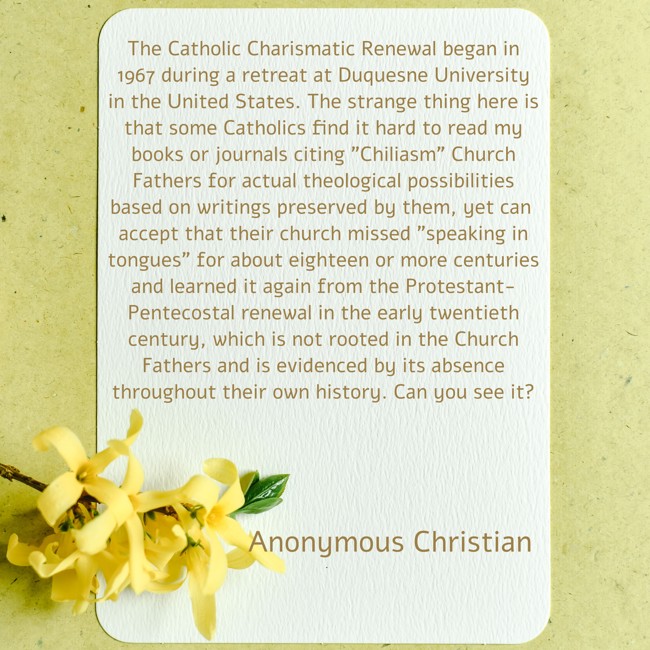
[Text] The entire Pentecostal “speaking in tongues” movement started with this image (via Agnes Ozman’s handwriting claiming to write it in Chinese with the Holy Spirit).
I believe God will understand my doubts. If I’m right to refrain, I’ll be rewarded for being accurate. If I’m wrong for not participating, I’ll simply receive a lesser reward than those who did.
But if the Pentecostals are right, they’ll be rewarded. The real question is: what happens if they’re wrong?
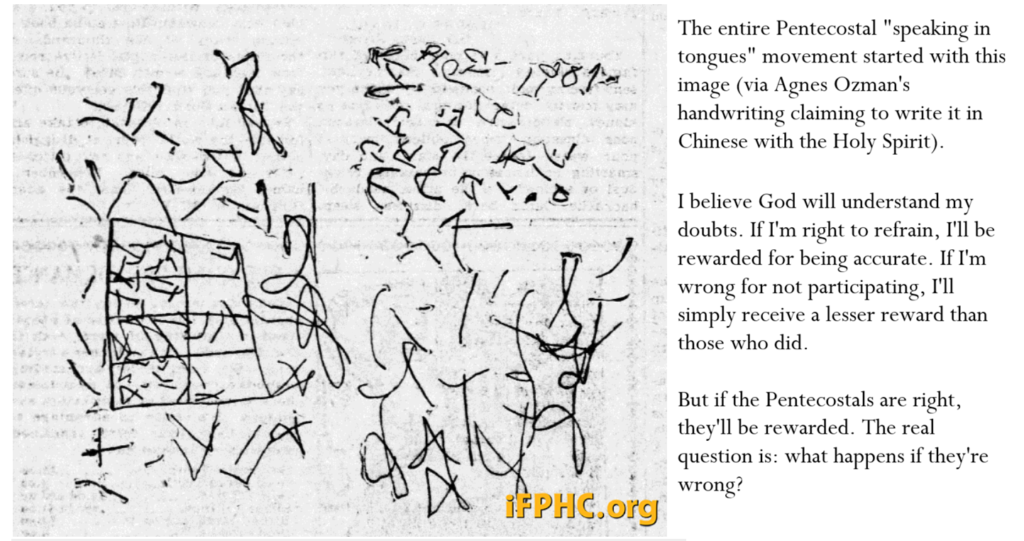
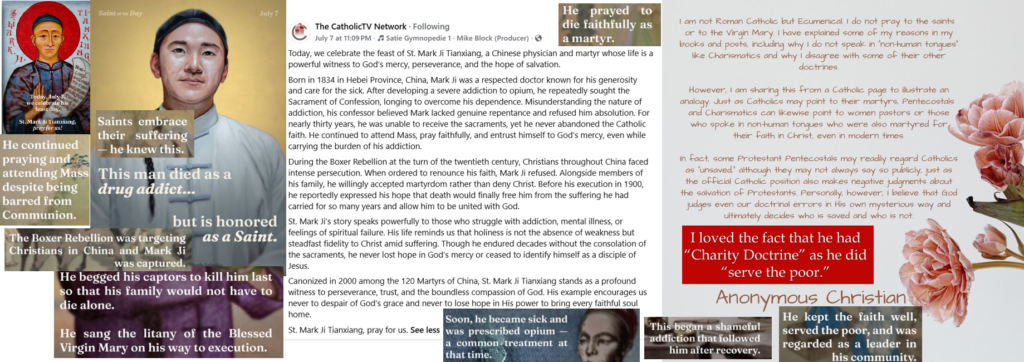
[Text] I am not Roman Catholic but Ecumenical. I do not pray to the saints or to the Virgin Mary. I have explained some of my reasons in my books and posts, including why I do not speak in “non-human tongues” like Charismatics and why I disagree with some of their other doctrines.
However, I am sharing this from a Catholic page to illustrate an analogy. Just as Catholics may point to their martyrs, Pentecostals and Charismatics can likewise point to women pastors or those who spoke in non-human tongues who were also martyred for their faith in Christ, even in modern times.
In fact, some Protestant Pentecostals may readily regard Catholics as “unsaved,” although they may not always say so publicly, just as the official Catholic position also makes negative judgments about the salvation of Protestants. Personally, however, I believe that God judges even our doctrinal errors in His own mysterious way and ultimately decides who is saved and who is not. I loved the fact that he had “Charity Doctrine” as he did “serve the poor.”
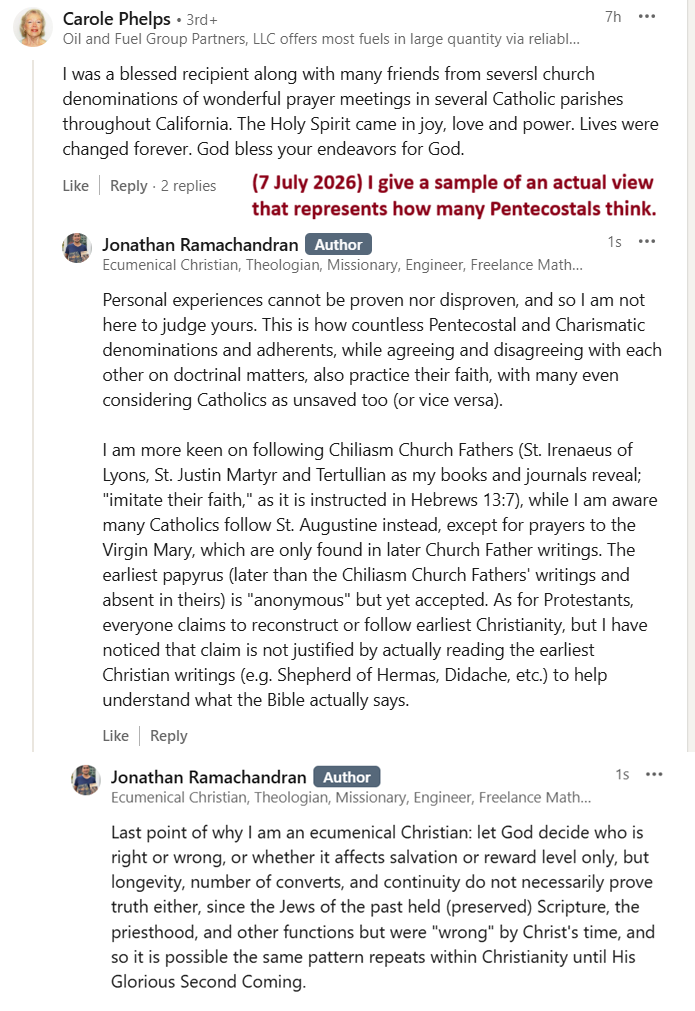
[Text] Next, I give a sample of an actual view that represents how many Pentecostals think.
A Catholic-Charismatic lady wrote: “I was a blessed recipient along with many friends from seversl church denominations of wonderful prayer meetings in several Catholic parishes throughout California. The Holy Spirit came in joy, love and power. Lives were changed forever. God bless your endeavors for God.”
My reply: “Personal experiences cannot be proven nor disproven, and so I am not here to judge yours. This is how countless Pentecostal and Charismatic denominations and adherents, while agreeing and disagreeing with each other on doctrinal matters, also practice their faith, with many even considering Catholics as unsaved too (or vice versa).
I am more keen on following Chiliasm Church Fathers (St. Irenaeus of Lyons, St. Justin Martyr and Tertullian as my books and journals reveal; “imitate their faith,” as it is instructed in Hebrews 13:7), while I am aware many Catholics follow St. Augustine instead, except for prayers to the Virgin Mary, which are only found in later Church Father writings. The earliest papyrus (later than the Chiliasm Church Fathers’ writings and absent in theirs) is “anonymous” but yet accepted. As for Protestants, everyone claims to reconstruct or follow earliest Christianity, but I have noticed that claim is not justified by actually reading the earliest Christian writings (e.g. Shepherd of Hermas, Didache, etc.) to help understand what the Bible actually says.
Last point of why I am an ecumenical Christian: let God decide who is right or wrong, or whether it affects salvation or reward level only, but longevity, number of converts, and continuity do not necessarily prove truth either, since the Jews of the past held (preserved) Scripture, the priesthood, and other functions but were “wrong” by Christ’s time, and so it is possible the same pattern repeats within Christianity until His Glorious Second Coming.”
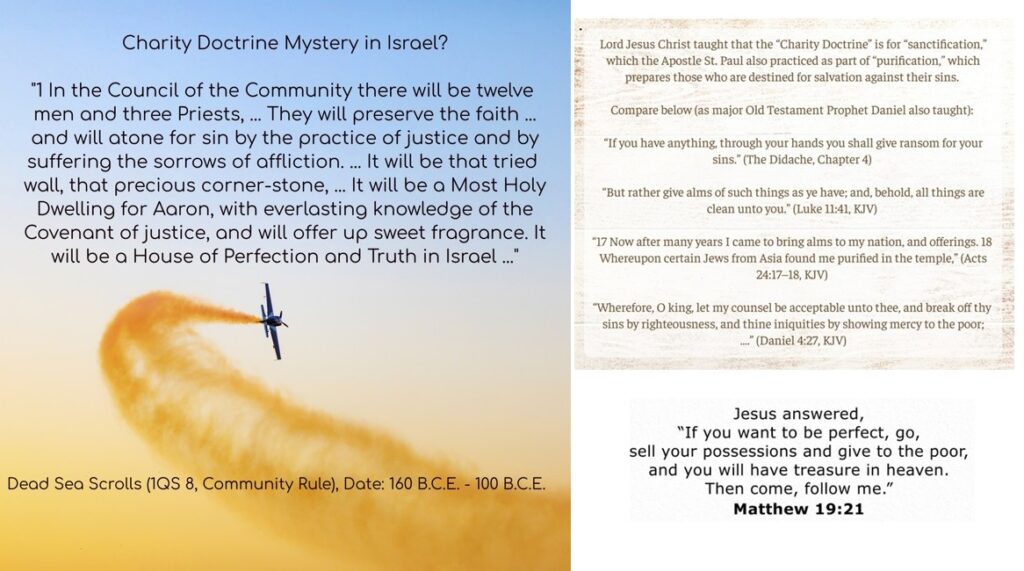
[Text] Charity Doctrine Mystery in Israel?
“1 In the Council of the Community there will be twelve men and three Priests, … They will preserve the faith … and will atone for sin by the practice of justice and by suffering the sorrows of affliction. … It will be that tried wall, that precious corner-stone, … It will be a Most Holy Dwelling for Aaron, with everlasting knowledge of the Covenant of justice, and will offer up sweet fragrance. It will be a House of Perfection and Truth in Israel …”
Dead Sea Scrolls (1QS 8, Community Rule), Date: 160 B.C.E. – 100 B.C.E.
Intertextual Bible. “1QS 8 // 1 Corinthians 3:16.” Accessed July 13, 2026. https://intertextual.bible/text/1qs-8/1-corinthians-3.16.
Lord Jesus Christ taught that the “Charity Doctrine” is for “sanctification,” which the Apostle St. Paul also practiced as part of “purification,” which prepares those who are destined for salvation against their sins.
Compare below (as major Old Testament Prophet Daniel also taught):
“If you have anything, through your hands you shall give ransom for your sins.” (The Didache, Chapter 4)
“But rather give alms of such things as ye have; and, behold, all things are clean unto you.” (Luke 11:41, KJV)
“17 Now after many years I came to bring alms to my nation, and offerings. 18 Whereupon certain Jews from Asia found me purified in the temple,” (Acts 24:17–18, KJV)
“Wherefore, O king, let my counsel be acceptable unto thee, and break off thy sins by righteousness, and thine iniquities by showing mercy to the poor; ….” (Daniel 4:27, KJV)
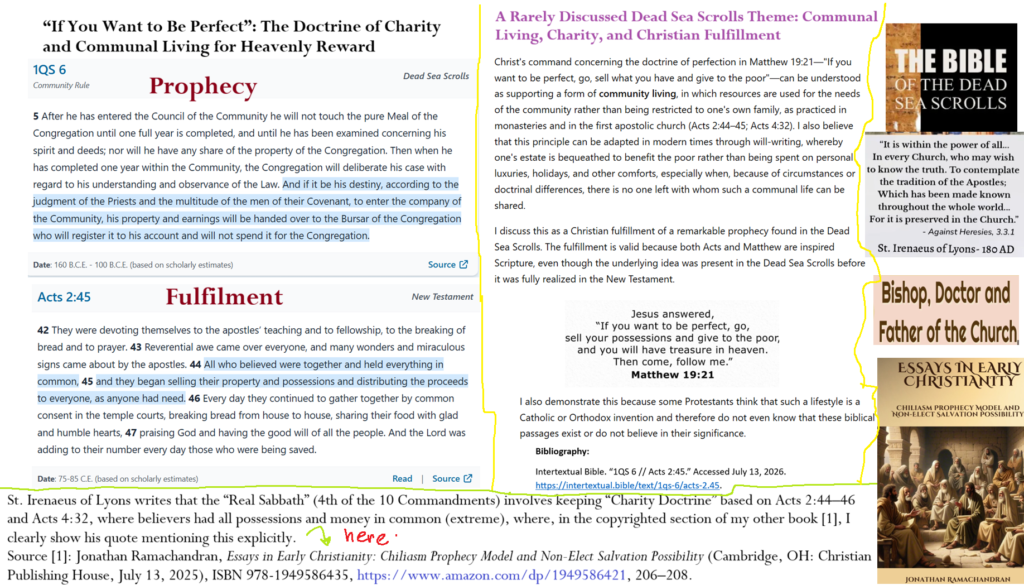
[Text] “If You Want to Be Perfect”: The Doctrine of Charity and Communal Living for Heavenly Reward
Christ’s command concerning the doctrine of perfection in Matthew 19:21—”If you want to be perfect, go, sell what you have and give to the poor”—can be understood as supporting a form of community living, in which resources are used for the needs of the community rather than being restricted to one’s own family, as practiced in monasteries and in the first apostolic church (Acts 2:44–45; Acts 4:32). I also believe that this principle can be adapted in modern times through will-writing, whereby one’s estate is bequeathed to benefit the poor rather than being spent on personal luxuries, holidays, and other comforts, especially when, because of circumstances or doctrinal differences, there is no one left with whom such a communal life can be shared.
I discuss this as a Christian fulfillment of a remarkable prophecy found in the Dead Sea Scrolls. The fulfillment is valid because both Acts and Matthew are inspired Scripture, even though the underlying idea was present in the Dead Sea Scrolls before it was fully realized in the New Testament. I also demonstrate this because some Protestants think that such a lifestyle is a Catholic or Orthodox invention and therefore do not even know that these biblical passages exist or do not believe in their significance.
A Rarely Discussed Dead Sea Scrolls Theme: Communal Living, Charity, and Christian Fulfillment
Prophecy:
1QS 6
Community Rule
Dead Sea Scrolls
5 After he has entered the Council of the Community he will not touch the pure Meal of the Congregation until one full year is completed, and until he has been examined concerning his spirit and deeds; nor will he have any share of the property of the Congregation. Then when he has completed one year within the Community, the Congregation will deliberate his case with regard to his understanding and observance of the Law. And if it be his destiny, according to the judgment of the Priests and the multitude of the men of their Covenant, to enter the company of the Community, his property and earnings will be handed over to the Bursar of the Congregation who will register it to his account and will not spend it for the Congregation.
Fulfilment:
Acts 2:45
New Testament
42 They were devoting themselves to the apostles’ teaching and to fellowship, to the breaking of bread and to prayer. 43 Reverential awe came over everyone, and many wonders and miraculous signs came about by the apostles. 44 All who believed were together and held everything in common, 45 and they began selling their property and possessions and distributing the proceeds to everyone, as anyone had need. 46 Every day they continued to gather together by common consent in the temple courts, breaking bread from house to house, sharing their food with glad and humble hearts, 47 praising God and having the good will of all the people. And the Lord was adding to their number every day those who were being saved.
Bibliography:
Intertextual Bible. “1QS 6 // Acts 2:45.” Accessed July 13, 2026. https://intertextual.bible/text/1qs-6/acts-2.45.
St. Irenaeus of Lyons writes that the “Real Sabbath” (4th of the 10 Commandments) involves keeping “Charity Doctrine” based on Acts 2:44–46 and Acts 4:32, where believers had all possessions and money in common (extreme), where, in the copyrighted section of my other book [1], I clearly show his quote mentioning this explicitly.
Source [1]: Jonathan Ramachandran, Essays in Early Christianity: Chiliasm Prophecy Model and Non-Elect Salvation Possibility (Cambridge, OH: Christian Publishing House, July 13, 2025), ISBN 978-1949586435, https://www.amazon.com/dp/1949586421, 206–208.
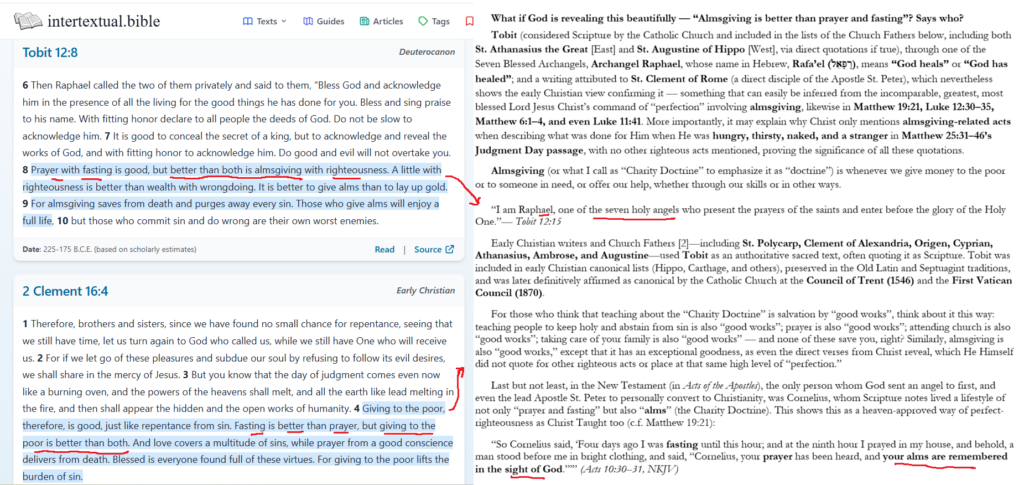
What if God is revealing this beautifully — “Almsgiving is better than prayer and fasting”? Says who?
Tobit (considered Scripture by the Catholic Church and included in the lists of the Church Fathers below, including both St. Athanasius the Great [East] and St. Augustine of Hippo [West], via direct quotations if true), through one of the Seven Blessed Archangels, Archangel Raphael, whose name in Hebrew, Rafa’el (רָפָאֵל), means “God heals” or “God has healed”; and a writing attributed to St. Clement of Rome (a direct disciple of the Apostle St. Peter), which nevertheless shows the early Christian view confirming it — something that can easily be inferred from the incomparable, greatest, most blessed Lord Jesus Christ’s command of “perfection” involving almsgiving, likewise in Matthew 19:21, Luke 12:30–35, Matthew 6:1–4, and even Luke 11:41. More importantly, it may explain why Christ only mentions almsgiving-related acts when describing what was done for Him when He was hungry, thirsty, naked, and a stranger in Matthew 25:31–46’s Judgment Day passage, with no other righteous acts mentioned, proving the significance of all these quotations.
Almsgiving (or what I call as “Charity Doctrine” to emphasize it as “doctrine”) is whenever we give money to the poor or to someone in need, or offer our help, whether through our skills or in other ways.
1) Tobit
“8 Prayer with fasting is good, but better than both is almsgiving with righteousness. A little with righteousness is better than wealth with wrongdoing. It is better to give alms than to lay up gold. 9 For almsgiving saves from death and purges away every sin. Those who give alms will enjoy a full life,” – Raphael (in Tobit 12:8)[1]
Source [1]: Tobit 12:8 and 2 Clement 16:4,” Intertextual Bible, accessed July 14, 2026, https://intertextual.bible/text/tobit-12.8/2-clement-16.4.
“I am Raphael, one of the seven holy angels who present the prayers of the saints and enter before the glory of the Holy One.”— Tobit 12:15
Early Christian writers and Church Fathers [2]—including St. Polycarp, Clement of Alexandria, Origen, Cyprian, Athanasius, Ambrose, and Augustine—used Tobit as an authoritative sacred text, often quoting it as Scripture. Tobit was included in early Christian canonical lists (Hippo, Carthage, and others), preserved in the Old Latin and Septuagint traditions, and was later definitively affirmed as canonical by the Catholic Church at the Council of Trent (1546) and the First Vatican Council (1870).
Source [2]: “Tobias,” The Catholic Encyclopedia, New Advent, accessed July 14, 2026, https://www.newadvent.org/cathen/14749c.htm.
2) 2 Clement
“and then shall appear the hidden and the open works of humanity. 4 Giving to the poor, therefore, is good, just like repentance from sin. Fasting is better than prayer, but giving to the poor is better than both. And love covers a multitude of sins, while prayer from a good conscience delivers from death. Blessed is everyone found full of these virtues. For giving to the poor lifts the burden of sin.” – 2 Clement 16:4[3]
Source [3]: Tobit 12:8 and 2 Clement 16:4,” Intertextual Bible, accessed July 14, 2026, https://intertextual.bible/text/tobit-12.8/2-clement-16.4.
For those who think that teaching about the “Charity Doctrine” is salvation by “good works”, think about it this way: teaching people to keep holy and abstain from sin is also “good works”; prayer is also “good works”; attending church is also “good works”; taking care of your family is also “good works” — and none of these save you, right? Similarly, almsgiving is also “good works,” except that it has an exceptional goodness, as even the direct verses from Christ reveal, which He Himself did not quote for other righteous acts or place at that same high level of “perfection.”
Last but not least, in the New Testament (in Acts of the Apostles), the only person whom God sent an angel to first, and even the lead Apostle St. Peter to personally convert to Christianity, was Cornelius, whom Scripture notes lived a lifestyle of not only “prayer and fasting” but also “alms” (the Charity Doctrine). This shows this as a heaven-approved way of perfect-righteousness as Christ Taught too (c.f. Matthew 19:21):
“So Cornelius said, ‘Four days ago I was fasting until this hour; and at the ninth hour I prayed in my house, and behold, a man stood before me in bright clothing, and said, “Cornelius, your prayer has been heard, and your alms are remembered in the sight of God.”’” (Acts 10:30–31, NKJV)
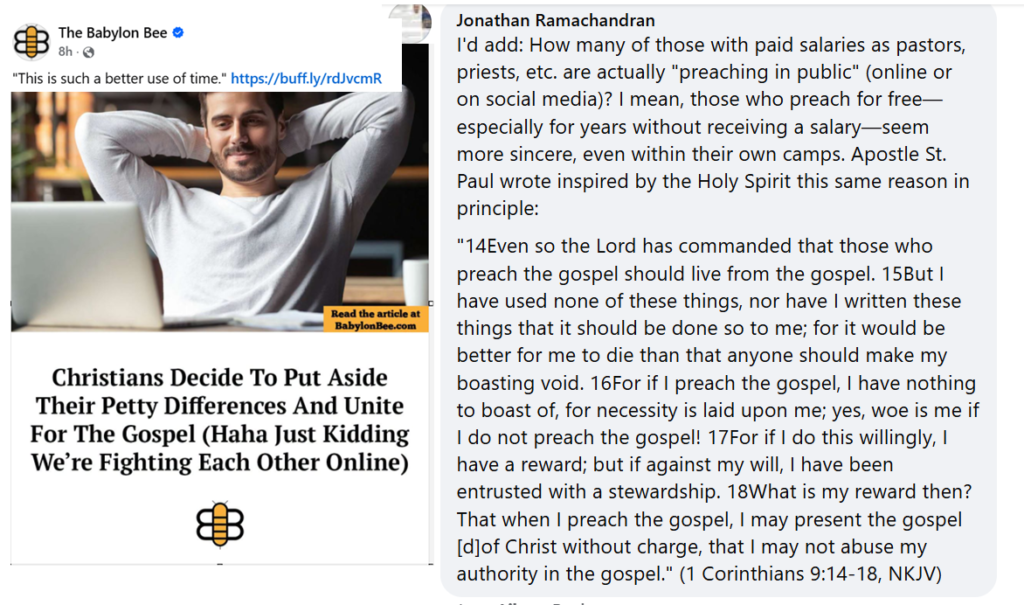
[Text] I’d add: How many of those with paid salaries as pastors, priests, etc. are actually “preaching in public” (online or on social media)? I mean, those who preach for free—especially for years without receiving a salary—seem more sincere, even within their own camps. Apostle St. Paul wrote inspired by the Holy Spirit this same reason in principle:
“14Even so the Lord has commanded that those who preach the gospel should live from the gospel. 15But I have used none of these things, nor have I written these things that it should be done so to me; for it would be better for me to die than that anyone should make my boasting void. 16For if I preach the gospel, I have nothing to boast of, for necessity is laid upon me; yes, woe is me if I do not preach the gospel! 17For if I do this willingly, I have a reward; but if against my will, I have been entrusted with a stewardship. 18What is my reward then? That when I preach the gospel, I may present the gospel [d]of Christ without charge, that I may not abuse my authority in the gospel.” (1 Corinthians 9:14-18, NKJV)
[Text] Proverbs 16:6 (or Proverbs 15:27 for LXX) is a good example where a “charity doctrine” can be inferred, since it is connected with kindness expressed through action or mercy.
It is true that, in some cases, New Testament (NT) writers quote the Septuagint verbatim, while in other cases they reflect wording closer to the Masoretic Text (MT) when the two differ. Therefore, it can sometimes be difficult to determine which textual tradition is being followed. I think the Septuagint is quoted more often than the Masoretic Text in the New Testament.
Brenton’s Septuagint Translation (LXX) – Proverbs 15:27:
“By alms and faithfulness sins are cleansed away: and by the fear of the Lord every one departs from evil.”
King James Version (KJV), translated from the Masoretic Text tradition – Proverbs 16:6:
“By mercy and truth iniquity is purged: and by the fear of the LORD men depart from evil.”
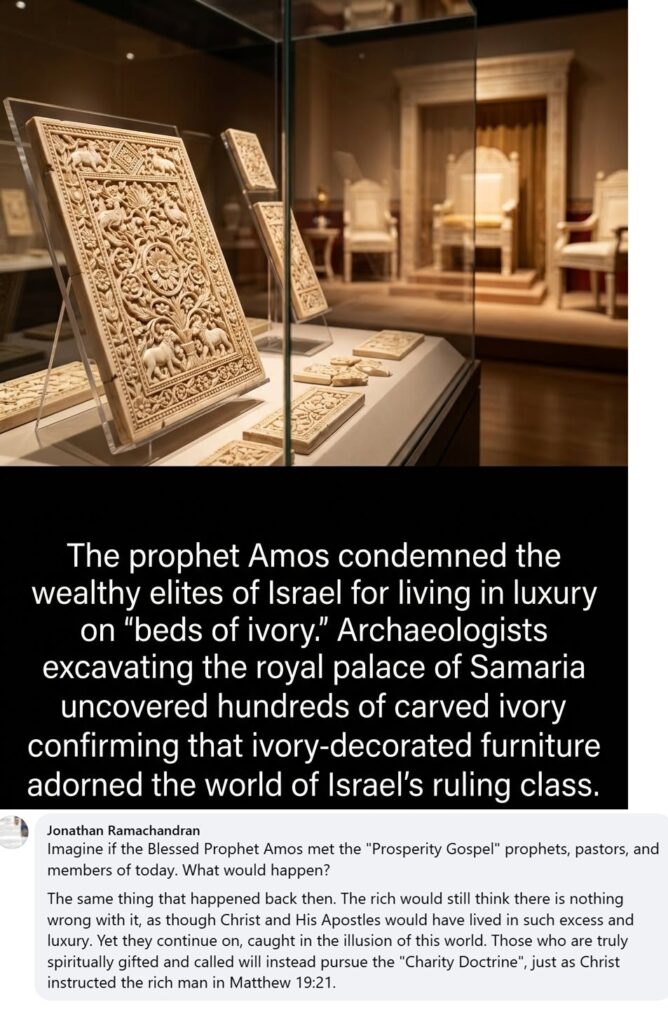
[Text] Imagine if the Blessed Prophet Amos met the “Prosperity Gospel” prophets, pastors, and members of today. What would happen?
The same thing that happened back then. The rich would still think there is nothing wrong with it, as though Christ and His Apostles would have lived in such excess and luxury. Yet they continue on, caught in the illusion of this world. Those who are truly spiritually gifted and called will instead pursue the “Charity Doctrine”, just as Christ instructed the rich man in Matthew 19:21.
[Text] Did You Know? Personally, I would avoid Protestant Bible schools that don’t even teach this properly.
Martin Luther (founder of the Lutheran tradition and widely regarded as the Father of Protestantism), John Calvin (leader of the Reformed tradition and the theologian most closely associated with Calvinism), and John Wesley (founder of the Methodist movement) did not teach that tithing is a binding obligation for Christians.
Nor is there clear historical evidence that they practiced a mandatory 10% tithe. Wesley, however, gave the most among the three—often giving away almost everything—and strongly emphasized the doctrine of charity.
Neither did they teach the modern Prosperity Gospel.
Of course, all three taught generous giving to the church, the ministry, and the poor—not just giving to the church alone. Again, this is proof that you can practice a more accurate form of Christianity than what popular seminaries in your area teach, even in the context of finance. Please don’t be deceived.
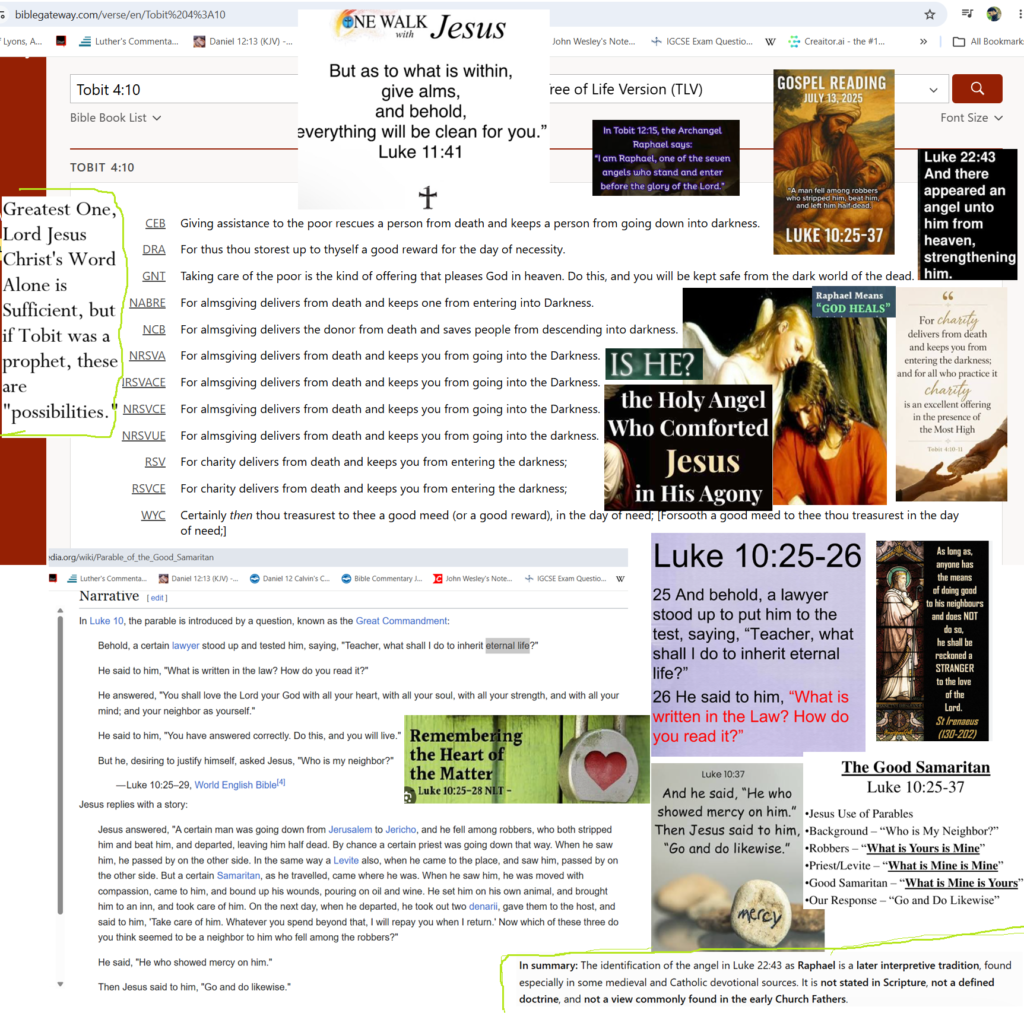
[Text] Tithe or Alms Explanation — And Why Not Both?
The tithe law does not apply to Gentile believers. It is most likely a mistaken reading, since neither St. Augustine of Hippo nor St. Irenaeus of Lyons, both Church Fathers, advocated it. Tithing existed for the Levitical priesthood’s way of life (with no tribal inheritance of the Land with only males as priest from a particular subrace/tribe), which was clearly abolished and replaced by the singular Melchizedek Priesthood of Christ (with no other mediator), as the author of Hebrews mentions. Even when Hebrews mentions tithes, it does not advocate them for New Testament believers to observe. Rather, it mentions them as belonging to the old order that was passing away, serving as a contextual example.
Here’s a Cambridge University Press Journal’s paper supporting my position academically even where the key finding is “Mandatory tithing to the church was not a custom of early Christianity but rather something that developed in late antiquity.”[1]
Source [1]: Eric Shuler, “Caesarius of Arles and the Development of the Ecclesiastical Tithe: From a Theology of Almsgiving to Practical Obligations,” Traditio 67 (2012): 43–69, https://doi.org/10.1017/S036215290000132X.
Notice also carefully that in Luke 11:42, Christ pronounced a “woe” upon the Pharisees for their “tithing,” but also contrasted it with a “blessing,” namely “cleansing” (sanctification), for “alms” (the “Charity Doctrine”) in Luke 11:41. The part where He says, “these you ought to have done,” refers to the Old Testament context and to the Jews.
Alms applies today in the New Testament because many other passages mention it by Christ directly to “Christians” (not the Pharisees), e.g., Matthew 19:21, Luke 12:30–35, Luke 10:25–37, and Matthew 6:1–4, including the future “Judgment Day” passage in Matthew 25:31–46, where Christ never mentioned “tithes” again anywhere else, nor did He quote the “Prophet Malachi” regarding the “prosperity promise if tithes are given,” which was specific to that time of disobedience, since even that “blessing” was not given when the tithe law was instituted in the Law of Moses, meaning it was a specific thing, not universal.
In short, if the Malachi passage or promise applied generally to the New Testament Church, then Christ, Paul, or the other apostles would have quoted or applied it as such. None of them did, which suggests that it was specifically directed to Israel under the Mosaic covenant, especially since this particular promise was not even stated in Deuteronomy when the tithe law was originally given.
The fact if tithers become rich is not proof that God is blessing them because of tithing, since even non-tithing Christians are rich, and even non-Christians are rich as well.
Best is, I have already shown with proof quotes that the Chiliasm Church Fathers (real bishops and leaders of the Church before any “schism-curse”) did not teach tithing at all, and I follow them. [2[
Source [2]: Jonathan Ramachandran, Essays in Early Christianity: Chiliasm Prophecy Model and Non-Elect Salvation Possibility (Cambridge, OH: Christian Publishing House, July 13, 2025), ISBN 978-1949586435, https://www.amazon.com/dp/1949586421, 215–218.
If your church members would not give even 10% of their income unless there is a “prosperity promise of getting rich or a hundred times the amount or equivalent,” wrongly quoting Malachi or other verses to apply to themselves, or even only give to “pastors or church” thinking it gives “greater money or blessings in return,” does that sound “Christlike”?
The truth is, Christlike giving, which He Himself taught, includes giving money even to “enemies” in Matthew 5:44–48 and the charity doctrine toward enemies too (Luke 10:25–37), meaning that fulfilling giving to family, church, ministry, or charity—even to enemies—only gains the “reward” of an intimate relationship, since obedience is proof, and “heavenly treasures,” since earthly recompense is “too low” for such a divine command of perfection.
Summary
For both “What to do to inherit Eternal Life?” and to fulfill the Greatest Commands, Lord Jesus Christ did not mention a verbal formula or creed, but instead God in the Flesh here revealed only 1 Fruit that evidences it, namely, the “Charity Doctrine” in His famous Parable of the Good Samaritan (Luke 10:25–37), as “it is Written.”
These secrets God did not reveal earlier because only the true Messiah, Lord Jesus, can confirm them, meaning that He speaks the greatest truths compared to earlier prophets, having preeminence in all things, even in the divine and best knowledge of God. Can you see it? Keywords:
“And behold, a certain lawyer stood up and tested Him, saying, “Teacher, what shall I do to inherit eternal life? … Love God …Love your neighbor as yourself … he had compassion … went to him and bandaged his wounds, pouring on oil and wine … set him on his own animal … brought him to an inn … took care of him … took out two denarii, gave them to the innkeeper … Take care of him … whatever more you spend, when I come again, I will repay you … Go and do likewise.” (Luke 10:25–37, NKJV)
In short, the doctrine of Almsgiving beyond one’s race, religion, or family, as shown by the Samaritan (whom some Jews considered as “low-class dogs”), is that he was the one who did it for his enemy, the “robbed and wounded Jew,” with his “own money and possessions” (not donation money, which are lower in value), showing an extremely high value of relative measure (compare, e.g., Luke 21:1–3, to know that God measures all this), bearing the fruit of eternal life according to Christ Himself (not humans, not even Apostle Paul), since it fulfills the two greatest commandments (see Mark 12:30 –31), namely, “love God and love your neighbour as yourself” in action beyond tricky words.
This truth is in Luke 10:25–37 and, hence, in all the Bible. Comparing it with Tobit 4:10—that those who give almsgiving their soul will not go into “darkness” (punishment realm of the dead)*—agrees with it and could be true if Tobit is a prophet. But even without Tobit, it is already true because the Holiest Son of God, Lord Jesus Christ, already taught it directly, meaning it is of utmost importance for doctrine for any true church by the relative measure of circumstances. Since this is the “greatest command” and “how to fulfill it” according to Christ directly, it is best to both “teach and do” (Matthew 5:17–20). All else is “secondary doctrine.”
If you did not know nor practice this, do not be angry with God (it is available today even for free by literally just reading the passages given from the Bible online), nor with the preacher (since I did not take monthly tithes, salary, nor love offerings, even if I made you realize this “greatest command” context), but rather be angry logically with your pastor or church (if they did not teach you this while taking all your money), or with your culture (if that did not teach you this either, or if it teaches you to ignore doing it, which certainly is “doctrine of demons” since it teaches against the purest “Unbiased Love of God”).
* Tobit 4:10–11, Douay-Rheims / Vulgate-influenced translation: “For alms deliver from all sin, and from death, and will not suffer the soul to go into darkness”; Good News Translation (GNT): “Taking care of the poor is the kind of offering that pleases God in heaven. Do this, and you will be kept safe from the dark world of the dead,” accessed at Bible Gateway, https://www.biblegateway.com/verse/en/Tobit%204%3A10.
I will re-tell of the Night when the Angels Sang:


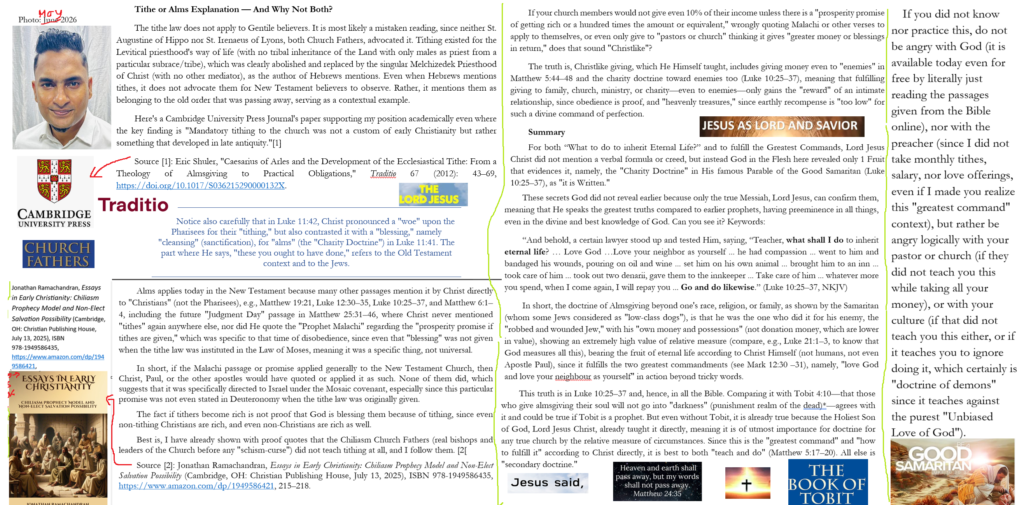

[Text] Impressive, because it’s for the “poor” and provided “free,” unlike many modern Christian schools that primarily serve the “rich” and operate with “business” motives while claiming to be “missionary works.”
Just sharing an interesting perspective, regarding the Lord Jesus Christ’s “Charity Doctrine” as the only righteous act in Scripture mentioned directly to “merit” the reward of “heavenly treasures” (e.g., Matthew 19:21; Luke 12:30–35, etc.), “as it is written.”
Source for images:
https://www.facebook.com/permalink.php?story_fbid=pfbid02YQLXVUbwAtT5FtH8uw5H1MHruGLzZMnuFHzmmua3TpsR5wWJQ3956h6cCQ4rWS2hl&id=100074400020500
Or
https://www.facebook.com/jonathan.ramachandran/posts/pfbid0oxCJAL6y5b1Pym38aYfcmeJLT1MSwiPquZ92tM7464Eiej6HGq1L8KJKz7jbraQQl
It is in the Acts of Thomas, particularly the Second Act, often titled “The Acts of Judas Thomas, When He Entered India and Built a Palace for the King in Heaven.”
Anonymous, Acts of Thomas, PDF, Wesley Center Digital Library, accessed July 22, 2026. [Free PDF: https://apnts.whdl.org/en/browse/resources/20433]
To quote:
The Acts of Thomas (Acta Thomae) is an early Christian apocryphal work about the apostle Thomas’s missionary activity, especially his preaching and miracles in India. It was probably composed in Syriac in the early third century, often dated to approximately the 220s–230s CE, and is associated with the Syriac Christian tradition of Edessa.
The work survives in several languages and manuscripts and consists of thirteen major acts, including the famous story of Thomas building a palace for King Gundaphorus in heaven through his charitable works, as well as the Hymn of the Pearl in some manuscript traditions.
The book is not part of the New Testament canon and is generally classified as one of the early Christian Apocryphal Acts. Its historical value is debated: it is a major early source for the tradition of Thomas’s mission to India, but it also contains extensive legendary and theological material.
For a scholarly overview, see Jonathan Henry, “Acts of Thomas,” e-Clavis: Christian Apocrypha, North American Society for the Study of Christian Apocryphal Literature (NASSCAL), accessed July 22, 2026: https://www.nasscal.com/e-clavis-christian-apocrypha/acts-of-thomas/
Just Interesting.
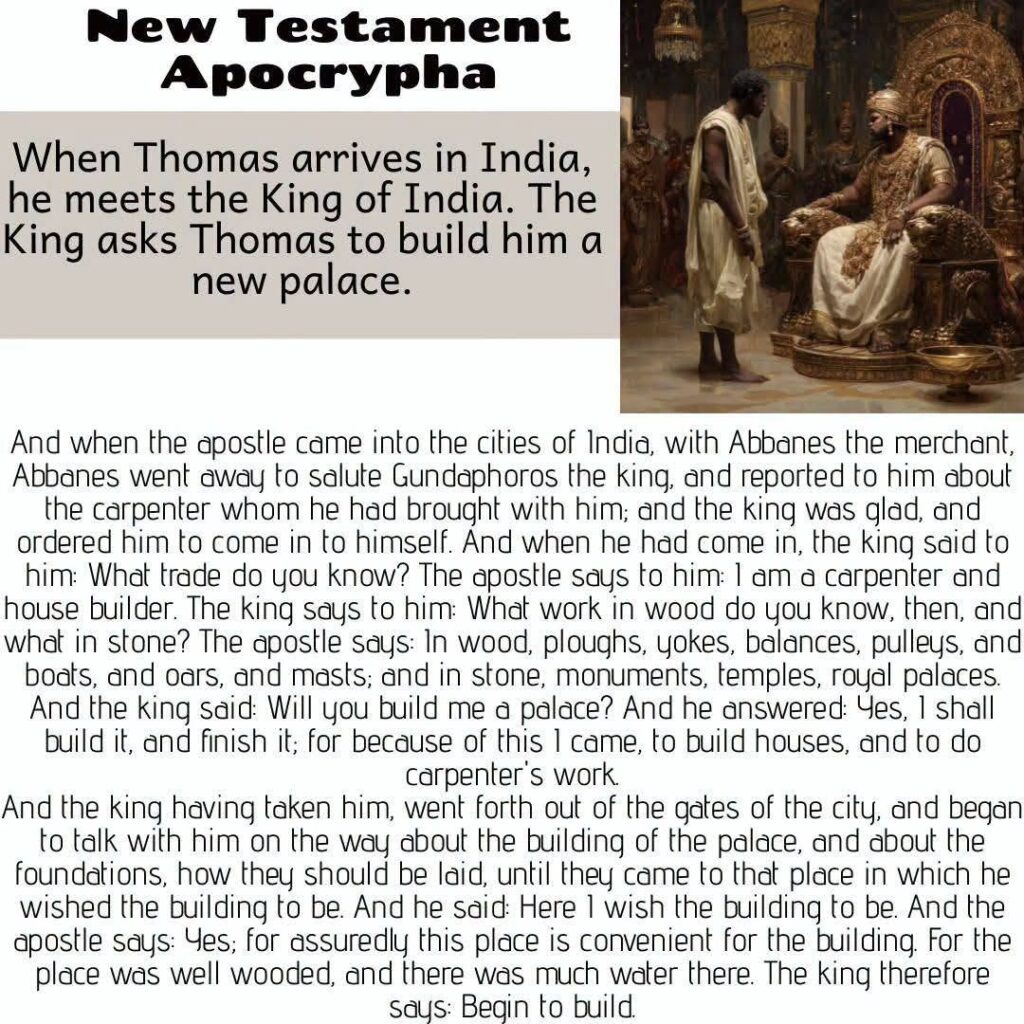
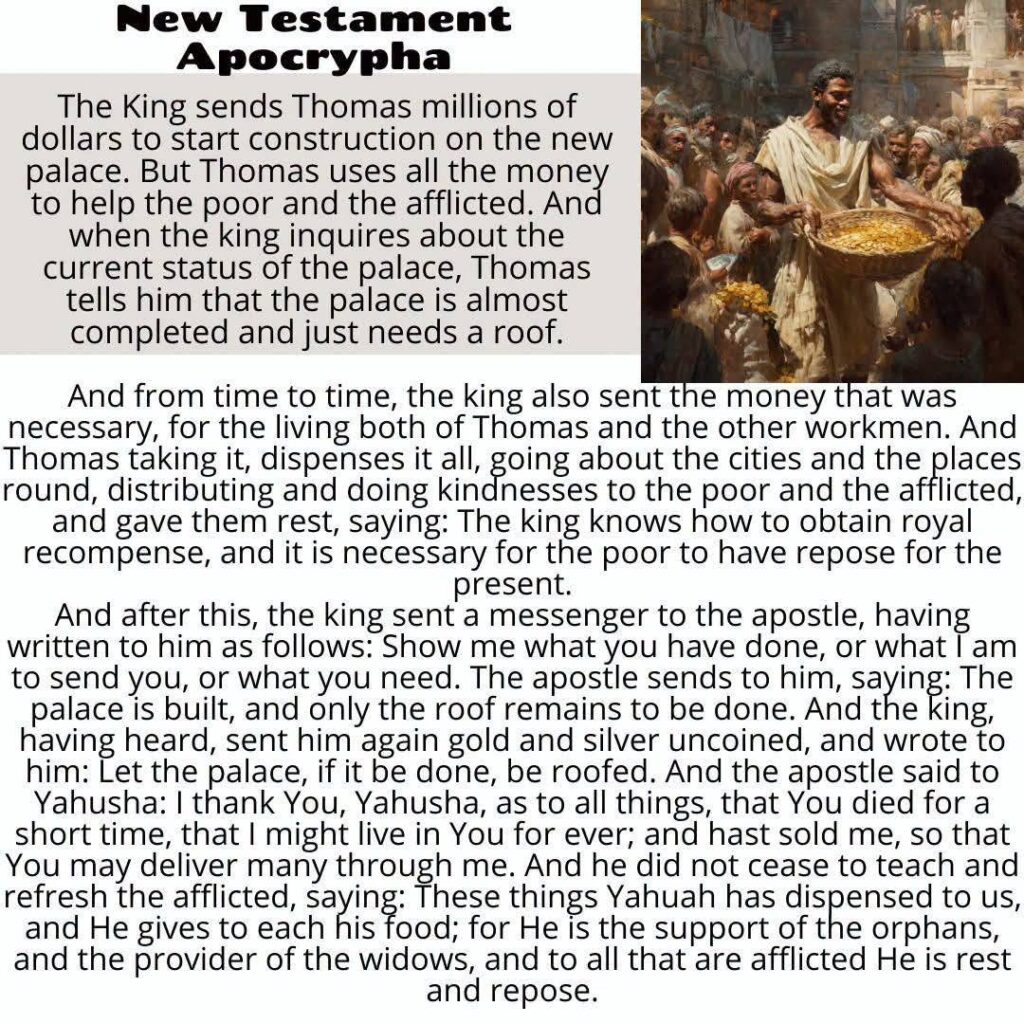
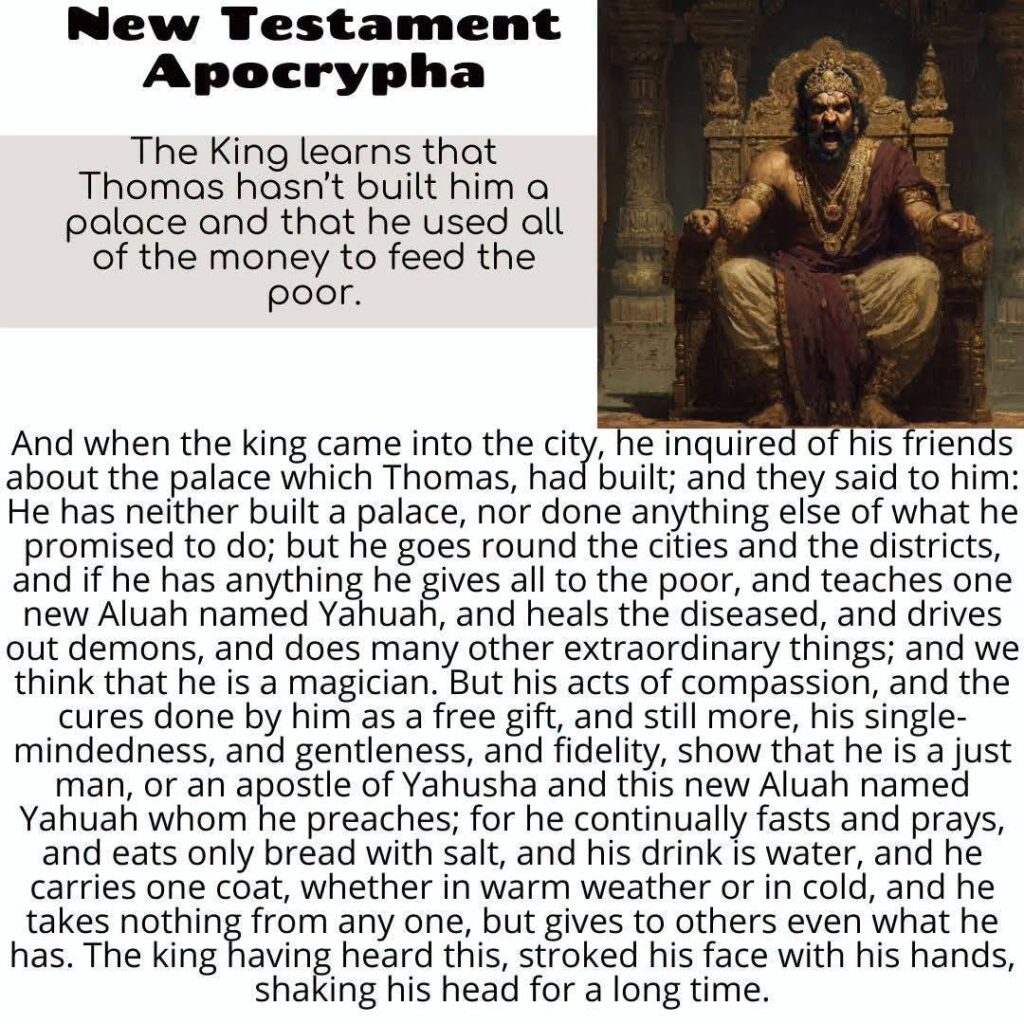
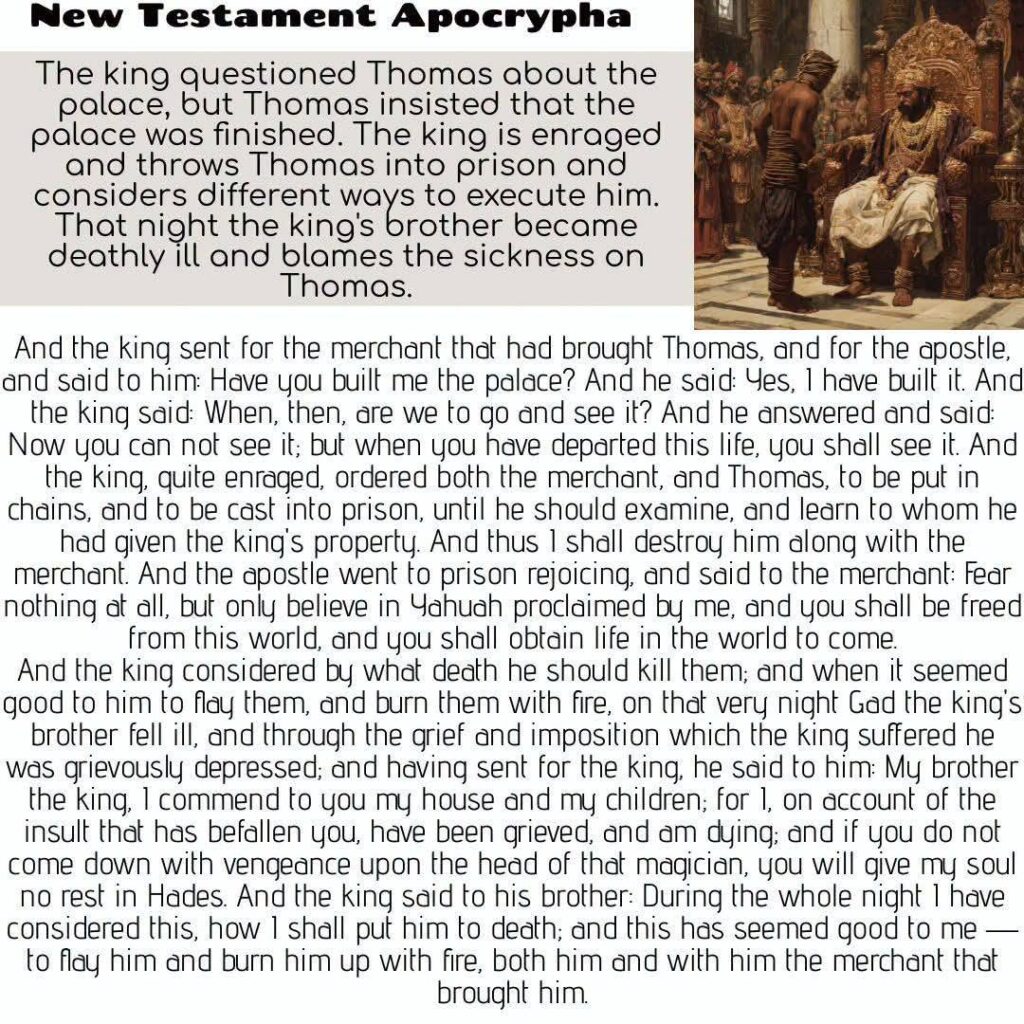
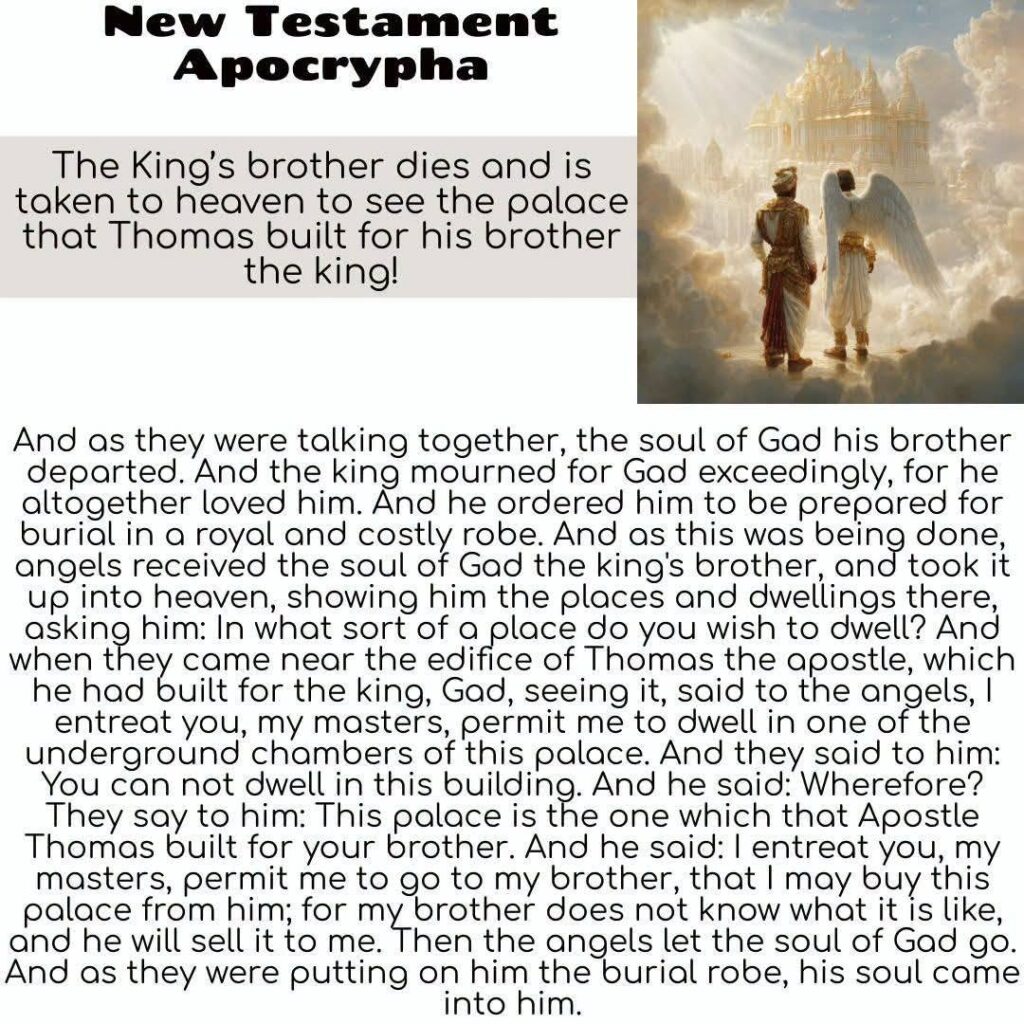
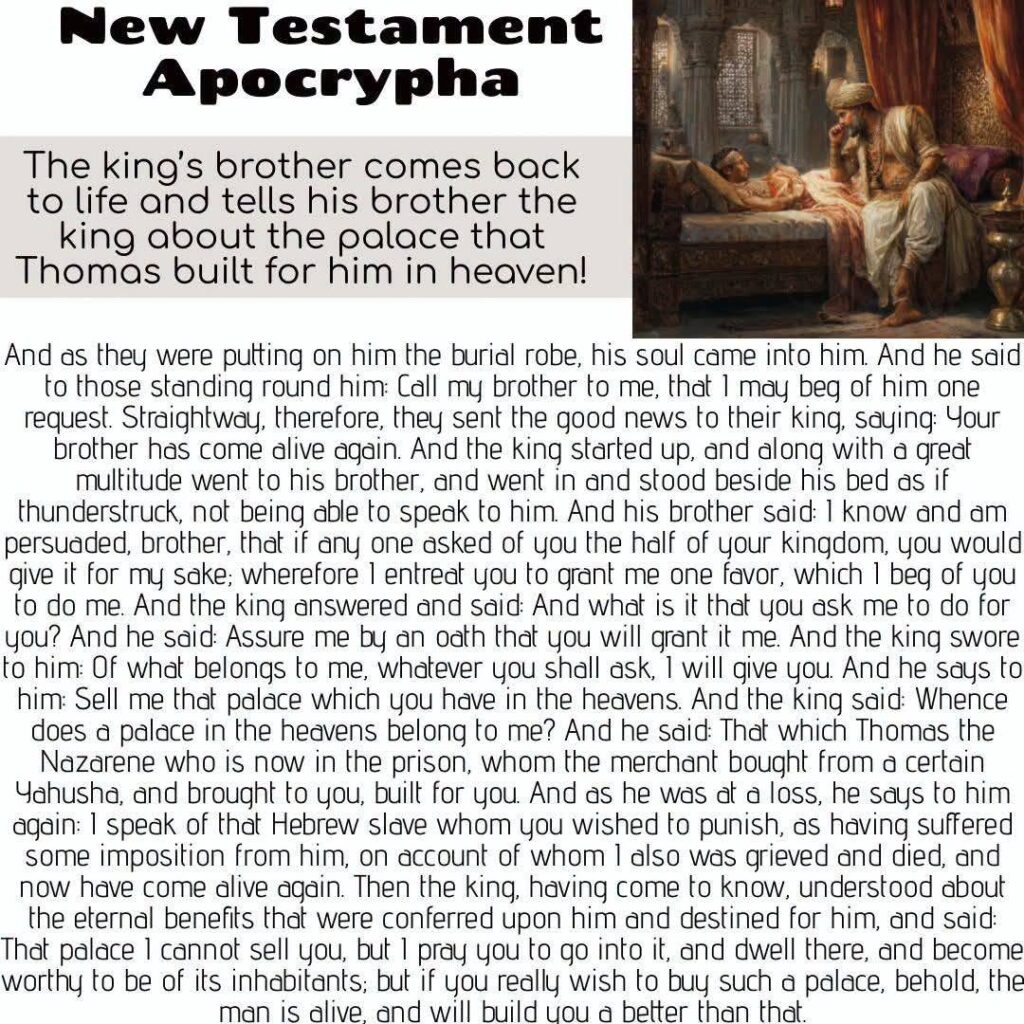
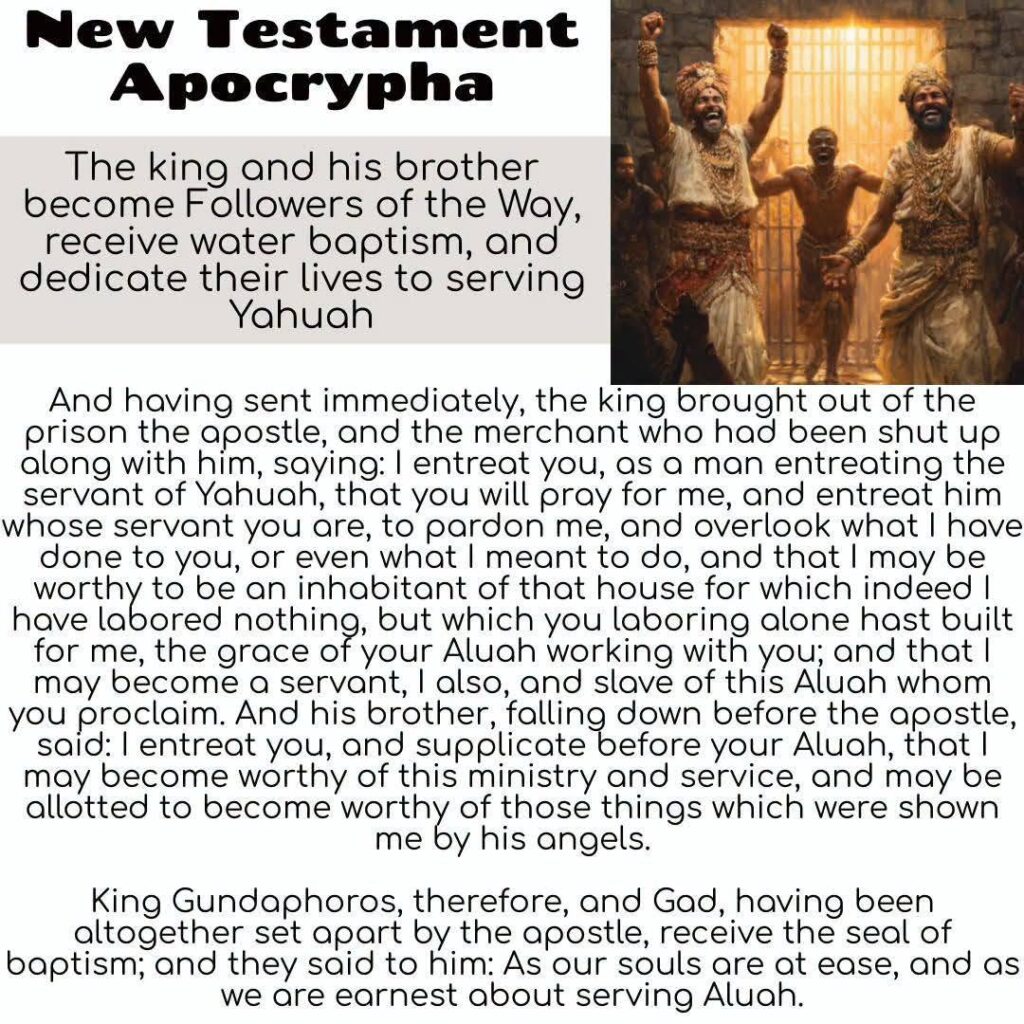
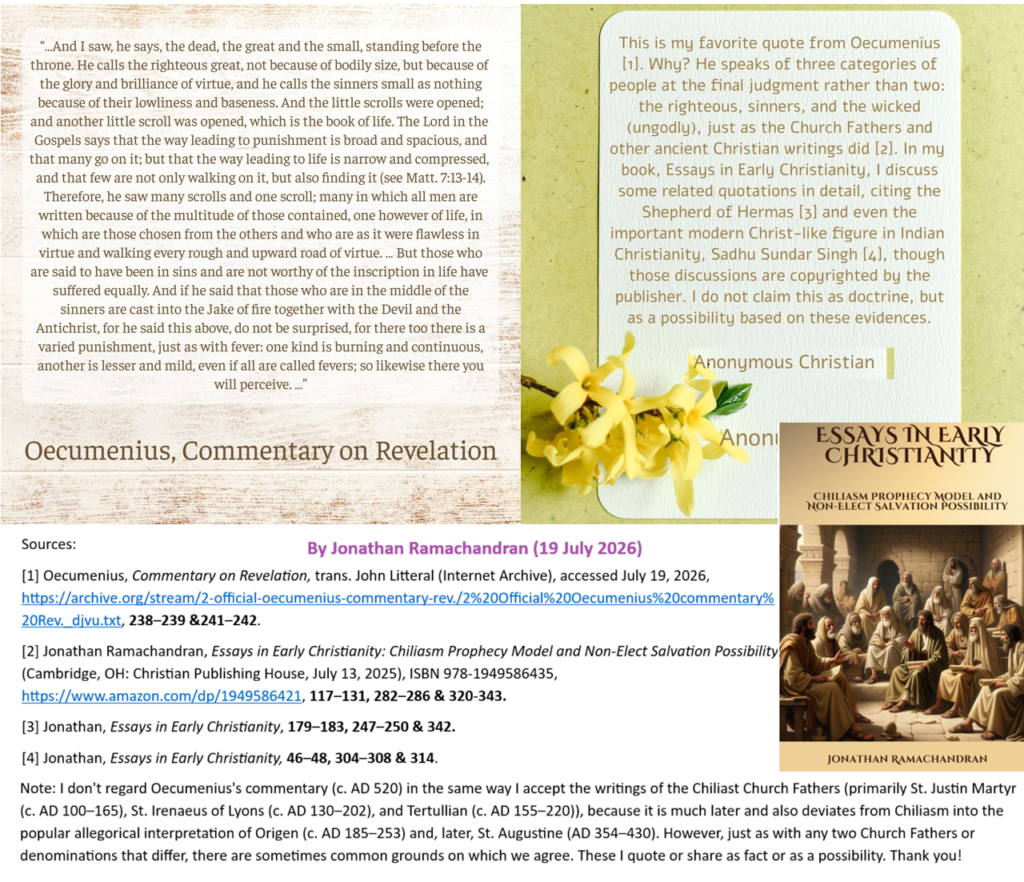
[Text] Full quote is in this source (somewhere at the bottom section):
https://www.linkedin.com/pulse/tithe-alms-explanation-why-both-jonathan-ramachandran-df6hc
This is my favorite quote from Oecumenius [1]. Why? He speaks of three categories of people at the final judgment rather than two: the righteous, sinners, and the wicked (ungodly), just as the Church Fathers and other ancient Christian writings did [2]. In my book, Essays in Early Christianity, I discuss some related quotations in detail, citing the Shepherd of Hermas [3] and even the important modern Christ-like figure in Indian Christianity, Sadhu Sundar Singh [4], though those discussions are copyrighted by the publisher. I do not claim this as doctrine, but as a possibility based on these evidences.
Sources:
[1] Oecumenius, Commentary on Revelation, trans. John Litteral (Internet Archive), accessed July 19, 2026, https://archive.org/stream/2-official-oecumenius-commentary-rev./2%20Official%20Oecumenius%20commentary%20Rev._djvu.txt, 238–239 &241–242.
[2] Jonathan Ramachandran, Essays in Early Christianity: Chiliasm Prophecy Model and Non-Elect Salvation Possibility (Cambridge, OH: Christian Publishing House, July 13, 2025), ISBN 978-1949586435, https://www.amazon.com/dp/1949586421, 117–131, 282–286 & 320-343.
[3] Jonathan, Essays in Early Christianity, 179–183, 247–250 & 342.
[4] Jonathan, Essays in Early Christianity, 46–48, 304–308 & 314.
Note: I don’t regard Oecumenius’s commentary (c. AD 520) in the same way I accept the writings of the Chiliast Church Fathers (primarily St. Justin Martyr (c. AD 100–165), St. Irenaeus of Lyons (c. AD 130–202), and Tertullian (c. AD 155–220)), because it is much later and also deviates from Chiliasm into the popular allegorical interpretation of Origen (c. AD 185–253) and, later, St. Augustine (AD 354–430). However, just as with any two Church Fathers or denominations that differ, there are sometimes common grounds on which we agree. These I quote or share as fact or as a possibility.
Thank you!
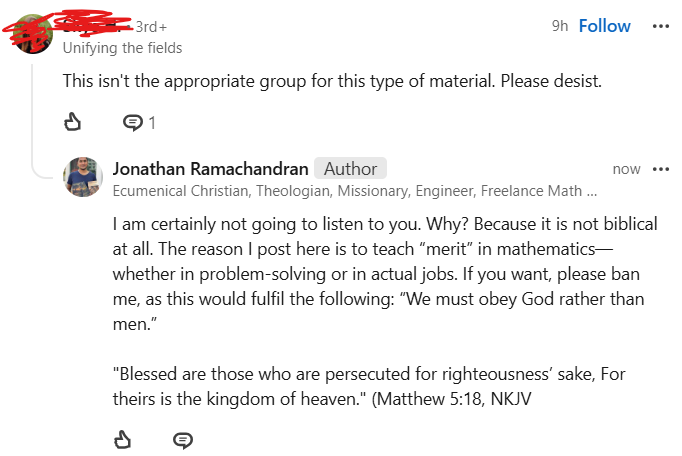
[Text] Someone wrote:
“This isn’t the appropriate group for this type of material. Please desist.”
I replied:
I am certainly not going to listen to you. Why? Because it is not biblical at all. The reason I post here is to teach “merit” in mathematics—whether in problem-solving or in actual jobs. If you want, please ban me, as this would fulfil the following: “We must obey God rather than men.”
“Blessed are those who are persecuted for righteousness’ sake, For theirs is the kingdom of heaven.” (Matthew 5:18, NKJV)
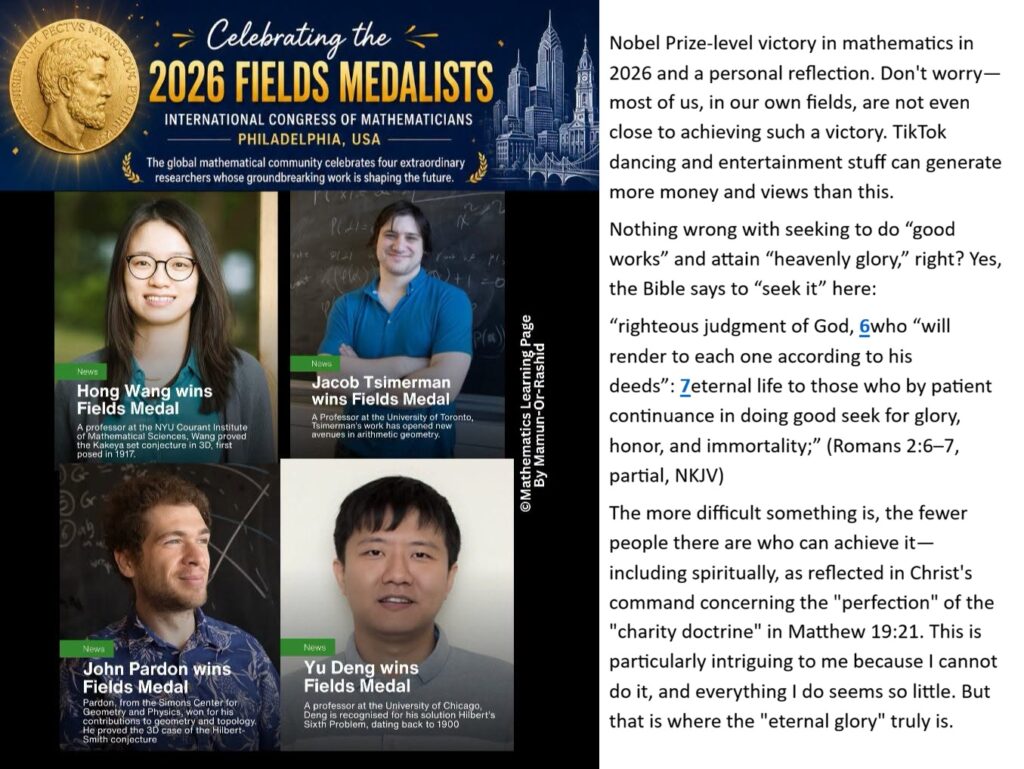
[Text] Nobel Prize-level victory in mathematics in 2026 and a personal reflection. Don’t worry—most of us, in our own fields, are not even close to achieving such a victory. TikTok dancing and entertainment stuff can generate more money and views than this.
Nothing wrong with seeking to do “good works” and attain “heavenly glory,” right? Yes, the Bible says to “seek it” here:
“righteous judgment of God, 6who “will render to each one according to his deeds”: 7eternal life to those who by patient continuance in doing good seek for glory, honor, and immortality;” (Romans 2:6–7, partial, NKJV)
The more difficult something is, the fewer people there are who can achieve it—including spiritually, as reflected in Christ’s command concerning the “perfection” of the “charity doctrine” in Matthew 19:21. This is particularly intriguing to me because I cannot do it, and everything I do seems so little. But that is where the “eternal glory” truly is.

[Text] Video Link:
https://www.youtube.com/watch?v=k0OfDLnGQbQ
Here’s a fact about John Sung that even videos like this don’t mention or focus on:
His relationship to Pentecostalism
John Sung lived during the rise of the global Pentecostal movement, but historians generally do not classify him as a Pentecostal. He worked with a wide range of Protestant churches and deliberately focused on doctrines that united evangelicals rather than distinctive Pentecostal teachings.
Did he oppose tongues?
There is no clear evidence that he publicly condemned speaking in tongues as unbiblical. Likewise, there is no reliable evidence that he practiced it himself or encouraged it as a normative Christian experience.
So the most accurate conclusion is:
• Did John Sung speak in tongues? There is no reliable historical evidence that he did.
• Did he make tongues a major doctrine? No.
• Was he Pentecostal? Generally, no—he is best described as an evangelical revivalist whose ministry centered on repentance, holiness, and biblical preaching rather than charismatic gifts.
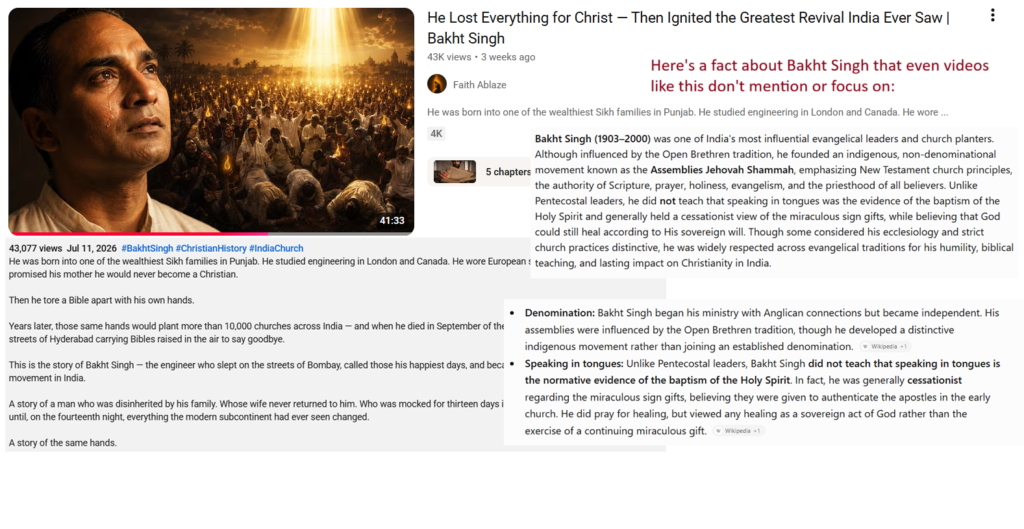
[Text] Video Link: https://www.youtube.com/watch?v=LdEHVuwukRY
Here’s a fact about Bakht Singh that even videos like this don’t mention or focus on:
Bakht Singh (1903–2000) was one of India’s most influential evangelical leaders and church planters. Although influenced by the Open Brethren tradition, he founded an indigenous, non-denominational movement known as the Assemblies Jehovah Shammah, emphasizing New Testament church principles, the authority of Scripture, prayer, holiness, evangelism, and the priesthood of all believers. Unlike Pentecostal leaders, he did not teach that speaking in tongues was the evidence of the baptism of the Holy Spirit and generally held a cessationist view of the miraculous sign gifts, while believing that God could still heal according to His sovereign will. Though some considered his ecclesiology and strict church practices distinctive, he was widely respected across evangelical traditions for his humility, biblical teaching, and lasting impact on Christianity in India.
He was born into one of the wealthiest Sikh families in Punjab. He studied engineering in London and Canada. He wore European suits, cut his sacred hair, and promised his mother he would never become a Christian. Then he tore a Bible apart with his own hands. Years later, those same hands would plant more than 10,000 churches across India — and when he died in September of the year 2000, 250,000 people flooded the streets of Hyderabad carrying Bibles raised in the air to say goodbye. This is the story of Bakht Singh — the engineer who slept on the streets of Bombay, called those his happiest days, and became the father of the indigenous church movement in India. A story of a man who was disinherited by his family. Whose wife never returned to him. Who was mocked for thirteen days in a forgotten village called Martinpur — until, on the fourteenth night, everything the modern subcontinent had ever seen changed. A story of the same hands.
• Denomination: Bakht Singh began his ministry with Anglican connections but became independent. His assemblies were influenced by the Open Brethren tradition, though he developed a distinctive indigenous movement rather than joining an established denomination.
• Speaking in tongues: Unlike Pentecostal leaders, Bakht Singh did not teach that speaking in tongues is the normative evidence of the baptism of the Holy Spirit. In fact, he was generally cessationist regarding the miraculous sign gifts, believing they were given to authenticate the apostles in the early church. He did pray for healing, but viewed any healing as a sovereign act of God rather than the exercise of a continuing miraculous gift.

[Text]: A good ranking Christian Police officer from another country wrote:
“I by accident reported you. I Apologize. Was bussy with a person spreading lies about the Bible. My sincere apologie.”
My Reply:
Oh, I did not realize that and so far, it has not affected me negatively, haha but thanks for being honest and letting me know brother, no worries. If the reporting had worked, still no worries since I would have gotten this reward if God wills then:
“11Blessed are you when they revile and persecute you, and say all kinds of evil against you falsely for My sake. 12Rejoice and be exceedingly glad, for great is your reward in heaven” (Matthew 5:11-12, NKJV)