Free Sample Article from My Book – Imprint Hermeneutics Sample for Apocalyptic Prophecy: “Who Dares to Nuke Israel?”—Third Temple Prophecy, Christian Chiliasm, and the Misunderstood Judgment of Zion
Disclaimer: If this book gets published, this free article may be “removed.”
Chiliasm – Creating the Beautiful Christian: The Bride of Christ!
My Search for the First Christian Ends Here.
Exploring Mixed Possibilities and Doctrine, Even in Prophecy, Regarding the Misunderstood Zionism. Understanding Game Theory in God’s Human Providence: Judgment Context via Unbelieving Israel’s Temple Agenda.
Some say: North Korea’s “Nuke Israel” Statement? 1-to-1 War Claim, but Silence on Many-to-1 Armageddon Hypocrisy.
Disclaimer
Based on 1 Corinthians 5:9-13 (so no heavenly reward exists for breaking it) and respecting my country’s laws, I cannot comment on other religions in a disrespectful manner.
However, I am free to express my views on:
- My own religion
- Non-religion secularism (e.g., North Korea’s recent anti-Israel statement)
Readers may analogously apply these principles to other antisemitic ideas and assess which are more logical or true.
Note: reference for further prophecy in Chiliasm context can be found throughout my book[1].
Background
- Catholic Christians (including Jewish Christians) held Jerusalem long before any other religion could have built a temple for “unbelieving” Jews.
- No Church Father ever wrote that building the Temple was a Christian responsibility.
- Jerusalem was ruled by Christians during the Byzantine period (4th–7th centuries) and again under the Crusaders (1099–1187), yet no effort was made to rebuild the Jewish Temple.
- The only serious late-antique attempt came from the pagan emperor Julian the Apostate in 363 AD, who tried to rebuild it to undermine Christianity — but the project failed.
- Earlier Church Fathers consistently taught that the Temple was fulfilled in Christ and ended in 70 AD. No Church Father ever described rebuilding it as a Christian prophetic responsibility.
Method
- North Korea or other’s claim to eliminate Israel is used as a sample study, referred to as “Religion N.”
- This argument examines prophecy and Church Father writings to understand God’s human providence and judgment.
- Important clarification: So far, none of the authoritative news sources report that North Korea has stated it will use nuclear weapons against Israel, or that it plans to provide nuclear weapons via Iran to strike Israel. Some fringe or unverified online posts claim such statements, but they are not supported by reliable media reporting.
Context: Daniel’s Prophecy
- Daniel reveals that Israel will succeed in rebuilding the Temple.
- The prophecy mentions the Antichrist, who confirms a covenant with many and builds the Temple—not God.
- St. Irenaeus of Lyons and other Chiliasm Church Fathers illustrate:
- The Antichrist achieves this first.
- Mid-week, he declares himself god and kills those who refuse conversion or cannot buy/sell without his mark (“666”).
- Non-Chiliasm Church Fathers (e.g., St. Augustine of Hippo) interpret allegorically rather than literally.
- Daniel confirms that unbelieving Jews do not build the Temple without the Antichrist—this is a judgment context.
Game Theory Alternative
- If unbelieving Jews had fully accepted Jesus Christ as Messiah and repented:
- God would not have allowed Religion N to exist.
- The Temple could have been built without bloodshed.
- King David did not build it due to “too much bloodshed in his hands,” even in lawful wars.
- Jesus Christ, the true Messiah, will build the Temple afterHis Second Coming:
- Ends Armageddon
- Ushers in the 1,000-year Millennial Reign of Christ
- St. Irenaeus’ quotes in my book support this.
“We get the leaders we deserve” – God’s judgment occurs even amid schisms in Christianity.
Pure Christians who avoid bloodshed gain greater final rewards, even if persecuted by Religion N types.
Risks
- Killing me—by Religion N or unbelieving Jews—fulfills prophecy.
- True Christians do not kill anyone to build the Temple, pursue economic gain, or wage religious war.
Scriptural Support
“They will put you out of the synagogues; yes, the time is coming that whoever kills you will think that he offers God service.”— John 16:2, NKJV
“Fill up, then, the measure of your fathers’ guilt. Serpents, brood of vipers! How can you escape the condemnation of hell? Therefore, behold, I send you prophets, wise men, and scribes: some of them you will kill and crucify, and some of them you will scourge in your synagogues and persecute from city to city, that on you may come all the righteous blood shed on the earth, from the blood of righteous Abel to the blood of Zechariah, son of Berechiah, whom you murdered between the temple and the altar. Assuredly, I say to you, all these things will come upon this generation.”— Matthew 23:32–36, NKJV
The Temple Rebuilding Prophecy: Views Across Christian and Jewish Traditions
This article surveys how major Christian denominations—Reformed, Catholic, Lutheran, Methodist, Pentecostal, Orthodox, Anglican, and others—interpret prophecies concerning the rebuilding of Israel’s Temple, alongside the traditional Jewish view which closely associates Temple restoration with the coming of the Messiah. Each section includes representative confessional or doctrinal sources.
1. Reformed (Westminster Confession of Faith)
Source: Westminster Confession of Faith, Chapter XIX, “Of the Law of God,” paragraphs III–IV. [2] [3]
III. Beside this law, commonly called moral, God was pleased to give to the people of Israel, as a Church under age, ceremonial laws, containing several typical ordinances, partly of worship, prefiguring Christ, his graces, actions, sufferings, and benefits; and partly holding forth divers instructions of moral duties. All which ceremonial laws are now abrogated, under the New Testament.
IV. To them also, as a body politic, He gave sundry judicial laws, which expired together with the State of that people; not obliging any other now, further than the general equity thereof may require.
Interpretation:
The Westminster Confession clearly states that Israel’s ceremonial and temple-based worship was typological—fulfilled in Christ—and is no longer required. Thus, no future literal Temple is expected as part of Christian prophecy.
2. Roman Catholic Church
Source: Catechism of the Catholic Church §§585–586.[4]
585. On the threshold of his Passion Jesus announced the coming destruction of this splendid building, of which there would not remain “one stone upon another.” By doing so, he announced a sign of the last days, which were to begin with his own Passover.
586. Far from having been hostile to the Temple, where he gave the essential part of his teaching, Jesus was willing to pay the Temple-tax, associating with him Peter, whom he had just made the foundation of his future Church. He even identified himself with the Temple by presenting himself as God’s definitive dwelling-place among men. Therefore his being put to bodily death presaged the destruction of the Temple, which would manifest the dawning of a new age in the history of salvation: “The hour is coming when neither on this mountain nor in Jerusalem will you worship the Father” (John 4:21).
Interpretation:
Catholic teaching identifies Christ Himself as the new and final Temple, replacing the Jerusalem Temple as the place of God’s presence. There is no expectation or doctrinal need for a future rebuilt Temple.
3. Lutheran (Book of Concord)
Source: Apology of the Augsburg Confession, Article VII/VIII.
“4 Neither are the Sacraments without efficacy for the reason that they are administered by wicked men; yea, we can even be right in using the Sacraments administered by wicked men. For Paul also predicts, 2 Thess. 2:4, that Antichrist will sit in the temple of God, i.e., he will rule and bear office in the Church.”[5]
Interpretation:
Lutheran confessions interpret “temple” language symbolically, referring to the Church as God’s dwelling. The Lutheran tradition does not teach that the physical Temple will be rebuilt as a prophetic requirement.
4. John Calvin (Reformed Commentaries)
Source: Commentary on Daniel 9:27 (Calvin’s Commentaries).
What Calvin does say in that passage
- The passage is Calvin’s exposition on Daniel 9:27, particularly the clause:
“and in the midst of the week he shall cause the sacrifice and the oblation to cease, and for the overspreading of abominations he shall make it desolate …”
- He interprets “cause the sacrifice and the oblation to cease” as meaning that Christ’s sacrifice put an end to the old ritual ceremonies, and that after Christ’s resurrection, those ceremonies lost their legitimacy.
- He also sees the “abominations” and temple profanation in symbolic or historical terms (for example, the destruction of the temple by the Romans, the putting away of the old shadows) rather than expecting a future rebuilt temple desecrated by an Antichrist.
- Calvin explicitly says[6]:
“Thus the temporary pollution of the temple was shewn by Ezekiel … But we are now treating of a profanation of the temple, which should prove, if I may use the phrase, eternal and irreparable. … Without the slightest doubt, this prophecy was fulfilled when the city was captured and overthrown, and the temple utterly destroyed by Titus …”
- He rejects the idea of a restoration of the temple:
“I have no hesitation in stating God’s wish to cut off all hope of restoration from the Jews, whom we know to have been blinded by … suppose God’s presence confined to a visible temple.”
Interpretation:
Calvin interprets the temple prophecy typologically—Christ and His Church replace the old Temple system. His theology consistently denies any prophetic necessity for a rebuilt physical Temple.
5. Martin Luther
Source: SERMONS OF MARTIN LUTHER – TENTH SUNDAY AFTER TRINITY.2.
Luther did not view the rebuilding of a third temple as a Christian prophecy, but rather as a hope or expectation held by the unbelieving Jews. Luther explains that Stephen was killed for declaring that Jesus would destroy the Jerusalem temple and change Mosaic customs (Acts 6:14).
The Jews objected because the prophets and Christ himself had called the temple God’s house of prayer. However, Luther clarifies that the temple, city, and people were meant to last only until Christ’s coming.
After that, the prophetic promises pointed to Christ’s spiritual kingdom, which would extend over the whole world. Citing Malachi 1:10–11, Luther concludes that Christ’s “house of prayer” is no longer a physical temple but the universal Church, where true worship is offered everywhere. In his words:
“For this reason they also murdered Stephen, because he spoke against that holy place and said, Acts 6:14: “Jesus shall destroy this place, and shall change the customs which Moses delivered unto us.” And they said: have not the prophets praised this house, and Christ himself says here, that it is a house of prayer, and you Apostles say, he will destroy it.
25. But we must rightly understand this expression, that the city of Jerusalem, the temple and the people, should remain until the time of Christ. With this agree all the prophets, who have given all things into the hands of Christ; as he would then dispose of it, so it should be and remain.
Hence the passage in Isaiah goes no further than unto the times of Christ, as also all the prophets say, that after that there shall come a kingdom extending over the whole world, as in Malachi 1:10-11 we read: “For from the rising of the sun unto the going down of the same my name shall be great among the Gentiles; and in every place incense shall be offered unto my name, and a pure offering; for my name shall be great among the Gentiles, saith Jehovah of hosts.” Here the prophet speaks of the spiritual kingdom of Christ, who shall build himself a house of prayer as extensive as the whole world..” (“A sermon on the destruction of Jerusalem. In like manner will Germany also be destroyed, if she will not recognize the time of her visitation. What the temple of God is. Martin Luther. Wittenberg, 1525.”)[7]
Here is another sermon from Luther along these lines.
Source: Martin Luther Postil, Matthew 24 (“Twenty-Fifth Sunday after Trinity, Matthew 24-15-28”).
Luther clearly says that the 3rd Jewish temple can “never be rebuilt again” in the physical context when he writes:
“21. St. Paul prophesied all this, when in 2 Thessalonians 2:3-4, he calls him: “The man of sin and the son of perdition, he that opposeth and exalteth himself against all that is called God or that is worshipped; so that he sitteth in the temple of God, setting himself forth as God.” But that the Papists want to turn this passage from themselves and say: Christ and Paul are speaking of the temple of Jerusalem, that Antichrist shall sit and rule there, amounts to nothing. For Christ says here, that Jerusalem together with the temple shall have an end, and after its destruction it shall never be rebuilt. Therefore since Paul is pointing to the time after the Jewish kingdom, and the destruction of the material temple, it cannot be understood otherwise than of the new spiritual temple, which as he says himself, we are.”[8]
In this sermon, Luther explains that the “abomination of desolation” refers to Emperor Gaius (Caius Caligula) setting up his idol in the Jerusalem temple—a symbol of idolatry that marked the end of the Jewish kingdom as foretold by Daniel.
Christ warned that when this occurred, Jerusalem’s destruction was near, and it would never be rebuilt. Luther emphasizes that this prophecy applied specifically to the Jews, whose rejection of Christ and persecution of the apostles brought divine judgment upon them.
He notes that the terrible destruction of Jerusalem—unparalleled in history—was the result of their own stubbornness. Christ urged his followers to flee quickly, which the disciples obeyed, escaping before the city’s fall.
Luther then connects this event to the end of the world, explaining that while such a physical calamity will not happen again, a spiritual war will come upon unbelievers who reject God’s Word, just as the Jews did. He warns that Christ’s kingdom, now spread through the Gospel to all nations, faces the same rejection from false religion and corrupt church leaders. Just as Jerusalem’s fall fulfilled God’s judgment, so too will the final destruction of the ungodly at the end of time.
Luther interprets Paul’s prophecy in 2 Thessalonians 2:3–4 about the “man of sin” sitting in the temple of God as referring not to a rebuilt Jewish temple, but to the spiritual temple—the Church.
Since Christ declared that the Jerusalem temple would be destroyed and never rebuilt, Luther argues that Paul must be speaking of a later spiritual corruption within Christianity itself. He identifies this “man of sin” or Antichrist as the Pope, who exalts himself above everything called God by placing his own authority, decrees, and traditions above God’s Word.
Luther points out that the papacy treats disobedience to its laws—such as clerical marriage or taking Communion in both kinds—as worse sins than theft or adultery, while persecuting true believers as if such violence were service to God. Thus, according to Luther, the papal system perfectly fulfills Paul’s prophecy of the Antichrist enthroned within God’s temple—meaning within the visible Church—exalting human authority and false worship above divine truth.
Interpretation:
Luther’s Christological interpretation equates the true Temple with the incarnate Christ, fulfilled in His death and resurrection. Thus, the restoration of the old Temple is neither needed nor anticipated.
6. John Wesley / Methodist
Source: Wesley’s Explanatory Notes on the New Testament (Daniel 9).
“Daniel 9:27 He shall confirm – Christ confirmed the new covenant, By the testimony of angels, of John baptist, of the wise men, of the saints then living, of Moses and Elias. By his preaching. By signs and wonders. By his holy life. By his resurrection and ascension. By his death and blood shedding. Shall cause the sacrifice to cease – All the Jewish rites, and Levitical worship. By his death he abrogated, and put an end to this laborious service, for ever…”[9]
Interpretation:
Wesley clearly treats Jesus’ statement as referring to His resurrection, with the Temple as a metaphor. Methodist theology thus views the prophecy as fulfilled in Christ, not in a future structure.
The commentary on Daniel 9:25–27 explains that the prophecy begins with the decree (by Cyrus or Darius) to rebuild Jerusalem. After the appointed “seven and sixty-two weeks,” the Messiah would come and be “cut off,” not for His own sins but for humanity’s salvation. Following this, the Romans under Titus would destroy Jerusalem and the temple, fulfilling God’s decree of desolation.
Christ, the promised One, would confirm the new covenant through His teaching, miracles, death, and resurrection. By His sacrifice, He ended the old Levitical system, making temple sacrifices unnecessary forever. The passage concludes that God would send a spirit of spiritual blindness over Israel until the appointed time when their restoration and salvation would come.
7. Orthodox
These excerpts show that, if the prophecy of a third temple is understood in a literal, physical sense, it would serve as the place where the Antichrist exalts himself as “god” — not a temple built for Christ.
i) Faith Protection — “Arab-Israeli Conflict and Prophecies about the ‘Third Temple’” (Union of Orthodox Journalists)[10]
- This discusses how some Orthodox holy fathers believed the Apostle Paul’s reference in 2 Thessalonians 2:3-4 (“sits in the temple of God …”) might refer to the old Jewish temple (i.e. the Jerusalem Temple) rather than only the Church.
- It quotes St. John of Damascus: “In the church of God – not ours, but the ancient one, the Jewish”. And St. Cyril of Jerusalem: “What church? In the ruined temple of the Jews, rather than the one we are now in…” etc.
- The article also mentions that some fathers consider that the Antichrist will sit in a restored Jewish temple. Others believe “temple” is more symbolic. So it’s not unanimous.
ii) St. Paisios of Mount Athos (quoted in Orthodox media)[11]
- Elder Paisios is widely respected in modern Orthodox monastic circles. He is attributed with saying:
“A sign that the fulfillment of the prophecies is approaching will be the destruction of the Omar Mosque in Jerusalem. It will be destroyed to rebuild the Temple of Solomon, which is said to have been in its place. In the rebuilt temple, the Zionists will eventually proclaim the Antichrist as the Messiah.”
- But note: these are private prophetic-monastic speculations rather than official Church teaching. They are widely circulated, but not part of a dogmatic or conciliar statement.
iii) OrthodoxChrist.info — “On the Threshold” article (Orthodox America)[12]
- This article interprets Daniel 9:24-27 in a traditional Orthodox way: the sevens (weeks) point to the restoration of Jerusalem, the coming of Christ, etc. It also says:
“The Jews want to build on this same site a new temple. But this will be the third temple, concerning which the ancient prophets said nothing. This will be that temple that the Apostle Paul had in mind when he said that in it would sit the Antichrist (II Thes. 2:4).”
- That suggests that at least some Orthodox apologists or writers do teach that Paul believed in a literal temple for the Antichrist. But again, this is commentary / opinion, not dogmatic teaching.
Interpretation:
Orthodox theology understands the Temple as a type fulfilled in Christ and perpetuated in the Church and Eucharist. There is no dogmatic teaching expecting a future physical Temple.
8. Anglican
There is no authoritative Anglican (Church of England / Lambeth / Anglican Communion) declaration that mandates belief in a future physical rebuilding of the Jerusalem Temple. Anglican formularies (Thirty-Nine Articles, BCP, Lambeth resolutions) do not address a “Third Temple” as required belief. Anglican teaching therefore allows a range of eschatological interpretations (literal/futurist, symbolic/realized, amillennial, etc.). Sample:
“The Church is the Third Temple built on Yeshua (Jesus) as the cornerstone. We do not formally endorse the view of a future third temple building – nor do we oppose it. Should that be the case, this building would not replace the Church as the real Third Temple, where both the Twelve Tribes of Israel and all nations are gathering together under the God of Israel (Rev 7).”[13]
Interpretation:
Anglican doctrine has no official stance requiring belief in a future physical Third Temple, allowing diverse interpretations of biblical prophecy.
9. Jewish (Orthodox and Rabbinic Tradition)
The belief that Zionism’s prophecy involves rebuilding the Temple before Christ’s return is rooted in Jewish expectation, not in historic Christian teaching.
Source: Maimonides, Mishneh Torah, Hilchot Melachim 11:1 and 11:4
i) Hilchot Melachim 11:1[14]
“The King Messiah will arise and restore the kingdom of David to its former sovereignty. He will build the Temple and gather the dispersed of Israel. In his days, all the laws will return as they were before; we will offer sacrifices, and observe the Sabbatical and Jubilee years according to all their details as set forth in the Torah. Whoever does not believe in him, or does not await his coming, denies not only the prophets, but also the Torah and Moses our teacher, for the Torah testified concerning him.”[15] — Mishneh Torah, Hilchot Melachim uMilchamot, Chapter 11, Halachah 1.
ii) Hilchot Melachim 11:4[16]
“If a king arises from the house of David, who studies the Torah and observes its commandments as David his ancestor did, in accordance with the written and oral Torah, and he compels all Israel to walk in it and strengthen its breaches, and he fights the wars of the Lord, he may be presumed to be the Messiah. If he does so successfully, builds the Temple in its place, and gathers the dispersed of Israel, then he is certainly the Messiah.”[17]
— Mishneh Torah, Hilchot Melachim uMilchamot, Chapter 11, Halachah 4.
Interpretation:
In Orthodox Judaism, rebuilding the Temple is both a commandment and proof of the Messiah’s identity. Daily prayers, such as the Amidah, include petitions for the Temple’s restoration.
Summary
Christian traditions—including Reformed, Lutheran, Calvinist, Methodist, Catholic, Orthodox, and Anglican—see the Jerusalem Temple as fulfilled in Christ and the Church, rejecting any necessity for a future physical rebuilding. Prophecies about the “man of sin” or Antichrist are understood symbolically within the Church, not as a literal temple event. In contrast, Jewish tradition views the Temple’s restoration as central to the coming of the Messiah, with rebuilding tied to Messianic fulfillment. Thus, expectation of a future physical Temple is a Jewish belief, not part of historic Christian doctrine.
In my book[18], based on research into Chiliasm and the writings of Irenaeus of Lyons—a disciple of Polycarp and student of the Apostle John—I present an interpretation not found even in official Christian positions (and I welcome correction if historical sources suggest otherwise):
False Zionism seeks to rebuild the Temple before Christ’s return, expecting a messiah who turns out to be the Antichrist, appearing as a peacemaker but desecrating the Temple midway through his covenant. True Zionism, by contrast, begins with Christ’s glorious Second Coming, when He destroys the Antichrist, raises the faithful, and inaugurates the Millennial Kingdom. The Temple and Jerusalem are fully restored only after Christ returns, as affirmed by Irenaeus, marking God’s true, everlasting reign. (For documentation see Essays in Early Christianity: Chiliasm Prophecy Model and Non-Elect Salvation Possibility, pp. 39, 102, 359-369, 405, Christian Publishing House, 2025.) Maranatha!
Summary
- Christian Zionism vs. Unbelieving Jewish Zionism:
- Christian Zionism: zero wars and bloodshed in this New Testament timeline
- Unbelieving Jewish Zionism: historically full of wars and bloodshed
- Judge my beliefs based on what I actually believe, not assumptions.
- Compare the beauty and perfection of your own religion or worldview.
Reflection
- Amid hidden agendas, discrimination, and religious power struggles, am I “mad” or “possessed by the Devil” when I don’t support any of these?
- Pure Chiliasm Christians, following non-bloodshed paths, shine with the highest heavenly glory and possess true “insight,” as I follow St. Irenaeus of Lyons since “prophecy is not of any private interpretation” (2 Peter 1:20), fully quoted in my book titled “Essays in Early Christianity: Chiliasm Prophecy Model and Non-Elect Salvation Possibility” even in Antichrist & Temple Rebuilding Prophecy contexts (yes, full quotes are included in the book; there is too much to quote here, and I must respect my publisher by not infringing copyright). These may surpass mere “stars” of glory, even if saved, in the context of this prophecy and for accuracy in this topic (cf. Daniel 12:3, another prophecy of Daniel).
Conclusion
Is your religion or humanism this beautiful or perfect? Read and compare for yourselves!
The sad part: prophecy already indicates that many will not repent or believe, even after reading all this—meaning the Antichrist, wars, and murders will still occur (the other alternative, according to “game theory,” is allowed by God through our collective will for judgment)—all “as it is written.”
For those who are called, come, repent, believe in Christ, and become beautiful in eternity!
After all this drama and the hidden, unspoken, murderous agendas on both sides affecting daily life decisions—from discrimination to “prosperity games” meant to prove the superiority of one’s religion, culture, or worldview—I am the “mad” one and “possessed by the Devil,” is that it?
“I am the light of the world. He who follows Me shall not walk in darkness, but have the light of life.”— John 8:12, NKJV
Choose your beliefs and interpret prophecy wisely, for the loss of reward is eternal; Maranatha! Even so, come, Lord Jesus. Amen.
P/S: I know that your strength and nuclear weapons (of USA) can obliterate entire “holy cities” of other nations, meaning none of their prophecies could ever come to pass—since those places would be gone and could not even be inhabited again due to the aftermath of nuclear waste, contradicting their own writings which proclaim the continuity of such sites till the end of time (and God returns to Judge).
But remember Christ: the Antichrist will also do the worst to all when he appears, whatever evil he is decreed to do. As Christians, the greatest heavenly reward is for those who love their enemies. Though I understand the need for nations to wage a just war, I am not sure if all of this is right, since both sides have terrible faults, and the Lord Jesus Christ will judge on Judgment Day. In short, evil will happen, but may it not be through us.
Why Pentecostal Theology Grew Rapidly and Gained Support from Unbelieving Jews: Differences Between Christian Zionism and Jewish Zionism — Before Calling Me a False Prophet, Please Read This First
Pentecostal theology has grown very quickly and gained support from unbelieving Jews, which has chiefly fueled their conversion numbers into Christianity today. Simply put: many Pentecostals view the building of the Third Temple as an act of God rather than a work of the Antichrist.
Reason for this brief highlight: in nearly every Christian denomination, some believers secretly accuse others of being “false prophets” based on disagreements over prophecy, particularly regarding this verse:
“Then many false prophets will rise up and deceive many.” (Matthew 24:11, NKJV)
For now, we will set aside Non-Elect Salvation Possibility (NESP) and the 1,000-year gap interpretation of 1 Thessalonians 4:17 and 1 Corinthians 15:52, from my journal papers, as these are possibilities rather than settled doctrine, which Jeremiah 23:36–40 allows.
The key difference in modern Christian doctrine lies in whether the Third Temple is built “now” by God or by the Antichrist. This distinction has significant implications for identifying false prophets, since it affects global events today.
Two Main Views
- God builds the Third Temple, but the Antichrist later hijacks it
- Christian Zionists must therefore support unbelieving Jews.
- The building of the Temple will usher in the Second Coming of Christ. Pentecostal Christians usually support this view.
- Unbelieving Jews, however, may believe that Christ will not come, and the figure Christians call the Antichrist will instead be their true Messiah.
In this popular Pentecostal understanding[19]:
- The Antichrist does not build the Temple.
- Instead, the Antichrist enters the already-built Temple at the midpoint of the seven-year Tribulation and defiles it (the “abomination of desolation”).
- Therefore, the act of building the Temple itself is not attributed to the Antichrist but is part of God’s prophetic schedule, later misused by the Antichrist.
Some non-Pentecostals also subscribe to this view. The question remains: are these believers the “false prophets” Christ warned about, or are the ones quoted below the false prophets instead? You decide.
- The Antichrist Builds the Third Temple as a Sign of God’s Judgment
- In this view, the Antichrist constructs the Third Temple as part of God’s judgment on unbelieving Jews.
- Christian Zionists do not support the building of the Temple under this scenario. Instead, they may work to deter it, knowing that the Antichrist will eventually deceive or manipulate Christians into participating.
- According to this perspective, Christ Himself rebuilds the Third Temple after His Second Coming, destroying any prior “fake” building carried out by the Antichrist.
Sample Church Father Quotes:
i) St. Ephrem the Syrian – c. 306 – 373 AD
“Therefore, when he [the antichrist] receives the kingdom, he orders the temple of God to be rebuilt for himself, which is in Jerusalem; who after coming into it, he shall sit as God.—Ephraim the Syrian, A.D. 373. (Thomas Ice and Timothy J. Demy, When the Trumpet Sounds)”[20] [21]
ii) St. Cyril of Jerusalem – c. 313 – 386 AD
“15. And again he says, Who opposes and exalts himself against all that is called God, or that is worshipped; (against every God; Antichrist forsooth will abhor the idols,) so that he seats himself in the temple of God. 2 Thessalonians 2:4 What temple then? He means, the Temple of the Jews which has been destroyed. For God forbid that it should be the one in which we are! Why say we this? That we may not be supposed to favour ourselves. For if he comes to the Jews as Christ, and desires to be worshipped by the Jews, he will make great account of the Temple, that he may more completely beguile them; making it supposed that he is the man of the race of David, who shall build up the Temple which was erected by Solomon. And Antichrist will come at the time when there shall not be left one stone upon another in the Temple of the Jews, according to the doom pronounced by our Saviour;”[22]
iii) St. Hippolytus of Rome – c. 170 – 235 AD
“6. Now, as our Lord Jesus Christ, who is also God, was prophesied of under the figure of a lion, on account of His royalty and glory, in the same way have the Scriptures also aforetime spoken of Antichrist as a lion, on account of his tyranny and violence. For the deceiver seeks to liken himself in all things to the Son of God. Christ is a lion, so Antichrist is also a lion; Christ is a king,John 18:37 so Antichrist is also a king. The Saviour was manifested as a lamb; John 1:29 so he too, in like manner, will appear as a lamb, though within he is a wolf. The Saviour came into the World in the circumcision, and he will come in the same manner. The Lord sent apostles among all the nations, and he in like manner will send false apostles. The Saviour gathered together the sheep that were scattered abroad, and he in like manner will bring together a people that is scattered abroad. The Lord gave a seal to those who believed on Him, and he will give one like manner. The Saviour appeared in the form of man, and he too will come in the form of a man. The Saviour raised up and showed His holy flesh like a temple, John 2:19 and he will raise a temple of stone in Jerusalem. And his seductive arts we shall exhibit in what follows. But for the present let us turn to the question in hand.”[23]
Note: if you don’t dare to call any of these Blessed Church Fathers listed here as heretical (who are usually accepted across all mainstream denominations) for these quotes, please don’t quote me a heretic either since I am being safe by considering them! (since “no prophecy of Scripture is of any private interpretation” (2 Peter 1:20), right?) Also, no point in discriminating me from any Church or ministry jobs or collaborations either in light of these patristic quotes.
My comment: In fact, we can remain neutral and observe whether, on that day, Christ will approve the Pentecostal and Charismatic men and women pastors and prophets—many of whom are also proponents of feminism—who aligned with View 1 presented earlier, or whether the patriarchal Church Fathers, who never had women priests or pastors and whose traditions predated the major denominational splits, were correct on this crucial subtopic of Zionism (view 2 earlier). Even if some were mistaken in this prophecy but still saved, Daniel 12:3 assures greater heavenly glory for those with more accurate insight. Therefore, let us make our choices wisely, with eternal rewards in mind!
Conclusion: where do I stand? Blessed St. Irenaeus of Lyons also says it is the Antichrist who builds the Temple, and this is taught by Christ Himself in one of the parables[24] (rarely known and even cited by St. Hippolytus of Rome here). The “rapture,” according to this understanding, is a “post-tribulation rapture,” as evidenced by his other quotes as well.
Please read my book[25], compare the evidence, and see which interpretation is more accurate to St. Irenaeus’ doctrine, as well as the possible interpretations (especially for passages where his quotes are difficult—something also reflected in my peer-reviewed journal papers).
He is one of my favourite theologians, standing third in lineage from the Apostle St. John himself, who leaned on Christ at the Last Supper. St. John’s disciple, St. Polycarp, was in turn the direct teacher of St. Irenaeus.
Hence, St. Irenaeus is sometimes called the first Doctor of the Church in order of time and the “Father of Catholic Theology,” a title that is fitting since his ecclesial authority and anointing were established before the Church experienced the later denominational break-ups—which, in another sense, may also be seen as permitted by God’s mercy to reward those who hold more accurate teachings among the Elect.
Daniel’s Seventy Weeks: Before Calling Me a False Prophet, Consider Whether Scripture Supports the Pentecostal Claim or the Early Church Fathers’ Interpretation
Some (especially modern Pentecostals) claim that the Church Fathers I quoted are wrong and that it is God who builds this Third Temple during the final week (the last seven years) of the prophet Daniel’s oracle. They further argue that to claim otherwise would mean I am destined for eternal Hell along with the Catholics who supposedly altered those wordings.
Firstly, I do not believe that my Lord—God in the flesh, the Most Blessed Lord Jesus Christ—will send me to Hell simply for quoting ancient Church Father writings that are beyond my ability to authenticate. Consider the opposite carefully: Pentecostals or Charismatics who make such claims often do so without any patristic citations, relying instead only on modern interpreters.
The question, then, is whether these Sola Scriptura passages align with the view commonly held by Pentecostals, many modern Charismatics, and some other non-Pentecostal interpreters: that the Antichrist does not build the Temple. Rather, the Temple is already rebuilt as part of God’s prophetic timeline, and at the midpoint of the seven-year Tribulation the Antichrist enters it and desecrates it, committing the “abomination of desolation.” In this understanding, the rebuilding of the Temple itself is not attributed to the Antichrist but is later exploited by him for his own purposes.
Now, let us try a Sola Scriptura approach with the passage from Daniel below, where I will use two of the best English translations in the world: the KJV and the ESV. Unlike Pentecostals who claim that the Holy Spirit directly told them so, I am not saying that the following interpretation is definitely correct. Rather, I am attempting to illustrate why I think the writings of those Church Fathers may have been preserved as they are (instead of being altered by Catholics), since their views appear to match the Daniel verses that follow. Compare:
1) Game Theory Perspective: God’s Fair and Overall Will. God’s decree that seventy weeks are given for Israel initially allowed them the opportunity to rebuild the Third Temple, provided that they obeyed God’s will (an implicit condition).
“24“Seventy weeks[c] are decreed about your people and your holy city, to finish the transgression, to put an end to sin, and to atone for iniquity, to bring in everlasting righteousness, to seal both vision and prophet, and to anoint a most holy place.” (Daniel 9:24, ESV)
“24Seventy weeks are determined upon thy people and upon thy holy city, to finish the transgression, and to make an end of sins, and to make reconciliation for iniquity, and to bring in everlasting righteousness, and to seal up the vision and prophecy, and to anoint the most Holy.” (Daniel 9:24, KJV)
2) Game Theory Perspective: God’s Conditional Will that the Jews Accept the Lord Jesus as the Messiah. The total number of weeks for this period is weeks, at the end of which the “Anointed One” (literally the Messiah—whom Christians identify as the Lord Jesus) will have nothing to do with the subsequent prophecy.
“25Know therefore and understand that from the going out of the word to restore and build Jerusalem to the coming of an anointed one, a prince, there shall be seven weeks. Then for sixty-two weeks it shall be built againe with squares and moat, but in a troubled time. 26And after the sixty-two weeks, an anointed one shall be cut off and shall have nothing…” (Daniel 9:25–26, ESV)
“25Know therefore and understand, that from the going forth of the commandment to restore and to build Jerusalem unto the Messiah the Prince shall be seven weeks, and threescore and two weeks: the street shall be built again, and the wall, even in troublous times. 26And after threescore and two weeks shall Messiah be cut off, but not for himself:…” (Daniel 9:25–26, KJV)
Comment: This period concludes with the destruction of the Temple in AD 70, a point on which Christian historians generally agree. Notice carefully that the phrase “the Anointed One (Messiah) shall be cut off” at the end of these 69 weeks likely implies that He has nothing to do with the final one week (seven years), next. Although the reason is not explicitly stated in the passage, when considered together with other New Testament verses and the earlier quotations from the Church Fathers, one may infer that this is because many of the Jews did not accept the Lord Jesus as their Christ.
3) Game Theory Perspective: God’s Judgmental Will. As quoted by St. Irenaeus of Lyons in my book Essays in Early Christianity (page 363)—a view also echoed by St. Hippolytus of Rome (see in note next), who is sometimes considered a hearer or student of Irenaeus—this phrase, “the people of the prince who is to come,” appears to refer to the Antichrist (the Beast). The context suggests this because he does not “restore” (as the Messiah’s aim is described earlier in Daniel 9:25), but rather seeks “to destroy both the city and its sanctuary.” Please read:
“And the people of the prince who is to come shall destroy the city and the sanctuary. Itsf end shall come with a flood, and to the end there shall be war. Desolations are decreed. 27And he shall make a strong covenant with many for one week, [g] and for half of the week he shall put an end to sacrifice and offering. And on the wing of abominations shall come one who makes desolate, until the decreed end is poured out on the desolator.” (Daniel 9:26–27, ESV)
“and the people of the prince that shall come shall destroy the city and the sanctuary; and the end thereof shall be with a flood, and unto the end of the war desolations are determined. 27And he shall confirm the covenant with many for one week: and in the midst of the week he shall cause the sacrifice and the oblation to cease, and for the overspreading of abominations he shall make it desolate, even until the consummation, and that determined shall be poured upon the desolate.” (Daniel 9:26–27, KJV)
Comment: This aligns closely with the Church Fathers I quoted earlier, where the “destroyer prince” (not God, Lord Jesus) makes a covenant with many for one week—implicitly concerning the building of the Third Jewish Temple (the final week, seven years), the missing week from the total 70 weeks, since 69 weeks had already been fulfilled. Earlier verses clearly distinguish that the true Messiah (the Lord Jesus—the only one who came in history, even up to 2026, meaning it must be Him) is “cut off” at the end of 69 weeks and has nothing to do with this final disjointed week, which is instead assigned to the Antichrist and his people.
During this last week, the Antichrist—not God nor the Lord Jesus—makes a covenant to build the Temple for the full seven years. At its midpoint (3.5 years), he betrays the Jews and Christians, triggering the final great tribulation, as St. Irenaeus (see pages surrounding 363 onward in my book) illustrates.
Modern Pentecostal and similar views that God builds the Temple in this last week, with the Antichrist merely hijacking it, find no support in the text—Daniel 9:24 decrees 70 weeks for the Temple’s rebuilding, so this final week must be included. Speculating beyond the text is risky.
Thus, the last week falls entirely under the Antichrist’s control: he rebuilds the Temple, desecrates it at the midpoint, revealing his true nature, and this sequence culminates in destruction, ultimately pointing to Christ’s Second Coming—a conclusion not in Daniel but described later in Revelation 19 onward. As usual, I am not claiming my interpretation is entirely correct, but it illustrates how the Church Fathers’ writings may align with these texts.
Note: here is St. Hippolytus of Rome quote for that part for comparison too:
“…this thing, then, the prophet has adopted as a simile, applying it in a similar manner to Antichrist. For he will allure mankind to himself, wishing to gain possession of those who are not his own, and promising deliverance to all, while he is unable to save himself. 56. He then, having gathered to himself the unbelieving everywhere throughout the world, comes at their call to persecute the saints, their enemies and antagonists, as the apostle and evangelist says: There was in a city a judge, which feared not God, neither regarded man: and there was a widow in that city, who came unto him, saying, Avenge me of mine adversary. And he would not for a while: but afterward he said within himself, Though I fear not God, nor regard man; yet because this widow troubles me, I will avenge her. 57. By the unrighteous judge, who fears not God, neither regards man, he means without doubt Antichrist, as he is a son of the devil and a vessel of Satan. For when he has the power, he will begin to exalt himself against God, neither in truth fearing God, nor regarding the Son of God, who is the Judge of all. And in saying that there was a widow in the city, he refers to Jerusalem itself, which is a widow indeed, forsaken of her perfect, heavenly spouse, God. She calls Him her adversary, and not her Saviour;” (Hippolytus of Rome, On Christ and Antichrist, Points 55–57)[26]
Does your Bible read differently? If so, in what way?
Counter‑Reply FAQ: Defending the Interpretation That the Antichrist Builds the Temple in the Final Week
1. Daniel 9:24 and the Necessity of a Temple
Scholarly claim: Daniel 9:24 never mentions a temple; God is acting, not the Antichrist.
Counter‑reply:
- While Daniel 9:24 does not explicitly say “Temple,” the acts mentioned—“put an end to sin, atone for iniquity, bring in everlasting righteousness”—cannot be fully accomplished without the Temple context (sacrificial system and holy place).
- From a Christian perspective, the Lord Jesus fulfills the ultimate Temple function Himself:
- 1 John 2:2: He is the propitiation for the whole world.
- John 2:19–21: His body is the Temple.
- Hebrews 10:10: His sacrifice sanctifies us once for all.
- Implication: The Temple is not an irrelevant structure—it is fulfilled spiritually in Christ, but Daniel’s prophecy still anticipates a physical fulfillment for Israel during the Antichrist’s final week.
2. Daniel 9:27 and the Identity of “He”
Scholarly claim: The “he” confirming the covenant may refer to the Messiah, not the Antichrist.
Counter‑reply:
- Daniel 9:27 is one continuous sentence: “He shall make a strong covenant… and in the middle of the week he shall put an end to sacrifice and offering.” Both actions are by the same “he.”
- Matthew 24:15–16 explicitly references this verse and identifies the abomination of desolation as coming from the same figure, i.e., the Antichrist:
“Therefore when you see the ‘abomination of desolation,’… flee to the mountains.”
- Observation: The Messiah was “cut off” in verse 26 and thus cannot be the one causing destruction in verse 27. The context makes clear it is a separate, future figure—the Antichrist—who mimics the covenant but desecrates it.
3. “Higbir” (Confirm/Strengthen) and the Covenant
Scholarly claim: The Hebrew verb indicates “confirm” rather than “create,” implying God’s covenant, not a political treaty.
Counter‑reply:
- This does not invalidate the interpretation. The Antichrist “strengthening” or “confirming” the covenant shows a counterfeit of God’s true covenant, mimicking divine authority but corrupting it.
- The text specifically says “he shall make a strong covenant”, not God. The covenant’s outcome—desolation and ending sacrifices—demonstrates it is a perverted covenant under the Antichrist, fulfilling judgment rather than redemption.
4. The Gap Between Weeks 69 and 70
Scholarly claim: Prophecy is continuous; no gap exists.
Counter‑reply:
Though St. Irenaeus does not explicitly state a “gap,” his interpretation places the 70th week in the future, which later interpreters reference in gap arguments. The “cut off” language implies a temporal gap, reinforced by Revelation: the final Antichrist period coincides with the Second Coming of Christ, so it cannot be fulfilled in 70 AD.
As I show in Essays in Early Christianity (pp. 365–369)[27], St. Irenaeus even allows for past “antichrists” as types, but only the final Antichrist fulfills all aspects, including Temple building and Jerusalem reconstruction.
Observation: Some scholars incorrectly separate building the Temple from building Jerusalem. Without the Temple, Daniel 9:24’s functions cannot be fulfilled.
This shows the 70th week is deliberately future, fulfilling Daniel 9:24–27 in a way full-preterists misunderstand.
5. Building Jerusalem and the Temple
Scholarly claim: Temple reconstruction is separate from Jerusalem or unnecessary.
Counter‑reply:
- Daniel 9:24 requires a physical fulfillment of Israel’s Temple for transgression and sin atonement.
- Without a Temple, Jerusalem alone cannot fulfill the prophecy’s functions.
- Early Chiliasm Church Fathers agree:
- St. Irenaeus: Earth and Jerusalem rebuilt during the Millennial Kingdom.
- Justin Martyr: Jerusalem, with the Temple, will be rebuilt after the first resurrection for Christ’s reign.
- Antichrist builds the Temple during the final week, as supported by Church Fathers.
- Beyond the 70 weeks, St. Irenaeus notes the earthly Jerusalem is rebuilt in the times of the kingdom (first resurrection in Chiliasm after Christ’s Second Coming), including the Temple:
“But in the times of the kingdom, the earth has been called again by Christ [to its pristine condition], and Jerusalem rebuilt after the pattern of the Jerusalem above…”[28]
— St. Irenaeus, Against Heresies, Book 5, Chapter 35
- Justin Martyr also confirms:
“There will be a resurrection of the dead, and a thousand years in Jerusalem, which will then be built, adorned, and enlarged, [as] the prophets Ezekiel and Isaiah and others declare…”[29]— Dialogue with Trypho, Chapter 80
Emphasis: Note that the Antichrist builds the Temple during this last week (a process), as stated by the Church Fathers, which seems to agree with this interpretation.
Beyond the 70 weeks prophecy (not written explicitly in Daniel), on page 39 of my book Essays in Early Christianity (footnote 116)[30], I show this same quote by St. Irenaeus indicating that the “Jerusalem rebuilt” context by the “Lord Jesus Christ” occurs in the “times of the kingdom” (the first resurrection in Chiliasm after His Second Coming, and not before it).
This likewise must include the Temple—since, as noted before, building Jerusalem without the Temple for mortal Israelites at that time would not make sense to fulfill all earthly Jewish prophecies during that 1,000-year period.
Implication: The true fulfillment occurs after Christ returns, not before, whereas the Antichrist’s actions are counterfeit attempts at fulfillment.
6. Antichrist’s Role in the Final Week
Summary of interpretation:
- The final week (Daniel 9:27) is under the control of the Antichrist.
- He builds (or confirms) the Temple, breaks the covenant midway, and causes desolation.
- Christ is already cut off (v.26) and cannot be acting in this week.
- The Church Fathers, including Irenaeus, Hippolytus, and Justin Martyr, explicitly distinguish the Antichrist’s actions from the Messiah, supporting a future fulfillment.
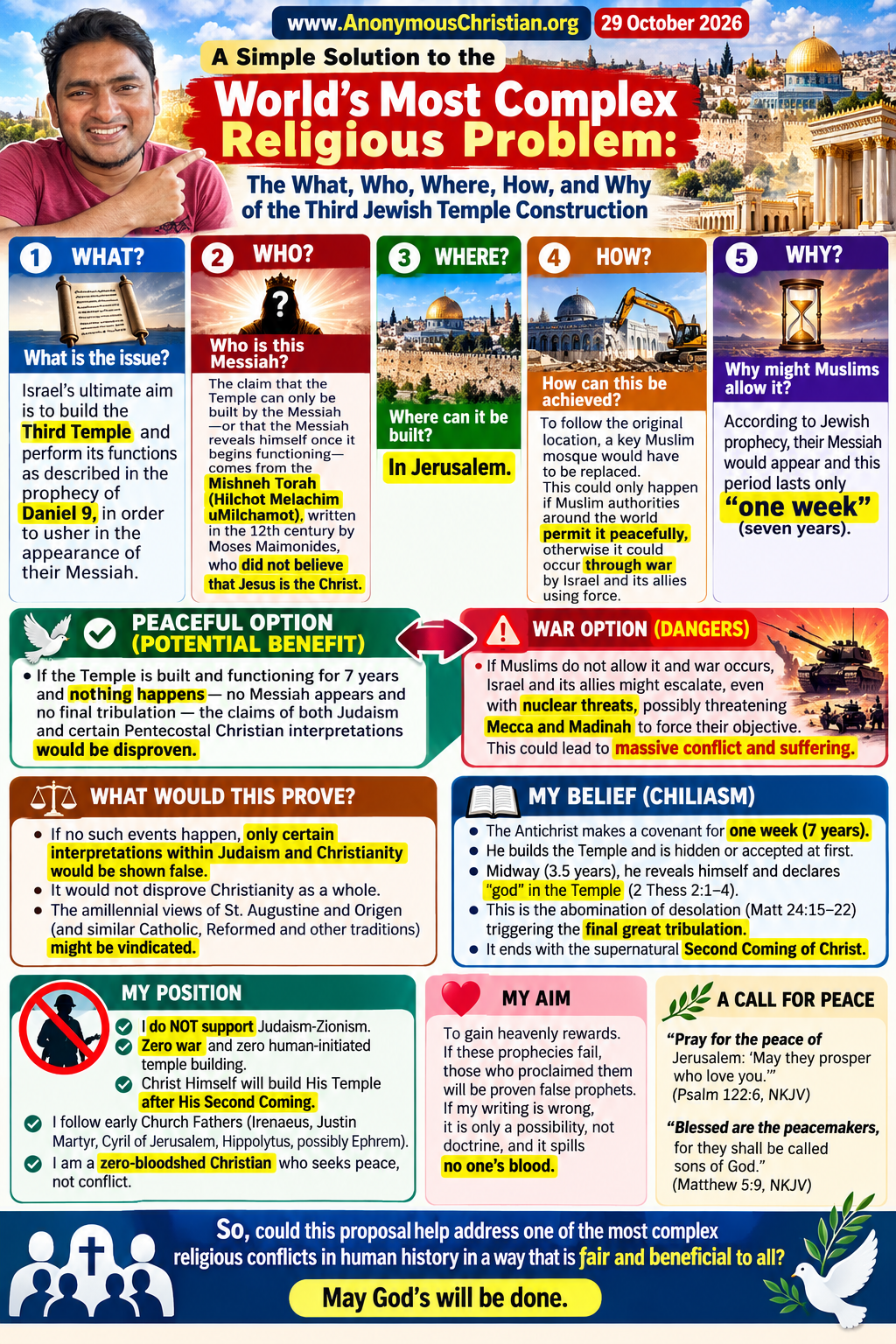
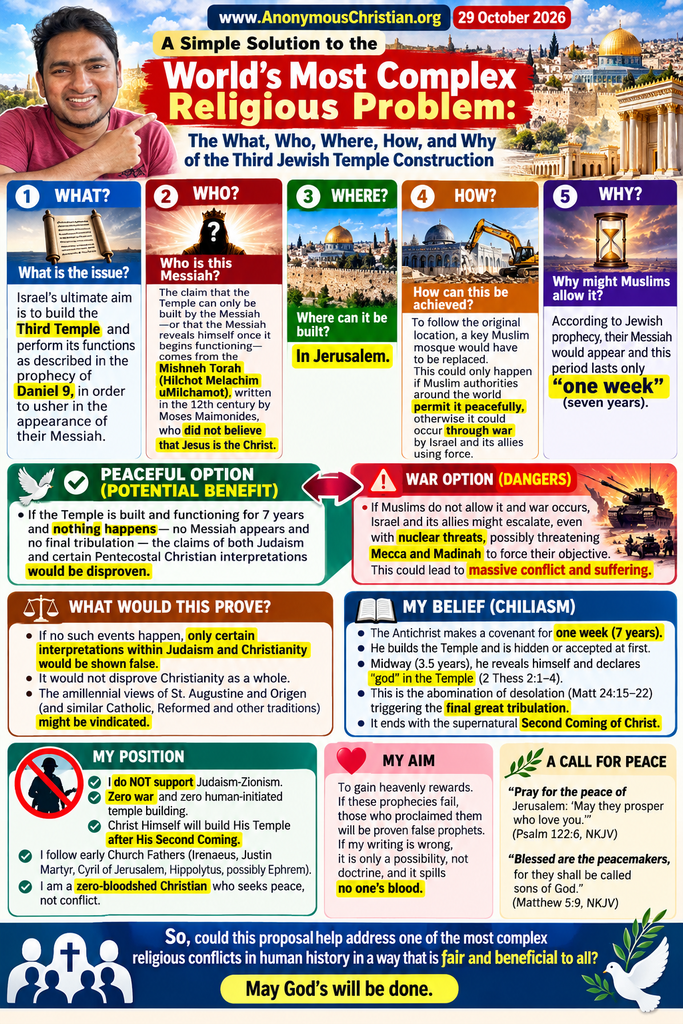
A Simple Solution to the World’s Most Complex Religious Problem: The What, Who, Where, How, and Why of the Third Jewish Temple Construction
What: What is the issue? Israel’s ultimate aim is to build the Third Temple and perform its functions as described in the prophecy of Daniel 9, in order to usher in the appearance of their Messiah.
Who: Who is this Messiah? The Jewish claim that the Temple can only be built by the Messiah—or that the Messiah reveals himself once the Temple begins functioning—is surprisingly not derived directly from the Bible, the Tanakh, or the Torah. Instead, it comes from a work called Mishneh Torah, specifically Hilchot Melachim uMilchamot. Christians do not recognize this text as canonical. It was written relatively late by the Jewish scholar Moses Maimonides in the late 12th century, who did not believe that the Lord Jesus is the Christ.
Where: Where can this Third Jewish Temple be built? In Jerusalem.
How: How can this be achieved? In Jerusalem, in order to follow the Temple’s original location, a key Muslim mosque would have to be replaced to make way for it. This could only happen if Muslim authorities around the world permit it peacefully, or otherwise it could occur through war by Israel and its allies using force.
Why: If Muslims were to allow it peacefully, there would actually be a potential benefit for them. According to Jewish prophecy, their Messiah would appear—or be the one who builds it. Daniel 9 mentions that this period lasts only “one week” symbolically (understood as seven years in many interpretations).
According to popular Pentecostal or pro-Zionist Christian prophecy as well, believers would either be secretly raptured before this seven-year period, or midway through it (3.5 years) by the Lord Jesus Christ. In those interpretations, the “Jewish Messiah” would actually be the Antichrist, and the construction of the Third Temple would usher in the secret coming of Christ for believers while the “left behind” would undergo the final great tribulation.
How could this benefit Muslims? If the Temple were built and functioning for seven years and nothing happens—no Messiah appears and no final tribulation occurs as interpreted from Daniel 9—then the claims of both Judaism and certain Pentecostal Christian interpretations would be disproven because their predicted events would not have taken place.
If Muslims do not allow it and war occurs instead, Israel and its allies might escalate the situation with nuclear threats in order to force their objective. Consider the possibility: if Israel and its allies were losing support and facing destruction, they might act out of desperation and threaten Muslim holy sites in Mecca and Madinah. One could imagine an argument such as: “If you do not allow us to build our Third Temple, we will destroy your holy cities as well,” attempting to challenge Muslim prophecies that these cities will possibly stand until the end of time.
However, this scenario would not disprove Christianity as a whole—only certain interpretations within Christianity and Judaism if their predictions fail to occur. If no such events happen, then the amillennial interpretations of St. Augustine and Origen might be correct. In that case, Catholicism and some Reformed and other Christian traditions that hold similar views might be vindicated.
What do I believe? I hold to the Chiliasm interpretation described in detail in my book Essays in Early Christianity (ISBN-10: 1949586421, ISBN-13: 978-1949586428), where I discuss relevant patristic citations. In this view, the Antichrist will make a covenant for “one week” (seven years), whether visibly or not. This covenant will become evident through events such as the visible construction of the Temple until it is completed and functioning.
Midway through that period, the Antichrist will reveal himself. During the first 3.5 years he may remain hidden or unrecognized, or perhaps even be perceived as the leader supporting the Temple’s construction. At the midpoint, however, he will reveal his true identity. According to 2 Thessalonians 2:1–4, he will declare himself to be “god” within the Temple. This will be the “abomination of desolation” warned about by the Lord Jesus Christ in Matthew 24:15–22, triggering the final great tribulation. This period will end with the supernatural Second Coming of Christ, bringing all these events to their conclusion.
It is important to understand that I do not support Judaism-Zionism from a Chiliasm Christian perspective. My position is one of zero war and zero human-initiated temple building, because Christ Himself will build His Temple after His Second Coming, not before it.
I follow the teachings of early Church Fathers such as St. Irenaeus of Lyons, St. Justin Martyr, St. Cyril of Jerusalem, St. Hippolytus of Rome, and possibly St. Ephrem the Syrian. According to these patristic interpretations, the earlier Third Temple would be associated with the Antichrist rather than with Christ.
Therefore, I remain a zero-bloodshed Christian who does not advocate war against unbelieving Jews, Muslims, or even Zionist Christians. I seek peace rather than conflict.
Given this perspective, could the proposal above help address one of the most complex religious conflicts in human history?
My aim is to gain heavenly rewards. If these prophecies fail in any part, those who proclaimed them will be proven to be “false prophets.” If my own writing turns out to be false, it is still excusable, since I have never preached it as doctrine but only as a possibility. More importantly, my view spills no one’s blood—whether Jewish, Muslim, Christian, or anyone else’s.
As a bonus, I can hope to receive a reward from God for seeking peace, not war, in Jerusalem. Can you see it?
As it is written:
“Pray for the peace of Jerusalem: ‘May they prosper who love you.’” (Psalm 122:6, NKJV).
And from my God in the flesh, the Lord Jesus Christ:
“Blessed are the peacemakers, for they shall be called sons of God.” (Matthew 5:9, NKJV).
Thus, I hope that Muslims, Jews, and Zionist Christians alike might choose the path of peace that I have proposed here.
Is this not a solution that is both fair and beneficial to all?
May God’s will be done.
Summary:
The proposal examines the religious and political issue surrounding the possible construction of a Third Jewish Temple in Jerusalem. It explains the motivations behind it, the Jewish belief about the Messiah connected to the Temple, and the difficulty of building it because the site currently contains an important Muslim mosque.
The author suggests that allowing the Temple to be built peacefully could serve as a test of certain Jewish and Pentecostal Christian prophecies about a seven-year period connected to the Messiah and the Antichrist. If the predicted events do not occur, those interpretations would be disproven without bloodshed.
The author personally follows a Chiliasm interpretation based on early Church Fathers, believing the Antichrist will be connected to a future Temple and that Christ Himself will establish His Temple only after His Second Coming.
Therefore, the author rejects war, Zionist militancy, and violence, advocating instead for peace among Jews, Muslims, and Christians. The overall goal is to seek peace in Jerusalem and avoid conflict while remaining faithful to Christian teachings about peacemaking.
Nice Worship:
Source LinkedIn article:
https://www.linkedin.com/pulse/free-sample-article-from-my-unpublished-book-who-ramachandran-mfi0c
Thank you
[1] Jonathan Ramachandran, ESSAYS IN EARLY CHRISTIANITY: Chiliasm Prophecy Model and Non-Elect Salvation Possibility (Cambridge, OH: Christian Publishing House, July 13, 2025), ISBN 978-1949586435, https://www.amazon.com/dp/1949586421
[2] Westminster Confession of Faith, Of the Law of God, Blue Letter Bible, https://blueletterbible.org/study/ccc/westminster/Of_The_Law_Of_God.cfm
[3] Joseph Momjian, Westminster Confession of Faith, “Chapter 19, Section 3: Ceremonial Laws,” 9; “Chapter 19, Section 4: Judicial Laws,” 12, https://momjian.us/main/writings/other/westminster.pdf
[4] Catechism of the Catholic Church, Part One: The Profession of Faith, article “Jesus Christ suffered under Pontius Pilate, was crucified, died and was buried,” Vatican.va, accessed March 5, 2026, https://www.vatican.va/archive/ENG0015/__P1N.HTM
[5] Apology of the Augsburg Confession, “Article VII & VIII: Of the Church,” The Book of Concord, accessed March 5, 2026, https://thebookofconcord.org/apology-of-the-augsburg-confession/article-vii-and-viii/
[6] John Calvin, Commentary on Daniel 9:27, in John Calvin’s Commentaries, CCEL, accessed March 5, 2026, https://www.ccel.org/ccel/calvin/comment3/comm_vol25/htm/iv.xx.htm
[7] Martin Luther, A Sermon on the Destruction of Jerusalem. In Like Manner Will Germany Also Be Destroyed, if She Will Not Recognize the Time of Her Visitation. What the Temple of God Is, Wittenberg, 1525, in GodRules.net, accessed March 5, 2026, https://godrules.net/library/luther/129luther_d22.htm
[8] Martin Luther, Matthew 24:15‑28 (Twenty‑Fifth Sunday after Trinity), in Martin Luther Postil, accessed March 5, 2026, https://martinlutherpostil.com/TWENTY-FIFTH%20SUNDAY%20AFTER%20TRINITY%20%20MATTHEW%2024-15-28.pdf
[9] John Wesley, Wesley’s Explanatory Notes on the New Testament, “Notes on Daniel 9,” Sacred‑Texts.com, accessed March 5, 2026, https://sacred-texts.com/bib/cmt/wesley/dan009.htm
[10] Andrey Vlasov, “Arab‑Israeli Conflict and Prophecies about the ‘Third Temple,’” Faith Protection (Union of Orthodox Journalists), May 24, 2021, accessed March 5, 2026, https://spzh.eu/en/zashhita-very/80067-arabo-izrailyskij-konflikt-i-prorochestva-o-tretyjem-khrame
[11] Dmitry Vorontsov, “I‑net Users Recall St. Paisios’ Words on Mosque Demolition on Temple Mount,” Faith Protection (Union of Orthodox Journalists), May 15, 2021, accessed March 5, 2026, https://spzh.eu/en/news/79883-v-seti-napomnili-slova-sv-paisija-o-znachenii-snosa-mecheti-na-khramovoj-gore
[12] Bishop Alexander of Argentina and South America, “On the Threshold,” Orthodox America (Volume XVIII, Issue 161), The Archives of Orthodox America, accessed March 5, 2026, https://roca.org/oa/volume‑xviii/issue‑161/on‑the‑threshold/
[13] “Theology of the New Temple,” Theology of the Body Protestant Church, accessed March 5, 2026, https://www.theology-of-the-body-church.co.uk/theology-of-the-new-temple
[14] Mishneh Torah, Hilchot Melachim uMilchamot, chap. 11, halachah 1, Chabad.org, accessed March 5, 2026, https://www.chabad.org/library/article_cdo/aid/1188356/jewish/Melachim‑uMilchamot‑Chapter‑11.htm
[15] Mishneh Torah, Hilchot Melachim uMilchamot, chap. 11, halachah 1, Sefaria, accessed March 5, 2026, https://www.sefaria.org/Mishneh_Torah%2C_Kings_and_Wars.11.1
[16] Mishneh Torah, Hilchot Melachim uMilchamot, chap. 11, halachah 4, Chabad.org, accessed March 5, 2026, https://www.chabad.org/library/article_cdo/aid/1188356/jewish/Melachim‑uMilchamot‑Chapter‑11.htm
[17] Mishneh Torah, Hilchot Melachim uMilchamot, chap. 11, halachah 4, Sefaria, accessed March 5, 2026, https://www.sefaria.org/Mishneh_Torah%2C_Kings_and_Wars.11.4
[18] Jonathan, Essays in Early Christianity.
[19] Jonathan Brentner, “Biblical Necessity of a Third Jewish Temple,” PentecostalTheology.com, April 7, 2023, https://www.pentecostaltheology.com/biblical-necessity-of-a-third-jewish-temple-by-jonathan-brentner/
[20] Thomas Ice and Timothy J. Demy, When the Trumpet Sounds: A Study in Premillennial Theology (Chicago: Moody Publishers, 2006).
[21] Precept Austin, “Matthew 24:15 Commentary,” accessed March 11, 2026, https://www.preceptaustin.org/matthew_2415_commentary
[22] St. Cyril of Jerusalem, Catechetical Lectures, Lecture 15, trans. Edward Yarnold, from Nicene and Post-Nicene Fathers, Second Series, Vol. 7, ed. Philip Schaff and Henry Wace (Buffalo, NY: Christian Literature Publishing Co., 1894; revised and edited for New Advent by Kevin Knight), https://www.newadvent.org/fathers/310115.htm
[23] St. Hippolytus of Rome, On Christ and Antichrist, trans. J.H. MacMahon, from Ante-Nicene Fathers, Vol. 5, ed. Alexander Roberts, James Donaldson, and A. Cleveland Coxe (Buffalo, NY: Christian Literature Publishing Co., 1886; revised and edited for New Advent by Kevin Knight), https://www.newadvent.org/fathers/0516.htm
[24] Jonathan Ramachandran, Essays in Early Christianity, 363.
[25] Ibid.
[26] Hippolytus of Rome, On Christ and Antichrist, trans. J. H. MacMahon, in Ante-Nicene Fathers, vol. 5, ed. Alexander Roberts, James Donaldson, and A. Cleveland Coxe (Buffalo, NY: Christian Literature Publishing Co., 1886), revised and edited for New Advent by Kevin Knight, https://www.newadvent.org/fathers/0516.htm
[27] Jonathan Ramachandran, Essays in Early Christianity, 365–369.
[28] Irenaeus of Lyons, Against Heresies, trans. Alexander Roberts and William Rambaut, in Ante-Nicene Fathers, vol. 1, ed. Alexander Roberts, James Donaldson, and A. Cleveland Coxe (Buffalo, NY: Christian Literature Publishing Co., 1885), 5.35, https://www.newadvent.org/fathers/0103535.htm.
[29] Justin Martyr, Dialogue with Trypho, trans. Marcus Dods and George Reith, in Ante-Nicene Fathers, vol. 1, ed. Alexander Roberts, James Donaldson, and A. Cleveland Coxe (Buffalo, NY: Christian Literature Publishing Co., 1885), https://www.newadvent.org/fathers/01286.htm.
[30] Jonathan Ramachandran, Essays in Early Christianity, 39.
About this article author:
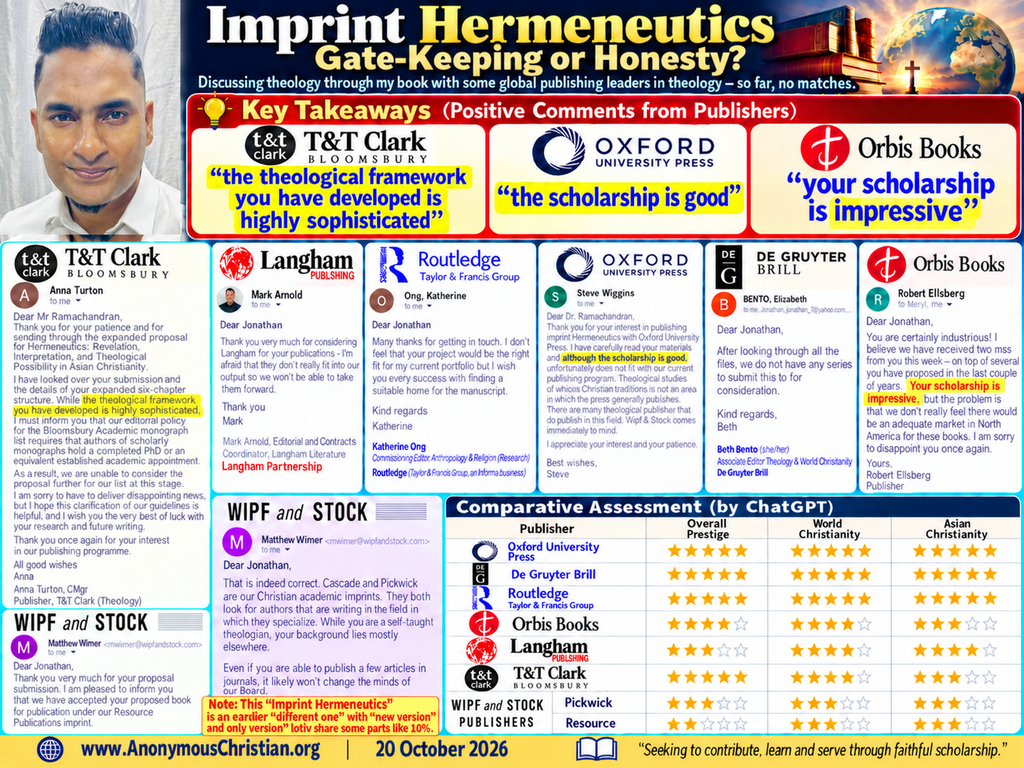
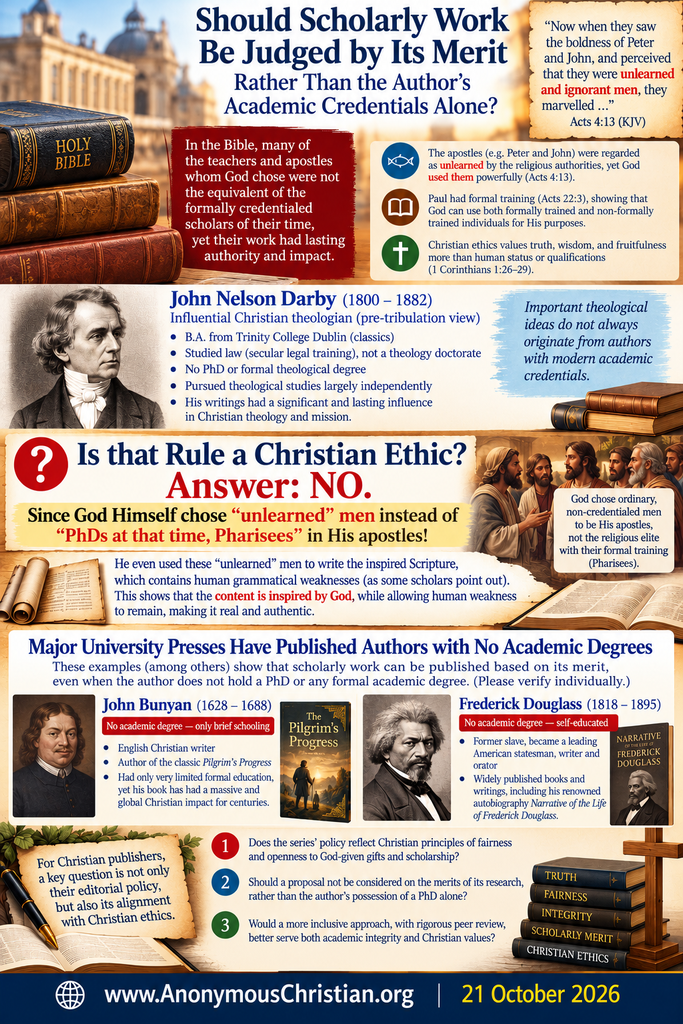
Jonathan Ramachandran is an ecumenical Christian, a Malaysian theologian, missionary blogger, and operations manager who bridges mathematics and ministry. A self-taught enthusiast of Chiliasm Church Fathers, he has published in peer-reviewed journals and runs www.AnonymousChristian.org. He is an International Mathematical Olympiad (IMO) coach for Malaysia, guiding students in advanced competition mathematics. A graduate in actuarial science and Bank Negara scholar, his professional path spans seismic engineering, education, charity, and freelance preaching, including baptizing students into Christianity . He holds honorary doctorates in theology, divinity, and ministry, dedicating his life to scholarship, service, and mathematical coaching. Education: B.Sc., Th.D. (Hon.), D.Div. (Hon.), D.Min. (Hon.)
Bsc. Actuarial Science (National University of Malaysia, 2006) with Honors.
Dr. Jonathan Ramachandran obtained his Honorary Doctor of Theology (Th.D.) from University of Jerusalem (UJ, Chennai, India, 20 August 2025; Reg. No.: 11230), Honorary Doctor of Divinity (D.Div.) from Triumphant Christian University of America (TCUA, Illinois, USA, 20 August 2025, Cert. ID.: 7704247) and Honorary Doctor of Ministry (D.Min.) from Open Christian University (OCU, California, USA, 31 August 2025, Cert. ID.: OCU250124/831208-14-6517MY).



Works & Links:
Ramachandran, Jonathan. Anonymous Christian. Accessed October 30, 2025. https://www.anonymouschristian.org/
Ramachandran, Jonathan. Coach Jonathan Ramachandran (Facebook Pages). https://www.facebook.com/CoachJonathanRamachandran/, or https://www.facebook.com/profile.php?id=100057109853813, or https://www.facebook.com/profile.php?id=100070978834712
Ramachandran, Jonathan. Defense of Honorary Doctorates. Accessed October 30, 2025. https://drive.google.com/file/d/1dLffkOnLe8BPz9vd3RMPbhZmn6puY7op/view?usp=sharing
Ramachandran, Jonathan. Elementary School Math Olympiad Facebook Links. Updated October 26, 2025. Problems 1–264, https://www.facebook.com/jonathan.ramachandran/posts/pfbid0wkPqT9UULb6G4x1qRVRceBzqARRuWajpKdeVT7d2YfGkD28z7hcqB7yvMFRE3Wpal; Website listing, https://www.anonymouschristian.org/blog/elementary-school-math-olympiad-facebook-links/
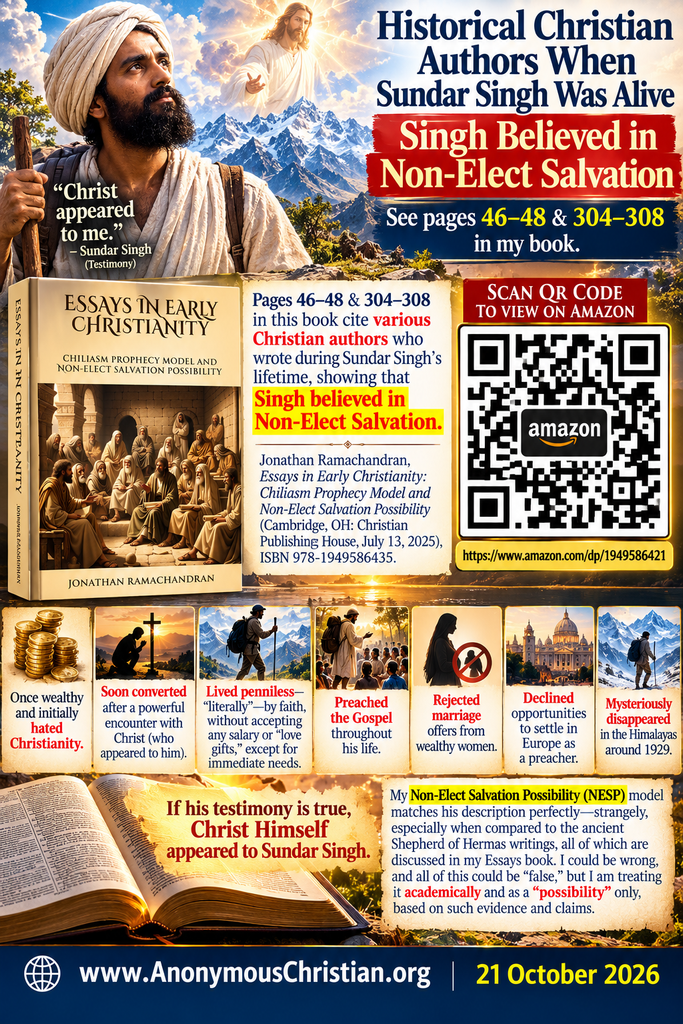
Ramachandran, Jonathan. Essays in Early Christianity: Chiliasm Prophecy Model and Non-Elect Salvation Possibility. Cambridge, OH: Christian Publishing House, 13 July 2025. ISBN 978-1949586435. https://www.amazon.com/dp/1949586421.
Ramachandran, Jonathan. Free High School Math Olympiad: 546 Problems & Solutions. 5 Loaf 2 Fish Publications, May 28, 2026. https://books.google.com.my/books/about?id=eaHdEQAAQBAJ or https://drive.google.com/drive/folders/1d0go0yKivMwt7mseVcJucot_E56h1po7?usp=sharing.
Ramachandran, Jonathan. High School Math Olympiad Facebook Links. Updated October 26, 2025. Problems 1–340, https://www.facebook.com/jonathan.ramachandran/posts/pfbid0AwdYEToSrX8B2W1KJyzuKoCyWv3VXAHPAtt5bSfwd3tF2oMEbnmgwCoacyPxczppl; Problems 341–545, https://www.facebook.com/jonathan.ramachandran/posts/pfbid0hJeHxUuJp5kRwWJQ5QFhoNPS4Ym2mmh3ciei2nctqsThbNhWuTAJYvRzk3AU5APil; Website listing of Problems 1–545, https://www.anonymouschristian.org/blog/high-school-math-olympiad-facebook-links/
Ramachandran, Jonathan. Hope Beyond the Elect: Revisiting Early Christian Views on Prophecy and Salvation. Cambridge, OH: Christian Publishing House, 2025. www.amazon.com/dp/1949586405.
Ramachandran, Jonathan. Jonathan’s Math Video Solutions. YouTube channel. https://youtube.com/@jonathanramachandran1537?si=oKVTC4hLTK7iRKSf
Ramachandran, Jonathan. Jonathan Ramachandran – Independent Researcher (Academia.edu profile). Accessed October 30, 2025. https://independent.academia.edu/RamachandranJonathan
Ramachandran, Jonathan. Sample CV. 14 September 2025. https://drive.google.com/file/d/19YuhL31EpC4l3JnHcbbQNio-ueogAEXQ/view?usp=sharing
Ramachandran, Jonathan. School Math Facebook Links. Updated October 26, 2025. Problems 1–154, https://www.facebook.com/jonathan.ramachandran/posts/pfbid025mCA6wGPKLJ4ERhfLBzUwooHBJez59wdhJuHnbKZ9F9ZdaDpEmvX4vinwmoNjdsUl; Website listing, https://www.anonymouschristian.org/blog/school-math-facebook-links/
Ramachandran, Jonathan. Thank God Regardless: Math, Merit, and Being Unapologetically Christian. 5 Loaf 2 Fish Publications, 2026. https://drive.google.com/drive/folders/1d0go0yKivMwt7mseVcJucot_E56h1po7?usp=sharing or https://books.google.com.my/books/about?id=3KPfEQAAQBAJ.
Ramachandran, Jonathan. “Jonathan Ramachandran – Google Scholar Profile.” Accessed October 30, 2025. https://scholar.google.com/citations?hl=en&user=Bv7IFrAAAAAJ
Ramachandran, Jonathan. “Non Elect Salvation Possibility.” American Journal of Biblical Theology (AJBT) 26, no. 6 (February 2025). www.biblicaltheology.com/Research/RamachandranJ01.pdf.
Ramachandran, Jonathan. “ORCID 0009‑0008‑4669‑1077.” Accessed October 30, 2025. https://orcid.org/0009-0008-4669-1077
Ramachandran, Jonathan. “The Personhood of the Holy Spirit and the Unity of the Trinity.” JOY! Magazine, theology section, April 2026. Accessed April 3, 2026. https://joygifts.co.za/product/https-joygifts-co-za-joy-april-2026/.
Ramachandran, Jonathan. “Thousand Year Gap for Prophecy in 1 Thessalonians 4:17 and 1 Corinthians 15:52 with Chiliasm Church Fathers.” Journal of Biblical Theology (JBT) 8, no. 3 (June 2025).
Ramachandran, Jonathan. “Thousand Year Gap for Prophecy in 1 Thessalonians 4:17 and 1 Corinthians 15:52 with Chiliasm Church Fathers.” American Journal of Biblical Theology (AJBT) 26, no. 22 (June 2025). www.biblicaltheology.com/Research/RamachandranJ02.pdf.