From Nobel-Level Discoveries to Theology: Great Truths Can Emerge Without Formal Degrees
Some of the greatest discoveries in history, including Nobel Prize–winning breakthroughs, were made by individuals with only undergraduate education—or even no university degree at all.
This reminds us that truth, insight, and meaningful contribution are not confined to formal credentials.
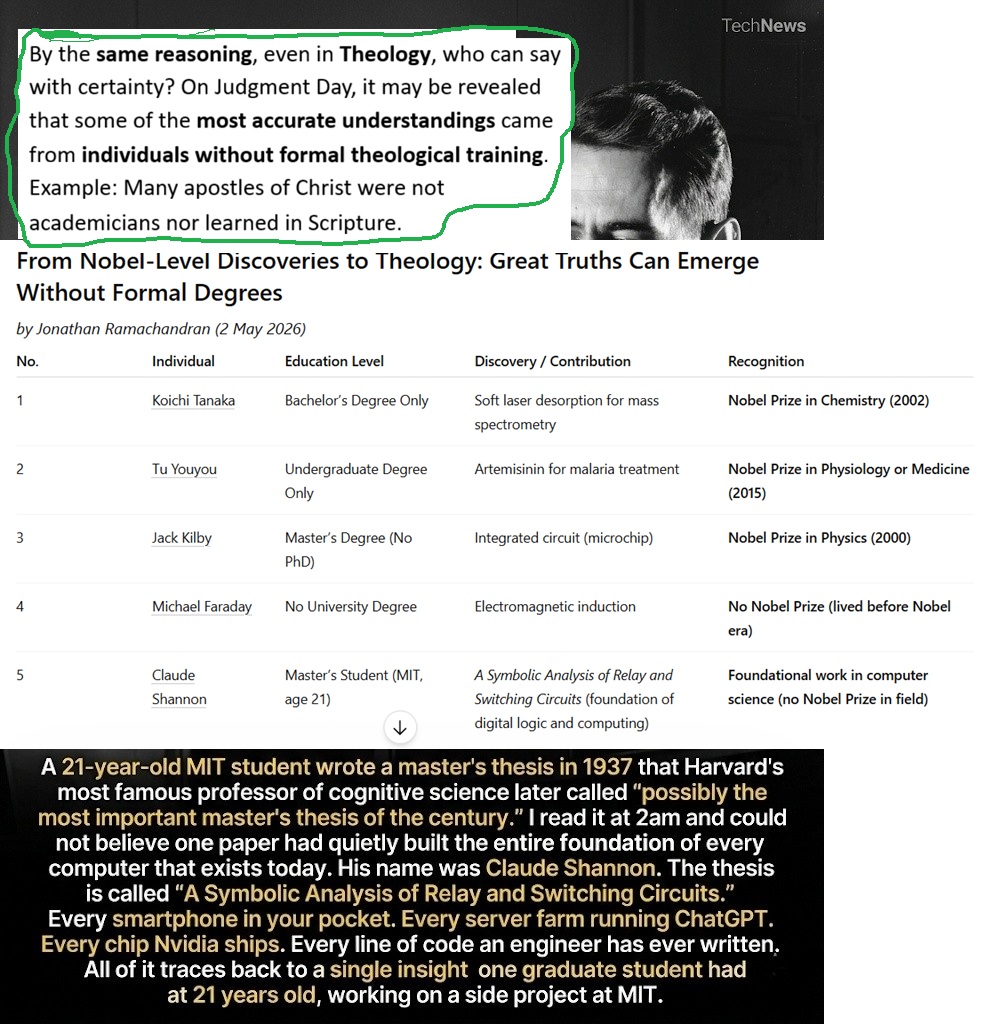
By the same reasoning, even in Theology, who can say with certainty? On Judgment Day, it may be revealed that some of the most accurate understandings came from individuals without formal theological training. Example: Many apostles of Christ were not academicians nor learned in Scripture.
Academic titles can provide structure and depth, but they do not hold a monopoly on wisdom. History repeatedly shows that extraordinary insight can emerge from unexpected places.
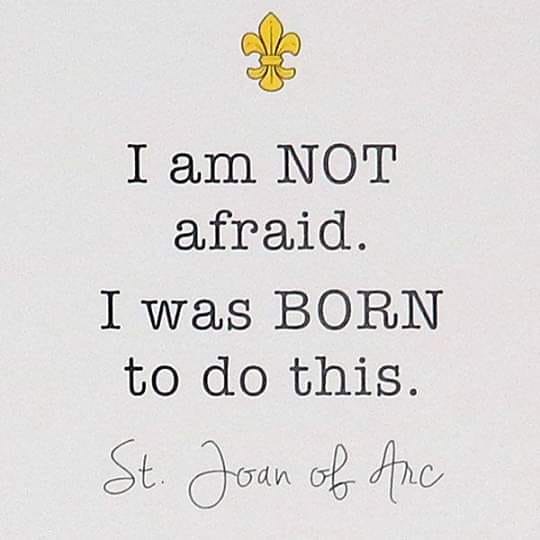
1) Koichi Tanaka — Bachelor’s Degree Only
Discovery: Soft laser desorption for mass spectrometry
Impact: Revolutionized protein analysis and biotechnology
Recognition: Nobel Prize in Chemistry (2002)
Tanaka entered industry directly after university and became the first Nobel laureate without a master’s or doctoral degree.
Proof URL:
https://www.shimadzu.com/about/nobel/noblesoul/index.html
2) Tu Youyou — Undergraduate Degree Only
Discovery: Artemisinin for malaria treatment
Impact: Saved millions of lives worldwide
Recognition: Nobel Prize in Physiology or Medicine (2015)
She achieved this without a PhD, medical degree, or overseas research background.
3) Jack Kilby — Master’s Degree, No PhD
Discovery: Integrated circuit (microchip)
Impact: Foundation of modern electronics
Recognition: Nobel Prize in Physics (2000)
Kilby’s invention made modern computers and smartphones possible—all without a doctorate.
Proof URL:
https://www.nobelprize.org/prizes/physics/2000/kilby/
4) Michael Faraday — No University Degree
Discovery: Electromagnetic induction
Impact: Basis of electric motors and generators
Faraday had only basic schooling and was largely self-taught, yet became one of history’s greatest scientists.
Proof URL:
https://www.britannica.com/biography/Michael-Faraday
5) Claude Shannon — Master’s Student at Age 21
Discovery: A Symbolic Analysis of Relay and Switching Circuits
Impact: Laid the theoretical foundation of modern digital computing
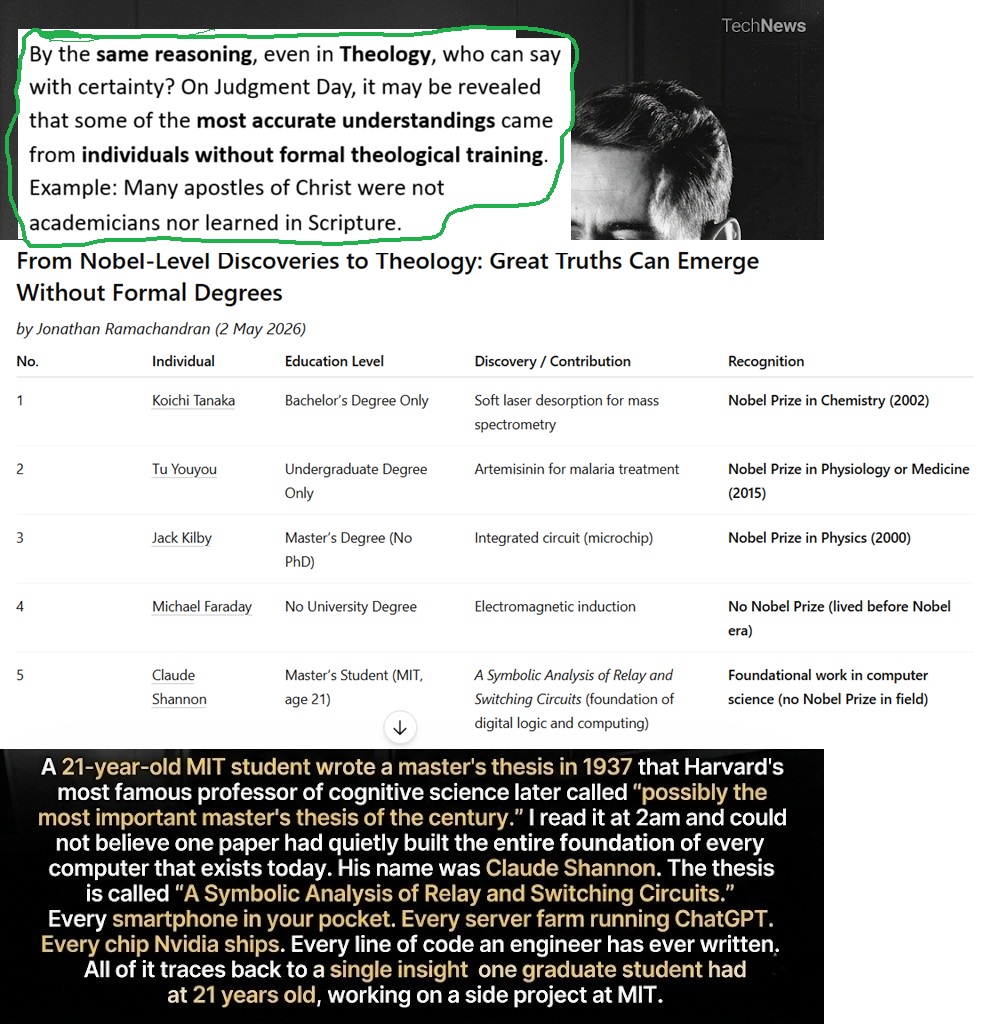
At just 21 years old, as a master’s student at MIT, Shannon demonstrated how Boolean algebra could be applied to electrical relay circuits. This became the basis of digital logic design—the core principle behind every modern computer.
Harvard psychologist Howard Gardner later described it as “possibly the most important, and also the most famous, master’s thesis of the century.”
Proof URL:
https://en.wikipedia.org/wiki/A_Symbolic_Analysis_of_Relay_and_Switching_Circuits
https://dspace.mit.edu/handle/1721.1/11173
Conclusion
These examples prove that transformative discoveries are not limited to PhD holders.
Bachelor’s degrees, master’s degrees, or even self-education have all led to breakthroughs that changed the world.
Source:
Thank you.