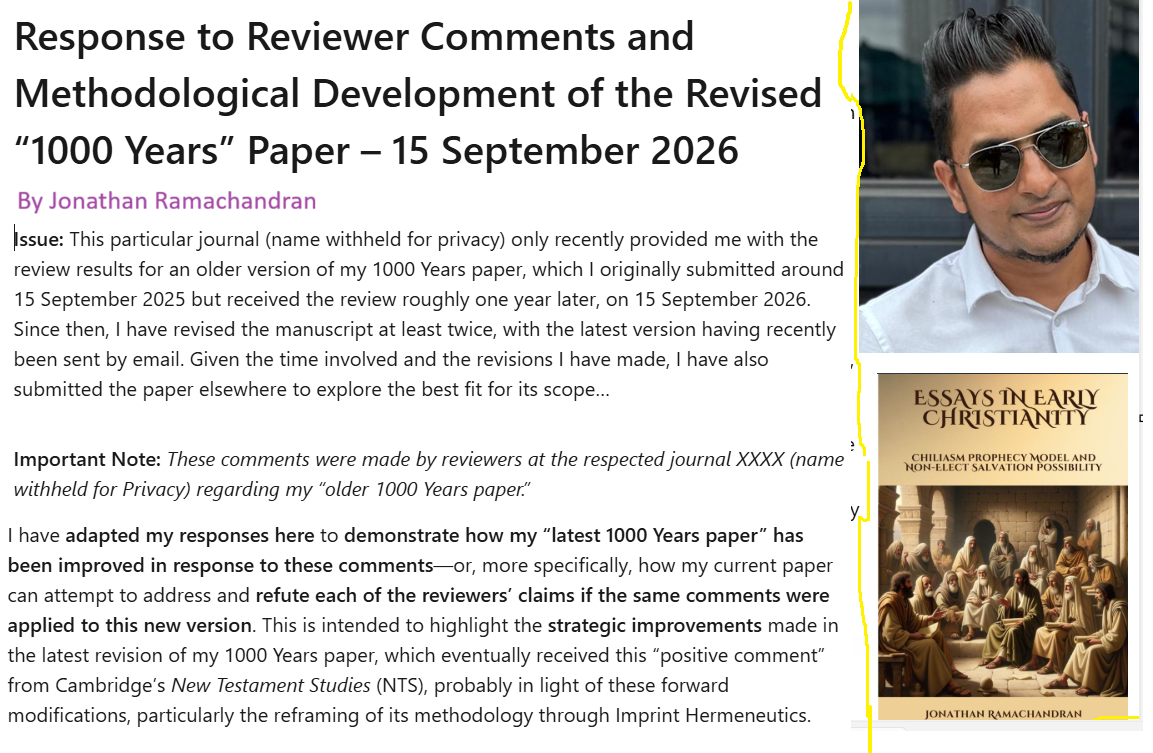
Response to Reviewer Comments and Methodological Development of the Revised “1000 Years” Paper – 15 September 2026
And He sent him a portrait of:
“Death itself being defeated … by the Lord Jesus Christ.”
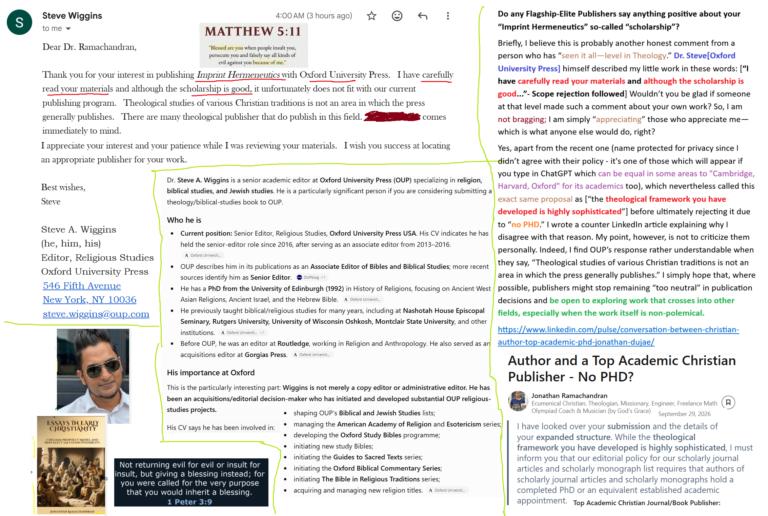
Issue: This particular journal (name withheld for privacy) only recently provided me with the review results for an older version of my 1000 Years paper, which I originally submitted around 15 September 2025 but received the review roughly one year later, on 15 September 2026. Since then, I have revised the manuscript at least twice, with the latest version having recently been sent by email. Given the time involved and the revisions I have made, I have also submitted the paper elsewhere to explore the best fit for its scope…

Important Note: These comments were made by reviewers at the respected journal XXXX (name withheld for Privacy) regarding my “older 1000 Years paper.”
I have adapted my responses here to demonstrate how my “latest 1000 Years paper” has been improved in response to these comments—or, more specifically, how my current paper can attempt to address and refute each of the reviewers’ claims if the same comments were applied to this new version. This is intended to highlight the strategic improvements made in the latest revision of my 1000 Years paper, which eventually received this “positive comment” from Cambridge’s New Testament Studies (NTS), probably in light of these forward modifications, particularly the reframing of its methodology through Imprint Hermeneutics.
1. Reviewer Comment 1:
“At end of first section author says ‘established lexical, grammatical, and contextual analyses… neither interpret nor contradict the millennium-long interval suggested in this paper between these two verses.’ Multiple commentaries using different historical critical methods does precisely this. In addition the author’s references at the end of this sentence are to grammars and lexicons, not to critical commentaries. Consequently, the statement and references does not make sense. What is meant by ‘analyses’ and then referencing dictionaries, grammars, and lexicons?”
My Response 1:
I respectfully disagree with the reviewer’s characterization of my statement and references. None of the seven sources cited at this point states that 1 Thessalonians 4:17 and 1 Corinthians 15:52 must be understood as one indivisible event, nor do they demonstrate that a literal 1,000-year interval between these two verses is grammatically, lexically, or contextually impossible.
If the reviewer has specific commentaries using historical-critical methods that actually establish that such an interval is possible, I would welcome the reviewer identifying the specific works and pages so that I can examine and correct my statement if necessary (since the reviewer implies here that there are “multiple commentaries stating a 1,000-year interval between 1 Thessalonians 4:17 and 1 Corinthians 15:52,” I would be grateful if the reviewer could identify them. If the reviewer can demonstrate this, I would acknowledge that I was incorrect in making my claim and would be thankful for the correction. I would also welcome knowing the reviewer’s name so that I could thank them personally if this claim can indeed be substantiated.)
The seven references cited are also not merely “dictionaries, grammars, and lexicons.” They include:
- BDAG, 3rd ed., 134–136, s.v. ἁρπάζω;
- LSJ, 9th ed., 228, s.v. ἀπάντησις;
- NA28, 1 Thessalonians 4:17 and 1 Corinthians 15:50–52;
- Daniel B. Wallace, Greek Grammar Beyond the Basics, 431–432;
- Blass-Debrunner-Funk, §448;
- Gordon D. Fee, The First and Second Letters to the Thessalonians, NICNT, 173–180; and
- Anthony C. Thiselton, The First Epistle to the Corinthians, NIGTC, 1276–1294.
Thus, the list contains lexicons, grammars, a critical Greek edition, and, importantly, major critical commentaries by Fee and Thiselton. The reviewer’s description of these references as simply “grammars and lexicons” is therefore inaccurate.
By “lexical, grammatical, and contextual analyses,” I mean the established lexical, grammatical, syntactical, and immediate contextual observations concerning the relevant Pauline texts. I was not claiming that BDAG, LSJ, Wallace, Blass-Debrunner-Funk, or NA28 independently proves the proposed 1,000-year interval. Rather, these sources establish the linguistic and textual parameters within which my constructive proposal is developed.
My argument is therefore not that the lexical and grammatical sources explicitly teach a millennium between the passages. My argument is that they do not themselves interpret or contradict the millennium-long interval proposed here. The distinction is important. The proposed interval is a constructive theological inference, not a claim that either Pauline verse explicitly states, “1,000 years intervene here.”
This is precisely where the improved Imprint Hermeneutics Methodology is relevant. The methodology distinguishes what is directly established by the historical-grammatical reading of a passage from what may subsequently be constructed through canonical, intertextual, and reception-historical synthesis. The proposed millennium is therefore not being inserted arbitrarily into the Greek text. The Pauline passages provide the relevant resurrection and transformation events, while Revelation 20 and the early chiliast material are examined as additional witnesses for a possible chronological relationship between those events.
Accordingly, the fact that Fee or Thiselton may discuss 1 Thessalonians 4:17 and 1 Corinthians 15:50–52 in close relationship does not refute my claim. It demonstrates only that those commentators adopt a particular interpretation of the relationship between the passages. My proposal asks whether the Pauline descriptions necessarily require the two events to be temporally simultaneous. I argue that the cited lexical, grammatical, and immediate contextual evidence does not establish such necessity.
I therefore maintain the substance of my original statement. I would, however, clarify the terminology so that “analyses” cannot be misunderstood as claiming that the lexicons and grammars themselves establish the proposed chronology. The intended meaning is that the established lexical, grammatical, syntactical, and immediate contextual observations do not themselves exclude the proposed millennium-long interval.
The methodological distinction is fundamental to my argument: the Greek lexical and grammatical evidence establishes what the Pauline texts can and cannot linguistically sustain; the proposed 1,000-year interval is then a second-order constructive inference developed through Imprint Hermeneutics. It is therefore incorrect to reject the proposal merely because the cited lexical and grammatical sources do not themselves state the proposed interval. That is not the function I assign to them.
2. Reviewer’s Comment
“Under the section ‘SYMBOLIC AND ALLEGORICAL INTERPRETATIONS OF THE MILLENNIUM’ the works of, among others, Adela Yarbro Collins and Craig R. Koester are presented as if they support a Chiliastic reading of Revelation 20, this is not accurate. There is no proof in how these scholarly work are presented in the article that the author read or engaged with the references works.”
My Response 2:
I respectfully disagree with this characterization of the manuscript. Adela Yarbro Collins and Craig R. Koester are not presented as supporting a Chiliastic reading. They are presented precisely as representatives of the symbolic or allegorical interpretation that the section is examining.
The manuscript states that Collins interprets the “thousand years” allegorically within early Christian apocalypticism and discusses the literal-versus-spiritual interpretive question.
The manuscript is even more explicit concerning Koester. It states that Koester traces the allegorical reading of the “thousand years” through Tyconius and Augustine and explains that Koester understands the vision as relating to the church’s struggle during the present age.
The article then places Koester together with Augustine, Storms, Osborne, and Mathewson as interpreters who understand Revelation 20 symbolically. Mathewson’s position is also explicitly contrasted with a literal millennium.
Thus, the structure of the article is the opposite of the reviewer’s description. The article first presents symbolic/allegorical interpretations, including Collins and Koester, and subsequently has a separate section entitled “DIRECT AND INDIRECT LITERAL INTERPRETATIONS FOR 1 THESS. 4:17 AND 1 COR. 15:52 VIA CHILIASM CHURCH FATHERS.”
The manuscript therefore does not use Collins or Koester as evidence for Chiliasm. It uses them as evidence for the contrasting interpretive position.
Moreover, the treatment is not merely a list of names. Specific interpretive claims are attributed to each scholar, and the relevant footnotes are supplied. Collins is associated with the allegorical understanding of the thousand years, while Koester is specifically discussed in relation to the historical development of allegorical interpretation.
I therefore believe the statement that these scholars were presented as supporting Chiliasm results from a misreading of the organization and wording of this section.
Example of actual wording from my paper which proves it (samples):
“… while Collins sees the “thousand years” as an allegorical period…”
“… Koester traces the allegorical reading of the “thousand years” …”
3. Reviewer’s Comment
“Throughout the article 1 Thessalonians 4:17 and 1 Corinthians 15:52 are refer to as ‘prophecies.’ What is understood about under ‘prophecy’ needs to defined more clearly in the article.”
My Response 3:
I find this comment somewhat surprising because my use of the term “prophecy” throughout the article is in its ordinary Christian eschatological sense. By calling 1 Thessalonians 4:17 and 1 Corinthians 15:52 “prophecies,” I mean that these passages describe events understood within Christian interpretation as future events rather than events that had already occurred at the time Paul wrote them. The terminology is therefore not intended to introduce a specialized or novel definition of “prophecy.”
Both passages concern future eschatological events. 1 Thessalonians 4:17 describes believers being “caught up” to meet the Lord, while 1 Corinthians 15:52 describes the future transformation of believers at the resurrection. My article examines how these future-oriented Pauline statements may relate chronologically to the millennium. Calling them “prophecies” therefore simply identifies their eschatological and future-oriented character.
I do not understand the reviewer to be suggesting that these passages are not future-oriented. If, however, the reviewer is arguing that 1 Thessalonians 4:17 and 1 Corinthians 15:52 should not be described as prophecy, then I would welcome clarification of what technical definition of “prophecy” is being applied and why these passages would be excluded from it. Such a definition would be particularly important because the article is written within a Christian theological context in which the future eschatological character of these passages is not itself the disputed issue.
My use of “prophecy” also does not imply that I am claiming that Paul explicitly revealed a 1,000-year interval between the two events. That is an important distinction in my argument. The passages themselves are treated as prophetic or eschatological statements concerning future events; the proposed millennium-long relationship between those events is the constructive theological inference developed through Imprint Hermeneutics.
If the reviewer’s concern is instead that the passages should not be called prophetic at all, I would respectfully ask the reviewer to provide the theological or exegetical basis for that objection. Otherwise, requiring a lengthy definition of a term used in this ordinary eschatological sense appears unnecessary to the central argument of the article.
4. Reviewer’s Comment
“The author speaks of ‘chiliasm church fathers’ without providing the criteria for which church fathers would be classified as such.”
My Response 4:
I am not sure whether the reviewer actually read my paper, because this is another obvious point that I described clearly (in footnotes 5 to 8). Here is the actual quotation, and “Chiliasm” is already an established academic term describing the belief in a literal millennium among these early Christian Fathers. I would therefore expect a journal at this academic standing to recognize the term without requiring me to define every basic term in extensive detail, as this is generally not done in top academic journals:
“The Chiliasm Church Fathers mentioned here lived only between …”
Footnotes 8 in my paper (sample):
Jerome, De Viris Illustribus (On Illustrious Men), mentions the biographies of eminent Christians, including Papias, Justin Martyr, Irenaeus of Lyons, Tertullian, Victorinus of Pettau, Methodius of Olympus, and Lactantius. ↩
5. Reviewer’s Comment
“Assumptions are made that the comments of fathers whom the author discusses can be applied to 1 Thessalonians and 1 Corinthians. These conclusions do not make logical sense.”
My Response 5:
This is not a sufficiently specific review statement because it does not identify which of my quotations in this entire section are allegedly being applied incorrectly to 1 Thessalonians or 1 Corinthians. The relevant section is explicitly titled “DIRECT AND INDIRECT LITERAL INTERPRETATIONS FOR 1 THESS. 4:17 AND 1 COR. 15:52 VIA CHILIASM CHURCH FATHERS.”
If the reviewer considers my conclusions illogical, it would be helpful to identify which specific quotations, arguments, or conclusions do not logically follow and to explain why.
Otherwise, I am willing to let the paper itself be evaluated by readers, whether academic or otherwise, who can examine the cited primary sources and determine whether my claims are substantiated or whether the reviewer’s characterization is correct. I am confident that a line-by-line examination of this section can demonstrate how the evidence is being used.
In particular, my argument does not simply assume that everything written by the Church Fathers can automatically be applied to Paul’s letters. Rather, through Imprint Hermeneutics, I examine their writings as historical and interpretive witnesses and identify elements that may provide indirect evidence for how the eschatological events described in 1 Thessalonians 4:17 and 1 Corinthians 15:52 could be related to the millennium. The distinction between direct and indirect evidence is already stated in the section title and developed in the discussion.
I therefore respectfully disagree with the assertion that my conclusions “do not make logical sense.” If there are specific instances in which I have incorrectly applied a particular Father’s comments to 1 Thessalonians or 1 Corinthians, those instances should be identified individually so that they can be evaluated on their textual and logical merits.
I would also welcome the opportunity for these arguments to be examined transparently, including through a recorded line-by-line academic video discussion if appropriate. Such an examination would allow the primary sources, translations, quotations, and the methodological operation of Imprint Hermeneutics to be considered directly, rather than dismissing the entire section with the general statement that the conclusions are illogical.
My claim is not that the Church Fathers independently prove my proposed literal 1,000-year interval. Rather, I argue that their writings contain historical interpretive elements that, when examined through the constructive-theological framework of Imprint Hermeneutics, may reveal previously overlooked relationships between the Pauline passages and the millennium. The hypothesis therefore rests on a cumulative argument rather than on an unsupported assumption that patristic comments can simply be transferred to Paul’s texts.
6. Reviewer’s Comment
“The author presents vague statement and conclusions with no supporting references. For example, under the ‘comparative studies’ section references to ‘other patriarchs’ and research ‘papers’ are made, but non of these ‘other patriarchs’ are named, and a single paper is given as reference to the ‘papers.’”
My Response 6:
Is the reviewer from the African journal Scriptura? This seems like a biased statement, as though the reviewer is offended that one of their own is being contradicted in the paper. I am going to reproduce that part of my paper here so that any reader can see for themselves whether my claim is correct or whether the reviewer’s claim is correct instead. Here it is:
COMPARATIVE STUDIES
In historical papers regarding chiliasm, it’s often said that “other patriarchs excluded Chiliasm.”[1] However, what is unsaid is that these same other patriarchs did not write about an allegorical view of the book of Revelation either, and so, their position on the doctrine is unknown. In fact, these same papers demonstrate clearly that the chiliasm quotes presented are from the earliest church fathers, and claims such as these beliefs are held individually[2] and not by the church as a whole contradict recent discoveries such as the Didache[3], which …
Footnotes used here:
[1] J. C. De Smidt, “Chiliasm: An Escape from the Present into an Extra-Biblical Apocalyptic Imagination.”, Scriptura, 45 (1993): 84.
scriptura.journals.ac.za/pub/article/view/1647/1508
[1] Ibid. 84.
[1] The Didache was rediscovered in 1875 with an old Latin translation in 1900. (Chapman, J., “Didache”, in The Catholic Encyclopedia, (New York: Robert Appleton Company, 1908)). www.newadvent.org/cathen/04779a.htm
7. Reviewer’s Comment
“The overall methodology of the article is problematic. No where is it stated what the methodology for reading the biblical texts is. Considering XXXX as a ‘internationally established peer-reviewed academic journal’ the methodology and approach to the biblical text found in this article is not a good fit for the journal. It is highly uncritical, and does not take the context of any of the references biblical texts into consideration. So called ‘millennial’ or ‘prophecy’ timelines are imposed onto the biblical text, and the texts of 1 Thessalonians, 1 Corinthians, and even Revelation is stitched together without taking the historical situatedness of these texts into consideration. In the conclusion the author substantiates the argument that the 1 000 year reign is correct by simply noting ‘God would not have included an explicit reference to 1000 years (e.g., Revelation 20:5) if it were merely symbolic.’”
My Response 7:
The reviewer is right in “method-style” if the paper is judged according to the classical historical method, but that is precisely why I have changed the methodology to a constructive theology textual comparison using Imprint Hermeneutics. The positive comments from Cambridge’s NTS also led me to make corresponding changes, as reflected in the other version that I shared, which is currently under review elsewhere as well.
The statement that the article nowhere states its methodology is not consistent with the manuscript itself. The article contains a dedicated “IMPRINT HERMENEUTICS” section that explicitly describes the methodology used to read the biblical texts.
It states that Imprint Hermeneutics is a constructive interpretive framework concerned with layered prophetic fulfillment across scriptural and historical witnesses. It explicitly explains that biblical revelation is being read as a progressively disclosed eschatological architecture and that passages commonly harmonized as singular occurrences may be evaluated as temporally distinct stages through comparative canonical trajectories, early ecclesial reception, and thematic continuity.
The article also explicitly explains how this methodology relates to historical-grammatical interpretation. It says that Imprint Hermeneutics does not reject historical-grammatical analysis but supplements it. It distinguishes immediate literary meaning from the question of how a passage may be situated within a broader diachronic architecture of eschatological fulfillment.
Most importantly, the manuscript expressly identifies its methodological distinction between direct exegesis and derivative reconstruction. Primary revelation is treated as infallible, while interpretive synthesis is treated as provisional and evaluated according to internal consistency, canonical alignment, and historical plausibility.
Consequently, the article is not claiming that historical context is irrelevant or that Paul’s two passages explicitly state a millennium-long interval. Its claim is that the passages can be examined within a larger canonical and reception-historical reconstruction in which Revelation 20 and early Christian eschatological interpretation provide additional evidence for considering whether the Pauline passages represent distinct stages.
The manuscript states this directly: the thousand-year interval is proposed through the convergence of Revelation 20, the internal logic of resurrection sequences, and early chiliast interpreters, “not from arbitrary insertion.”
The charge that the texts are simply “stitched together” therefore describes the methodology differently from how the article itself describes it. The relationship among 1 Thessalonians, 1 Corinthians, Revelation, and patristic sources is deliberately intertextual and diachronic. Imprint Hermeneutics is specifically intended to investigate whether later revelation can preserve, develop, or disclose dimensions of earlier prophetic patterns that are not exhausted by the immediate historical setting of the earlier text.
The actual statement I made in my paper, in full, is as follows (so let the reader decide whether it means “symbolic” or, more likely, “literal”):
Yet God would not have included an explicit reference to 1000 years (e.g., Revelation 20:5) if it were merely symbolic. In such a case, non-numerical, figurative terms like “day” or “hour” would have sufficed. Thus, the explicit numerical declaration strongly supports a literal 1000-year interpretation.
FURTHER RESPONSES TO REVIEWER COMMENTS
Reviewer Comment 8
“Despite the considerable efforts made to explain the overlap with earlier publications, the submission amounts to an attempt to secure publication of an expanded paraphrase of the author’s own earlier texts, published in questionable outlets. The response from NTS cited by the author is nothing more than a very politely worded but unequivocal rejection.”
My Response 8:
Your “questionable outlet” claim is the same for any Protestant vs. Catholic journal, especially on sensitive theological points. In short, it is just an opinion.
NTS did not give me a pity polite comment, as they attacked my same paper’s earlier versions, but they did not attack the latest version (Solution: please ask them and CC me on the reply, since they may entertain a journal more than an individual, and since it is you who are pointing out that they made a polite lie, right? Also, if they actually do this, how do I know they are not being forced by your “powerful church or institution” to go against their honest comments earlier in order to suppress me, since I am not from your race, religion, or for other prestige-related reasons?); rather, they gave positive comments regarding it without your coercion.
Regardless, the truth of the matter is not dependent on NTS, nor on your journal’s approval, nor mine, and so arguing on prestige markers is not going to prove anything overall.
Reviewer Comment 9
“Use of sources. It is difficult to overlook … does not consult critical editions of either biblical texts or works of early Christian writers. Nor sound scholarly treatments … websites questionable … newadvent … online adaptation ANF merely reproduces text. Little justification revives Victorinus interpretation and embellishes with passages from other writers, taken out of literary and historical contexts. Moreover, regards patristic exegesis as conveying original meaning of Pauline texts.”
My Response 9:
I respectfully disagree with this assessment.
Whether you use critical editions or the translations as they are, just like the Bible, the arguments hold according to the translation. No proof is given that the passages I used are differently translated in any critical edition version. Please show me if this is the case, since I do not have access beyond the free-text versions only, sorry, I am poor.
Also, what I did with the texts is exactly how doctrines are created within Catholicism and other traditions, where the difference is that mine is a “possibility,” while denominations claim that they are absolutely right through either their own reading of the text or by selectively claiming that certain Church Fathers support their position. The most famous examples are Calvinism vs. Arminianism and the attempts to quote patristic evidence for each.
Therefore, doing such things does not exclude my argument from being a “theological possibility.” This is what I have done too, and it is a normal part of theological reasoning.
Christian theological traditions frequently develop theological conclusions by bringing different biblical passages and historical theological witnesses into dialogue. My argument does something similar, but I explicitly present the resulting conclusion as a possibility, not as an established doctrine.
Most importantly, I do not claim that patristic exegesis automatically conveys the original meaning of Paul’s texts. Patristic evidence is used as part of the reception history and as a possible theological witness to relationships between eschatological passages. The manuscript’s use of the Fathers should therefore not be confused with a claim that they provide the original Pauline meaning.
Reviewer Comment 10
“As for Fathers … uses millenarian/chiliastic statements to interpret 1 Thessalonians/1 Corinthians even when Fathers themselves do not refer to texts. Rather ungracious to accuse contemporary exegetes … ignorance… not need conveyed.”
My Response 10:
The Church Fathers I quote do refer to these texts in the section where I describe the quotes, except sometimes they allude to them rather than quoting them verbatim. That is why the Imprint methodology sees this, which you miss since you are not looking for such hidden structures.
These kinds of general statements are simply stated from your doctrinal and institutional authority and response, which is normal. However, since some parts of my argument have already been published in my books and other journals, let the reader decide whether I have claimed the Fathers wrongly or whether you have missed it.
You highlight the fact that I disagree with your contemporary exegetes as being discourteous, proving that you are too sensitive to consider differences against your beliefs. I have to defend my paper like this under the assumption that I am right, but I balance it out by saying that I could be wrong—which none of your doctrinal stances claim as a possibility, but rather with certainty in comparison, right?
See the difference, and who is actually biased?
Fast fact: say you’re Catholic—have you ever published an anti-Catholic doctrinal position, for example, articles against prayers to the Virgin Mary or those disagreeing with Purgatory, but such papers are still published by other academic or elite journals equivalent to yours, right? So, you already have a built-in rejection mechanism while masking a pretense of being “neutral or academic” by simply “not touching sensitive topics or topics which you disagree with.” That is the real thing going on here, possibly.
The reviewer’s statement that the Fathers do not refer to the relevant Pauline texts is too general. The Fathers discussed in the manuscript do refer to, or in some cases clearly allude to, the relevant Pauline passages. Where a Father does not directly quote the passage, I have treated the evidence as indirect, rather than claiming that the Father explicitly interpreted that Pauline verse.
This distinction is already made in the section entitled “DIRECT AND INDIRECT LITERAL INTERPRETATIONS FOR 1 THESS. 4:17 AND 1 COR. 15:52 VIA CHILIASM CHURCH FATHERS.”
I also do not claim that every Church Father explicitly taught that 1 Thessalonians 4:17 occurs exactly 1,000 years before 1 Corinthians 15:52. Rather, I examine their statements about the resurrection, the millennium, the catching up of believers, and the final transformation and ask whether these elements can provide indirect evidence for the proposed structure (which is the “constructive theology approach,” different from the “historical method” you crave, since you know that your history dominates it and so all traces of opposing thought are eliminated or almost eliminated).
Regarding contemporary exegetes, disagreement with an established interpretation is not necessarily an accusation of ignorance. My argument is that certain possible relationships may not have been considered because of particular methodological or interpretive assumptions. That is a legitimate point of scholarly disagreement.
In any case, I present my own conclusion as a possibility and acknowledge that I could be wrong. The reader can therefore examine the quotations and decide whether my interpretation is justified.
Reviewer Comment 11
“Imprint Hermeneutics … does not enable reconstruction of hidden prophetic structure … imposes unwarranted harmonization on different books/periods/contexts … pretext not objective method.”
My Response 11:
Imprint Hermeneutics allows the texts to be harmonized in that way, starting from the assumption of the 1,000-year interval, two resurrections, and other possibilities, yes. Then, it looks at those selected quotes and sees if traces of wording and/or concepts are similar, but situated before the millennium or after the millennium in the context of the discussion. This uses, at times, selected words from 1 Thessalonians or 1 Corinthians, or even developed concepts within this framework, such as theosis and rapture, while looking at the placement of these elements and whether they are more likely to be during the 1,000 years or at the end of it, using Patristic voices as dialogical loci.
Since no one has done this in this way, I call the method “Imprint Hermeneutics” to classify this idea and conceptualize this pattern and tracing hunt within the texts based on the translated wordings used.
Same thing said in a different way since it’s new:
The method begins with the stated hypothesis of a 1,000-year interval and two resurrection stages, and then examines selected biblical and patristic passages for possible correspondence with this proposed structure. I look at similarities in wording and concepts, the placement of events before or after the millennium, relevant words from the Pauline passages, and later-developed theological concepts such as theosis and the rapture. Patristic voices are also used as dialogical loci in this investigation.
Because I have not encountered this exact procedure being conceptualized in this way, I have called it Imprint Hermeneutics.
The method is therefore not intended to be classical historical-critical exegesis, nor does it pretend to be completely presupposition-free. It is a constructive theological and hermeneutical method. The important point is that the presupposition is stated openly rather than being hidden.
The reviewer describes this as “unwarranted harmonization.” I would instead describe it as deliberate theological harmonization subject to examination. The question is not whether harmonization occurs, but whether the proposed harmonization is sufficiently supported by the textual, canonical, historical, and theological evidence.
The methodology also does not claim that the resulting reconstruction is infallible. The primary biblical revelation remains primary, while the proposed theological reconstruction is derivative and fallible. Therefore, the conclusion is presented as a theological possibility rather than as a replacement for established biblical exegesis or doctrine.
Reviewer Comment 12
“Style. In many passages, author appears writing under strong emotions, language disjointed and falls short of academic standards.”
My Response 12:
This is the smallest issue raised in the review and can be addressed through editing and rephrasing where necessary.
I accept that some passages can be made more academically polished, and I am willing to revise the wording accordingly. However, the emotional tone of a statement does not by itself determine whether the underlying argument is correct or incorrect. A statement does not become more true simply because it is expressed in highly academic language, nor does an argument become false merely because the author expresses it strongly.
Therefore, I am willing to improve the style, grammar, and academic presentation of the manuscript, while maintaining the substantive argument and its stated theological qualifications.
If the reviewer considers particular passages to be excessively emotional or disjointed, identifying those specific passages would make the criticism much more useful and would allow them to be revised directly.
::
P/S: Sample recommendation[1] I got regarding this same paper from a top-tier journal even though it’s outside their scope:
Details:
from: New Testament Studies <[email protected]>
reply-to: [email protected]
to: [email protected],
date: May 26, 2026, 2:29 AM
subject: Decision on NTS-2026-0058 – New Testament Studies
25-May-2026
Dear Dr. Ramachandran,
Your manuscript (ID NTS-2026-0058 entitled “Imprint Hermeneutics: A Thousand-Year Eschatological Gap for the Rapture in 1 Thessalonians 4:17 and Theosis in 1 Corinthians 15:52″) has now been reviewed and it will unfortunately not be possible to publish it in New Testament Studies.
The article makes a well-researched case for its thesis, but the mode of scholarship is not a good fit for NTS. Whereas we publish close textual work on the New Testament, you make a synthetic theological and hermeneutical proposal. That might work quite well in a theology journal, but it fits neither the nonsectarian readership of NTS nor the particular kinds of textual work that we publish. With all due respect, we think you might find a better fit with a different kind of journal.
Thank you for submitting your article to New Testament Studies, and we wish you well in your future scholarly work.
Yours sincerely,
Prof. Teresa Morgan (Editor)
Prof. Matthew Novenson (Associate Editor)
New Testament Studies
About: New Testament Studies (NTS), published by Cambridge University Press, is widely regarded as an elite, top-tier international journal in biblical and New Testament scholarship and is commonly considered among the top handful (roughly top 5–10) specialist journals in New Testament studies worldwide. As the official journal of the Studiorum Novi Testamenti Societas (SNTS), it is known for highly selective peer review, rigorous scholarship, and publication by leading scholars in the field. NTS is Q1-ranked and is indexed in major databases including Scopus, Web of Science / Arts & Humanities Citation Index, and ATLA Religion Database, reinforcing its strong global academic standing in the discipline.
What does it mean?
New Testament Studies declined the manuscript not for lack of scholarship, but for poor fit with the journal’s scope. While recognizing the article as well-researched and strongly argued, the editors judged it to be a synthetic theological and hermeneutical proposal rather than the close New Testament textual analysis that NTS publishes. They felt its approach better suits a theology journal, as it does not align with NTS’s nonsectarian readership or its established mode of textual scholarship. The editors closed respectfully, thanking the author and wishing success in future publication efforts.
ChatGPT analyzed the response and concluded: In essence, the editors are saying that your article is substantial and scholarly, but that it belongs to a different academic conversation from the one New Testament Studies typically hosts.
Proof image:
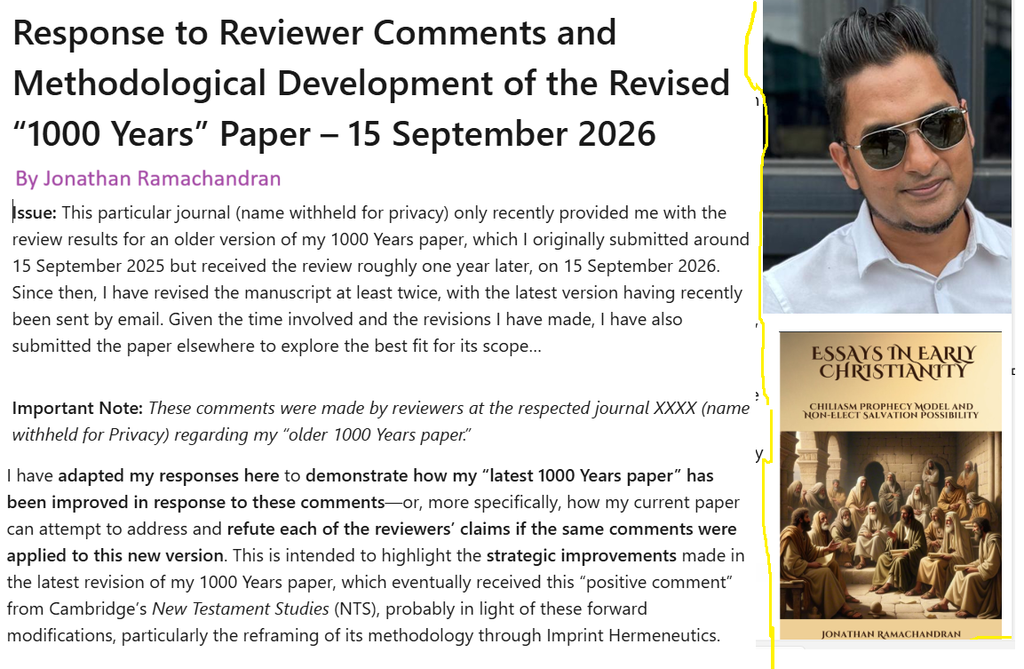
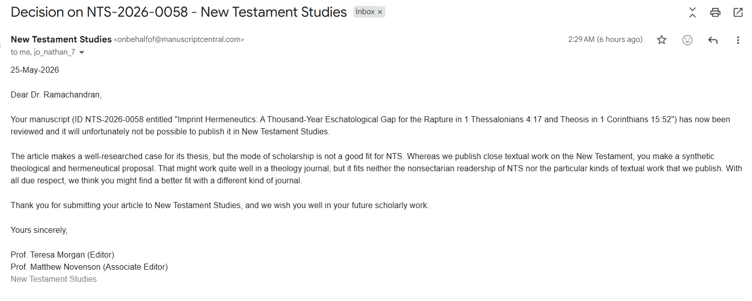
About: New Testament Studies (NTS), published by Cambridge University Press, is widely regarded as an elite, top-tier international journal.
[1] Jonathan Ramachandran, Free High School Math Olympiad: 546 Problems & Solutions (5 Loaf 2 Fish Publications, May 28, 2026), 1415–16, Appendix 6, “Editorial Verdict: Strong Scholarship, Wrong Journal Fit—by Elite Journal New Testament Studies (Cambridge University Press) regarding my ‘1000 Years’ Paper,” https://books.google.com.my/books/about?id=eaHdEQAAQBAJ; https://drive.google.com/drive/folders/1d0go0yKivMwt7mseVcJucot_E56h1po7?usp=sharing.
About the author:
Jonathan Ramachandran is an ecumenical Christian, a Malaysian theologian, missionary blogger, and operations manager who bridges mathematics and ministry. A self-taught enthusiast of Chiliasm Church Fathers, he has published in peer-reviewed journals and runs www.AnonymousChristian.org. He is an International Mathematical Olympiad (IMO) coach for Malaysia, guiding students in advanced competition mathematics. A graduate in actuarial science and Bank Negara scholar, his professional path spans seismic engineering, education, charity, and freelance preaching, including baptizing students into Christianity . He holds honorary doctorates in theology, divinity, and ministry, dedicating his life to scholarship, service, and mathematical coaching. Education: B.Sc., Th.D. (Hon.), D.Div. (Hon.), D.Min. (Hon.)
Bsc. Actuarial Science (National University of Malaysia, 2006) with Honors.
Dr. Jonathan Ramachandran obtained his Honorary Doctor of Theology (Th.D.) from University of Jerusalem (UJ, Chennai, India, 20 August 2025; Reg. No.: 11230), Honorary Doctor of Divinity (D.Div.) from Triumphant Christian University of America (TCUA, Illinois, USA, 20 August 2025, Cert. ID.: 7704247) and Honorary Doctor of Ministry (D.Min.) from Open Christian University (OCU, California, USA, 31 August 2025, Cert. ID.: OCU250124/831208-14-6517MY).
Works & Links:
Ramachandran, Jonathan. Anonymous Christian. Accessed October 30, 2025. https://www.anonymouschristian.org/
Ramachandran, Jonathan. Coach Jonathan Ramachandran (Facebook Pages). https://www.facebook.com/CoachJonathanRamachandran/, or https://www.facebook.com/profile.php?id=100057109853813, or https://www.facebook.com/profile.php?id=100070978834712
Ramachandran, Jonathan. Defense of Honorary Doctorates. Accessed October 30, 2025. https://drive.google.com/file/d/1dLffkOnLe8BPz9vd3RMPbhZmn6puY7op/view?usp=sharing
Ramachandran, Jonathan. Elementary School Math Olympiad Facebook Links. Updated October 26, 2025. Problems 1–264, https://www.facebook.com/jonathan.ramachandran/posts/pfbid0wkPqT9UULb6G4x1qRVRceBzqARRuWajpKdeVT7d2YfGkD28z7hcqB7yvMFRE3Wpal; Website listing, https://www.anonymouschristian.org/blog/elementary-school-math-olympiad-facebook-links/
Ramachandran, Jonathan. Essays in Early Christianity: Chiliasm Prophecy Model and Non-Elect Salvation Possibility. Cambridge, OH: Christian Publishing House, 13 July 2025. ISBN 978-1949586435. https://www.amazon.com/dp/1949586421.
Ramachandran, Jonathan. Free High School Math Olympiad: 546 Problems & Solutions. 5 Loaf 2 Fish Publications, May 28, 2026. https://books.google.com.my/books/about?id=eaHdEQAAQBAJ or https://drive.google.com/drive/folders/1d0go0yKivMwt7mseVcJucot_E56h1po7?usp=sharing.
Ramachandran, Jonathan. High School Math Olympiad Facebook Links. Updated October 26, 2025. Problems 1–340, https://www.facebook.com/jonathan.ramachandran/posts/pfbid0AwdYEToSrX8B2W1KJyzuKoCyWv3VXAHPAtt5bSfwd3tF2oMEbnmgwCoacyPxczppl; Problems 341–545, https://www.facebook.com/jonathan.ramachandran/posts/pfbid0hJeHxUuJp5kRwWJQ5QFhoNPS4Ym2mmh3ciei2nctqsThbNhWuTAJYvRzk3AU5APil; Website listing of Problems 1–545, https://www.anonymouschristian.org/blog/high-school-math-olympiad-facebook-links/
Ramachandran, Jonathan. Hope Beyond the Elect: Revisiting Early Christian Views on Prophecy and Salvation. Cambridge, OH: Christian Publishing House, 2025. www.amazon.com/dp/1949586405.
Ramachandran, Jonathan. Jonathan’s Math Video Solutions. YouTube channel. https://youtube.com/@jonathanramachandran1537?si=oKVTC4hLTK7iRKSf
Ramachandran, Jonathan. Jonathan Ramachandran – Independent Researcher (Academia.edu profile). Accessed October 30, 2025. https://independent.academia.edu/RamachandranJonathan
Ramachandran, Jonathan. Sample CV. 14 September 2025. https://drive.google.com/file/d/19YuhL31EpC4l3JnHcbbQNio-ueogAEXQ/view?usp=sharing
Ramachandran, Jonathan. School Math Facebook Links. Updated October 26, 2025. Problems 1–154, https://www.facebook.com/jonathan.ramachandran/posts/pfbid025mCA6wGPKLJ4ERhfLBzUwooHBJez59wdhJuHnbKZ9F9ZdaDpEmvX4vinwmoNjdsUl; Website listing, https://www.anonymouschristian.org/blog/school-math-facebook-links/
Ramachandran, Jonathan. Thank God Regardless: Math, Merit, and Being Unapologetically Christian. 5 Loaf 2 Fish Publications, 2026. https://drive.google.com/drive/folders/1d0go0yKivMwt7mseVcJucot_E56h1po7?usp=sharing or https://books.google.com.my/books/about?id=3KPfEQAAQBAJ.
Ramachandran, Jonathan. “Jonathan Ramachandran – Google Scholar Profile.” Accessed October 30, 2025. https://scholar.google.com/citations?hl=en&user=Bv7IFrAAAAAJ
Ramachandran, Jonathan. “Non Elect Salvation Possibility.” American Journal of Biblical Theology (AJBT) 26, no. 6 (February 2025). www.biblicaltheology.com/Research/RamachandranJ01.pdf.
Ramachandran, Jonathan. “ORCID 0009‑0008‑4669‑1077.” Accessed October 30, 2025. https://orcid.org/0009-0008-4669-1077
Ramachandran, Jonathan. “The Personhood of the Holy Spirit and the Unity of the Trinity.” JOY! Magazine, theology section, April 2026. Accessed April 3, 2026. https://joygifts.co.za/product/https-joygifts-co-za-joy-april-2026/.
Ramachandran, Jonathan. “Thousand Year Gap for Prophecy in 1 Thessalonians 4:17 and 1 Corinthians 15:52 with Chiliasm Church Fathers.” Journal of Biblical Theology (JBT) 8, no. 3 (June 2025).
Ramachandran, Jonathan. “Thousand Year Gap for Prophecy in 1 Thessalonians 4:17 and 1 Corinthians 15:52 with Chiliasm Church Fathers.” American Journal of Biblical Theology (AJBT) 26, no. 22 (June 2025). www.biblicaltheology.com/Research/RamachandranJ02.pdf.
Source article:
Thank you!