A Conversation Between a Christian Author and a Top Academic Christian Publisher – No PHD?
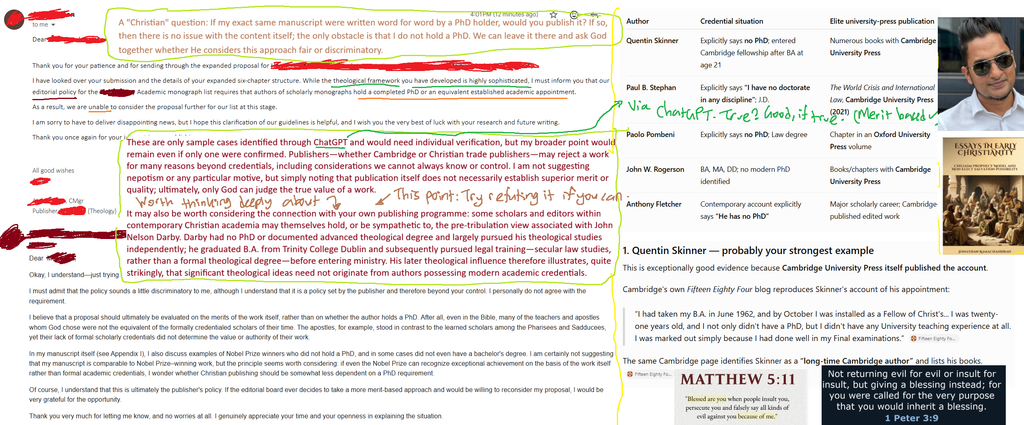
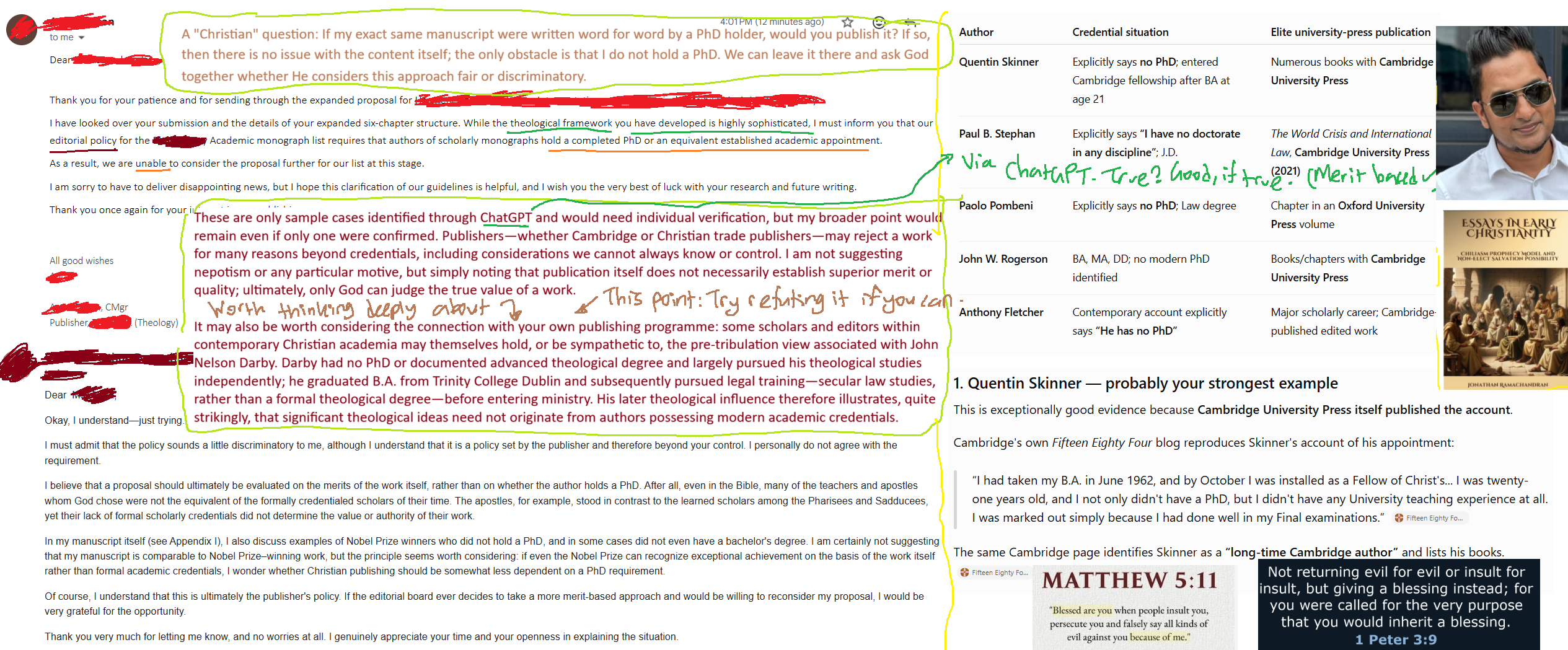
A Christian author submitted an expanded scholarly writing proposal to a top academic Christian publisher. After reviewing the proposal and its expanded structure, the publisher responded:
Top Academic Christian Journal/Book Publisher:
Thank you for your patience and for sending through the expanded proposal.
I have looked over your submission and the details of your expanded structure. While the theological framework you have developed is highly sophisticated, I must inform you that our editorial policy for our scholarly journal articles and scholarly monograph list requires that authors of scholarly journal articles and scholarly monographs hold a completed PhD or an equivalent established academic appointment.
As a result, we are unable to consider the proposal further for our list at this stage.
I am sorry to have to deliver disappointing news, but I hope this clarification of our guidelines is helpful, and I wish you the very best of luck with your research and future writing.
Thank you once again for your interest in our publishing programme.
Christian Author:
Okay, I understand—just trying.
I must admit that the policy sounds a little discriminatory to me, although I understand that it is a policy set by the publisher and therefore beyond your control. I personally do not agree with the requirement.
I believe that a proposal should ultimately be evaluated on the merits of the work itself, rather than on whether the author holds a PhD. After all, even in the Bible, many of the teachers and apostles whom God chose were not the equivalent of the formally credentialed scholars of their time. The apostles, for example, stood in contrast to the learned scholars among the religious authorities, yet their lack of formal scholarly credentials did not determine the value or authority of their work.
In my manuscript itself, I also discuss examples of Nobel Prize winners who did not hold a PhD, and in some cases did not even have a bachelor’s degree. I am certainly not suggesting that my manuscript is comparable to Nobel Prize–winning work, but the principle seems worth considering: if even the Nobel Prize can recognize exceptional achievement on the basis of the work itself rather than formal academic credentials, I wonder whether Christian publishing should be somewhat less dependent on a PhD requirement.
Of course, I understand that this is ultimately the publisher’s policy. If the editorial board ever decides to take a more merit-based approach and would be willing to reconsider my proposal, I would be very grateful for the opportunity.
Thank you very much for letting me know, and no worries at all. I genuinely appreciate your time and your openness in explaining the situation.
Top Academic Christian Journal/Book Publisher:
Thank you for your follow-up email.
To clarify our editorial process, our academic publishing programme operates under strict commissioning guidelines for our scholarly journal articles and scholarly monograph list. Because these books are intended primarily for university library acquisition and postgraduate research, our editorial board requires that monograph authors hold a completed PhD or a senior, established academic appointment in the relevant field.
This policy is in place because academic monographs must undergo a highly specialized peer-review process, where the author’s institutional standing and credentials are major factors in ensuring the book’s authority and market viability.
Because you do not currently hold these specific academic credentials, we are unfortunately unable to publish your work on our academic list.
I understand this may be disappointing news, but I hope this provides a clearer understanding of our institutional parameters. I wish you the very best with your future research and writing.
Christian Author:
Here are some thoughts for your distinguished publishing house:
I do wonder whether this policy may be somewhat inconsistent with the broader Christian principle of evaluating a person’s work on its merits rather than primarily on formal credentials. I offer the following two points for your kind consideration, especially given your standing as an undoubtedly distinguished academic publisher.
1. It may also be worth considering the connection with your own publishing programme: some scholars and editors within contemporary Christian academia may themselves hold, or be sympathetic to, the pre-tribulation view associated with John Nelson Darby. Darby had no PhD or documented advanced theological degree and largely pursued his theological studies independently; he graduated B.A. from Trinity College Dublin and subsequently pursued legal training—secular law studies, rather than a formal theological degree—before entering ministry. His later theological influence therefore illustrates, quite strikingly, that significant theological ideas need not originate from authors possessing modern academic credentials.
2. Even major university presses have published non-PhD authors in recent times and throughout the history of academic publishing.
Proof?: These are only sample cases identified through ChatGPT and would need individual verification, but my broader point would remain even if only one were confirmed.
Start of ChatGPT part.
1. Quentin Skinner — probably your strongest example
This is exceptionally good evidence because Cambridge University Press itself published the account.
Cambridge’s own Fifteen Eighty Four blog reproduces Skinner’s account of his appointment:
“I had taken my B.A. in June 1962, and by October I was installed as a Fellow of Christ’s… I was twenty-one years old, and I not only didn’t have a PhD, but I didn’t have any University teaching experience at all. I was marked out simply because I had done well in my Final examinations.”
The same Cambridge page identifies Skinner as a “long-time Cambridge author” and lists his books.
Most importantly, Cambridge University Press subsequently published his major scholarly works, including The Foundations of Modern Political Thought and From Humanism to Hobbes.
Chicago footnote:
Quentin Skinner, interview, “Long Quentin Skinner Interview,” Fifteen Eighty Four, Cambridge University Press, February 17, 2009. The interview records that Skinner entered Christ’s College, Cambridge, as a Fellow at age twenty-one after completing his B.A. and explicitly states that he “didn’t have a PhD”; Cambridge identifies him as a long-time Cambridge author. https://cambridgeblog.org/2009/02/long-quentin-skinner-interview/
Relevant CUP publication: Quentin Skinner, The Foundations of Modern Political Thought, 2 vols. (Cambridge: Cambridge University Press, 1978). DOI: https://doi.org/10.1017/CBO9780511817878
Why this is powerful: This is not merely someone who eventually became a scholar without a PhD. The Cambridge account explicitly describes BA → Cambridge Fellowship → major scholarly career without a PhD, followed by publication with CUP.
2. Paul B. Stephan — extraordinarily strong modern Cambridge case
This may actually be the best contemporary example I found.
Paul B. Stephan’s The World Crisis and International Law was published by Cambridge University Press. In the book’s own Cambridge University Press front matter, Stephan explicitly writes:
“I have no doctorate in any discipline.”
He then distinguishes his Juris Doctor (J.D.) as a professional legal qualification rather than an academic research doctorate.
The Cambridge publication is:
Paul B. Stephan, The World Crisis and International Law (Cambridge: Cambridge University Press, 2021).
This is not an obscure or self-published work: it is a contemporary scholarly monograph issued by Cambridge University Press.
Chicago footnote:
Paul B. Stephan, The World Crisis and International Law (Cambridge: Cambridge University Press, 2021), front matter. Stephan explicitly states that he has “no doctorate in any discipline” and distinguishes his J.D. from an academic doctorate. https://assets.cambridge.org/97810093/20979/frontmatter/9781009320979_frontmatter.pdf
This one deserves special attention
Because it is 2021, it eliminates much of the objection that these examples are merely artifacts of an older British academic system.
It gives you:
modern author → explicitly no academic doctorate → Cambridge University Press scholarly monograph.
That is very close to the proposition you are looking for.
3. Paolo Pombeni — explicit no-PhD + Oxford University Press
This is another exceptionally clean case.
Paolo Pombeni’s institutional biography states:
- degree in Law, University of Bologna, 1971;
- became a university lecturer in 1977;
- became a professor/chair in 1980;
- and explicitly:
“I have no PhD for the simple reason that the PhD was introduced in the Italian University System in 1982, when I was already full professor.”
His publication list then records:
“The problem of Political Parties in Western Liberalism 1868–1968,” in an edited volume published by Oxford University Press in 2012.
Chicago footnote:
Paolo Pombeni, “Paolo Pombeni,” Fondazione Bruno Kessler, biography, accessed September 29, 2026. Pombeni states explicitly that he had no PhD because the Italian PhD was introduced only in 1982, after he had already become a full professor; his selected publications include a chapter in an Oxford University Press volume. https://magazine.fbk.eu/en/spotlight/paolo-pombeni/
Relevant publication:
Paolo Pombeni, “The Problem of Political Parties in Western Liberalism 1868–1968,” in Liberalism as Ideology: Essays in Honour of Michael Freeden, ed. Ben Jackson and Marc Stears (Oxford: Oxford University Press, 2012), 119–136.
Why this matters
This isn’t merely “someone without a PhD published something somewhere.”
It is:
Law degree → university professor → no PhD → scholarly contribution to an Oxford University Press volume.
4. John W. Rogerson — particularly relevant to your theology/Bible project
This is probably the most relevant disciplinary example for you.
A biographical source identifies John W. Rogerson’s qualifications as:
- B.A. — University of Manchester
- M.A. — University of Oxford
- D.D. — University of Manchester
with no PhD listed.
Rogerson became Professor Emeritus of Biblical Studies at Sheffield and published extensively in biblical studies.
Crucially, Cambridge University Press published his work:
John W. Rogerson and John W. McKay, Psalms 1–50, Psalms 51–100, and Psalms 101–150, Cambridge University Press, 1977, and later John Rogerson and Philip Davies, The Old Testament World (Cambridge University Press, 1989).
Cambridge’s own Cambridge Companion to the Bible also lists Rogerson as one of its editors/contributors.
Chicago footnote:
John W. Rogerson, author biography in Introduction to Genesis, noting his B.A. from the University of Manchester, M.A. from the University of Oxford, and D.D. from the University of Manchester. https://m.j-road.co.kr/product/%EC%B0%BD%EC%84%B8%EA%B8%B0-%EC%97%B0%EA%B5%AC-%EC%9E%85%EB%AC%B8/4410
Relevant CUP publication:
John W. Rogerson and Philip R. Davies, The Old Testament World (Cambridge: Cambridge University Press, 1989). https://obnb.uk/p8757641-the-old-testament-world
And a Cambridge journal review independently confirms the CUP publication:
Stephen B. Dawes, review of The Old Testament World, by John Rogerson and Philip Davies, Scottish Journal of Theology 44, no. 1 (1991): 109–110. DOI: https://doi.org/10.1017/S0036930600025333
Caveat
I would phrase this as “Rogerson’s documented qualifications were BA, MA and DD, rather than a PhD”, rather than claiming that a source explicitly says “Rogerson never had a PhD.” The evidence is strong, but the wording matters.
5. Anthony Fletcher — another explicit “no PhD” historian
This is a particularly interesting historical example.
R. I. Moore’s contribution to a Cambridge University Press volume explicitly states of Anthony:
“He has no PhD”
and explains that he had actually declined an opportunity to pursue one.
The same passage discusses his subsequent scholarly development and identifies his major works, including A County Community in Peace and War, The Outbreak of the English Civil War, and Reform in the Provinces.
Fletcher subsequently participated in Cambridge University Press publications, including Order and Disorder in Early Modern England.
Chicago footnote:
R. I. Moore, contribution to The Family in Early Modern England, ed. Helen Berry and Elizabeth Foyster (Cambridge: Cambridge University Press, 2007), xii. Moore notes explicitly that Anthony Fletcher “has no PhD” and describes his independent scholarly development. https://assets.cambridge.org/97805211/82669/frontmatter/9780521182669_frontmatter.pdf
6. An important scholarly study that strengthens the general argument
I also found a Cambridge-published empirical article that is much more useful than I initially realized:
Mark Davies, “Educational Background and Access to Legal Academia,” Legal Studies 38 (2018): 120–146.
The study examined academic lawyers in England and Wales and found that among long-experience academics, a substantial proportion had no doctorate, including almost a quarter of academics in the Oxbridge category. Many had reached positions up to and including full professorship.
The author explicitly concludes that doctoral requirements have increased over time and that the absence of a doctorate did not historically prevent many academics from reaching senior academic positions.
Chicago footnote:
Mark Davies, “Educational Background and Access to Legal Academia,” Legal Studies 38 (2018): 120–146. The study finds that approximately one-quarter of long-experience Oxbridge academic lawyers in its sample lacked doctorates, with many reaching senior and professorial positions. DOI: https://doi.org/10.1017/lst.2017.5 https://www.cambridge.org/core/services/aop-cambridge-core/content/view/186B79C305444E8F21213318770978C4/S0261387517000058a.pdf/educational_background_and_access_to_legal_academia.pdf
End of ChatGPT part.
Note: Publishers—whether Cambridge or Christian trade publishers—may reject a work for many reasons beyond credentials, including considerations we cannot always know or control. I am not suggesting nepotism or any particular motive, but simply noting that publication itself does not necessarily establish superior merit or quality; ultimately, only God can judge the true value of a work.
I would respectfully suggest that formal academic credentials and scholarly merit are not necessarily identical. The history of theological scholarship itself provides numerous examples of substantial scholarly works produced by authors whose qualifications followed educational pathways quite different from the modern PhD system.
Conclusion
A “Christian” question: If my exact same manuscript were written word for word by a PhD holder, would you publish it? If so, then there is no issue with the content itself; the only obstacle is that I do not hold a PhD.
We can leave it there and ask God together whether He considers this approach fair or discriminatory.
Shalom.
Christian Author
And He sent him a portrait of:
“Death itself being defeated … by the Lord Jesus Christ.”
Source:
https://www.linkedin.com/pulse/conversation-between-christian-author-top-academic-phd-jonathan-dujae
About this article author:
Jonathan Ramachandran is an ecumenical Christian, a Malaysian theologian, missionary blogger, and operations manager who bridges mathematics and ministry. A self-taught enthusiast of Chiliasm Church Fathers, he has published in peer-reviewed journals and runs www.AnonymousChristian.org. He is an International Mathematical Olympiad (IMO) coach for Malaysia, guiding students in advanced competition mathematics. A graduate in actuarial science and Bank Negara scholar, his professional path spans seismic engineering, education, charity, and freelance preaching, including baptizing students into Christianity . He holds honorary doctorates in theology, divinity, and ministry, dedicating his life to scholarship, service, and mathematical coaching. Education: B.Sc., Th.D. (Hon.), D.Div. (Hon.), D.Min. (Hon.)
Bsc. Actuarial Science (National University of Malaysia, 2006) with Honors.
Dr. Jonathan Ramachandran obtained his Honorary Doctor of Theology (Th.D.) from University of Jerusalem (UJ, Chennai, India, 20 August 2025; Reg. No.: 11230), Honorary Doctor of Divinity (D.Div.) from Triumphant Christian University of America (TCUA, Illinois, USA, 20 August 2025, Cert. ID.: 7704247) and Honorary Doctor of Ministry (D.Min.) from Open Christian University (OCU, California, USA, 31 August 2025, Cert. ID.: OCU250124/831208-14-6517MY).
Works & Links:
Ramachandran, Jonathan. Anonymous Christian. Accessed October 30, 2025. https://www.anonymouschristian.org/
Ramachandran, Jonathan. Coach Jonathan Ramachandran (Facebook Pages). https://www.facebook.com/CoachJonathanRamachandran/, or https://www.facebook.com/profile.php?id=100057109853813, or https://www.facebook.com/profile.php?id=100070978834712
Ramachandran, Jonathan. Defense of Honorary Doctorates. Accessed October 30, 2025. https://drive.google.com/file/d/1dLffkOnLe8BPz9vd3RMPbhZmn6puY7op/view?usp=sharing
Ramachandran, Jonathan. Elementary School Math Olympiad Facebook Links. Updated October 26, 2025. Problems 1–264, https://www.facebook.com/jonathan.ramachandran/posts/pfbid0wkPqT9UULb6G4x1qRVRceBzqARRuWajpKdeVT7d2YfGkD28z7hcqB7yvMFRE3Wpal; Website listing, https://www.anonymouschristian.org/blog/elementary-school-math-olympiad-facebook-links/
Ramachandran, Jonathan. Essays in Early Christianity: Chiliasm Prophecy Model and Non-Elect Salvation Possibility. Cambridge, OH: Christian Publishing House, 13 July 2025. ISBN 978-1949586435. https://www.amazon.com/dp/1949586421.
Ramachandran, Jonathan. Free High School Math Olympiad: 546 Problems & Solutions. 5 Loaf 2 Fish Publications, May 28, 2026. https://books.google.com.my/books/about?id=eaHdEQAAQBAJ or https://drive.google.com/drive/folders/1d0go0yKivMwt7mseVcJucot_E56h1po7?usp=sharing.
Ramachandran, Jonathan. High School Math Olympiad Facebook Links. Updated October 26, 2025. Problems 1–340, https://www.facebook.com/jonathan.ramachandran/posts/pfbid0AwdYEToSrX8B2W1KJyzuKoCyWv3VXAHPAtt5bSfwd3tF2oMEbnmgwCoacyPxczppl; Problems 341–545, https://www.facebook.com/jonathan.ramachandran/posts/pfbid0hJeHxUuJp5kRwWJQ5QFhoNPS4Ym2mmh3ciei2nctqsThbNhWuTAJYvRzk3AU5APil; Website listing of Problems 1–545, https://www.anonymouschristian.org/blog/high-school-math-olympiad-facebook-links/
Ramachandran, Jonathan. Hope Beyond the Elect: Revisiting Early Christian Views on Prophecy and Salvation. Cambridge, OH: Christian Publishing House, 2025. www.amazon.com/dp/1949586405.
Ramachandran, Jonathan. Jonathan’s Math Video Solutions. YouTube channel. https://youtube.com/@jonathanramachandran1537?si=oKVTC4hLTK7iRKSf
Ramachandran, Jonathan. Jonathan Ramachandran – Independent Researcher (Academia.edu profile). Accessed October 30, 2025. https://independent.academia.edu/RamachandranJonathan
Ramachandran, Jonathan. Sample CV. 14 September 2025. https://drive.google.com/file/d/19YuhL31EpC4l3JnHcbbQNio-ueogAEXQ/view?usp=sharing
Ramachandran, Jonathan. School Math Facebook Links. Updated October 26, 2025. Problems 1–154, https://www.facebook.com/jonathan.ramachandran/posts/pfbid025mCA6wGPKLJ4ERhfLBzUwooHBJez59wdhJuHnbKZ9F9ZdaDpEmvX4vinwmoNjdsUl; Website listing, https://www.anonymouschristian.org/blog/school-math-facebook-links/
Ramachandran, Jonathan. Thank God Regardless: Math, Merit, and Being Unapologetically Christian. 5 Loaf 2 Fish Publications, 2026. https://drive.google.com/drive/folders/1d0go0yKivMwt7mseVcJucot_E56h1po7?usp=sharing or https://books.google.com.my/books/about?id=3KPfEQAAQBAJ.
Ramachandran, Jonathan. “Jonathan Ramachandran – Google Scholar Profile.” Accessed October 30, 2025. https://scholar.google.com/citations?hl=en&user=Bv7IFrAAAAAJ
Ramachandran, Jonathan. “Non Elect Salvation Possibility.” American Journal of Biblical Theology (AJBT) 26, no. 6 (February 2025). www.biblicaltheology.com/Research/RamachandranJ01.pdf.
Ramachandran, Jonathan. “ORCID 0009‑0008‑4669‑1077.” Accessed October 30, 2025. https://orcid.org/0009-0008-4669-1077
Ramachandran, Jonathan. “The Personhood of the Holy Spirit and the Unity of the Trinity.” JOY! Magazine, theology section, April 2026. Accessed April 3, 2026. https://joygifts.co.za/product/https-joygifts-co-za-joy-april-2026/.
Ramachandran, Jonathan. “Thousand Year Gap for Prophecy in 1 Thessalonians 4:17 and 1 Corinthians 15:52 with Chiliasm Church Fathers.” Journal of Biblical Theology (JBT) 8, no. 3 (June 2025).
Ramachandran, Jonathan. “Thousand Year Gap for Prophecy in 1 Thessalonians 4:17 and 1 Corinthians 15:52 with Chiliasm Church Fathers.” American Journal of Biblical Theology (AJBT) 26, no. 22 (June 2025). www.biblicaltheology.com/Research/RamachandranJ02.pdf.