Understanding the Divide Between Theological, Academic, and Mixed Journals: Scope and Audience Issue via my Journal Paper by Top Journals
[I believe these are very honest comments, which I respect in return.]
1) Catholic Biblical Quarterly (CBQ)
CBQ General Editor ([email protected]) Wrote:
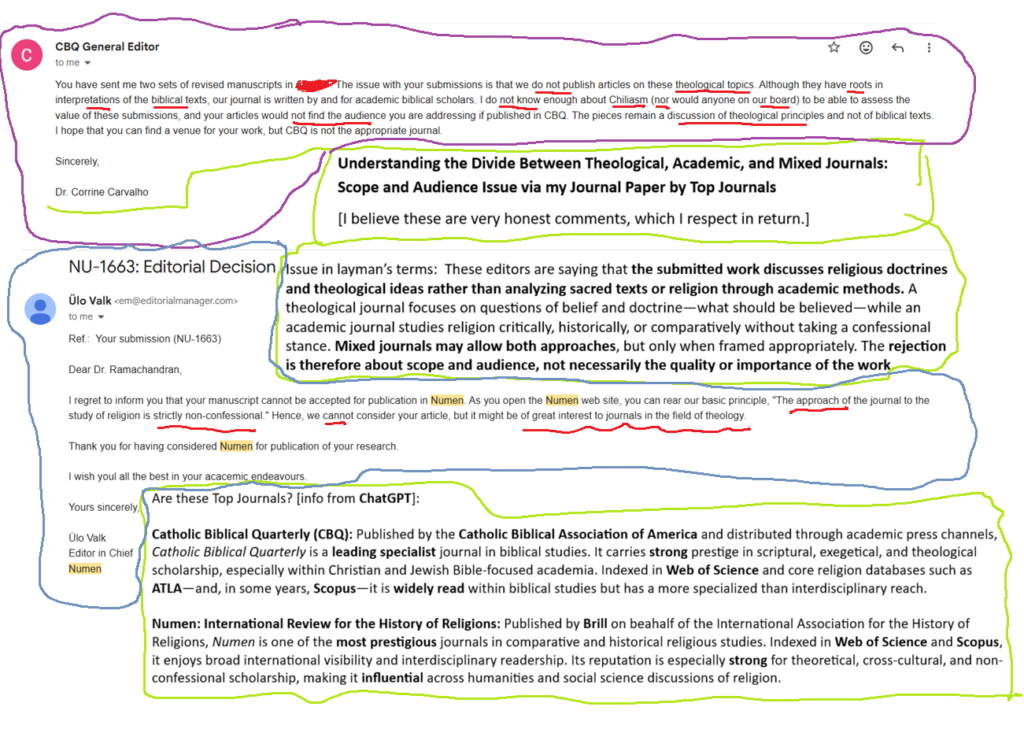
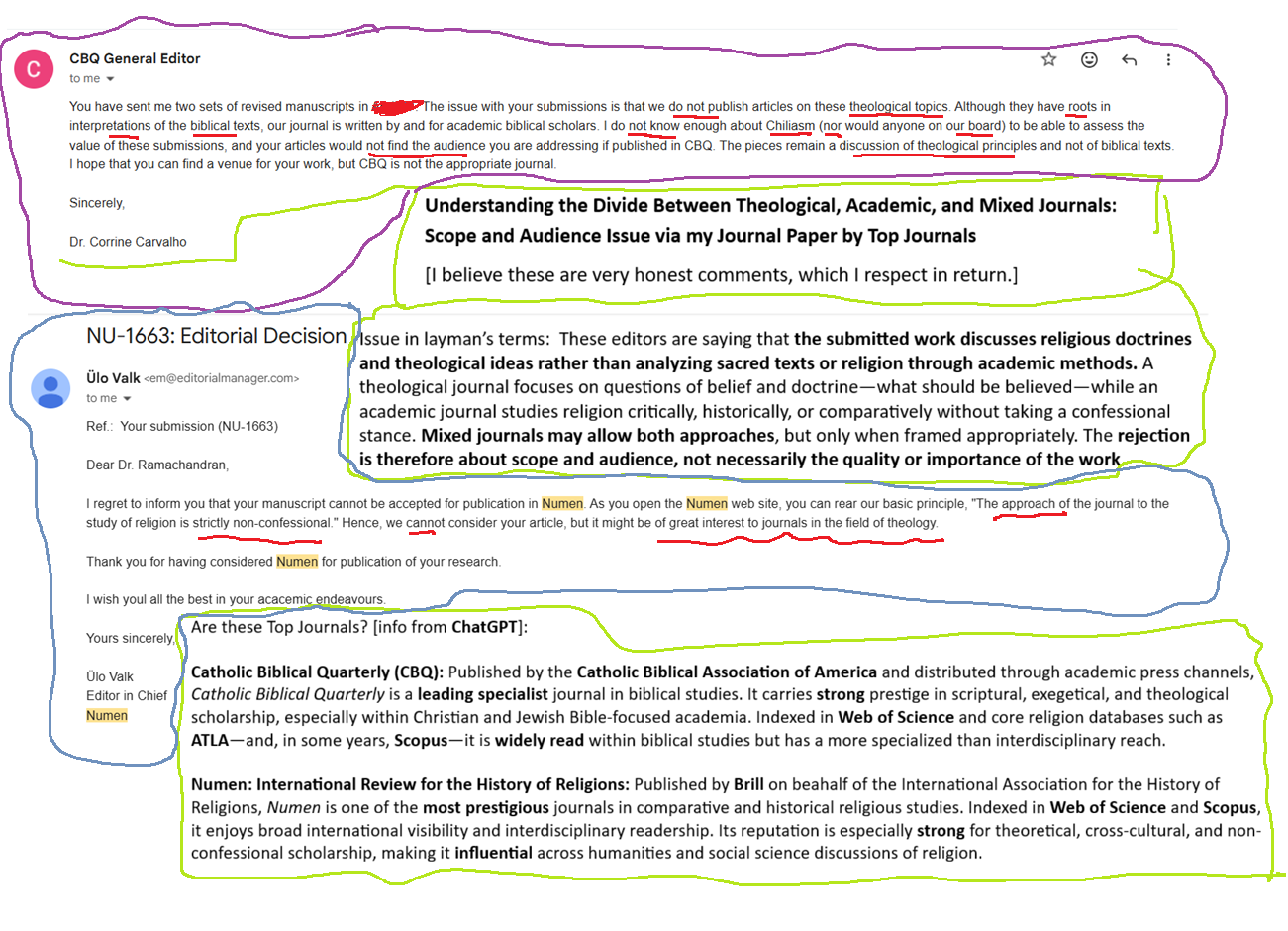
You have sent me two sets of revised manuscripts in XXX. The issue with your submissions is that we do not publish articles on these theological topics. Although they have roots in interpretations of the biblical texts, our journal is written by and for academic biblical scholars. I do not know enough about Chiliasm (nor would anyone on our board) to be able to assess the value of these submissions, and your articles would not find the audience you are addressing if published in CBQ. The pieces remain a discussion of theological principles and not of biblical texts. I hope that you can find a venue for your work, but CBQ is not the appropriate journal.
Sincerely,
Dr. Corrine Carvalho
2) Numen: International Review for the History of Religions
[from: Ülo Valk [email protected] reply-to: Ülo Valk [email protected]] wrote:
Ref.: Your submission (NU-1663)
Dear Dr. Ramachandran,
I regret to inform you that your manuscript cannot be accepted for publication in Numen. As you open the Numen web site, you can rear our basic principle, “The approach of the journal to the study of religion is strictly non-confessional.” Hence, we cannot consider your article, but it might be of great interest to journals in the field of theology.
Thank you for having considered Numen for publication of your research.
I wish youl all the best in your acacemic endeavours.
Yours sincerely,
Ülo Valk
Editor in Chief
Numen
3) Are these Top Journals? [info from ChatGPT]:
Catholic Biblical Quarterly (CBQ): Published by the Catholic Biblical Association of America and distributed through academic press channels, Catholic Biblical Quarterly is a leading specialist journal in biblical studies. It carries strong prestige in scriptural, exegetical, and theological scholarship, especially within Christian and Jewish Bible-focused academia. Indexed in Web of Science and core religion databases such as ATLA—and, in some years, Scopus—it is widely read within biblical studies but has a more specialized than interdisciplinary reach.
Numen: International Review for the History of Religions: Published by Brill on behalf of the International Association for the History of Religions, Numen is one of the most prestigious journals in comparative and historical religious studies. Indexed in Web of Science and Scopus, it enjoys broad international visibility and interdisciplinary readership. Its reputation is especially strong for theoretical, cross-cultural, and non-confessional scholarship, making it influential across humanities and social science discussions of religion.
4) Issue in layman’s terms:
These editors are saying that the submitted work discusses religious doctrines and theological ideas rather than analyzing sacred texts or religion through academic methods. A theological journal focuses on questions of belief and doctrine—what should be believed—while an academic journal studies religion critically, historically, or comparatively without taking a confessional stance. Mixed journals may allow both approaches, but only when framed appropriately. The rejection is therefore about scope and audience, not necessarily the quality or importance of the work.
Thank you
Source (Article titled “Understanding the Divide Between Theological, Academic, and Mixed Journals: Scope and Audience Issue via my Journal Paper by Top Journals”):
Thank you