
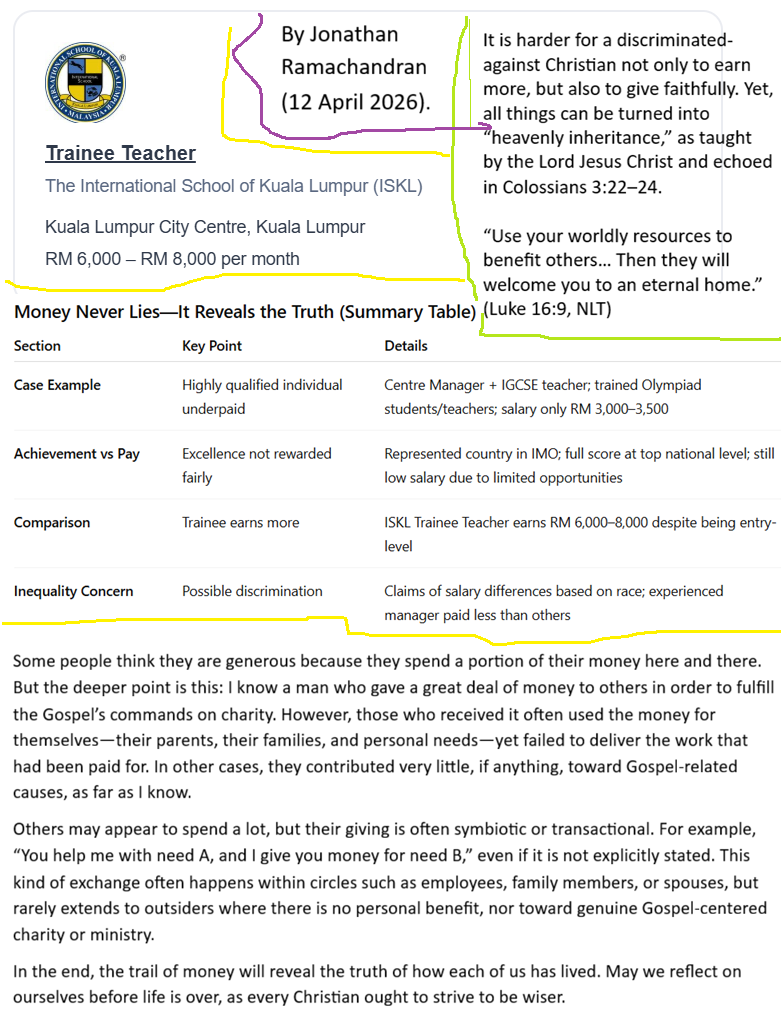
Money Never Lies—It Reveals the Truth
By Jonathan Ramachandran (12 April 2026).
I know a man who previously worked as a Centre Manager for Math Olympiad teaching, and also as a teacher in international and private schools for IGCSE Extended Mathematics (handling an average of 20+ students across two classes). He also trained both teachers and students for private Math Olympiads or IMO camps—from upper elementary all the way to high school. Despite this, the maximum salary he was ever paid in a full-time position was only RM 3,000 to RM 3,500 per month.
This same man even represented his country at the International Math Olympiad and achieved a full score at the highest levels of the national Olympiad. Yet, he was still paid very little due to a lack of opportunities for high-paying jobs and was only hired at a much lower salary.
Therefore, those earning RM 6,000 to RM 8,000 as a “Trainee Teacher” are definitely fortunate, especially considering that this is not even a full teaching position with experience.
Some have said that salary differences may depend on race. I personally know a man who experienced a situation where a parent privately commented to him that a regular teacher (of a different race) was earning more than him in the same organization—even though he was the Centre Manager of their largest centre in the country. He had even coached that parent’s son, who later went on to attend a Cambridge preparatory school in the UK.
If any part of what I have shared is untrue, then I accept the consequences. Now, consider this: how many people can truly say they treat others equally in employment, rather than practicing favoritism or nepotism?
That is life, but all rewards will come in the afterlife, as these Bible verses remind us:
“I returned and saw under the sun that—
The race is not to the swift,
Nor the battle to the strong,
Nor bread to the wise,
Nor riches to men of understanding,
Nor favor to men of skill;
But time and chance happen to them all.”
(Ecclesiastes 9:11, NKJV)
Even if one must work as a “slave,” there is no need to worry, as God promises a heavenly inheritance for Christians:
“Bondservants, obey in all things your masters according to the flesh, not with eyeservice, as men-pleasers, but in sincerity of heart, fearing God. And whatever you do, do it heartily, as to the Lord and not to men, knowing that from the Lord you will receive the reward of the inheritance; for you serve the Lord Christ.”
(Colossians 3:22–24, NKJV)
Job Advertisement Details (posted around 11 April 2026):
Trainee Teacher
The International School of Kuala Lumpur (ISKL)
Kuala Lumpur City Centre, Kuala Lumpur
Teaching – Secondary (Education & Training)
Full time
RM 6,000 – RM 8,000 per month
Source:
or
https://my.jobstreet.com/international-school-jobs/in-Kuala-Lumpur
Some people think they are generous because they spend a portion of their money here and there. But the deeper point is this: I know a man who gave a great deal of money to others in order to fulfill the Gospel’s commands on charity. However, those who received it often used the money for themselves—their parents, their families, and personal needs—yet failed to deliver the work that had been paid for. In other cases, they contributed very little, if anything, toward Gospel-related causes, as far as I know.
Others may appear to spend a lot, but their giving is often symbiotic or transactional. For example, “You help me with need A, and I give you money for need B,” even if it is not explicitly stated. This kind of exchange often happens within circles such as employees, family members, or spouses, but rarely extends to outsiders where there is no personal benefit, nor toward genuine Gospel-centered charity or ministry.
In the end, the trail of money will reveal the truth of how each of us has lived. May we reflect on ourselves before life is over, as every Christian ought to strive to be wiser.
Conclusion
You can see that it is harder for a discriminated-against Christian not only to earn a higher salary, but even, if he or she does, to give it as charity or for ministry in order to fulfill God’s commands. Hence, the Lord Jesus Christ taught the following: everything can be transformed into “heavenly inheritance,” making every unjust suffering more than worthwhile in eternity—this is what the Apostle Paul meant earlier in Colossians 3:22–24.
“Here’s the lesson: Use your worldly resources to benefit others and make friends. Then, when your possessions are gone, they will welcome you to an eternal home.” (Luke 16:9, NLT)
Thank you
Source:
https://www.linkedin.com/pulse/money-never-liesit-reveals-truth-jonathan-ramachandran-9jobc
Finally, some news worth reading in the “Charity Doctrine” context—minus the “political motives.” I’m conservative (not liberal) on most topics, but on this financial issue, I agree with Mr. Bernie Sanders. You will understand it if, one day, you or the breadwinner of your household suddenly lose your job and your family becomes homeless, or if someone in your family (you, your mother, father, brother, sister, son, daughter, grandmother, grandfather, or a close relative—since people often care more when it affects those close to them) dies or falls critically ill and you can no longer afford the treatment.
Strangely, it is often only then that most people begin to look for “God” and “charity,” rather than even the “church,” especially when they find themselves on the “receiving end” after having never given much (or anything) to charity. Even many prosperity gospel churches or pastors will not give a cent of church money to help you, and some may even say that you or your family member are cursed with a fatal disease.
Link:
https://malaysia.news.yahoo.com/benefit-bernie-sanders-wealth-tax-122441933.html

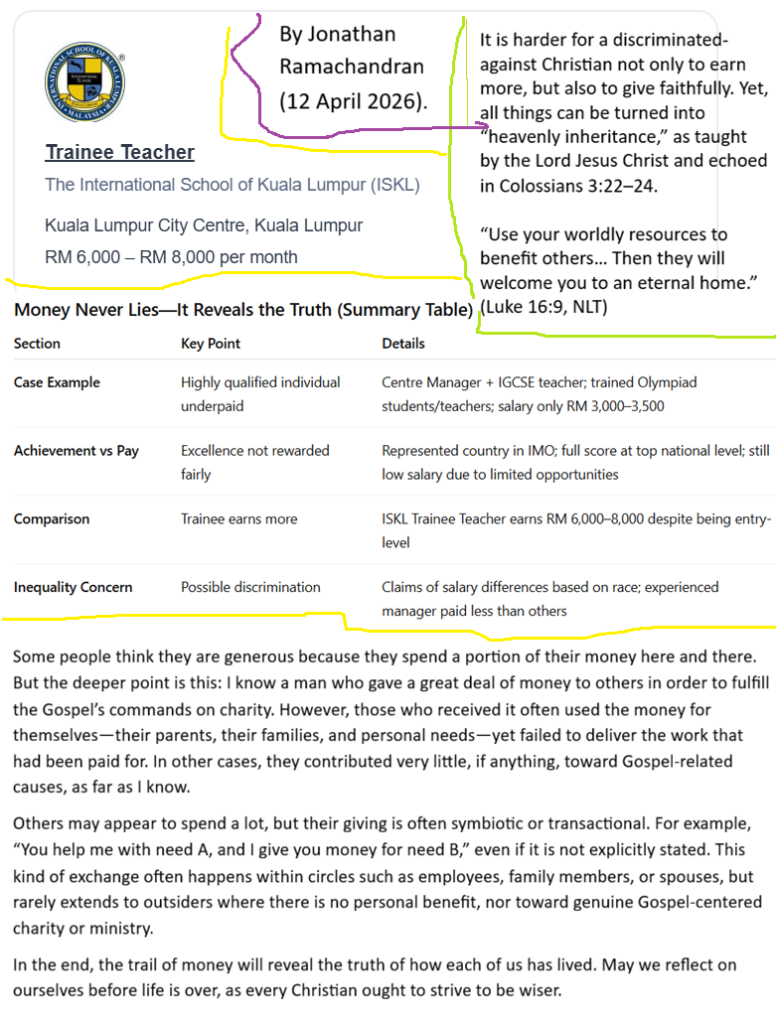
When reviewers of my NESP paper cite a methodological error based on their view that it should include the original context—such as the topic at the time the quote was made, the historical setting, other secondary scholars, and alternative interpretations of that same quote (if they exist)—I respond as follows:
By reading this, readers may become more aware of the complex landscape surrounding what constitutes Biblical exegesis versus eisegesis. Even when examining a single verse (1 Corinthians 3:15), John Calvin does not interpret it as supporting any form of posthumous salvation, whereas Augustine of Hippo, citing the same passage, clearly understands it as referring to purgatory (i.e., a form of salvation occurring after death and beyond judgment, not limited to this life).
For argument’s sake, if Calvin turned out to be right, then even Blessed Augustine would be wrong on this. In that case, my view of non-elect salvation possibility would not be entirely unreasonable, even if it were ultimately incorrect in a similar way. Can you see what I mean?
Source (Article titled “Thought: Toward a Revised Abstract of Non-Elect Salvation Possibility (NESP) Paper with Methodological Defense”), more details:
Thank you for reading!