Between Truth and Possibility: The Place of New Interpretations
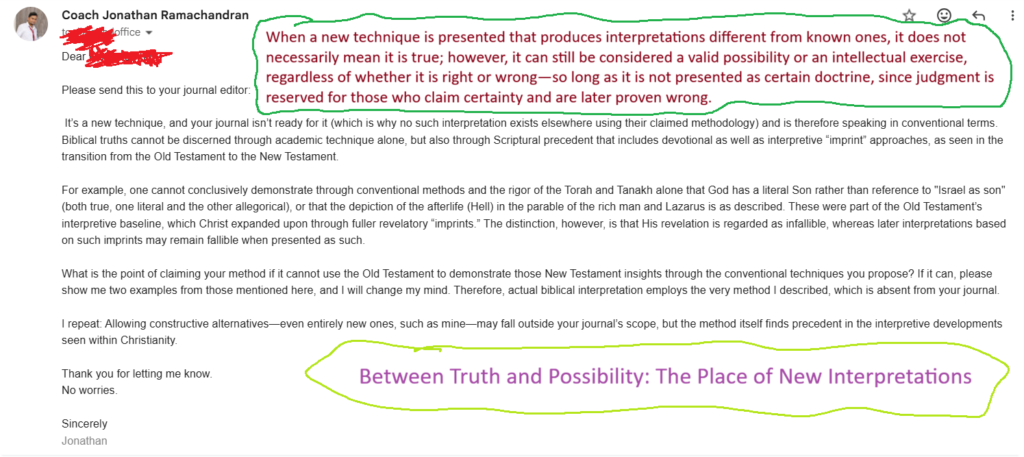
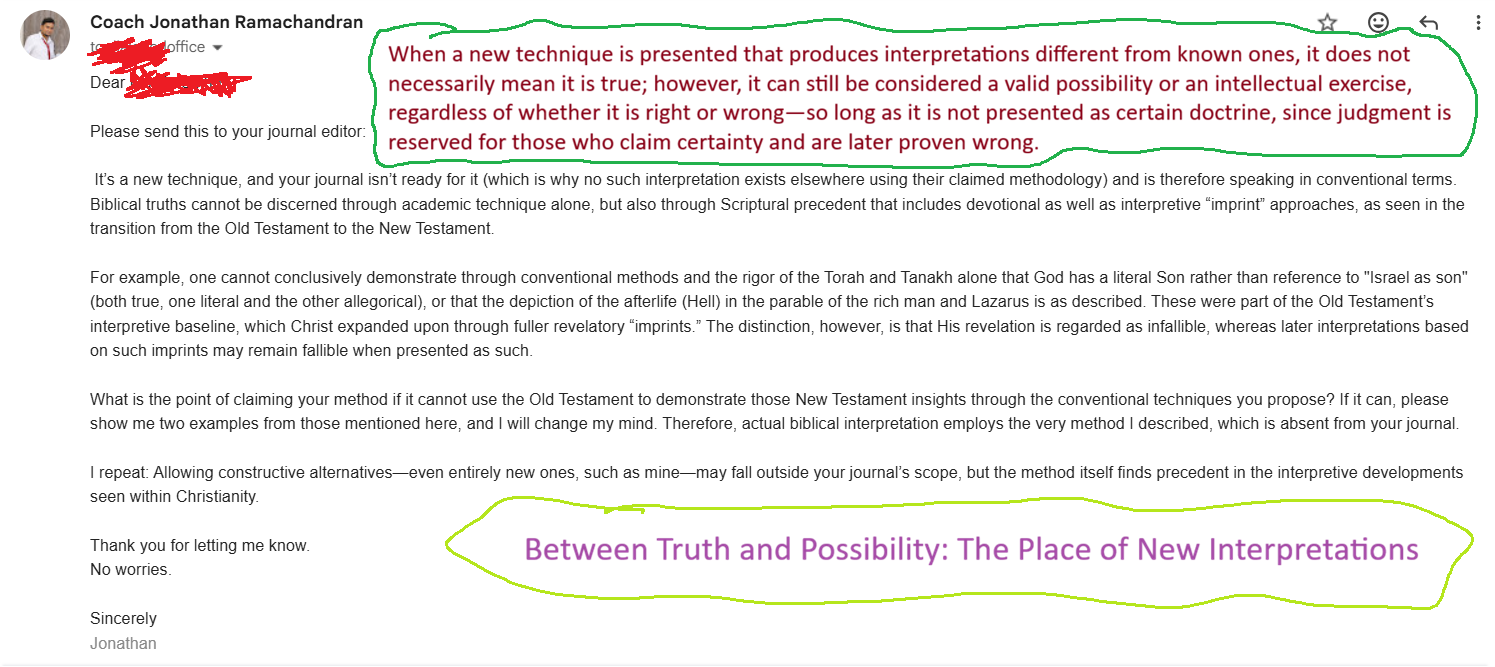
When a new technique is presented that produces interpretations different from known ones, it does not necessarily mean it is true; however, it can still be considered a valid possibility or an intellectual exercise, regardless of whether it is right or wrong—so long as it is not presented as certain doctrine, since judgment is reserved for those who claim certainty and are later proven wrong.
I replied this to a journal:
Dear ABC,
Please send this to your journal editor:
It’s a new technique, and your journal isn’t ready for it (which is why no such interpretation exists elsewhere using their claimed methodology) and is therefore speaking in conventional terms. Biblical truths cannot be discerned through academic technique alone, but also through Scriptural precedent that includes devotional as well as interpretive “imprint” approaches, as seen in the transition from the Old Testament to the New Testament.
For example, one cannot conclusively demonstrate through conventional methods and the rigor of the Torah and Tanakh alone that God has a literal Son rather than reference to “Israel as son” (both true, one literal and the other allegorical), or that the depiction of the afterlife (Hell) in the parable of the rich man and Lazarus is as described. These were part of the Old Testament’s interpretive baseline, which Christ expanded upon through fuller revelatory “imprints.” The distinction, however, is that His revelation is regarded as infallible, whereas later interpretations based on such imprints may remain fallible when presented as such.
What is the point of claiming your method if it cannot use the Old Testament to demonstrate those New Testament insights through the conventional techniques you propose? If it can, please show me two examples from those mentioned here, and I will change my mind. Therefore, actual biblical interpretation employs the very method I described, which is absent from your journal.
I repeat: Allowing constructive alternatives—even entirely new ones, such as mine—may fall outside your journal’s scope, but the method itself finds precedent in the interpretive developments seen within Christianity.
Thank you for letting me know.
No worries.
Sincerely
Jonathan
Source: