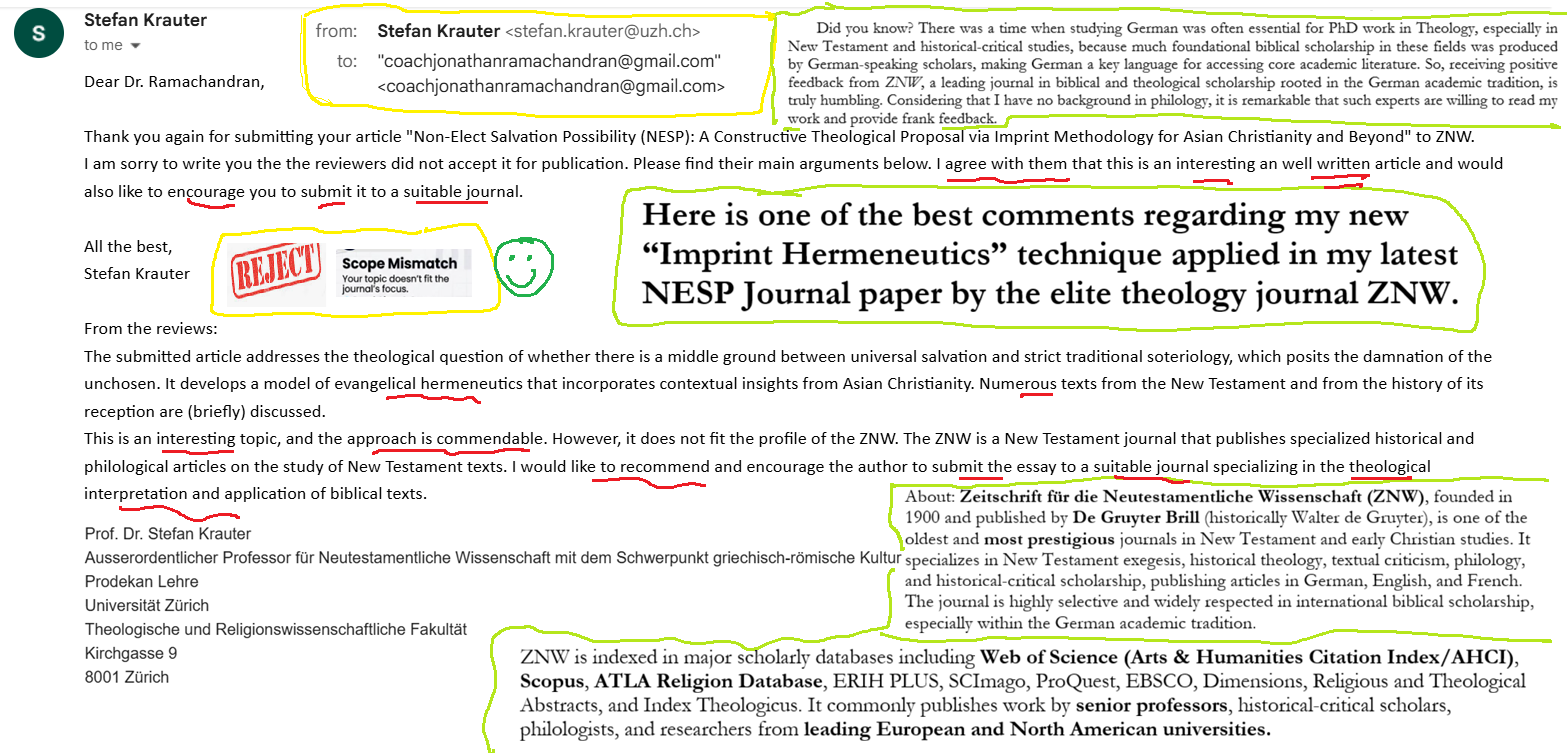
Here is one of the best comments regarding my new “Imprint Hermeneutics” technique applied in my latest NESP Journal paper by the elite theology journal ZNW
Yes, here’s an example of another top journal, comparable to Cambridge and Oxford journals in its field, providing comments on my paper. I appreciate the distinguished Professor’s honest and directive comments.
Stefan Krauter [email protected] wrote:
Dear Dr. Ramachandran,
Thank you again for submitting your article “Non-Elect Salvation Possibility (NESP): A Constructive Theological Proposal via Imprint Methodology for Asian Christianity and Beyond” to ZNW.
I am sorry to write you the the reviewers did not accept it for publication. Please find their main arguments below. I agree with them that this is an interesting an well written article and would also like to encourage you to submit it to a suitable journal.
All the best,
Stefan Krauter
From the reviews:
The submitted article addresses the theological question of whether there is a middle ground between universal salvation and strict traditional soteriology, which posits the damnation of the unchosen. It develops a model of evangelical hermeneutics that incorporates contextual insights from Asian Christianity. Numerous texts from the New Testament and from the history of its reception are (briefly) discussed.
This is an interesting topic, and the approach is commendable. However, it does not fit the profile of the ZNW. The ZNW is a New Testament journal that publishes specialized historical and philological articles on the study of New Testament texts. I would like to recommend and encourage the author to submit the essay to a suitable journal specializing in the theological interpretation and application of biblical texts.
Prof. Dr. Stefan Krauter
Ausserordentlicher Professor für Neutestamentliche Wissenschaft mit dem Schwerpunkt griechisch-römische Kultur
Prodekan Lehre
Universität Zürich
Theologische und Religionswissenschaftliche Fakultät
Kirchgasse 9
8001 Zürich
About: Zeitschrift für die Neutestamentliche Wissenschaft (ZNW), founded in 1900 and published by De Gruyter Brill (historically Walter de Gruyter), is one of the oldest and most prestigious journals in New Testament and early Christian studies. It specializes in New Testament exegesis, historical theology, textual criticism, philology, and historical-critical scholarship, publishing articles in German, English, and French. The journal is highly selective and widely respected in international biblical scholarship, especially within the German academic tradition.
ZNW is indexed in major scholarly databases including Web of Science (Arts & Humanities Citation Index/AHCI), Scopus, ATLA Religion Database, ERIH PLUS, SCImago, ProQuest, EBSCO, Dimensions, Religious and Theological Abstracts, and Index Theologicus. It commonly publishes work by senior professors, historical-critical scholars, philologists, and researchers from leading European and North American universities, particularly in areas such as Pauline studies, Gospel studies, Greek textual analysis, and early Christianity.
Historically, ZNW is associated with the German Protestant historical-critical academic tradition, although it functions primarily as an international scholarly journal rather than a confessional or denominational publication. Its long scholarly history, major indexing coverage, and strong academic reputation make it a highly respected journal in theology and biblical studies.
Conclusion
Did you know? There was a time when studying German was often essential for PhD work in Theology, especially in New Testament and historical-critical studies, because much foundational biblical scholarship in these fields was produced by German-speaking scholars, making German a key language for accessing core academic literature.
So, receiving positive feedback from ZNW, a leading journal in biblical and theological scholarship rooted in the German academic tradition, is truly humbling. Considering that I have no background in philology, it is remarkable that such experts are willing to read my work and provide frank feedback.
In this case, the ZNW reviewers indicated a scope mismatch and suggested submitting the paper to a more suitable journal. At the same time, they offered positive remarks on its quality, stating:
“This is an interesting topic, and the approach is commendable. I would like to recommend and encourage the author to submit the essay to a suitable journal specializing in the theological interpretation and application of biblical texts” and Prof. Dr. Stefan Krauter’s personal remark: “I agree with them that this is an interesting an well written article and would also like to encourage you to submit it to a suitable journal.”
Even though I have been rejected so far, I feel strangely happy about such positive feedback from all these real geniuses in theology.
Source:
Thank you for reading.