When Merit Is Ignored: Psalm 9:17–18, Justice, and the Fate of the Wicked
I used to wonder why the Gospel does not easily penetrate certain people groups until I understood these Bible verses:
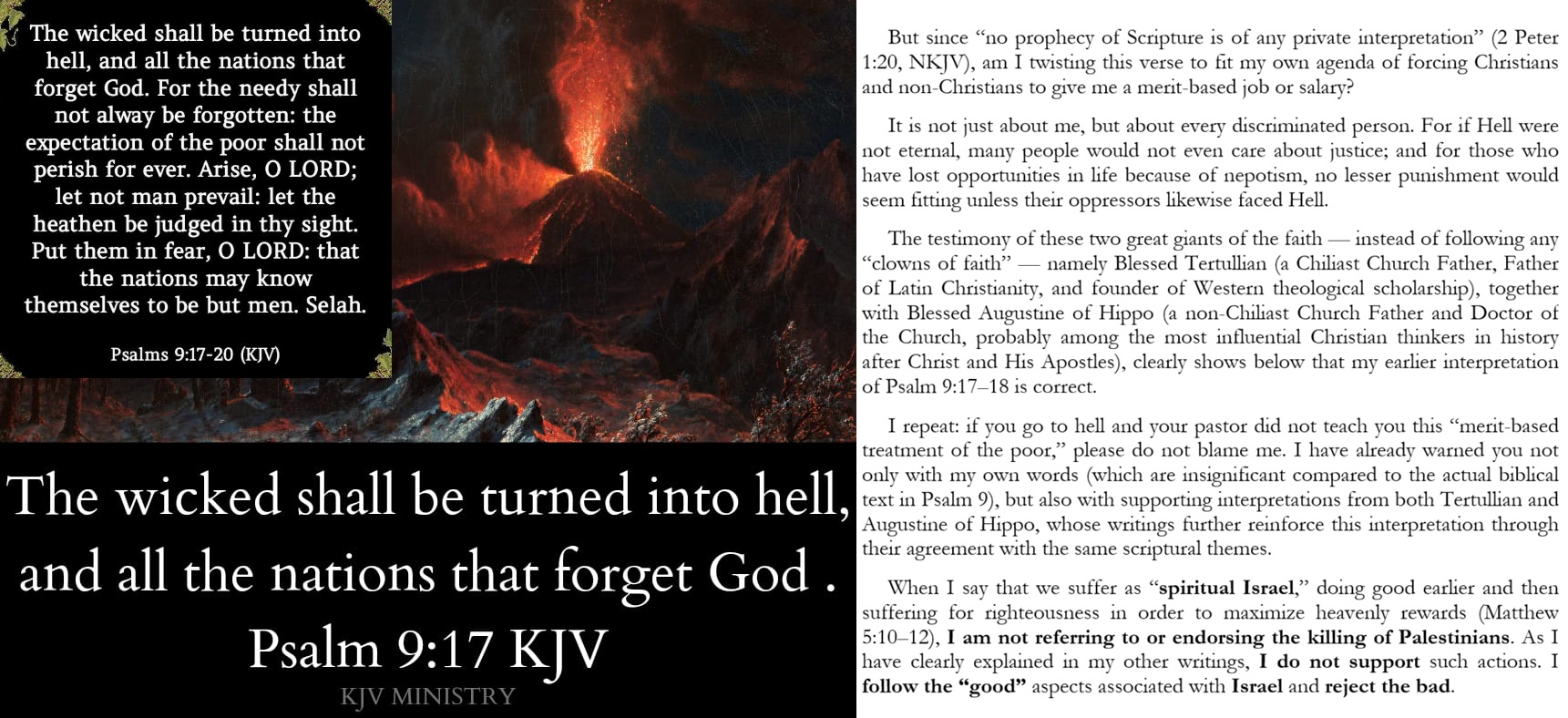
“17 The wicked shall be turned into hell,
And all the nations that forget God.
18 For the needy shall not always be forgotten;
The expectation of the poor shall not perish forever.”
(Psalm 9:17–18, NKJV)
Game Theory aspect:
There are some cultures (and perhaps even entire nations) where people think something like this: “Who cares about that minority Christian man asking for a merit-based position and salary, even if he represented the country at the IMO after defeating all the other students in that year’s National Math Olympiad — including students from the same country who later performed better than him at the IMO, showing that question types and luck also play a role? If I instead favor a wealthy majority race with at least some consideration of merit, the nation’s economy may improve. These minorities bring no economic benefit even if helped, so let us ignore them.”
I believe such people groups become resistant to believing the Gospel, in light of Psalm 9:17–18. In the passage, the “wicked” and the “nations that forget God,” who are turned into “hell” (Sheol/Hades), are contrasted with the “poor” and needy who are neglected or forgotten in the immediate context. This suggests that the passage especially concerns poor people who are rejected despite merit. Of course, not all poor people are necessarily righteous either, as Scripture gives other examples and reasons elsewhere.
Caution: sometimes a merit-based achiever is discriminated against even within his own race for being a Christian. Therefore, this same condemnation applies not only to majority races that discriminate against him, but also to members of his own race who do the same. That is why such people become unable to truly believe the Gospel, because no one can deceive God. Such a level of non-racial thinking, fairness, and merit-based judgment without partiality is required of a Christian.
Some may appear to be Christians, but if they are racist or nepotistic, they too are false, according to the lawlessness condemned in the Great Denial passage (Matthew 7:20–24). This statement does not exempt or support me either, because I also must not practice nepotism or partiality.
But since “no prophecy of Scripture is of any private interpretation” (2 Peter 1:20, NKJV), am I twisting this verse to fit my own agenda of forcing Christians and non-Christians to give me a merit-based job or salary?
It is not just about me, but about every discriminated person. For if Hell were not eternal, many people would not even care about justice; and for those who have lost opportunities in life because of nepotism, no lesser punishment would seem fitting unless their oppressors likewise faced Hell.
The testimony of these two great giants of the faith — instead of following any “clowns of faith” — namely Blessed Tertullian (a Chiliast Church Father, Father of Latin Christianity, and founder of Western theological scholarship), together with Blessed Augustine of Hippo (a non-Chiliast Church Father and Doctor of the Church, probably among the most influential Christian thinkers in history after Christ and His Apostles), clearly shows below that my earlier interpretation of Psalm 9:17–18 is correct. Consider:
i) St. Augustine of Hippo
However, this interpretation is not based merely on personal emotion, because even Blessed Augustine of Hippo, in his Exposition on Psalm 9, interprets Psalm 9:17–18 in a way connected to divine judgment upon those who oppress, neglect, or forget God while the poor and afflicted await justice.
All quotes for Augustine are from this source:
Augustine of Hippo, “Exposition on Psalm 9” trans. anonymous scholar, in Nicene and Post-Nicene Fathers, First Series, vol. 8, ed. Philip Schaff (Buffalo, NY: Christian Literature Publishing Co., 1888), revised and edited for New Advent by Kevin Knight, https://www.newadvent.org/fathers/1801009.htm.
Point 17 fits most directly:
“Let the sinners be turned into hell: that is, let them be given into their own hands, when they are spared, and let them be ensnared in deadly delight. All the nations that forget God.”
This especially supports the idea that those who persist in sinful oppression, corruption, partiality, or selfish injustice become trapped by their own evil desires and are ultimately judged by God.
Point 18 also strongly fits:
“For there shall not be forgetfulness of the poor man to the end… but the patience of the poor shall not perish forever.”
This supports the belief that God does not permanently ignore those who suffer unjustly, including those neglected, rejected, or discriminated against despite merit.
Point 16 further reinforces this:
“In the works of his own hands has the sinner been caught.”
This suggests that sinners are judged through the very corruption and injustice they themselves practice.
Point 13 is also relevant:
“The punishment of the slayers shall be made manifest… He has not forgotten the cry of the poor.”
This aligns with the idea that divine justice eventually answers the cries of those who suffer oppression or wrongful treatment.
Finally, Point 10 connects suffering with God’s refuge for the afflicted:
“And the Lord has become a refuge to the poor… an Helper in due season, in tribulation.”
Altogether, these passages support the broader principle that God judges injustice, remembers the afflicted, and condemns persistent wickedness and partiality. However, Augustine’s focus is primarily spiritual and moral — concerning pride, oppression, sin, and forgetfulness of God — rather than specifically employment systems, race, or economic merit structures in the modern sense.
ii) Tertullian
In this regard, the testimony of Blessed Tertullian is often cited in connection with Psalm 9:17–18, where divine judgment is described alongside God’s remembrance of the poor and oppressed.
All quotes for Tertullian are from this source:
Tertullian, Against Marcion, Book IV, “Chapter 14,” trans. Peter Holmes, in Ante-Nicene Fathers, vol. 3, ed. Alexander Roberts, James Donaldson, and A. Cleveland Coxe (Buffalo, NY: Christian Literature Publishing Co., 1885), revised and edited for New Advent by Kevin Knight, https://www.newadvent.org/fathers/03124.htm.
He explicitly quotes the passage:
“The wicked shall be turned into hell, even all the nations that forget God; because the needy shall not always be forgotten; the endurance of the poor shall not perish forever.”
This is then reinforced in his wider exposition on divine justice, where he highlights God’s opposition to injustice and partiality:
“Woe unto them that decree unrighteous decrees; for in their decrees they decree wickedness, turning aside the needy from judgment, and taking away their rights from the poor of my people.”
He also emphasizes God’s active concern for the oppressed:
“Deliver the poor, and rid the needy out of the hand of the wicked.”
And further describes God’s restorative justice toward those who are socially humbled:
“He raises up the needy from off the ground, and out of the dunghill exalts the poor; that He may set him with the princes of His people (that is, in His own kingdom), and on thrones of glory (even royal ones).”
Taken together, these passages present a consistent theme: God judges systems and individuals who persist in injustice, neglect the needy, or distort fairness, while also remembering and ultimately exalting those who are oppressed or disregarded. This includes those who may remain poor and afflicted in this life, even suffering discrimination or lack of recognition on earth, yet are lifted by God into eternal honor and reward in His kingdom.
Summary
Notice that in each of these quotations, the merit-based poor righteous person dies “poor” but still goes to heaven. God does not necessarily save him on earth or make him rich in this life. Meanwhile, the rich and wicked person who oppressed him dies “rich on earth” but ends up in “hell.” Can you see it?
I repeat: if you go to hell and your pastor did not teach you this “merit-based treatment of the poor,” please do not blame me. I have already warned you not only with my own words (which are insignificant compared to the actual biblical text in Psalm 9), but also with supporting interpretations from both Tertullian and Augustine of Hippo, whose writings further reinforce this interpretation through their agreement with the same scriptural themes.
When I say that we suffer as “spiritual Israel,” doing good earlier and then suffering for righteousness in order to maximize heavenly rewards (Matthew 5:10–12), I am not referring to or endorsing the killing of Palestinians. As I have clearly explained in my other writings, I do not support such actions. I follow the “good” aspects associated with Israel and reject the bad.
Source:
https://www.linkedin.com/pulse/when-merit-ignored-psalm-91718-justice-fate-wicked-ramachandran-s16vc
Thank you for reading.
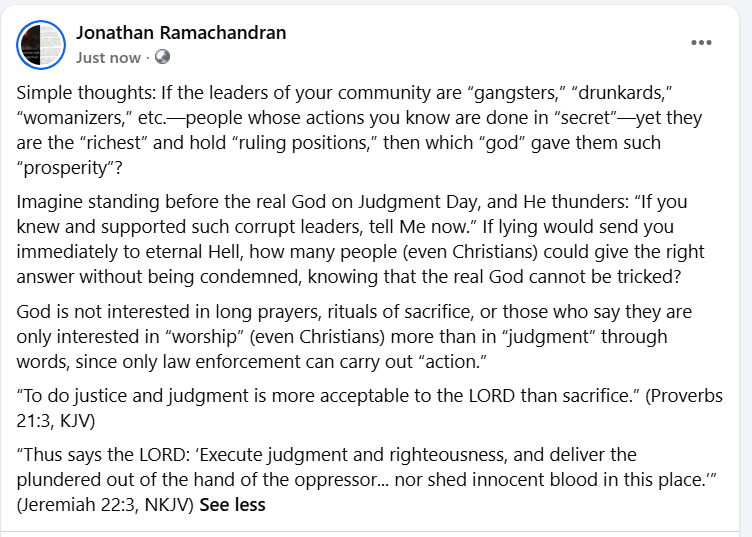
[Text] Simple thoughts: If the leaders of your community are “gangsters,” “drunkards,” “womanizers,” etc.—people whose actions you know are done in “secret”—yet they are the “richest” and hold “ruling positions,” then which “god” gave them such “prosperity”?
Imagine standing before the real God on Judgment Day, and He thunders: “If you knew and supported such corrupt leaders, tell Me now.” If lying would send you immediately to eternal Hell, how many people (even Christians) could give the right answer without being condemned, knowing that the real God cannot be tricked?
God is not interested in long prayers, rituals of sacrifice, or those who say they are only interested in “worship” (even Christians) more than in “judgment” through words, since only law enforcement can carry out “action.”
“To do justice and judgment is more acceptable to the LORD than sacrifice.” (Proverbs 21:3, KJV)
“Thus says the LORD: ‘Execute judgment and righteousness, and deliver the plundered out of the hand of the oppressor… nor shed innocent blood in this place.’” (Jeremiah 22:3, NKJV)