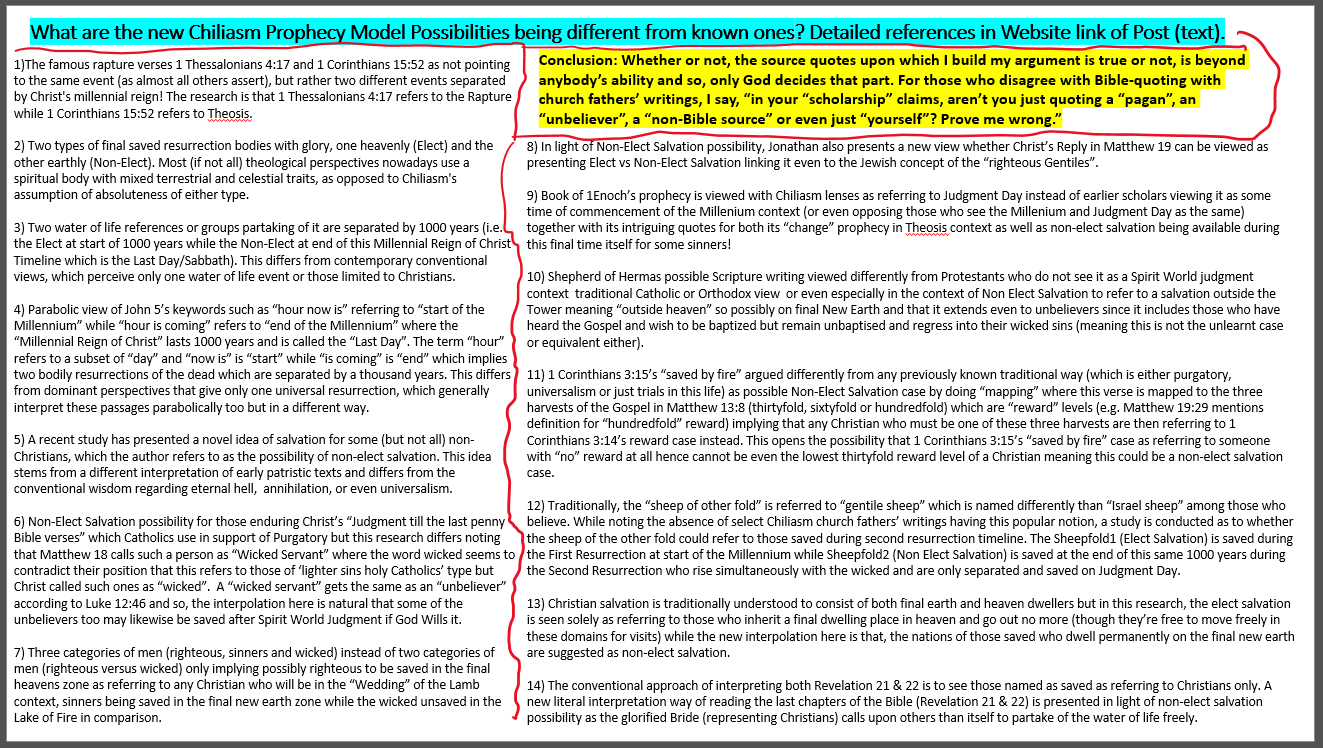
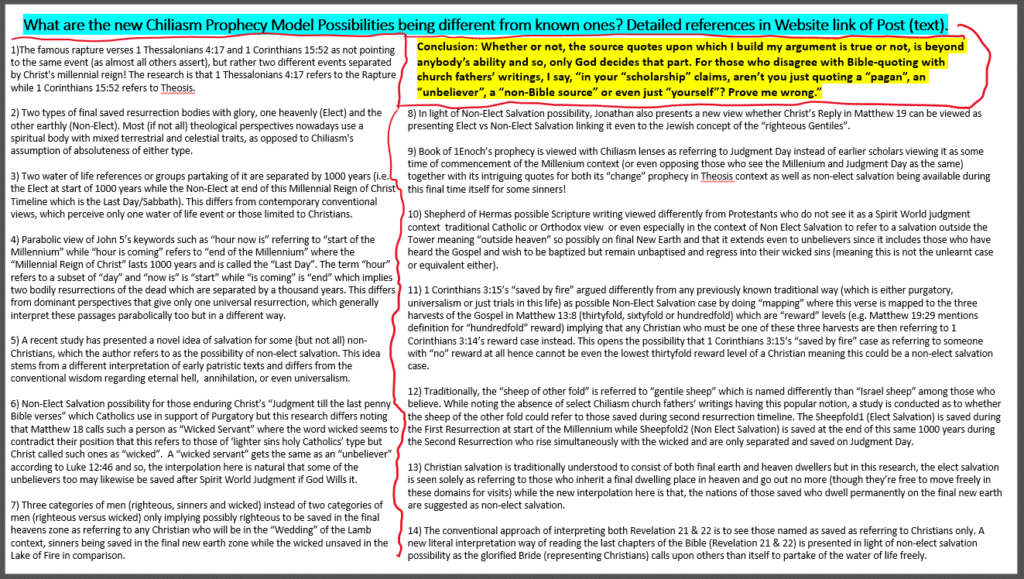
What are the new Chiliasm Prophecy Model Possibilities being different from known ones?
Title: Chiliasm Prophecy Model
Conclusion: Whether or not, the source quotes upon which I build my argument is true or not, is beyond anybody’s ability and so, only God decides that part. For those who disagree with Bible-quoting with church fathers’ writings, I say, “in your “scholarship” claims, aren’t you just quoting a “pagan”, an “unbeliever”, a “non-Bible source” or even just “yourself”? Prove me wrong.”
In recent research, Jonathan Ramachandran is first to propose a new reading of selected patristic materials from Chiliasm church fathers (St. Irenaeus of Lyons, St. Justin Martyr, Tertullian, St. Methodius of Olympus, Lactantius and St. Victorinus of Pettau). This points several interesting possibilities as follows:
1) The famous rapture verses 1 Thessalonians 4:17 and 1 Corinthians 15:52 as not pointing to the same event (as almost all others assert [1] [2] [3]), but rather two different events separated by Christ’s millennial reign! [4] [5] [6] The research is that 1 Thessalonians 4:17 refers to the Rapture while 1 Corinthians 15:52 refers to Theosis.
*https://en.wikipedia.org/wiki/Rapture
** https://en.wikipedia.org/wiki/Theosis_(Eastern_Christian_theology)
*** https://en.wikipedia.org/wiki/Divinization_(Christian)
2) Two types of final saved resurrection bodies with glory, one heavenly (Elect) and the other earthly (Non-Elect) [7] [8] [9]. Most (if not all) theological perspectives nowadays use a spiritual body with mixed terrestrial and celestial traits, as opposed to Chiliasm’s assumption of absoluteness of either type. [10] [11] [12] [13]
* https://en.wikipedia.org/wiki/Resurrection
** https://en.wikipedia.org/wiki/Election_in_Christianity
3) Two water of life references or groups partaking of it are separated by 1000 years (i.e. the Elect at start of 1000 years while the Non-Elect at end of this Millennial Reign of Christ Timeline which is the Last Day/Sabbath). [14] [15] [16] This differs from contemporary conventional views, which perceive only one water of life event or those limited to Christians. [17] [18] [19]
* https://en.wikipedia.org/wiki/Water_of_Life_(Christianity)
** https://en.wikipedia.org/wiki/Millennialism
*** https://en.wikipedia.org/wiki/Historic_premillennialism
4) Parabolic view of John 5’s keywords such as “hour now is” referring to “start of the Millennium” while “hour is coming” refers to “end of the Millennium” where the “Millennial Reign of Christ” lasts 1000 years and is called the “Last Day”. The term “hour” refers to a subset of “day” and “now is” is “start” while “is coming” is “end” which implies two bodily resurrections of the dead which are separated by a thousand years [20] [21] [22] This differs from dominant perspectives that give only one universal resurrection, which generally interpret these passages parabolically too but in a different way. [23] [24] [25]
* https://en.wikipedia.org/wiki/John_5
5) A recent study has presented a novel idea of salvation for some (but not all) non-Christians, which the author refers to as the possibility of non-elect salvation. [26] [27] [28] This idea stems from a different interpretation of early patristic texts and differs from the conventional wisdom regarding eternal hell [29], annihilation [30], or even universalism. [31]
* https://en.wikipedia.org/wiki/Hell
** https://en.wikipedia.org/wiki/Hell_in_Christianity
*** https://en.wikipedia.org/wiki/Annihilationism
**** https://en.wikipedia.org/wiki/Universalism
6) Non-Elect Salvation possibility for those enduring Christ’s “Judgment till the last penny Bible verses” which Catholics use in support of Purgatory [32] [33] but this research differs noting that Matthew 18 calls such a person as “Wicked Servant” where the word wicked seems to contradict their position that this refers to those of ‘lighter sins holy Catholics’ type [34] but Christ called such ones as “wicked”. A “wicked servant” gets the same as an “unbeliever” according to Luke 12:46 and so, the interpolation here is natural that some of the unbelievers too may likewise be saved after Spirit World Judgment if God Wills it. [35] [36] [37]
* https://en.wikipedia.org/wiki/Purgatory
7) Three categories of men (righteous, sinners and wicked) instead of two categories of men (righteous versus wicked) only [38] [39] implying possibly righteous to be saved in the final heavens zone as referring to any Christian who will be in the “Wedding” of the Lamb context, sinners being saved in the final new earth zone while the wicked unsaved in the Lake of Fire in comparison. [40] [41]
*https://en.wikipedia.org/wiki/Problem_of_Hell
8) In light of Non-Elect Salvation possibility, Jonathan also presents a new view whether Christ’s Reply in Matthew 19 can be viewed as presenting Elect vs Non-Elect Salvation [42] [43] [44] linking it even to the Jewish concept of the “righteous Gentiles”. [45] [46] [47]
* https://en.wikipedia.org/wiki/Jesus_and_the_rich_young_man
** https://en.wikipedia.org/wiki/Ger_toshav
*** https://en.wikipedia.org/wiki/Noahidism
**** https://en.wikipedia.org/wiki/Noahidism
**** https://en.wikipedia.org/wiki/Seven_Laws_of_Noah
9) Book of 1Enoch’s prophecy is viewed with Chiliasm lenses as referring to Judgment Day instead of earlier scholars viewing it as some time of commencement of the Millenium context (or even opposing those who see the Millenium and Judgment Day as the same) [48] [49] [50] together with its intriguing quotes for both its “change” prophecy in Theosis context as well as non-elect salvation being available during this final time itself for some sinners! [51] [52] [53]
* https://en.wikipedia.org/wiki/Book_of_Enoch
** https://en.wikipedia.org/wiki/Theosis_(Eastern_Christian_theology)
*** https://en.wikipedia.org/wiki/Divinization_(Christian)
10) Shepherd of Hermas possible Scripture writing viewed differently from Protestants who do not see it as a Spirit World judgment context [54] traditional Catholic or Orthodox view [55] [56] or even especially in the context of Non Elect Salvation to refer to a salvation outside the Tower meaning “outside heaven” so possibly on final New Earth and that it extends even to unbelievers since it includes those who have heard the Gospel and wish to be baptized but remain unbaptised and regress into their wicked sins (meaning this is not the unlearnt case or equivalent either). [57] [58] [59]
* https://en.wikipedia.org/wiki/The_Shepherd_of_Hermas
** https://en.wikipedia.org/wiki/Fate_of_the_unlearned
11) 1 Corinthians 3:15’s “saved by fire” argued differently from any previously known traditional way (which is either purgatory [60] [61], universalism [62] or just trials in this life [63]) as possible Non-Elect Salvation case by doing “mapping” where this verse is mapped to the three harvests of the Gospel in Matthew 13:8 (thirtyfold, sixtyfold or hundredfold) which are “reward” levels (e.g. Matthew 19:29 mentions definition for “hundredfold” reward) implying that any Christian who must be one of these three harvests are then referring to 1 Corinthians 3:14’s reward case instead. This opens the possibility that 1 Corinthians 3:15’s “saved by fire” case as referring to someone with “no” reward at all hence cannot be even the lowest thirtyfold reward level of a Christian meaning this could be a non-elect salvation case. [64] [65] [66]
*https://en.wikipedia.org/wiki/Purgatory
**https://en.wikipedia.org/wiki/First_Epistle_to_the_Corinthians
12) Traditionally, the “sheep of other fold” is referred to “gentile sheep” which is named differently than “Israel sheep” among those who believe [67] [68] [69]. While noting the absence of select Chiliasm church fathers’ writings having this popular notion, a study is conducted as to whether the sheep of the other fold could refer to those saved during second resurrection timeline. The Sheepfold1 (Elect Salvation) is saved during the First Resurrection at start of the Millennium while Sheepfold2 (Non Elect Salvation) is saved at the end of this same 1000 years during the Second Resurrection who rise simultaneously with the wicked and are only separated and saved on Judgment Day. [70] [71] [72]
* https://en.wikipedia.org/wiki/Last_Judgment
** https://en.wikipedia.org/wiki/John_10
13) Christian salvation is traditionally understood to consist of both final earth and heaven dwellers [73] [74] [75] but in this research, the elect salvation is seen solely as referring to those who inherit a final dwelling place in heaven and go out no more (though they’re free to move freely in these domains for visits) while the new interpolation here is that, the nations of those saved who dwell permanently on the final new earth are suggested as non-elect salvation. [76] [77] [78]
* https://en.wikipedia.org/wiki/New_Earth_(Christianity)
** https://en.wikipedia.org/wiki/Seven_heavens
*** https://en.wikipedia.org/wiki/Heaven
14) The conventional approach of interpreting both Revelation 21 & 22 is to see those named as saved as referring to Christians only. [79] [80] [81] A new literal interpretation way of reading the last chapters of the Bible (Revelation 21 & 22) is presented in light of non-elect salvation possibility as the glorified Bride (representing Christians) calls upon others than itself to partake of the water of life freely. [82] [83] [84]
* https://en.wikipedia.org/wiki/Revelation_21
** https://en.wikipedia.org/wiki/Revelation_22
*** https://en.wikipedia.org/wiki/Book_of_Revelation
**** https://en.wikipedia.org/wiki/Events_of_Revelation
***** https://en.wikipedia.org/wiki/Water_of_Life_(Christianity)
****** https://en.wikipedia.org/wiki/Lake_of_fire
******* https://en.wikipedia.org/wiki/Tree_of_life_(biblical)
******** https://en.wikipedia.org/wiki/Second_death
[1] Kyle, Richard G. (1998). The Last Days Are Here Again: A History of the End Times. Grand Rapids, Michigan: Baker Books. pp. 78–79. ISBN 978-0-8010-5809-7.
[2] Gill, John (1748). An Exposition of the Revelation of St. John the Divine. London: Printed for John Ward. OCLC 49243272.
[3] Henry, Matthew (1828). An Exposition of the Old and New Testament. Vol. 6. Philadelphia: Edward Barrington & George D. Haswell. p. 617.
[4] Ramachandran, Jonathan (13 July 2025). ESSAYS IN EARLY CHRISTIANITY: Chiliasm Prophecy Model and Non-Elect Salvation Possibility. Cambridge, Ohio: Christian Publishing House. p. 59-94. ISBN 978-1949586435.
[5] Jonathan Ramachandran, “Thousand Year Gap for Prophecy in 1 Thessalonians 4:17 and 1 Corinthians 15:52 with Chiliasm Church Fathers,” Journal of Biblical Theology (JBT), Vol 8, no. 3 (1 June 2025): p. 185-208.
[6] Ramachandran, Jonathan (6 June 2025). HOPE BEYOND THE ELECT: Revisiting Early Christian Views on Prophecy and Salvation. Cambridge, Ohio: Christian Publishing House. p. 36-58. ISBN 978-1949586411.
[7] Jonathan, ESSAYS IN EARLY CHRISTIANITY, p. 22-24.
[8] Ramachandran, Jonathan. “Non Elect Salvation Possibility,” American Journal of Biblical Theology (AJBT), Vol 26, no. 6 (9 February 2025): p. 9-10,12. www.biblicaltheology.com/Research/RamachandranJ01.pdf
[9] Jonathan, HOPE BEYOND THE ELECT, p. 99-100.
[10] “CCC – Part 1 Section 2 Chapter 3 Article 11”. www.vatican.va/content/catechism/en/part_one/section_two/chapter_three/article_11.html
[11] Hardon, John A. (1975). The Catholic Catechism. Doubleday. p. 265. ISBN 9780385080453.
[12] Ware, James P. (2025). The Final Triumph of God: Jesus, the Eyewitnesses, and the Resurrection of the Body in 1 Corinthians 15. Wm. B. Eerdmans Publishing. ISBN 978-1-4674-6306-5.
[13] Cook, John Granger (2025). The Enspirited Body in 1 Corinthians 15. Mohr Siebeck. pp. 399–400. ISBN 978-3-16-164174-9.
[14] Jonathan, ESSAYS IN EARLY CHRISTIANITY, p. 95-133.
[15] Jonathan, “Non Elect Salvation Possibility,” p. 9-10,48.
[16] Jonathan, HOPE BEYOND THE ELECT, p. 99-100.
[17] John R. W. Stott, Sandy Larsen, Dale Larsen (2008). Revelation: The Triumph of Christ. p. 53. ISBN 0-8308-2023-X.
[18] Saint Augustine and Edmund Hill (2009). Homilies on the Gospel of John 1–40. (Works of Saint Augustine: A Translation for the 21st Century). Hyde Park, NY: New City Press. p. 284. ISBN 1-56548-318-9.
[19] Barrett, C. K. (1955). The Gospel According to St. John: An Introduction With Commentary and Notes. New York: Macmillan. p. 12. ISBN 0-664-22180-7.
[20] Jonathan, ESSAYS IN EARLY CHRISTIANITY, p. 31,325.
[21] Jonathan, “Non Elect Salvation Possibility,” p. 20-21.
[22] Jonathan, HOPE BEYOND THE ELECT, p. 21,174.
[23] Schoonmaker, G. N. (2021). John 5:24–29. Interpretation, 75(3), 239-241. doi.org/10.1177/00209643211003721 (Original work published 2021).
[24] Beasley-Murray, George R (1987). John. WBC; Waco: Word Books. p. 76-77. ISBN 978-0849902352.
[25] Morris, Leon (1971). Commentary on the Gospel of John. NICNT; Grand Rapids: Eerdmans. p. 318. ISBN 978-0802825049.
[26] Jonathan, ESSAYS IN EARLY CHRISTIANITY, p. 15-58.
[27] Jonathan, “Non Elect Salvation Possibility,” p. 1-52.
[28] Jonathan, HOPE BEYOND THE ELECT, p. 11-35.
[29] Geisler & MacKenzie (1995). Roman Catholics and Evangelicals: agreements and differences. Grand Rapids, MI: Baker Academic. p. 143. ISBN 9780801038754.
[30] Hilborn, David (ed.). The Nature of Hell. London: Paternoster Publishing. pp. 130–135. ISBN 978-0-9532992-2-5.
[31] Ramelli, Ilaria (2019). A Larger Hope?. Vol. 1. Universal Salvation from Christian Beginnings to Julian of Norwich. Cascade Books. ISBN 978-1-61097-884-2.
[32] Schouppe, F.X. (1920). “Chapter IV.”. Purgatory: illustrated by the lives and legends of the saints. London: Benziger Brothers. p. 5. ISBN 978-0895550422.
[33] Le Goff, Jacques (1986). The birth of purgatory. Chicago: University of Chicago Press. ISBN 978-0-226-47083-2.
[34] “Catechism of the Catholic Church, 1030–1031”. www.vatican.va.
[35] Jonathan, ESSAYS IN EARLY CHRISTIANITY, p. 119-121,340.
[36] Jonathan, “Non Elect Salvation Possibility,” p. 1-52.
[37] Jonathan, HOPE BEYOND THE ELECT, p. 69-70.
[38] Beale, G. K. (1999). The Book of Revelation. Wm. B. Eerdmans Publishing. p. 1035. ISBN 978-0-8028-2174-4.
[39] Lockyer, Herbert (1964). All the Doctrines of the Bible: A Study and Analysis of Major Bible Doctrines. Harper Collins. p. 292. ISBN 978-0-310-28051-4.
[40] Jonathan, ESSAYS IN EARLY CHRISTIANITY, p. 118,282,320,340.
[41] Jonathan, HOPE BEYOND THE ELECT, p. 174-175.
[42] Jonathan, ESSAYS IN EARLY CHRISTIANITY, p. 38-42.
[43] Jonathan, “Non Elect Salvation Possibility,” p. 29,34-35.
[44] Jonathan, HOPE BEYOND THE ELECT, p. 28-29.
[45] Berlin, Meyer; Zevin, Shlomo Yosef, eds. (1992) [1969]. “BEN NOAH”. Encyclopedia Talmudica: A Digest of Halachic Literature and Jewish Law from the Tannaitic Period to the Present Time, Alphabetically Arranged. Vol. IV. Jerusalem: Yad Harav Herzog (Emet). pp. 360–380. ISBN 0873067142.
[46] Berkowitz, Beth (2017). “Approaches to Foreign Law in Biblical Israel and Classical Judaism through the Medieval Period”. In Hayes, Christine (ed.). The Cambridge Companion to Judaism and Law. New York: Cambridge University Press. pp. 147–149. ISBN 978-1-107-03615-4.
[47] Reiner, Gary (2011) [1997]. “Ha-Me’iri’s Theory of Religious Toleration”. In Laursen, John Christian; Nederman, Cary J. (eds.). Beyond the Persecuting Society: Religious Toleration Before the Enlightenment. Philadelphia, Pennsylvania: University of Pennsylvania Press. pp. 86–87. doi:10.9783/9780812205862.71. ISBN 978-0-8122-0586-2.
[48] Nickelsburg, George W.E.; Neusner, Jacob; Avery-Peck, Alan Jeffery, eds. (2003). Enoch and the Messiah Son of Man: Revisiting the Book of Parables. Brill. pp. 71–74. ISBN 90-04-12985-5.
[49] Reddish, Mitchell Glenn (2001). The Smyth & Helwys Bible Commentary: Revelation. Smyth & Helwys Pub.. p. 380.
[50] Hayman, Henry. “The Book of Enoch in Reference to the New Testament and Early Christian Antiquity.” The Biblical World 12, no. 1 (1898): p. 37–46. www.jstor.org/stable/3137165.
[51] Jonathan, ESSAYS IN EARLY CHRISTIANITY, p. 25-27,85,245-246.
[52] Jonathan, “Non Elect Salvation Possibility,” p. 14.
[53] Jonathan, HOPE BEYOND THE ELECT, p. 22-23,131-132.
[54] Bamba, Justin R. ” How the Flock Falters: An Analysis of Apostasy in the Shepherd of Hermas,” PhD diss., (Liberty University, John W. Rawlings School of Divinity, 19 December 2024). p. 54,93. digitalcommons.liberty.edu/cgi/viewcontent.cgi?article=2260&context=masters
[55] Kirsopp Lake (1911). “The Shepherd of Hermas and Christian Life in Rome in the Second Century.” Harvard Theological Review, 4, p. 30. doi:10.1017/S001781600000691X
[56] Waggoner, Ellet Joseph (2008). Fathers of the Catholic Church. BiblioBazaar. p. 89. ISBN 978-0559530296.
[57] Jonathan, ESSAYS IN EARLY CHRISTIANITY, p. 179-181,247.
[58] Jonathan, “Non Elect Salvation Possibility,” p. 26-29.
[59] Jonathan, HOPE BEYOND THE ELECT, p. 40,101,133-134.
[60] Edward Hanna, “Purgatory”, in The Catholic Encyclopedia, Vol. 12 (New York: Robert Appleton Company, 1911). www.newadvent.org/cathen/12575a.htm
[61] CCC1031. cf. Council of Florence (1439):DS 1304; Council of Trent (1563):DS 1820; (1547):1580; see also Benedict XII, Benedictus Deus (1336):DS 1000.
[62] Richard Bauckham, “Universalism: A Historical Survey”, in Themelios, 4.2 (September 1978): p. 47–54.
[63] Murphy, Keiran (June 2011). ““He Will Suffer Loss; But He Himself Will be Saved” 1 Corinthians 3:1-15,” The Expository Files 18.6. www.bible.ca/ef/expository-1-cor-3-1-15.html
[64] Jonathan, ESSAYS IN EARLY CHRISTIANITY, p. 19,21,109,116,177,235,257,282,310,314,331,342.
[65] Jonathan, “Non Elect Salvation Possibility,” p. 6-7.
[66] Jonathan, HOPE BEYOND THE ELECT, p. 15-17,126,175.
[67] Raymond E. Brown, “‘Other Sheep Not of This Fold’: The Johannine Perspective on Christian Diversity in the Late First Century,” Journal of Biblical Literature 97 (1978): p. 5–22. doi.org/10.2307/3265832
[68] Andreas J. Köstenberger, “Jesus the Good Shepherd Who Will Also Bring Other Sheep (John 10:16): The Old Testament Background of a Familiar Metaphor,” Bulletin for Biblical Research 12.1 (2002): p. 69–70. doi.org/10.2307/26422341
[69] Becerra, Daniel. “Johannine and Gentile Self-Revelatory Passages.” Studia Antiqua 7, no. 2 (2009): 2,8,19. scholarsarchive.byu.edu/studiaantiqua/vol7/iss2/8
[70] Jonathan, ESSAYS IN EARLY CHRISTIANITY, p. 42-46,66,122-125,274,293,336,343.
[71] Jonathan, “Non Elect Salvation Possibility,” p. 35-39.
[72] Jonathan, HOPE BEYOND THE ELECT, p. 15-17,126,175.
[73] Ehrman, Bart (2006). Peter, Paul, and Mary Magdalene: The Followers of Jesus in History and Legend. USA: Oxford University Press. ISBN 0-19-530013-0.
[74] “Catechism of the Catholic Church – PART 2 SECTION 2 CHAPTER 1 ARTICLE 1”. www.scborromeo.org.
[75] Moody, D.L. Heaven. Liskeard, Cornwall: Diggory Press, 2007. ISBN 978-1-84685-812-3.
[76] Jonathan, ESSAYS IN EARLY CHRISTIANITY, p. 28-32,358.
[77] Jonathan, “Non Elect Salvation Possibility,” p. 16-21.
[78] Jonathan, HOPE BEYOND THE ELECT, p. 102.
[79] Bauckham, Richard (2007). “81. Revelation”. In Barton, John; Muddiman, John (eds.). The Oxford Bible Commentary (first (paperback) ed.). Oxford University Press. p. 1287–1306. ISBN 978-0199277186.
[80] Garland, Anthony Charles (2007). A Testimony of Jesus Christ – Volume 2: A Commentary on the Book of Revelation. Vol. 2 (illustrated, revised ed.). SpiritAndTruth.org. ISBN 9780978886424.
[81] Evans, Craig A (2005). Bible Knowledge Background Commentary: John, Hebrews-Revelation. Colorado Springs, Colo.: Victor. ISBN 0781442281.
[82] Jonathan, ESSAYS IN EARLY CHRISTIANITY, p. 97,126,129,182-183.
[83] Jonathan, “Non Elect Salvation Possibility,” p. 9-10,48.
[84] Jonathan, HOPE BEYOND THE ELECT, p. 60,103-104.
P/S 2: My one page Curriculum Vitae (CV): Removed because outdated. New CV link (as of 22 July 2025) which was not in original submission:
https://drive.google.com/file/d/1PIGhZIauswvIVlE_poOrt4tI4shYVcTi/view?usp=sharing
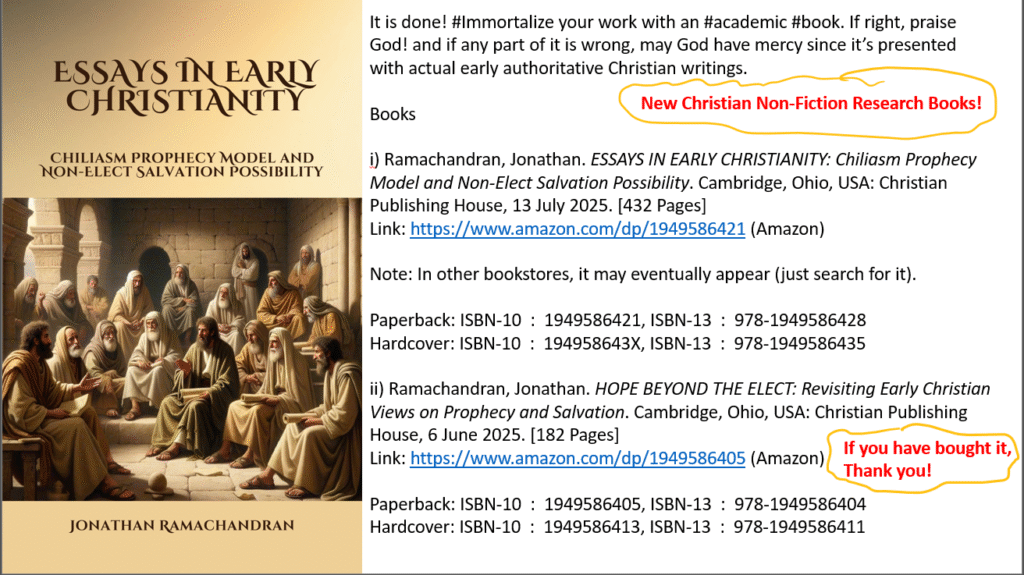
It is done! #Immortalize your work with an #academic #book. If right, praise God! and if any part of it is wrong, may God have mercy since it’s presented with actual early authoritative Christian writings.
1) Books
i) Ramachandran, Jonathan. ESSAYS IN EARLY CHRISTIANITY: Chiliasm Prophecy Model and Non-Elect Salvation Possibility. Cambridge, Ohio, USA: Christian Publishing House, 13 July 2025.
Links: https://www.amazon.com/dp/1949586421 (Amazon)
https://play.google.com/store/books/details?id=0rpwEQAAQBAJ (Google E-Book)
Note: In other bookstores, it may eventually appear (just search for it).

The other book:
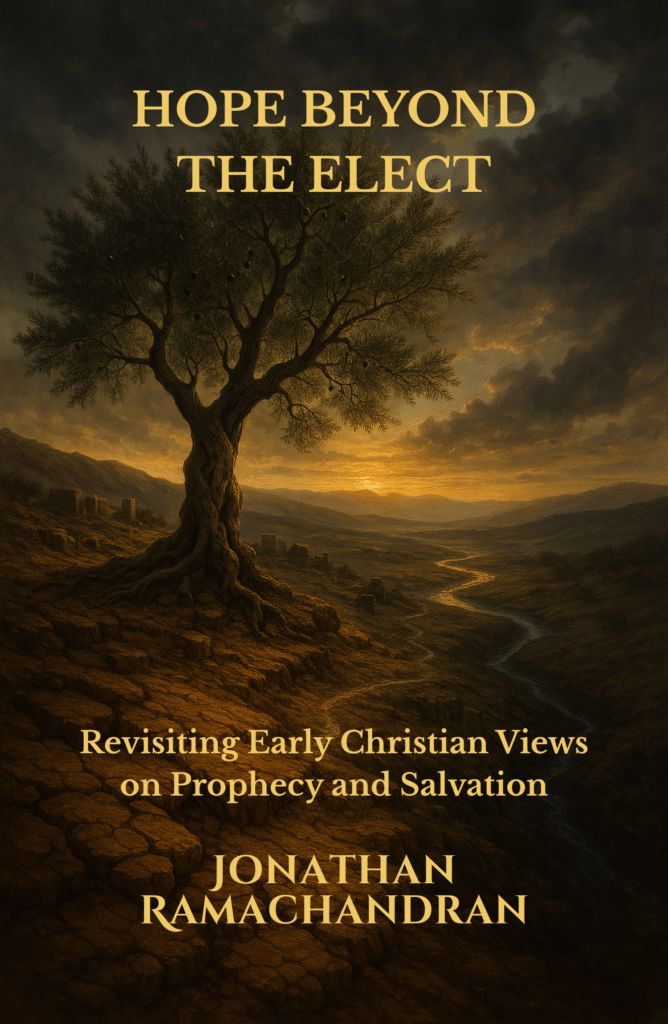
ii) Ramachandran, Jonathan. HOPE BEYOND THE ELECT: Revisiting Early Christian Views on Prophecy and Salvation. Cambridge, Ohio, USA: Christian Publishing House, 6 June 2025.
Links: https://www.amazon.com/dp/1949586405 (Amazon)
https://books.google.cl/books/about?id=_d1jEQAAQBAJ&redir_esc=y (Google E-Book)
https://www.goodreads.com/book/show/235829454-hope-beyond-the-elect (GoodReads)
https://www.christianpublishers.org/product-page/hope-beyond-the-elect-revisiting-early-christian-views-on-prophecy-and-salvation (CPH Bookstore: Under apocalyptic/eschatology and theology genres)
2) Journals
i) 1st Publication
Ramachandran, Jonathan. “Non Elect Salvation Possibility.” The American Journal of Biblical Theology (AJBT) Vol 26, no. 6 (9 February 2025).
www.biblicaltheology.com/Research/RamachandranJ01.pdf
ii) 2nd Publication
Ramachandran, Jonathan. “Thousand Year Gap for Prophecy in 1 Thessalonians 4:17 and 1 Corinthians 15:52 with Chiliasm Church Fathers.” The American Journal of Biblical Theology (AJBT) Vol 26, no. 22 (1 June 2025). www.biblicaltheology.com/Research/RamachandranJ02.pdf
iii) 3rd Publication on a 3-level peer review as well
Ramachandran, Jonathan. “Thousand Year Gap for Prophecy in 1 Thessalonians 4:17 and 1 Corinthians 15:52 with Chiliasm Church Fathers.” Journal of Biblical Theology (JBT) Vol 8, no. 3 (1 June 2025): 185-208. https://www.biblicaltheology.com/research.html
About the Author
JONATHAN RAMACHANDRAN
Theologian, Missionary, Engineer, Freelance Math Olympiad Coach & Musician
Jonathan Ramachandran is a self taught theological enthusiast who loves the Chiliasm Church Fathers and tries to understand Prophecy of the Bible with their writings. He has published with the Journal of Biblical Theology (JBT, 3 levels of peer reviews), the American Journal of Biblical Theology (AJBT, 2 levels of peer reviews) and also with Christian Publishing House (CPH, Cambridge, Ohio, USA). He runs his theology blog being a freelance missionary of tentmaker style at www.AnonymousChristian.org and lives in Malaysia where he is an operations manager for an engineering company.
Jon is a freelance preacher who is active both online and offline who has baptized some of his students into Christianity. His varied full time working experience includes working with Christian ministries dealing with charity, seismic engineering, educational centre management, teaching Math at schools (elementary and high school with a competition touch) and is one of Malaysia’s International Mathematical Olympiad (IMO) coaches.
Other Book details:
1) ESSAYS IN EARLY CHRISTIANITY: Chiliasm Prophecy Model and Non-Elect Salvation Possibility
i) Paperback
Print length : 432 pages
ISBN-10 : 1949586421
ISBN-13 : 978-1949586428
ii) Hardcover
Print length : 432 pages
ISBN-10 : 194958643X
ISBN-13 : 978-1949586435
2) HOPE BEYOND THE ELECT: Revisiting Early Christian Views on Prophecy and Salvation
i) Paperback
Print length : 182 pages
ISBN-10 : 1949586405
ISBN-13 : 978-1949586404
ii) Hardcover
Print length : 182 pages
ISBN-10 : 1949586413
ISBN-13 : 978-1949586411
#My ORCID Link: https://orcid.org/0009-0008-4669-1077
#GoogleScholar Link:
https://scholar.google.com/citations?hl=en&user=Bv7IFrAAAAAJ
#Academia Link:
https://independent.academia.edu/RamachandranJonathan
Note: Christian Publishing House (CPH) is publisher for the UASV Bible. About CPH: https://www.christianpublishers.org
www.AnonymousChristian.org
#CoachJonathanRamachandran #AnonymousChristian #ChiliasmProphecyModel #CPM #NonElectSalvationPossibility #NESP #Book released 9 June 2025 with #Irenaeus of #Lyons #Justin of #Rome #JustinMartyr and #Tertullian #Catholic #Protestant #Orthodox #Lutheran #Methodist #Anglican #Pentecostal #Denominations .